Stone Age People quick facts
- Most Stone Age people did not live in caves. Caves simply preserve evidence far better than open-air shelters.
- Several kinds of human lived at the same time, including Neanderthals and Denisovans, and they interbred with us.
- DNA published in 2018 showed Cheddar Man, Britain’s oldest near-complete skeleton, had dark skin and blue eyes.
- The claim that they only lived to 30 is an average dragged down by infant deaths. Adults often reached their sixties.
- They invented sewing, boats, medicine, skull surgery and art, all from scratch.
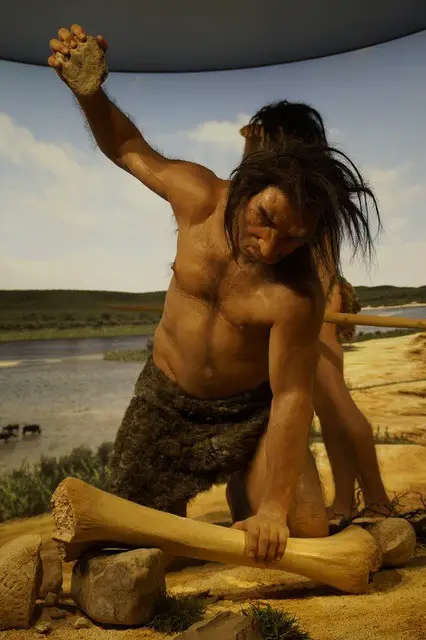
Stone Age people were not a different kind of creature from you. Their brains were the same size, they had the same hands, and if you could bring a baby from 20,000 years ago into a classroom today, that child would learn to read, argue about football and use a phone like anyone else.
What they did not have was accumulated knowledge. Everything humans now know had to be worked out by somebody, and Stone Age people worked out an enormous amount of it first.
Who counts as a Stone Age person?
Several kinds of human, not just ours. For most of the Stone Age, our species shared the planet with other humans.
- Homo sapiens — us. The oldest fossils of our species, from Jebel Irhoud in Morocco, are around 300,000 years old.
- Neanderthals — across Europe and western Asia until roughly 40,000 years ago. Stockier than us, with slightly larger brains.
- Denisovans — known mostly from DNA and a handful of bones and teeth from Siberia, Tibet and China. In 2025, scientists showed that a skull from Harbin, in China, belonged to a Denisovan. At last we have an idea of their faces.
- Homo floresiensis — a small human on the Indonesian island of Flores, barely over a metre tall, alive until about 50,000 years ago.
They met, and they had children together. If your family comes from outside Africa, roughly 1 to 2 per cent of your DNA is Neanderthal. Some people from Southeast Asia and Oceania carry Denisovan DNA too. These were not separate stories running in parallel; they are one tangled family.
Meet the Stone Age Humans
- Homo sapiens — Us. Our oldest fossils, from Morocco, are about 300,000 years old
- Neanderthals — Lived across Europe and western Asia until about 40,000 years ago
- Denisovans — Known mostly from their DNA, and only a few bones and teeth
- Homo floresiensis — A small human, barely over a metre tall, on an island in Indonesia
What did Stone Age people in Britain look like?
We can actually answer this now, for one person at least, and the answer surprised almost everybody.
Cheddar Man is Britain’s oldest near-complete skeleton, found in Cheddar Gorge in Somerset in 1903 and about 10,000 years old. In 2018, scientists at the Natural History Museum and University College London drilled a tiny hole in his skull, pulled out DNA, and read his genes.
He had dark to black skin, blue eyes and dark curly hair. The pale skin now common in northern Europe turned out to be a much more recent development than anyone had assumed, arriving with later farming populations. Other Mesolithic skeletons across Europe show the same combination.
Nearly every museum illustration painted before 2018 got this wrong, and plenty of websites still do.
Stone Age women
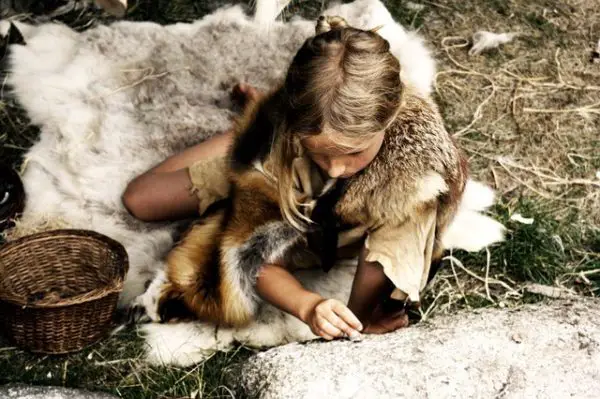
The old picture is simple: men hunted, women gathered. It is now looking too simple.
In 2020, archaeologists published a 9,000-year-old burial from the Andes in Peru. The person had been buried with a full big-game hunting kit: stone projectile points, scrapers, tools for processing hides. The skeleton was female. Reviewing other burials from the Americas, the team argued that a substantial share of early big-game hunters may have been women.
Not every archaeologist accepts how far that conclusion goes, and it is fair to say the debate is live. But the confident old split is no longer safe to teach as fact.
What is certain is that gathering was not the lesser job. In most hunter-gatherer societies studied, plant foods, shellfish, eggs and small animals supply the majority of daily calories. Hunting large animals is dramatic and unreliable. Gathering is what actually fed people, and knowing which of hundreds of plants were food, medicine or poison was expert knowledge.
Where they lived, and why “caveman” is wrong
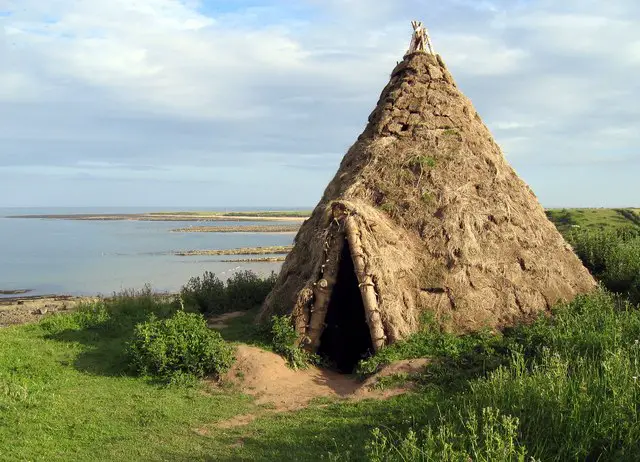
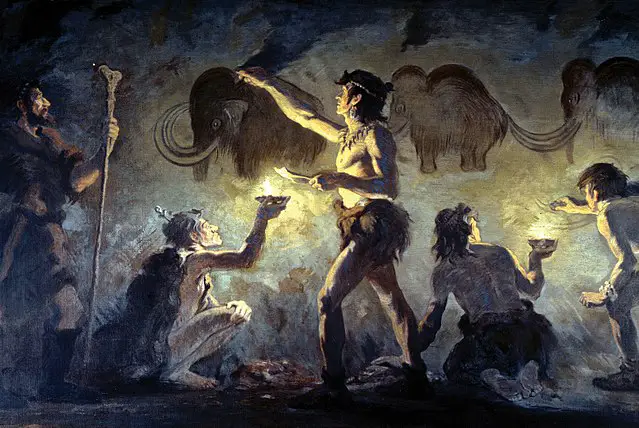
Most Stone Age people did not live in caves. This is the single most common mistake about them, and it comes from a simple bias in the evidence.
A cave keeps rain and wind off bones, ash, paint and tools, so things survive there for tens of thousands of years. A shelter built from wood, hide and turf rots away in a few decades and leaves nothing but post holes. Archaeologists find caves full of evidence and open ground nearly empty, which makes it look as though everyone lived in caves.
Where the ground has preserved things, we can see what they really built. At Mezhyrich in Ukraine, people built huts out of mammoth bones. In 2025, new dating showed that one of them is about 18,000 years old. It was built from the bones of at least 37 mammoths. At Skara Brae in Orkney, Neolithic villagers built stone houses with stone dressers, beds and drains, preserved under sand and older than the pyramids.
Daily life
Groups were usually small, perhaps twenty to fifty people, made of related families, and they moved with the seasons: to the coast when shellfish were good, to river crossings when herds passed, to high ground in summer.
Everybody worked, including children, who learned by copying rather than being taught in lessons. There was no money, no writing and no chief in the way later societies had one. Decisions were made by talking until people agreed, and someone who took more than their share was usually mocked back into line.
They ate whatever the season offered: deer, fish, shellfish, birds and eggs, nuts, berries, roots and honey. Our guide covers what Stone Age people ate in detail, and the tools they used to get it.
They hunted animals you would not believe
During the coldest periods, Europe held woolly mammoths, woolly rhinos, cave lions, cave bears and giant deer with antlers nearly four metres across. Mammoths were relatives of modern elephants, and hunting one with a stone-tipped spear required a group, a plan and considerable nerve.
A single mammoth also gave a group food for weeks, plus bone for building, ivory for carving, and hide for shelter. Nothing was wasted.
What One Mammoth Gave
- Meat — Food for the whole group for weeks
- Bones — Building material for huts
- Tusks — Ivory for carving
- Hide — A covering for shelters
Six things they worked out first
- Sewing. Bone needles with drilled eyes let people make fitted, layered clothing. Without that, humans could not have lived through northern winters, so a small carved needle helped put people across most of the planet.
- Medicine. A Neanderthal from El Sidrón in Spain had dental plaque containing poplar, which contains the natural version of aspirin, and a mould that produces penicillin. He also had a painful abscess. That looks a great deal like self-medication.
- Surgery. Stone Age people performed trepanation, cutting a hole through a living person’s skull. We know patients survived because the bone around the hole has healed and regrown.
- Boats. People reached Australia at least 50,000 years ago, which required deliberate open-water crossings. Nobody drifted there by accident.
- Astronomy. Neolithic monuments across Europe are aligned to sunrise at midwinter or midsummer, which means somebody was tracking the sun’s position across years.
- Art. The oldest known picture that tells a story is a cave painting in Sulawesi, Indonesia, dated in 2024 to at least 51,200 years old.
Ötzi: one Stone Age person we know properly
In 1991, walkers in the Alps found a body in melting ice. It turned out to be a man who died around 3300 BC, preserved so completely that we know more about him than about most people from the Middle Ages.
We know he was about 45, had brown eyes, was lactose intolerant, and suffered from worn joints and hardened arteries. He carried a copper axe, a bow he had not finished making, and a birch-bark container holding embers wrapped in leaves so he could start a fire.
He had 61 tattoos, mostly small lines over joints that were arthritic, which suggests they were treatment rather than decoration. His last meal was ibex meat, red deer, grain and fern.
And he was killed. An arrowhead is lodged in his left shoulder, and he has a deep cut on one hand. Somebody shot him in the back, and he was left where he fell with a valuable copper axe beside him, which nobody stopped to take.
Things people get wrong
- “They all lived in caves.” Most did not. Caves preserve evidence better, which is a different thing entirely.
- “They only lived to 30.” The average is dragged down by the number of babies who died. People who survived childhood often reached 60 or 70, and Ötzi was about 45 when he was murdered.
- “Men hunted, women gathered, always.” The 2020 Peru burial and others have made that neat split much harder to defend.
- “Early Britons were pale.” Cheddar Man’s DNA shows dark skin and blue eyes. Pale skin in northern Europe is more recent.
- “They dragged women by the hair and grunted.” A Victorian cartoon invention. Stone Age people had language, art, medicine, jewellery and burial rituals.
- “They were less intelligent than us.” Same brains. What they lacked was thousands of years of other people’s discoveries to build on.
See also our guides to Stone Age Weapons and tools.
Stone Age People: True or False?
- Stone Age people usually died by the age of 30.
- Stone Age people had smaller brains than us.
- A Neanderthal's teeth suggest he may have eaten poplar to ease his pain.
- Stone Age people could not talk to each other.
- Bone needles let people sew fitted clothes for cold winters.
- Some people survived having a hole cut in their skull.
- Every Stone Age group had a chief who gave the orders.
- Some Neolithic monuments line up with sunrise at midwinter or midsummer.
Common questions
Did Stone Age people really live in caves?
Mostly no. They built shelters from wood, hide, turf, stone and even mammoth bone. Caves were used for shelter in bad weather and for burial and painting, and they simply preserve evidence far better.
How long did Stone Age people live?
Longer than the famous “about 30” suggests. That figure is an average pulled down by high infant deaths. Adults who made it through childhood commonly lived into their sixties.
What did Stone Age people wear?
Fitted clothing sewn from animal hide and fur using bone needles and sinew thread, plus woven plant fibre later on. Ötzi wore a coat, leggings, a loincloth, a bearskin hat and shoes stuffed with grass.
Were Stone Age people as clever as us?
Their brains were the same. They invented sewing, boats, medicine, art and surgery from scratch. What they did not have was the accumulated knowledge of everyone who came before us.
Who was Cheddar Man?
Britain’s oldest near-complete skeleton, about 10,000 years old, found in Somerset in 1903. DNA published in 2018 showed he had dark skin, blue eyes and dark curly hair.
Did you know? At Mezhyrich in Ukraine, people built huts out of mammoth bones. One of them, about 18,000 years old, used the bones of at least 37 mammoths.
Stone Age People in Order
- Our species The oldest known fossils of our species are left in Morocco.
- A story on a wall Someone in Sulawesi, Indonesia, paints the oldest known picture that tells a story.
- The last Neanderthals Neanderthals disappear from Europe and western Asia.
- Cheddar Man Cheddar Man lives in what is now Somerset, in Britain.
- A hunter in the Andes A hunter is buried in Peru with her hunting kit.
- Otzi Otzi dies high in the Alps and is kept in the ice.
Try it
Look around your home and pick five things you use every day. For each one, work out what a Stone Age person would have used instead, and what it would have been made from.
Knowledge check
Why do people think Stone Age humans all lived in caves?
Show answer
Because caves protect bones, ash, tools and paintings for tens of thousands of years, while shelters built from wood, hide and turf rot away completely. The evidence survives in caves, so that is where archaeologists keep finding it.
What did Cheddar Man’s DNA reveal in 2018?
Show answer
That Britain’s oldest near-complete skeleton, about 10,000 years old, had dark to black skin, blue eyes and dark curly hair. Pale skin in northern Europe turned out to be much more recent than anyone had assumed.
Frequently Asked Questions About Stone Age People
Were Stone Age people less intelligent than us?
No. Their brains were the same size and they had the same abilities. What they lacked was accumulated knowledge, not capability. A baby from 20,000 years ago raised today would learn to read, argue about football and use a phone like anyone else.
Were there other kinds of human?
Yes, several lived at the same time as us. Neanderthals lived across Europe and western Asia until about 40,000 years ago. Denisovans are known mostly from DNA, and in 2025 a skull from Harbin in China was shown to be a Denisovan’s. Homo floresiensis, barely over a metre tall, lived on the Indonesian island of Flores until roughly 50,000 years ago.
Did humans and Neanderthals have children together?
Yes. That is why most people whose ancestors came from outside Africa carry about 1 to 2% Neanderthal DNA today. The two groups met, lived alongside each other, and interbred.
Did Stone Age people only live to 30?
No, that is a misreading of an average. Infant deaths were common, and they drag the average down sharply. Adults who survived childhood often reached their sixties.
What did Stone Age people invent?
An enormous amount, all from scratch: sewing, boats, medicine, rope, glue, pottery, farming, art and even skull surgery. Every one of those had to be worked out by somebody for the first time.
What did Stone Age people look like?
Not what most people picture. DNA published in 2018 showed that Cheddar Man, Britain’s oldest near-complete skeleton at about 10,000 years old, had dark skin and blue eyes. Pale skin in northern Europe came later than people assume.
Sources
- Natural History Museum: Cheddar Man — the 2018 DNA analysis and facial reconstruction.
- Nature (2024): narrative cave art in Indonesia by 51,200 years ago — the oldest known storytelling picture.
- South Tyrol Museum of Archaeology: Ötzi the Iceman — his clothing, tools, tattoos and cause of death.
- Open Research Europe (2025): a revised radiocarbon chronology for the mammoth bone structures at Mezhyrich — the age of one mammoth-bone hut and how many mammoths it used.
- English Heritage: prehistoric England — Neolithic Britain, including Skara Brae.
- Science (2025): the proteome of the Harbin individual — the proteins showing that the Harbin skull belonged to a Denisovan.
Stone Age People Final Challenge
- About how many people lived together in a Stone Age group?
- How did Stone Age children learn?
- Why did Stone Age groups move with the seasons?
- Which of these animals lived in Europe during the coldest times of the Stone Age?
- What did Otzi carry so that he could start a fire?
- Why do scientists think Otzi's tattoos were a kind of treatment?
- What were the houses at Skara Brae in Orkney made of?
- How did the first people reach Australia, at least 50,000 years ago?