Saber-toothed tiger vs lion: the evidence-based verdict
| Feature | Smilodon | Modern lion |
|---|---|---|
| When and where | Ice Age Americas | Africa, with a small population in India |
| Body build | Stocky body and very powerful forelimbs | Athletic build suited to running and grappling |
| Teeth | Very long, relatively fragile upper canines | Shorter, robust canines for gripping and killing |
| Hunting evidence | Fossils support close-range ambush and restraint | Observed stalking, chasing and cooperative hunting |
| Social evidence | Fossils prompt debate; exact social system is uncertain | Prides are well documented, though males may also live alone or in coalitions |
What this comparison can—and cannot—prove
- Smilodon was a saber-toothed cat, not a true tiger.
- Different Smilodon species differed in size, so one number cannot describe every individual.
- A hypothetical fight was never observed or tested; “who would win” is a reasoning exercise, not a scientific result.
- Claims about exact bite force or running speed should not be treated as established without direct measurements.
How their bodies differed
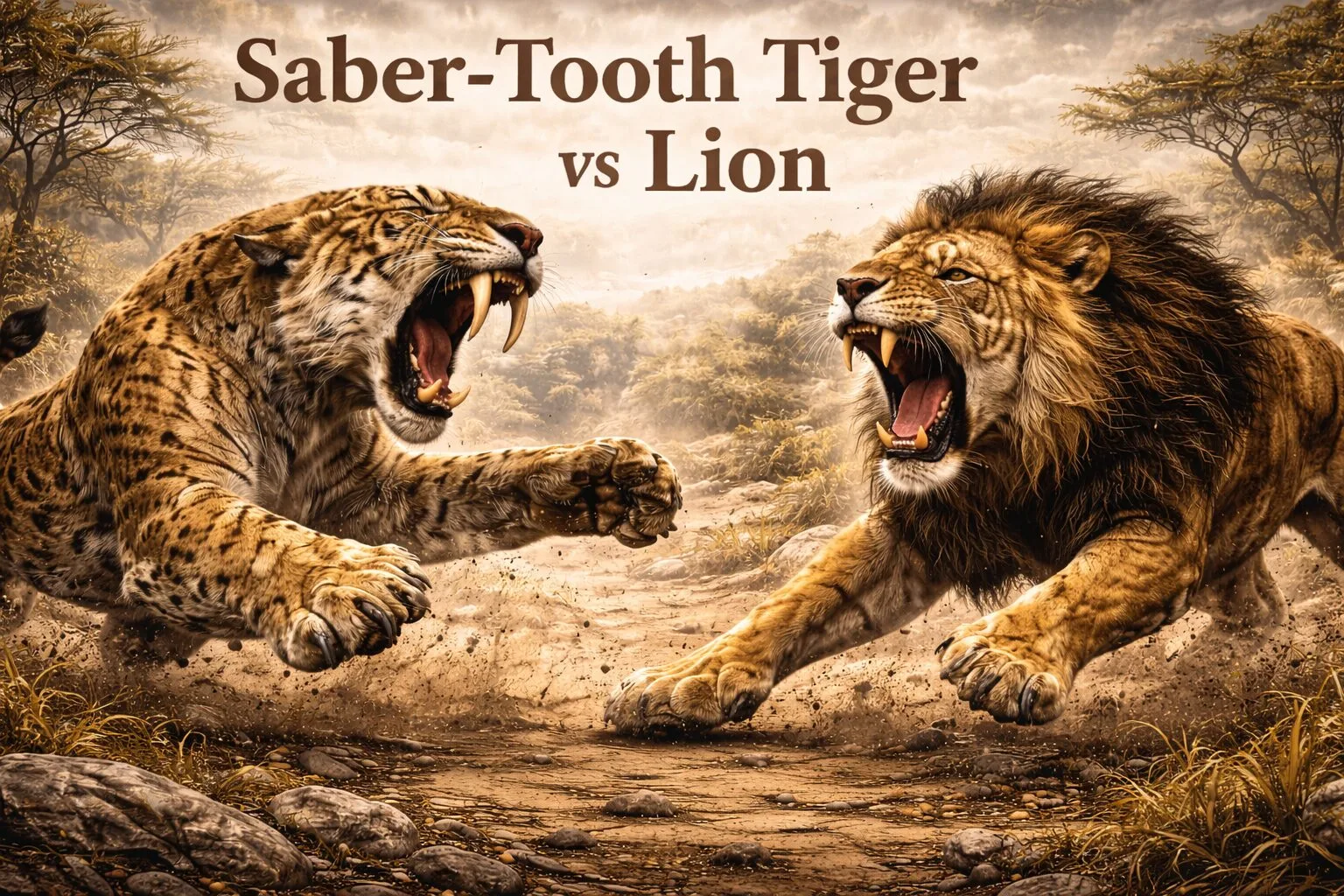
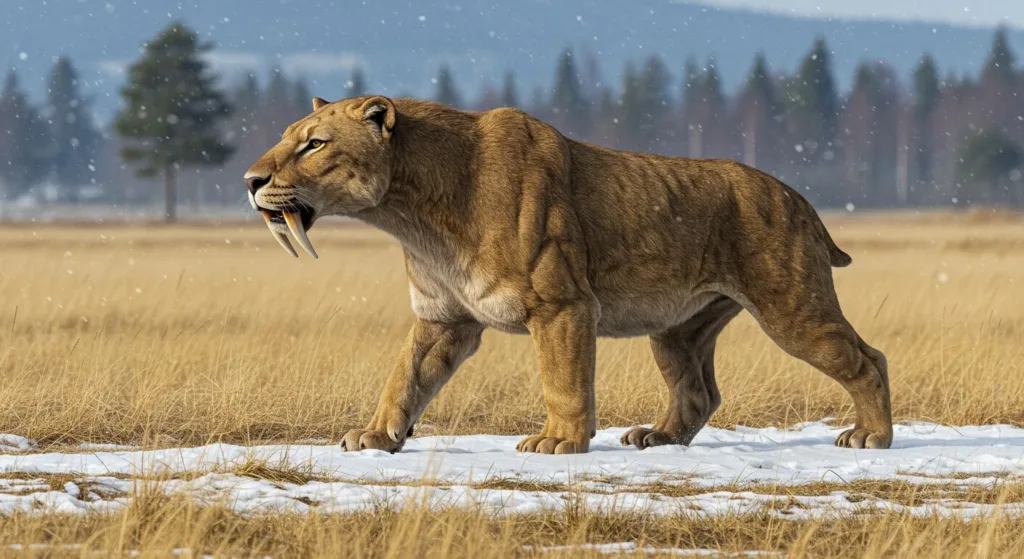
Smilodon had a deep chest, a short tail and exceptionally strong front limbs. Those features fit an ambush hunter that grappled with prey at close range. Its famous upper canines were long cutting tools, but they were not designed for smashing through bone.
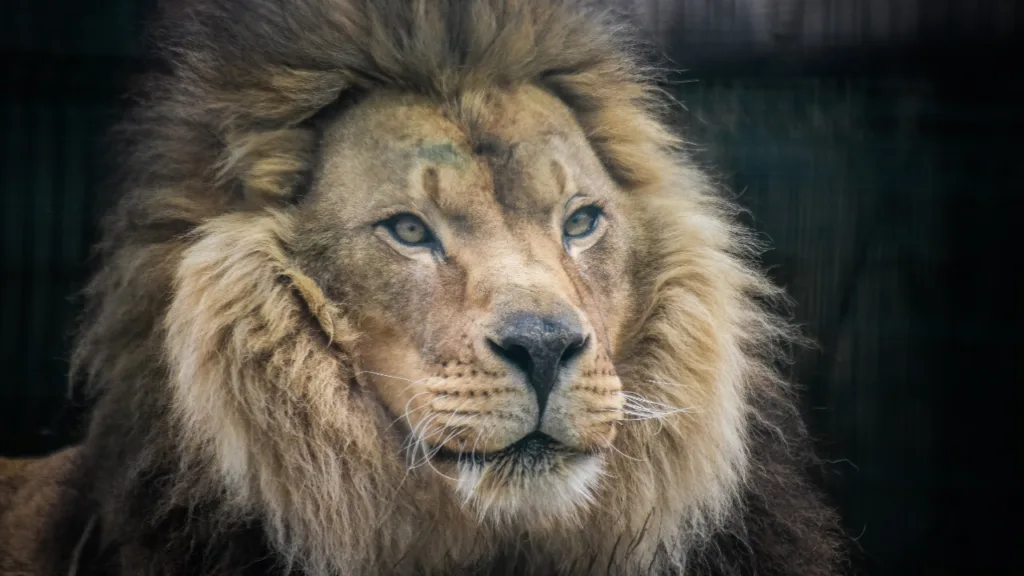
Lions have longer legs and a more flexible, running-oriented body. Their canines are much shorter than Smilodon’s, but they are robust and work with powerful jaws during a sustained bite.
How they hunted
Fossils, limb proportions and tooth wear help scientists reconstruct Smilodon’s behaviour. The evidence points to stalking, a short rush and strong forelimbs used to restrain prey before a carefully placed bite.
Lion hunting has been observed directly. Lions stalk close, accelerate over a short distance and use their paws and jaws to pull prey down. Lionesses frequently cooperate, although hunting behaviour changes with prey, habitat and group size.
Could they have met?
Smilodon lived in the Americas. Modern lions live naturally in Africa and India. Other extinct lion relatives lived during the Ice Age, but a contest between Smilodon and today’s African lion is imaginary.
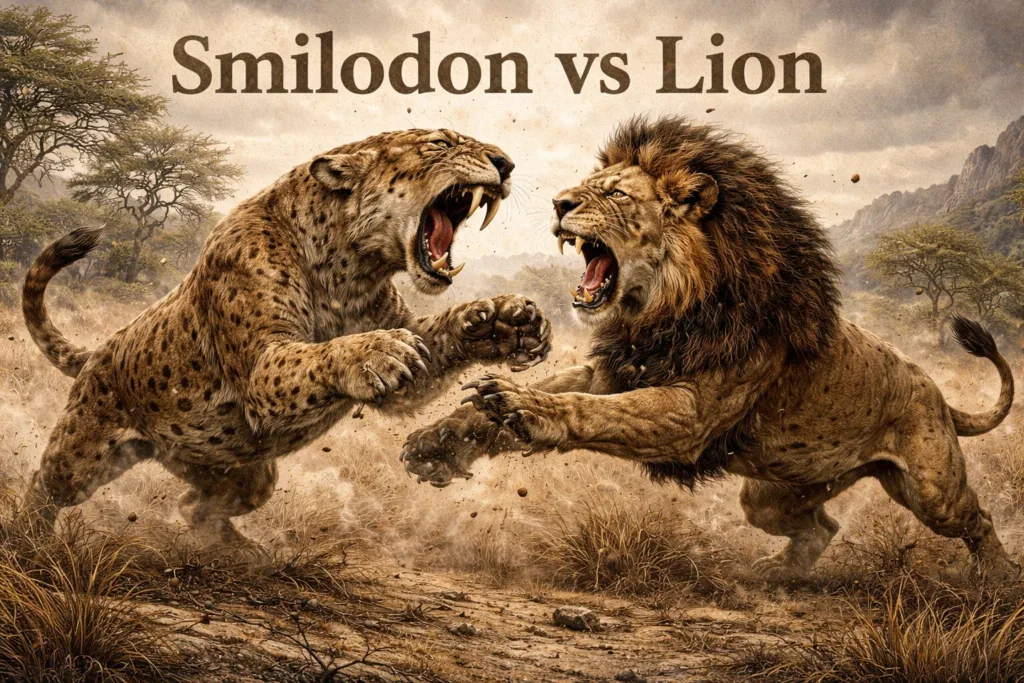
A fair conclusion is therefore conditional: Smilodon’s close-range strength could be an advantage in an ambush, while a lion’s mobility and flexible hunting behaviour could help in a more open setting. Neither advantage guarantees a win.
Picture guide
Continue the learning path
Did you know? Smilodon’s name means “knife tooth,” but its long canines worked as part of a whole hunting system that also depended on strong neck and forelimb muscles.
Try it
Use the comparison table to write two conditional predictions: one for dense cover and one for open ground. Include evidence and avoid claiming certainty.
Knowledge check
Why can science not identify a guaranteed winner between Smilodon and a modern lion?
Show answer
They were not tested together, individuals vary, and the result would depend on species, health, behaviour and setting.
Sources
These government, museum, zoo and scientific resources support the key facts and uncertainty statements in this guide.
- National Park Service: The Big Cats — Summarises Smilodon anatomy, range, prey and fossil evidence.
- Smithsonian’s National Zoo: Lion — Documents modern lion anatomy, habitat, diet and social hunting.
- Natural History Museum: Saber-toothed cats — Museum research and educational material about Smilodon fossils.