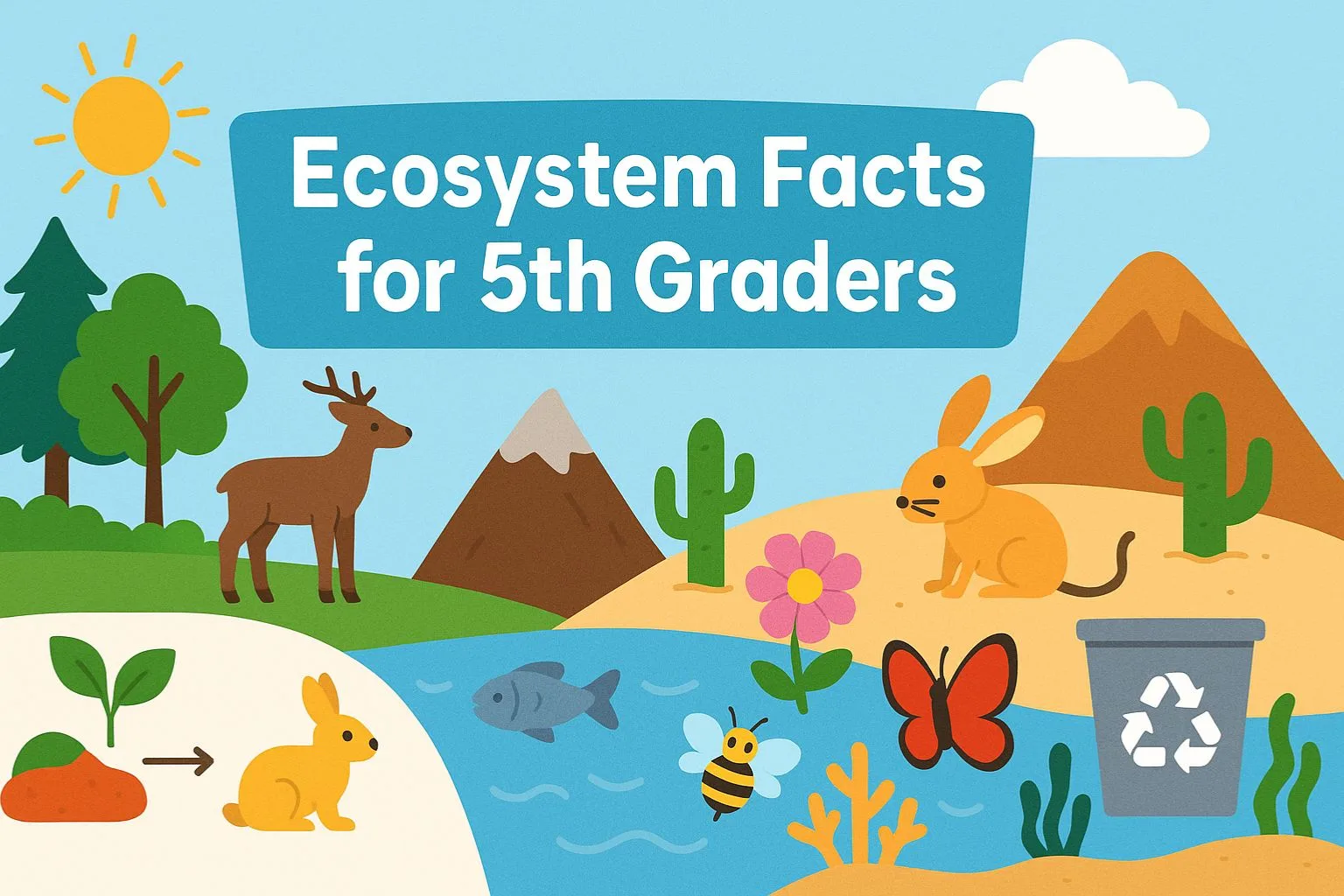
An ecosystem is a community of living things, such as plants, animals and fungi, together with the non-living things around them, such as sunlight, water and soil. Energy flows from the Sun to plants, called producers, then to animals, called consumers, while decomposers recycle dead matter. Ecosystems can be as small as a tide pool or as big as a rainforest.
ecosystems quick facts
- An ecosystem has living (biotic) and non-living (abiotic) parts.
- Plants are producers; animals are consumers.
- Decomposers such as fungi and worms recycle nutrients.
- A keystone species helps hold an ecosystem together.
- Ecosystems can be as small as a tide pool.
What is an ecosystem?
An ecosystem is a community of living things together with the non-living things around them, all working together in one place. National Geographic describes it as a place where plants, animals and other living things, along with weather and landscape, work together to form a bubble of life.
Britannica defines an ecosystem as the living things in a place, their physical surroundings, and all the ways they affect each other.
Every part of an ecosystem is connected. National Geographic says every part depends on every other part, directly or indirectly. Change one thing, and other things change too.
| Ecosystems at a glance | |
|---|---|
| Living parts (biotic) | plants, animals, fungi and bacteria |
| Non-living parts (abiotic) | sunlight, water, soil, air, rocks and temperature |
| Producers | plants and algae that make their own food |
| Consumers | animals that eat plants or other animals |
| Decomposers | fungi, bacteria and worms that break down dead things |
| Examples | a tide pool, a pond, a forest, a desert, a coral reef |
Parts of an ecosystem
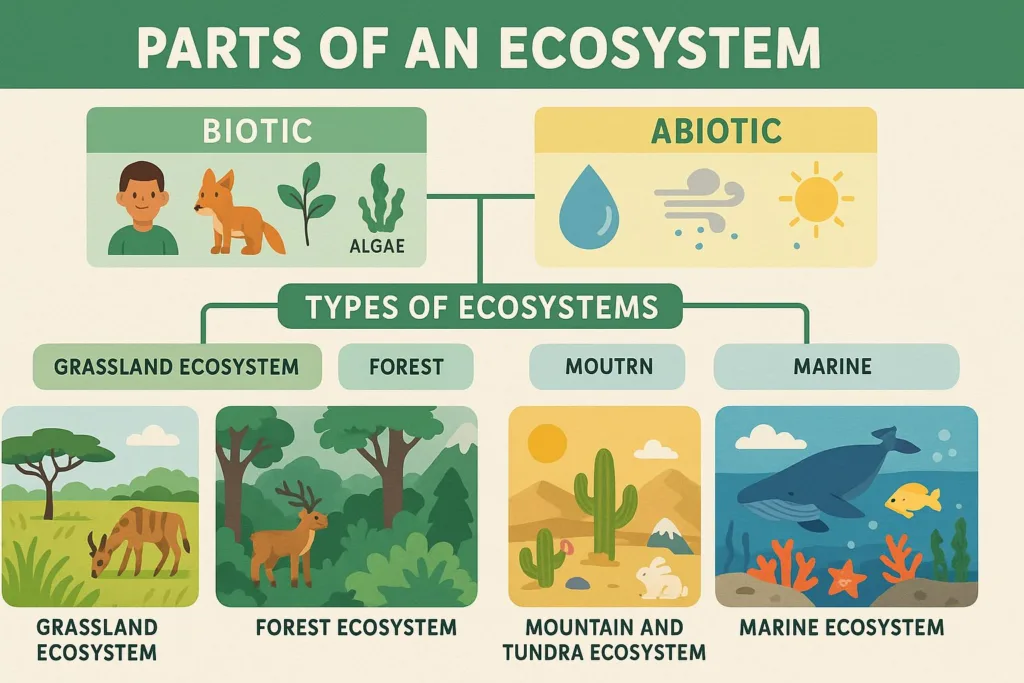
An ecosystem has two kinds of parts. The living parts are called biotic factors. They include plants, animals, fungi and tiny living things such as bacteria.
The non-living parts are called abiotic factors. Britannica lists them as minerals, climate, soil, water and sunlight. Temperature and rocks count too.
Both kinds of parts matter. Without sunlight, plants could not grow. Without water, nothing could live. Without soil, many plants would have nowhere to put down roots.
Britannica says sunlight is the main source of energy for most ecosystems, and water is vital for all life.
Big and small ecosystems
Ecosystems come in all sizes. National Geographic describes a tide pool, a small pool of seawater left on a rocky shore when the tide goes out, as a tiny but complete ecosystem.
A tide pool can hold seaweed and algae, which make food from sunlight, animals such as abalone that eat the seaweed, and sea stars that eat other animals.
At the other end of the scale, an ecosystem can be a huge desert that stretches across several countries, or a whole rainforest.
You can even find an ecosystem under a rotting log, in a garden pond or in a patch of your school field.
Types of ecosystems
Forests: woodlands and rainforests, full of trees, which are home to huge numbers of plants and animals. Explore one in our rainforest facts.
Grasslands: wide, open lands covered in grasses, such as prairies and savannas.
Deserts: very dry places where plants and animals have special ways to save water.
Tundra: cold, treeless land near the poles and high on mountains.
Freshwater: rivers, lakes, ponds and wetlands.
Marine: seas and oceans, from coral reefs and kelp forests to the deep sea.
How do ecosystems work?
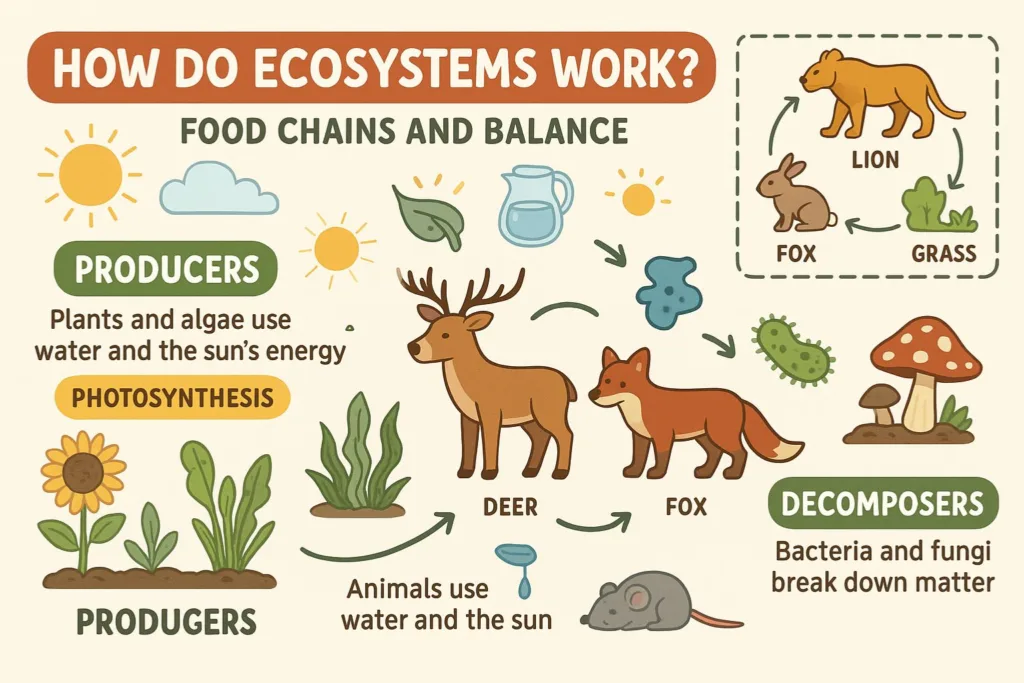
Ecosystems run on energy, and almost all of it starts with the Sun. Britannica explains that plants, called producers, use sunlight to make their own food through a process called photosynthesis.
Animals cannot make their own food, so they are called consumers. Plant-eaters, called herbivores, get their energy by eating plants. Meat-eaters, called carnivores, get their energy by eating other animals.
When plants and animals die, decomposers such as fungi, bacteria and worms break them down. This returns nutrients to the soil, where plants can use them again.
Britannica says a lot of energy is lost as heat at each step of the chain. That is why there are always far more plants than plant-eaters, and far more plant-eaters than meat-eaters.
Ecosystem words
- Producer — a plant or alga that makes its own food
- Consumer — an animal that eats plants or other animals
- Herbivore — a plant-eater
- Carnivore — a meat-eater
- Photosynthesis — the way plants use sunlight to make food
- Tide pool — a small pool of seawater left on a rocky shore
Food chains and food webs
A food chain shows who eats whom. For example, grass is eaten by a rabbit, and the rabbit is eaten by a fox. Energy passes along the chain from the grass to the fox.
In real ecosystems, most animals eat more than one kind of food, and many animals eat them. When you draw all the food chains together, they form a tangled food web.
National Geographic uses the example of a tide pool: seaweed makes food from sunlight, abalone eat the seaweed, and sea stars eat the abalone.
Plants, animals and oxygen
Plants and animals depend on each other in another way too. Britannica says that when plants make food by photosynthesis, they give off oxygen, which most animals need to breathe.
Animals, in turn, breathe out carbon dioxide, which plants use to make food. Animals also return nutrients to the soil through their droppings and, in the end, their bodies.
Keystone species
Some living things are so important that an ecosystem would fall apart without them. National Geographic calls these keystone species, because they help hold the whole system together.
National Geographic gives examples such as beavers, bees, tiger sharks and mangrove trees. Beavers build dams that create ponds for many other animals, and bees pollinate plants.
A famous experiment on the Pacific coast showed what can happen. When scientists removed starfish from an area, National Geographic says mussels multiplied and crowded out other species, and the variety of life fell sharply.
Sea otters are another keystone species. By eating sea urchins, they protect kelp forests. Read more in our sea otter facts.
Changes in ecosystems
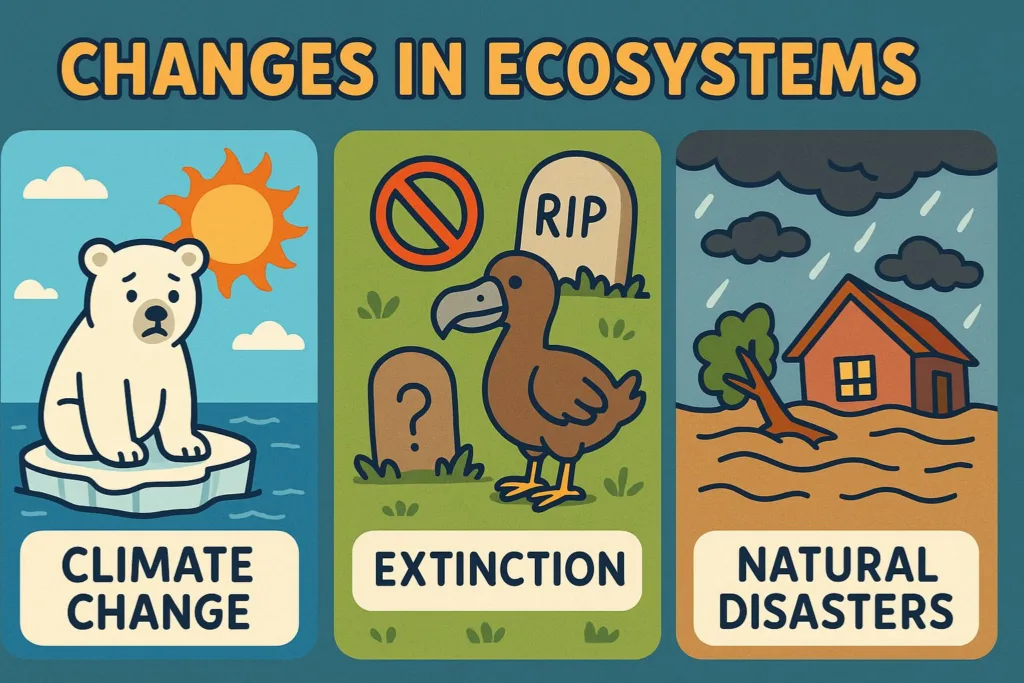
Ecosystems are always changing. Britannica calls this slow change ecological succession.
Primary succession: life moves into a bare place where nothing lived before, such as a new volcanic island. Tough plants such as mosses come first, then grasses, shrubs and finally trees.
Secondary succession: an ecosystem grows back after a disturbance, such as a wildfire or a flood, has changed it.
Britannica says ecosystems have resilience, which is the ability to recover after a disturbance.
Changes in the weather can also affect ecosystems. National Geographic says that if the temperature changes, it can affect how plants grow, and animals may have to adapt, move somewhere else or die out.
Life returns to bare ground
- To start A bare place appears where nothing lived before, such as a new volcanic island.
- First to arrive Tough plants such as mosses take hold.
- Next Grasses spread across the ground.
- After that Shrubs grow up among the grasses.
- In the end Trees grow, and the bare place has become a wood.
How people affect ecosystems
People change ecosystems more than any other living thing. National Geographic says cutting down forests, mining and overhunting have badly damaged ecosystems such as the Great Plains and the Amazon rainforest.
Britannica lists other threats, including habitat loss, pollution and invasive species, which are plants or animals brought from elsewhere that take over.
Climate change is changing ecosystems too, by altering weather patterns around the world. Learn more in our global warming guide.
Why are ecosystems important?
Healthy ecosystems give us almost everything we need: clean air, fresh water, food, and materials such as wood.
Forests and oceans help control the climate. Wetlands soak up floodwater. Insects pollinate the crops we eat, and soil creatures keep the ground healthy for growing food.
Every ecosystem is also home to its own unique plants and animals, many of which live nowhere else on Earth.
Kinds of ecosystem
- Forest — woodland or rainforest, full of trees
- Grassland — wide, open land covered in grasses
- Desert — a very dry place where living things must save water
- Tundra — cold, treeless land near the poles and high on mountains
- Freshwater — rivers, lakes, ponds and wetlands
- Marine — seas and oceans, from coral reefs to the deep sea
Explore an ecosystem near you
You do not need to travel far to study an ecosystem. A school field, a park, a hedge or a garden pond all have their own living and non-living parts.
Look closely and you may find plants making food from sunlight, insects eating the leaves, birds hunting the insects, and fungi and worms breaking down fallen leaves. That is a whole food web in one small place.
Try visiting the same spot in different seasons. You will see how the ecosystem changes through the year.
How can we protect ecosystems?
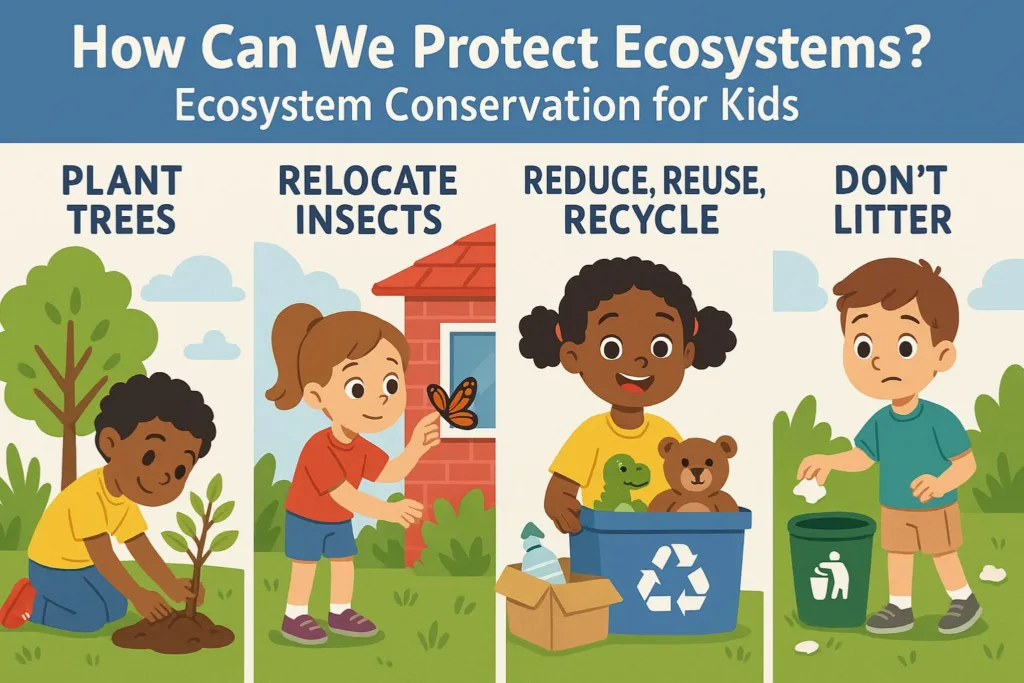
Britannica says people can help protect ecosystems by reducing their impact on the environment. That means using land carefully, cutting pollution and stopping the spread of invasive species.
Pick up litter: rubbish can harm animals and pollute water. Find out more in our littering facts.
Save water and energy: using less helps protect rivers and reduces pollution.
Plant native plants: local plants feed local insects and birds.
Leave wild places wild: stick to paths, and do not disturb nests or collect animals.
Ecosystems and the biosphere
All the ecosystems on Earth together make up the biosphere, the thin layer of our planet where life exists. Discover more in our biosphere facts.
Three things people get wrong
Ecosystems are not only big places. A tide pool or a pond can be a complete ecosystem.
Non-living things matter too. Sunlight, water and soil are vital parts of every ecosystem.
Losing one species can matter a lot. Removing a keystone species can change a whole ecosystem.
Did you know? When scientists removed starfish from part of the Pacific coast, mussels took over and the variety of life fell sharply.
Ecosystems: fact or myth?
- There are always far more plants in an ecosystem than there are plant-eaters.
- Plants give off oxygen when they make food, and animals breathe out carbon dioxide that plants can use.
- An invasive species is always a large animal.
- Once a wildfire sweeps through a place, its ecosystem is gone for good.
- Sunlight is the main source of energy for most ecosystems.
- All the ecosystems on Earth together make up the biosphere.
Try it
Mark out a square metre of grass or garden. List every living and non-living thing you can find inside it.
Knowledge check
What are the two kinds of parts in an ecosystem?
Show answer
Living (biotic) and non-living (abiotic) parts.
What does a decomposer do?
Show answer
It breaks down dead plants and animals, returning nutrients to the soil.
Frequently asked questions
What is an ecosystem?
An ecosystem is a community of living things, such as plants and animals, together with the non-living things around them, such as sunlight, water and soil.
What are the parts of an ecosystem?
Ecosystems have living parts, called biotic factors, and non-living parts, called abiotic factors, such as sunlight, water, soil, air and temperature.
What is a food web?
A food web shows all the connected food chains in an ecosystem, linking plants, the animals that eat them and the animals that eat those animals.
What is a keystone species?
A keystone species is one that helps hold an ecosystem together. Beavers, bees, sea otters and some starfish are examples.
How do ecosystems change?
Ecosystems change through ecological succession, as life moves into bare land or regrows after fires and floods. Climate and people also change them.
How can kids protect ecosystems?
Kids can pick up litter, save water and energy, grow native plants, stick to paths in wild places and avoid disturbing wildlife.
Sources
- National Geographic Education: ecosystem — definition, living and non-living parts, sizes, tide pools, food webs, change and human threats
- National Geographic Education: keystone species — what keystone species are, examples and the starfish experiment
- Encyclopaedia Britannica: ecosystem — definition, abiotic parts, producers and consumers, energy flow, oxygen, succession, resilience, threats and protection
Ecosystems Final Challenge
- What does a food web show?
- In the tide pool example, what do sea stars eat?
- What is a keystone species?
- How do beavers help other animals?
- What happened when scientists removed starfish from part of the Pacific coast?
- How do sea otters protect kelp forests?
- What is the slow change in an ecosystem over time called?
- Which of these is a non-living part of an ecosystem?
- Which of these do healthy ecosystems give people?
- What is one way the guide suggests helping ecosystems?