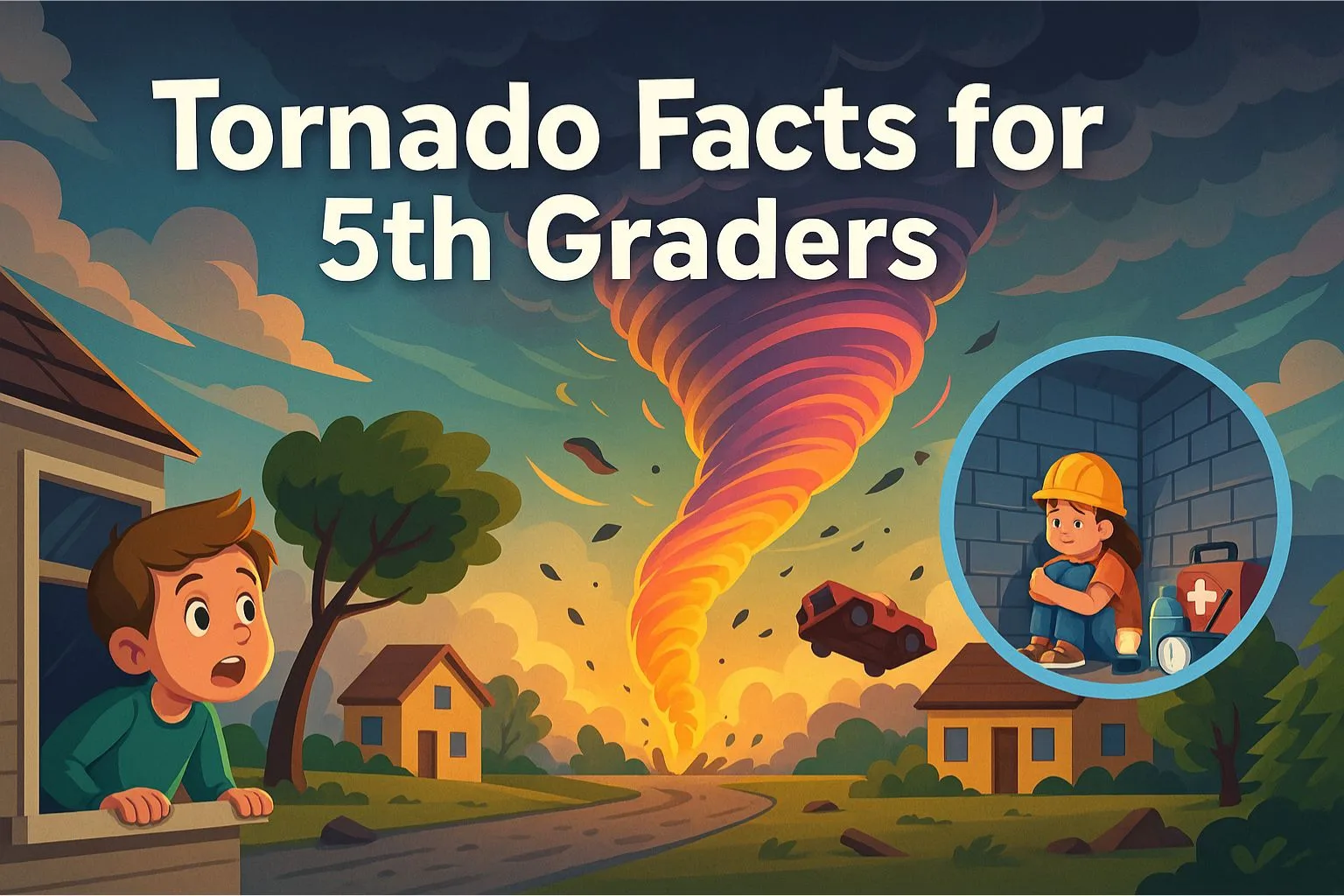
A tornado is a narrow, violently rotating column of air that reaches from a thunderstorm to the ground. The United States gets about 1,200 tornadoes a year, most often between 4 and 9 p.m. Most last less than 10 minutes. Their winds range from 65 mph to over 200 mph, rated on the Enhanced Fujita Scale.
tornadoes quick facts
- About 1,200 tornadoes hit the United States each year.
- Most tornadoes happen between 4 and 9 p.m.
- Most tornadoes last less than 10 minutes.
- The strongest tornadoes, EF5, have winds over 200 mph.
- Tornadoes have been reported in all 50 US states.
What is a tornado?
A tornado is a narrow, violently rotating column of air that reaches from a thunderstorm down to the ground. That is how NOAA’s National Severe Storms Laboratory describes it.
Wind is invisible, so you can only see a tornado when it forms a funnel made of water droplets, dust and flying debris.
Tornadoes are among the most violent storms on Earth. The National Weather Service says they can destroy well-built buildings, pull trees out of the ground and throw objects through the air like deadly missiles.
| Tornadoes at a glance | |
|---|---|
| Tornadoes in the US each year | about 1,200 |
| Most common time of day | 4 to 9 p.m. |
| Peak season on the southern Plains | May into early June |
| How long most last | less than 10 minutes |
| Average distance travelled | about 3.5 miles (5.6 km) |
| Wind speeds | 65 mph (105 km/h) to over 200 mph (320 km/h) |
| Where in the US | reported in all 50 states |
How do tornadoes form?

The honest answer is that scientists do not fully understand it yet. The National Severe Storms Laboratory says the most destructive tornadoes come from supercells, which are thunderstorms that rotate.
A supercell needs warm, damp air near the ground and cooler, drier air higher up. When the wind changes speed and direction as you go higher, the air can start to roll and spin sideways.
A strong updraft, where warm air rises quickly inside the storm, can tip that spinning air upright. If the spin tightens and reaches the ground, a tornado forms.
Not every supercell makes a tornado. Working out why some storms do and others do not is one of the big questions scientists at the National Severe Storms Laboratory are studying.
Where do tornadoes happen around the world?
Tornadoes are not only an American problem. The National Severe Storms Laboratory says they happen in many parts of the world, including Australia, Europe, Africa, Asia and South America.
Even New Zealand reports about 20 tornadoes a year. Two of the places with the most tornadoes outside the United States are Argentina and Bangladesh.
Still, the United States has far more tornadoes than any other country, because of the way warm air from the Gulf of Mexico meets cooler, drier air from the west and north over its wide, flat middle.
Where do tornadoes happen in the United States?

About 1,200 tornadoes hit the United States every year, according to the National Severe Storms Laboratory. Official records only go back to 1950, so nobody knows the true long-term average.
You may have heard of Tornado Alley. It is a nickname that the media invented for a broad area of the central United States where tornadoes are common. Different maps draw it in different places, because tornadoes can be counted in different ways.
The tornado threat also moves during the year. It starts in the Southeast in the cooler months, shifts to the southern and central Plains in May and June, and moves to the northern Plains and Midwest in early summer.
The National Weather Service says tornadoes are most common in the Central Plains and the Southeast, but they have been reported in all 50 states.
When do tornadoes happen?
Tornado season is the time of year when an area sees the most tornadoes. The National Severe Storms Laboratory says it runs from May into early June on the southern Plains, in states such as Texas, Oklahoma and Kansas.
On the Gulf coast, the season comes earlier in the spring. On the northern Plains and in the upper Midwest, it comes in June or July.
But tornadoes can happen at any time of year and at any time of day or night. Most happen between 4 and 9 p.m., after the sun has heated the ground all day.
How to stay safe during a tornado

Tornado watch: the NOAA Storm Prediction Center issues a watch when the weather is right for tornadoes. It can cover parts of a state or several states. It means be ready, and keep listening for warnings.
Tornado warning: your local National Weather Service office issues a warning when a tornado has been seen or shows up on radar. It means act now and get to safe shelter.
Go low: the safest place is a basement or storm shelter. If there is no basement, go to a small room in the middle of the lowest floor, such as a bathroom or cupboard, away from windows.
Protect your head: crouch down and cover your head and neck with your arms, a mattress or thick blankets, because flying debris causes most injuries.
At school: follow your teachers. Schools practise tornado drills, so everyone knows where to go.
Make a plan: talk with your family about where you would shelter at home, and practise going there quickly.
What does a tornado look like?
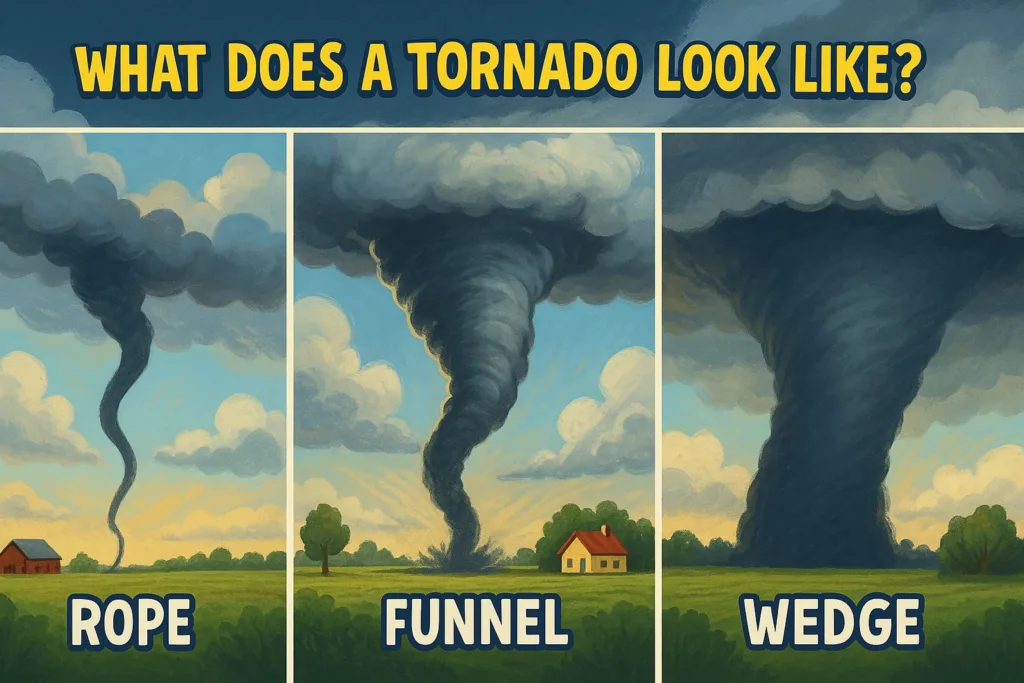
Tornadoes come in many shapes and sizes. The Storm Prediction Center says some are narrow, like a rope, while others are very wide, shaped like a wedge.
Many tornadoes look like a funnel hanging down from a dark cloud. Near the ground, you may see a swirling cloud of dust and debris even when the funnel itself is hard to see.
Some tornadoes are wrapped in heavy rain, which makes them very hard to spot. That is why warnings based on radar are so important.
How strong are tornadoes?

Scientists cannot easily measure the wind inside a tornado. Instead, experts look at the damage it caused and use that to estimate how strong the winds were.
Since 2007, the National Weather Service has used the Enhanced Fujita Scale, or EF Scale. The National Severe Storms Laboratory says it looks at 28 damage indicators, such as different kinds of buildings and trees.
| EF rating | Estimated wind speed | Damage |
|---|---|---|
| EF0 | 65 to 85 mph (105 to 137 km/h) | light |
| EF1 | 86 to 110 mph (138 to 177 km/h) | moderate |
| EF2 | 111 to 135 mph (178 to 217 km/h) | considerable |
| EF3 | 136 to 165 mph (218 to 266 km/h) | severe |
| EF4 | 166 to 200 mph (267 to 322 km/h) | devastating |
| EF5 | over 200 mph (322 km/h) | incredible |
EF5 tornadoes are rare, but they can flatten strong houses and throw cars. Weaker tornadoes are far more common, but even an EF0 can be dangerous.
How long do tornadoes last?
Most tornadoes are over quickly. The Storm Prediction Center says most last less than 10 minutes, and the average tornado travels about 3.5 miles (5.6 km).
Most tornadoes move from the south-west to the north-east, or from west to east. A few rare tornadoes last much longer and travel a very long way.
What dangers do tornadoes cause?
The biggest danger is flying debris. Strong winds pick up pieces of wood, glass, metal and other objects, and hurl them at great speed.
Tornadoes can tear roofs off houses, knock down power lines and uproot trees. The thunderstorms that make them can also bring lightning, hail and floods.
How scientists study tornadoes
Scientists at the National Severe Storms Laboratory study tornadoes to understand how they form and to improve warnings.
Weather radar can spot rotation inside a storm before a tornado touches down. Trained storm spotters also watch the sky and report tornadoes when they see them.
Every extra minute of warning gives people more time to reach shelter.
Tornadoes and hurricanes
A tornado is not the same as a hurricane. A hurricane is a giant storm hundreds of kilometres wide that forms over warm oceans and can last for days.
A tornado is much smaller and usually lasts only minutes, but its winds can be even stronger. When a hurricane reaches land, it can sometimes produce tornadoes too.
A tornado that forms over water is called a waterspout. Some waterspouts move onto land and become tornadoes.
A storm safety kit
It is a good idea for families to keep a small storm kit in their shelter. It could include a torch, a battery radio, spare batteries, a first-aid kit, bottled water and sturdy shoes.
Keeping everything in one place means nobody has to go looking for supplies when a warning comes.
Tornado words to know
Supercell: a thunderstorm that rotates, which can produce strong tornadoes.
Funnel cloud: a spinning, cone-shaped cloud that has not yet reached the ground.
Debris: broken pieces of buildings, trees and other things carried by the wind.
EF Scale: the scale used to rate a tornado’s strength from the damage it causes.
Three things people get wrong
Tornadoes do not only happen in Tornado Alley. They have been reported in all 50 states.
Opening windows does not protect a house. It wastes time; get to shelter instead.
A highway bridge is not a safe shelter. Wind speeds can be even higher underneath, and debris can fly through.
Did you know? Scientists still do not fully understand exactly how tornadoes form.
Try it
Fill a clear bottle with water, add a drop of washing-up liquid and swirl it quickly. Watch the spinning funnel that forms inside.
Knowledge check
What is the difference between a tornado watch and a warning?
Show answer
A watch means tornadoes are possible; a warning means one has been seen or detected, so shelter now.
How is a tornado’s strength rated?
Show answer
By the damage it causes, on the Enhanced Fujita Scale.
Frequently asked questions
What is a tornado?
A tornado is a narrow, violently rotating column of air that reaches from a thunderstorm down to the ground. You see it when it forms a funnel of droplets and debris.
How many tornadoes happen in the US each year?
About 1,200 tornadoes hit the United States each year, according to the National Severe Storms Laboratory. They have been reported in all 50 states.
How long do tornadoes last?
Most tornadoes last less than 10 minutes, and the average tornado travels about 3.5 miles (5.6 km), according to the Storm Prediction Center.
What is the difference between a tornado watch and a tornado warning?
A watch means the weather could produce tornadoes, so be ready. A warning means a tornado has been seen or detected, so take shelter now.
Where is the safest place in a tornado?
A basement or storm shelter is safest. Otherwise, go to a small room in the middle of the lowest floor, away from windows, and cover your head.
What is the EF Scale?
The Enhanced Fujita Scale rates tornadoes from EF0 to EF5 by the damage they cause. EF5 tornadoes have estimated winds over 200 mph.
Sources
- NOAA National Severe Storms Laboratory: tornado basics — definition, where and when tornadoes happen, numbers, Tornado Alley, watches and warnings, the EF Scale and formation
- NOAA Storm Prediction Center: tornado FAQ — EF Scale wind speeds, how long tornadoes last, path length, shapes, direction and sheltering
- National Weather Service: tornado safety — what tornadoes can destroy, when they happen and where they are most common