Hispanic Heritage Month quick facts
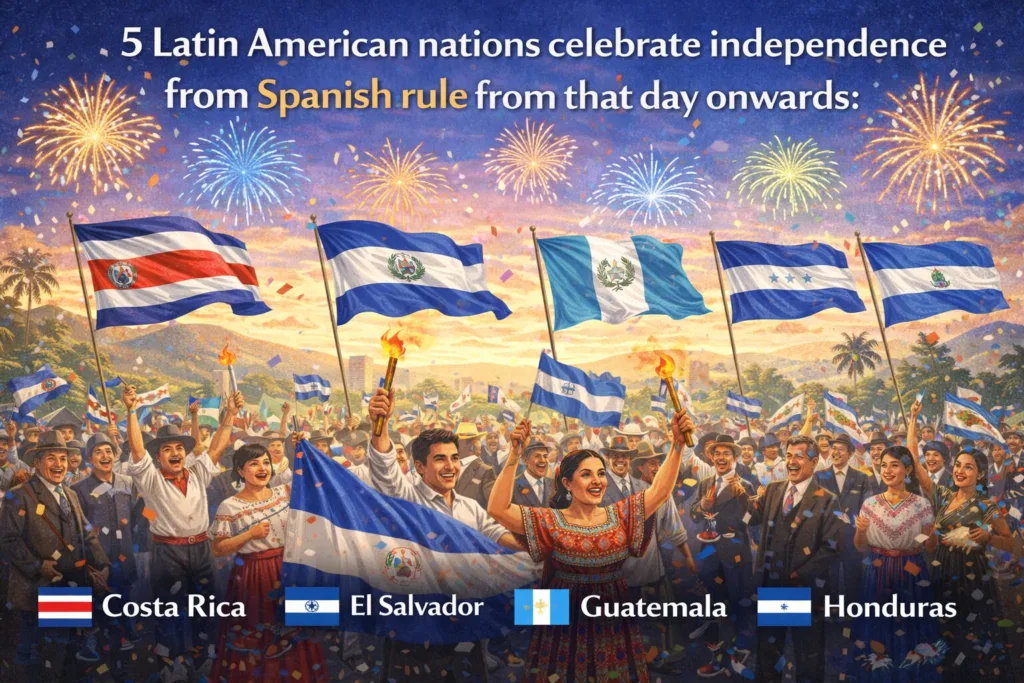
- Costa Rica, El Salvador, Guatemala, Honduras and Nicaragua all celebrate independence on 15 September.
- Congress created Hispanic Heritage Week in 1968 and expanded it to a month in 1988.
- In 2023 there were 65.2 million Hispanic people in the US, 19.5% of the population.
- Thirteen US states had at least one million Hispanic residents in 2023.
- Most Hispanic Americans are US citizens born in the United States.
What is Hispanic Heritage Month?
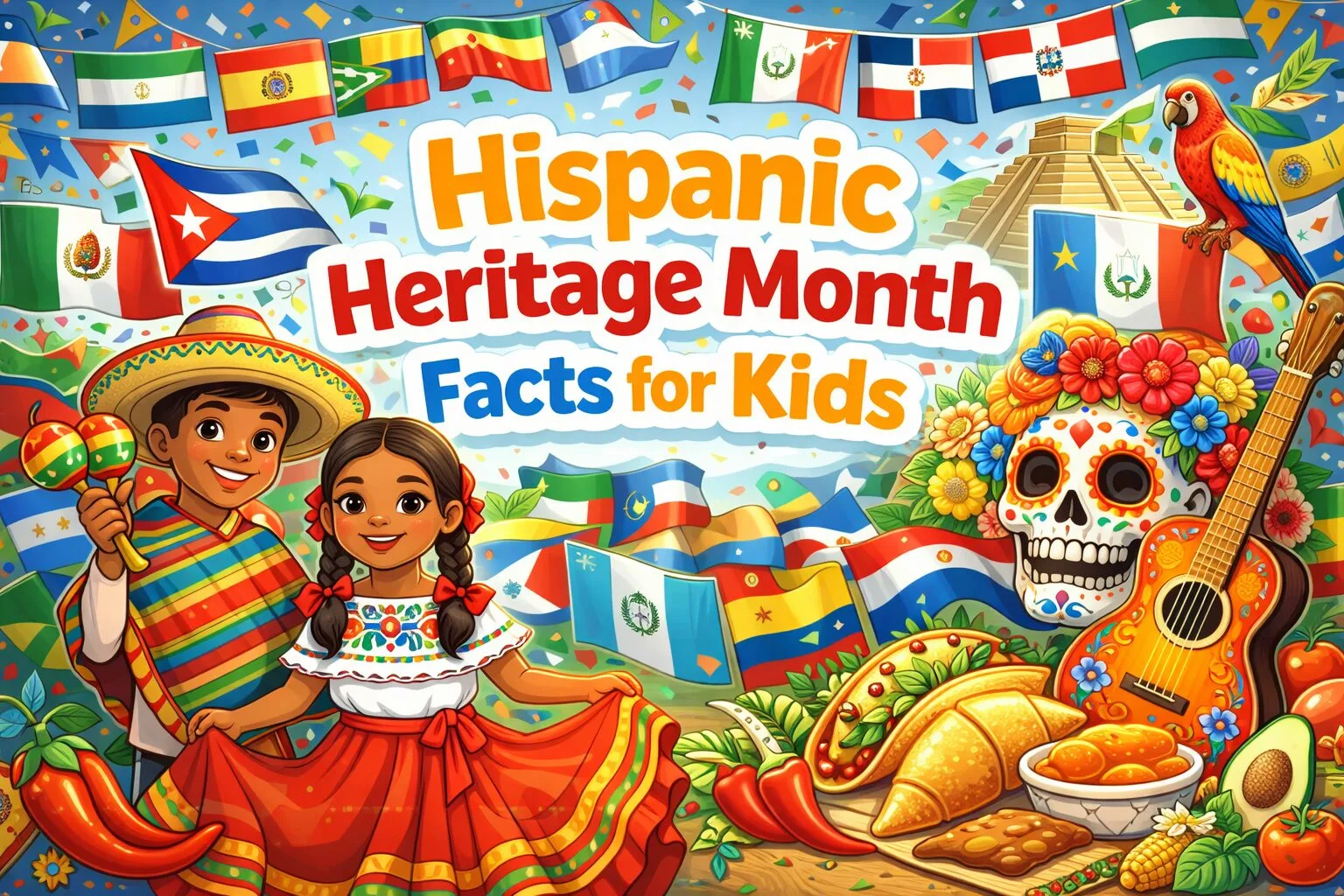
National Hispanic Heritage Month is a time when people in the United States celebrate the history, cultures and achievements of Hispanic Americans. It runs every year from 15 September to 15 October.
It is unusual because it does not start at the beginning of a month. Instead, it covers the second half of September and the first half of October.
What does heritage mean?
Heritage is what comes down to you from your family, and from the people who lived before you.
It can be a language, a song, a game, a story or a recipe. It can be the way your family marks a birthday or a feast day. Everyone has a heritage, and no two are quite the same.
So this month is a time to learn about one part of the heritage of the United States: the part that comes from Spain and Latin America.
Why does it start on 15 September?
The date was chosen on purpose. 15 September is Independence Day in five Latin American countries: Costa Rica, El Salvador, Guatemala, Honduras and Nicaragua.
Mexico celebrates its independence the next day, 16 September, and Chile two days after that, on 18 September. So the month starts with some of the biggest national days in Latin America.
The month also includes 12 October, which is marked in many Spanish-speaking countries as Día de la Raza. In the United States, Columbus Day was once held on 12 October too, but it now falls on the second Monday in October.
| Date | What happens |
|---|---|
| 15 September | Independence Day in Costa Rica, El Salvador, Guatemala, Honduras and Nicaragua |
| 16 September | Independence Day in Mexico |
| 18 September | Independence Day in Chile |
| 12 October | Día de la Raza in many Spanish-speaking countries |
| Second Monday in October | Columbus Day in the United States |
A month full of big days
Think of the month as a string of big days, one after another.
On 15 September, five countries mark their independence on the same day. The next day, it is Mexico’s turn. Two days after that, Chile has its own big day.
Then, near the end, comes 12 October. By the time the month is over, you have passed a whole run of special dates.
How it began
The celebration started small. In 1968, the US Congress asked the president to name a week in September, including 15 and 16 September, as National Hispanic Heritage Week.
Twenty years later, in 1988, Congress stretched it into a full 31-day period beginning on 15 September. That is how a week became a month.
The law asks people, and schools in particular, to mark the month with events. So if your school does something special in late September, this is why.
Who are Hispanic Americans?
Hispanic Americans are people living in the United States whose families came from Spanish-speaking countries. Most trace their roots to Latin America, so they are often called Latinos too.
They come from many different places. These include Mexico, Puerto Rico, Cuba, El Salvador, the Dominican Republic, Guatemala, Colombia and Honduras, as well as other parts of Central and South America, the Caribbean, and Spain.
Many Hispanic Americans think of themselves first by their family’s country, as Mexican American or Cuban American, for example, rather than as part of one big group.
Some families arrived recently. Others have lived in the United States for many generations, since long before their neighbours’ families came. In fact, most Hispanic Americans are US citizens who were born in the United States.
Hispanic or Latino?
The two words are often used to mean the same thing, but they start from slightly different places. Hispanic is linked to the Spanish language. Latino is linked to Latin America.
So someone whose family came from Spain could be called Hispanic but not Latino. Someone whose family came from Brazil, where people speak Portuguese, could be called Latino but not Hispanic.
In the end, the best word is usually the one a person chooses for themselves. Many people simply prefer to name their family’s country.
Hispanic Americans by the numbers
On 1 July 2023, there were 65.2 million Hispanic people in the United States, according to the US Census Bureau. That is 19.5% of the whole population, almost one person in five.
That makes them the largest minority group in the country.
In 2023, thirteen states had at least one million Hispanic residents: Arizona, California, Colorado, Florida, Georgia, Illinois, New Jersey, New Mexico, New York, North Carolina, Pennsylvania, Texas and Washington.
Between 2022 and 2023, the county that gained the most Hispanic residents was Harris County in Texas, which includes the city of Houston. It added 39,815 people.
The Hispanic population is also young. Its median age in 2023 was 31, which means half were younger than 31 and half were older.
Here before the United States
Spanish-speaking people have lived in what is now the United States since before the country was founded.
Before there was New England, there was New Spain. And before there was a city of Boston, there was Santa Fe, which is now in New Mexico.
You can still see this today. Many place names in the United States are Spanish. Los Angeles, San Francisco and Florida are just three of them. So Hispanic history is not only the story of people who arrived recently. It has been part of the story of the country from its very beginnings.
How people celebrate
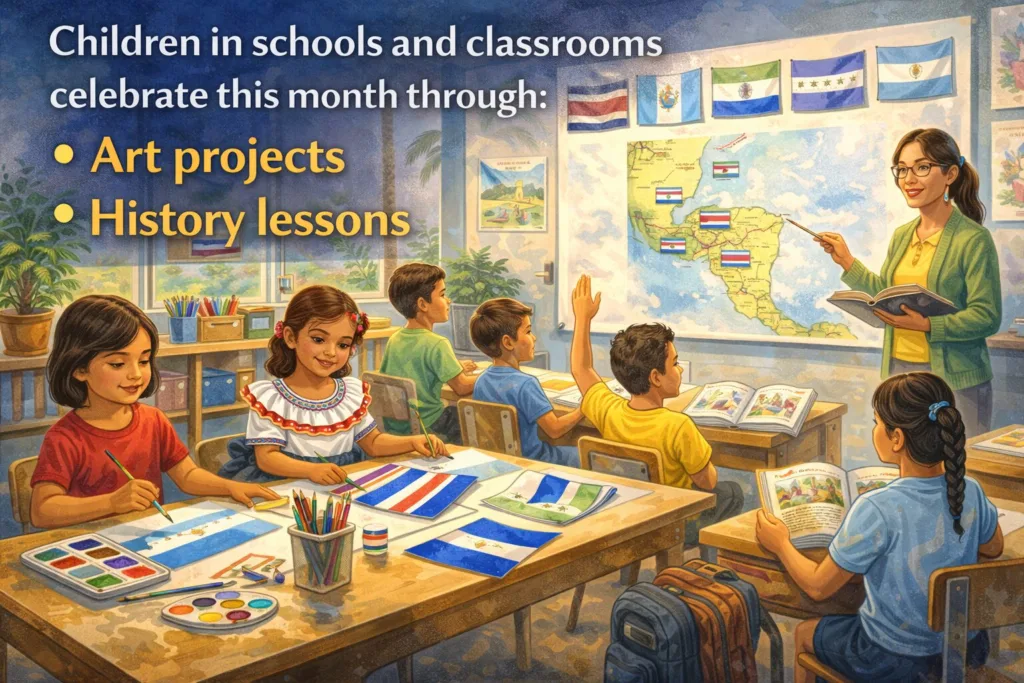
During the month, schools, museums, libraries and communities hold events about Hispanic history, art, music and food. Some towns hold parades or street fairs, with music and dancing. Libraries often set out books by Hispanic writers.
Here are a few ways you could take part. You could find the countries of Latin America on a map and look up when each one celebrates its independence. You could learn to say hello, please and thank you in Spanish.
You could ask a family member or neighbour about a tradition from their family’s country. Or you could read a book by a Hispanic author, or listen to music from a country you have never visited.
Food is a lovely way in, too. Many families share dishes from their home countries, and every country has its own favourites.
Here are some more things to try. Make a flag chart. Draw the flags of Costa Rica, El Salvador, Guatemala, Honduras, Nicaragua, Mexico and Chile. Put them in date order, with the day each one marks its independence.
Start a word wall. Each day, add one Spanish word and what it means. Hola means hello. Gracias means thank you. Amigo means friend.
If your own family has roots in Spain or Latin America, this is a good time to ask older relatives about the past. Where did they grow up? What games did they play? What did they eat on special days? Write down what they tell you, so the stories are not lost. At the end of the month, look back at what you found out. You might be surprised how much you can learn in 31 days.
The month runs into October, so you could combine it with our October fun facts.
Why it matters
Hispanic Americans have helped shape the United States in history, science, politics, sport, music and art. The month is a chance to learn what they have done.
It is also a reminder that Hispanic heritage is not one thing. It takes in many lands, many pasts and many ways of life. All of them are part of the same country’s story.
Three things people get wrong
Hispanic Heritage Month is not a calendar month. It runs from 15 September to 15 October, to match independence days in Latin America.
Hispanic Americans are not one single group. They have roots in many countries, and many identify first with their family’s country.
Most Hispanic Americans are not recent immigrants. Most are US citizens who were born in the United States.
Did you know? Santa Fe, now in New Mexico, was founded by Spanish settlers before the city of Boston existed.
Try it
Find Costa Rica, El Salvador, Guatemala, Honduras, Nicaragua, Mexico and Chile on a map. Mark each one with the date it celebrates its independence.
Knowledge check
Why does Hispanic Heritage Month start on 15 September?
Show answer
Because five Latin American countries, Costa Rica, El Salvador, Guatemala, Honduras and Nicaragua, celebrate independence that day.
When did Hispanic Heritage Week become a month?
Show answer
In 1988, when Congress expanded it to a 31-day period starting on 15 September.
Frequently asked questions
When is Hispanic Heritage Month?
Hispanic Heritage Month runs every year from 15 September to 15 October in the United States. It crosses two calendar months to match independence days in Latin America.
Why does Hispanic Heritage Month start on September 15?
It starts on 15 September because Costa Rica, El Salvador, Guatemala, Honduras and Nicaragua celebrate independence that day. Mexico follows on 16 September and Chile on 18 September.
When did Hispanic Heritage Month begin?
It began in 1968 as National Hispanic Heritage Week, set by the US Congress. In 1988 Congress expanded it to a 31-day period starting on 15 September.
What is the difference between Hispanic and Latino?
Hispanic is linked to the Spanish language, while Latino is linked to Latin America. Someone with roots in Spain is Hispanic but not Latino; someone with roots in Brazil could be Latino but not Hispanic.
How many Hispanic people live in the United States?
In July 2023 there were 65.2 million Hispanic people in the United States, according to the US Census Bureau. That is 19.5% of the population, the largest racial or ethnic minority.
How can kids celebrate Hispanic Heritage Month?
Kids can find Latin American countries on a map, learn some Spanish words, read books by Hispanic authors, try music or food from a Latin American country, or ask relatives about family traditions.
Sources
- Encyclopaedia Britannica: National Hispanic Heritage Month — dates, the 1968 and 1988 laws, and the independence days and holidays in the period
- Encyclopaedia Britannica: Hispanic Americans — who Hispanic Americans are, their countries of origin and their long history in the United States
- US Census Bureau: Hispanic Heritage Month 2024 — population, share of the US, states with a million or more Hispanic residents, and median age