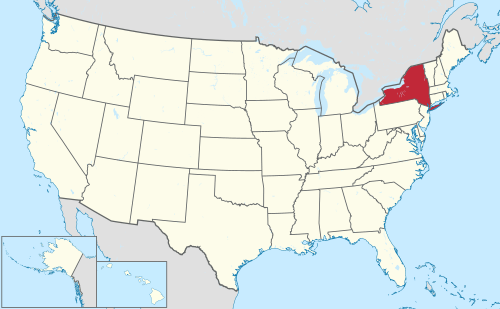
New York is a state in the north-eastern United States and one of the 13 original colonies. Its capital is Albany, not New York City, and about 19.9 million people live there. It stretches from the Atlantic to the Great Lakes, with mountains, 8,000 lakes and Niagara Falls. Its nickname is the Empire State.
New York quick facts
- The capital of New York state is Albany.
- New York became a state on 26 July 1788.
- New York has about 8,000 lakes and nine major rivers.
- New York City has five boroughs: Manhattan, Brooklyn, the Bronx, Queens and Staten Island.
- New York City has been the largest city in the US since 1790.
What is New York?
New York is a state in the north-east of the United States. It was one of the 13 original colonies that became the first states of the country.
When people say “New York”, they might mean the state or New York City, the biggest city in the United States. The city is inside the state, but the state is much bigger. Its capital is not New York City at all, but Albany.
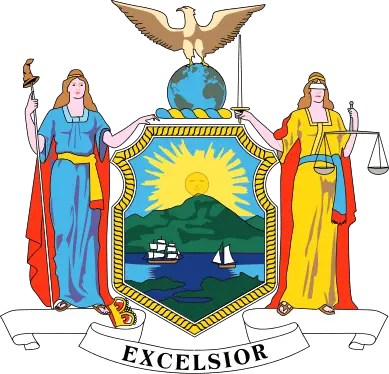
New York’s nickname is the Empire State, and its motto is Excelsior, which means “ever upward”.
New York fact file
- Capital
- Albany, one of the oldest cities in the United States
- Largest city
- New York City, the largest in the US since 1790
- Population
- About 19.9 million (2024 estimate)
- Nickname
- The Empire State
- Statehood date
- 26 July 1788
- State bird
- Eastern bluebird
- State flower
- Rose
- Landmarks
- Niagara Falls, and the Hudson River valley
- Rivers and lakes
- The Hudson River, the Great Lakes and about 8,000 lakes
- Flag
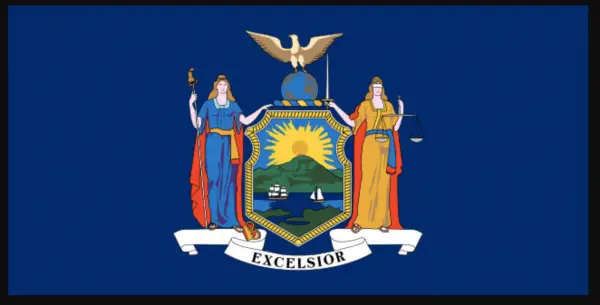
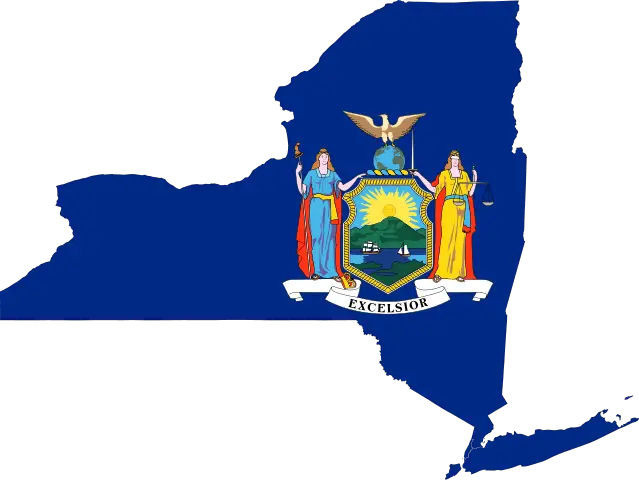
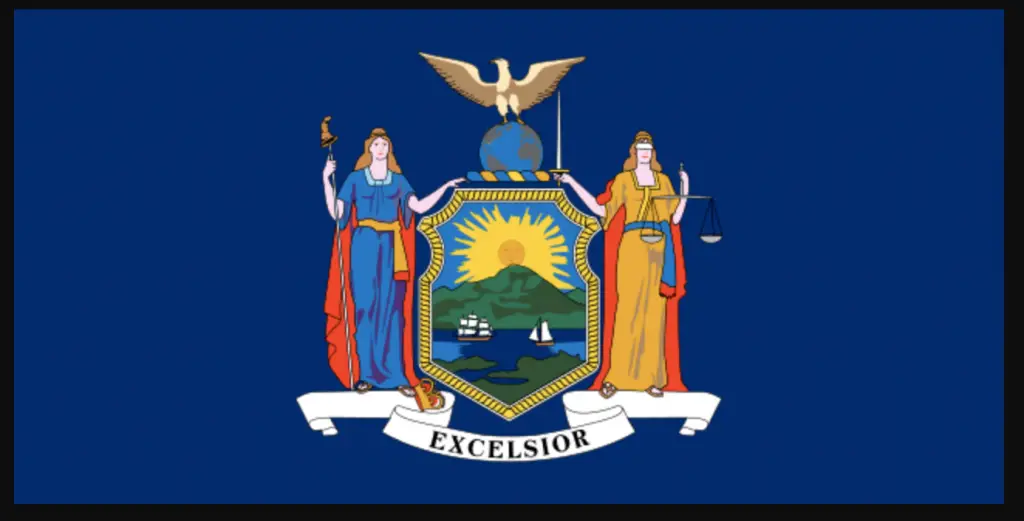
- Dark blue, with New York coat of arms in the middle
And a few things no report form asks for:
| Area | 54,555 square miles (141,297 km²) |
| Highest point | Mount Marcy, 5,344 feet (1,629 m) |
| State song | “I Love New York” |
Where is New York?
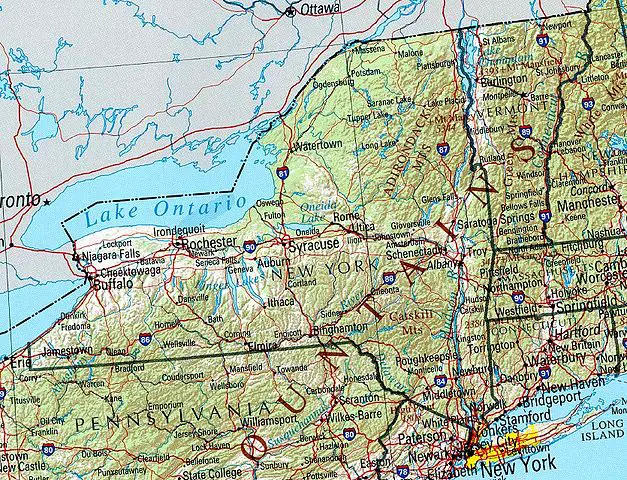
New York stretches from the Atlantic Ocean in the south-east to the Great Lakes in the west and north.
To the north and west are Lake Erie, Lake Ontario and two Canadian provinces, Ontario and Quebec. To the east are the New England states of Vermont, Massachusetts and Connecticut. To the south are New Jersey and Pennsylvania.
The state has about 130 miles (210 km) of Atlantic coastline and about 370 miles (600 km) of shoreline on Lakes Erie and Ontario.
The capital, Albany
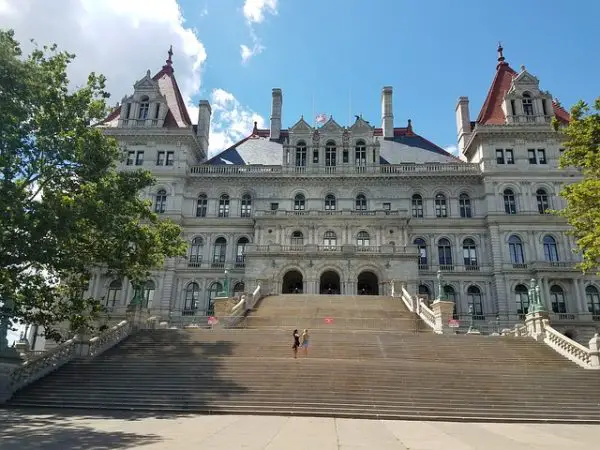
Albany is the state capital, and it is one of the oldest cities in the United States. It stands on the Hudson River, in the east of the state, where the Hudson meets the route west along the Mohawk River.
The state government meets in the grand New York State Capitol building in Albany.
Mountains, lakes and waterfalls
New York is not all skyscrapers. It has sandy beaches on Long Island, forests, mountains, rivers and thousands of lakes.
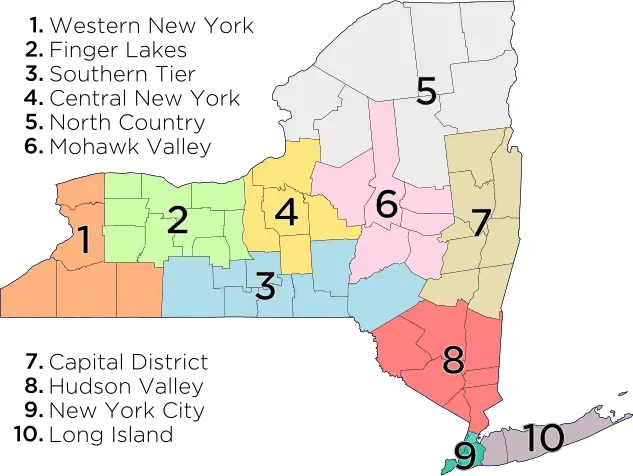
During the last Ice Age, glaciers covered almost all of the state. As they moved, they shaped the land into nine different regions, each with its own landscape.
The highest and most rugged mountains are the Adirondacks, in the north-east. Today they are a favourite place for hiking, canoeing, camping and skiing. The tallest peak is Mount Marcy, at 5,344 feet (1,629 m).
New York has about 8,000 lakes and nine major rivers. The Hudson and Mohawk rivers have been the most important in its history, because they made natural routes through the mountains.
On the border with Canada, the Niagara River plunges over the famous Niagara Falls.
Weather
New York has warm summers and cold, snowy winters. The first Dutch settlers were surprised, because Manhattan lies about as far south as the Mediterranean, yet its winters were freezing.
In July, the average temperature ranges from about 77°F (25°C) in New York City to about 64°F (18°C) in the Adirondack mountains. In January it can average as low as 14°F (−10°C) in the mountains.
A short history
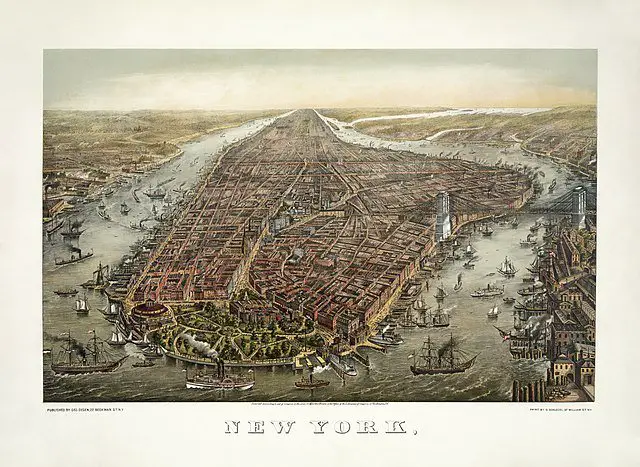
Long before Europeans arrived, the land was home to Native American peoples, including the Lenape around what is now New York City.
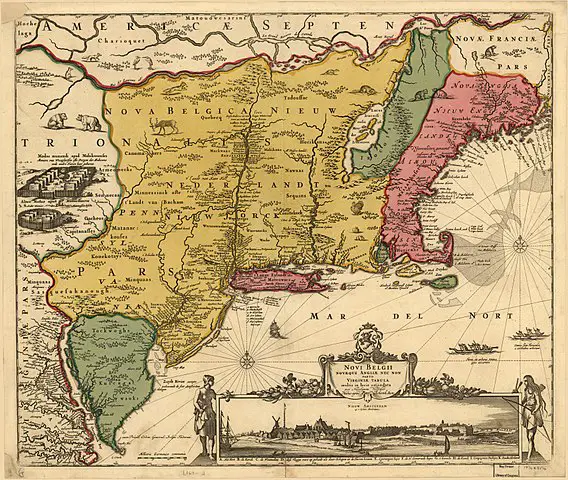
In the 1600s, the Dutch set up a colony called New Netherland. In 1626 its leader, Peter Minuit, arrived at the mouth of the Hudson River and was put in charge of the Dutch settlement on Manhattan Island.
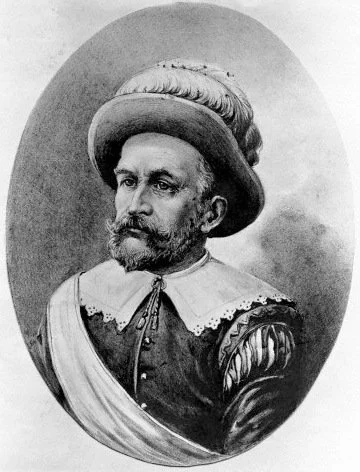
Minuit is remembered for “buying” Manhattan from the local Native American leaders, for trade goods worth 60 Dutch guilders. But the idea of owning land was foreign to Native Americans. The people Minuit dealt with most likely saw the goods as a gift to seal an agreement to share the land, not to sell it.
The Dutch town on Manhattan was called New Amsterdam. Later the English took control, and the colony and its main town were renamed New York, after the Duke of York, the brother of the English king. Find out more about that country in our England facts for kids.
After the American War of Independence, New York became a state on 26 July 1788. New York City was the country’s first capital, and George Washington took the oath as the first president there in 1789.
In the 1800s, the Erie Canal linked the Hudson River with the Great Lakes. It turned New York City into the country’s busiest gateway to the west.
The people of New York
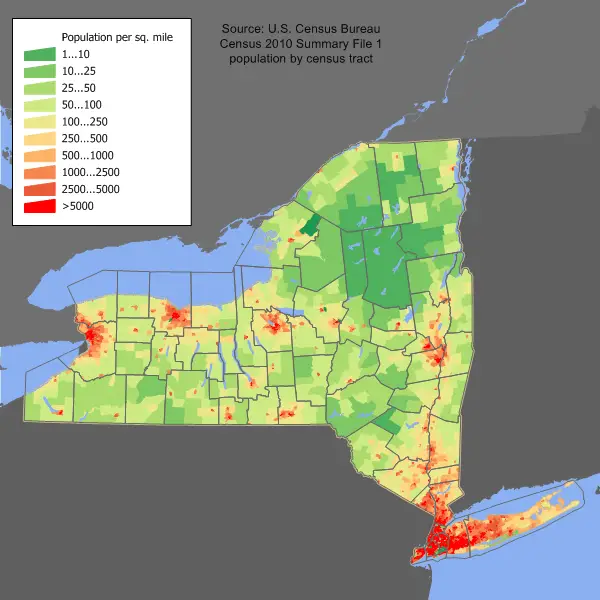
In 2020, 20.2 million people lived in New York. By 2024 it was estimated at about 19.9 million.
Until the 1960s, New York had more people than any other state. California then grew faster and overtook it, and in 2000 Texas did too. New York is still one of the most populous states in the country.
More than four in five New Yorkers live in or around its cities: New York City, Albany, Utica, Syracuse, Rochester and Buffalo.
Famous New Yorkers include Theodore Roosevelt, who was born in New York City and became president in 1901, and Donald Trump, who was born in Queens.
New York City
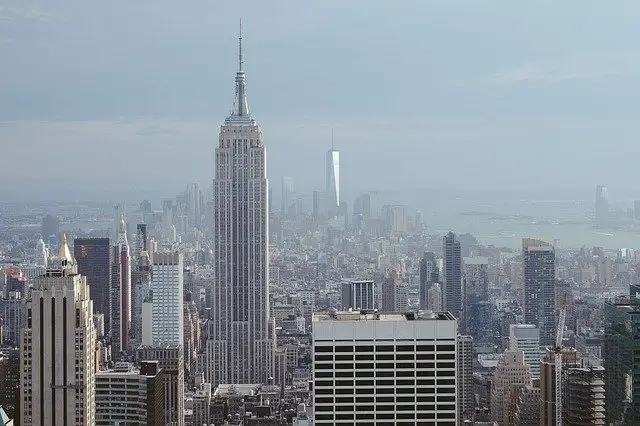
New York City sits at the mouth of the Hudson River, beside one of the world’s great harbours. It has been the largest city in the United States since the first count of the country’s people, in 1790.
In 2020, about 8.8 million people lived in the city. It is divided into five parts, called boroughs: Manhattan, Brooklyn, the Bronx, Queens and Staten Island.
New York City is one of the most international cities in the world. People from almost every country live there, and hundreds of languages are spoken.
Its most famous symbol is the Statue of Liberty, which stands on an island in New York Harbor. The city is also famous for the Empire State Building, Times Square, Central Park, Broadway theatres and Wall Street, the centre of American banking.
State symbols
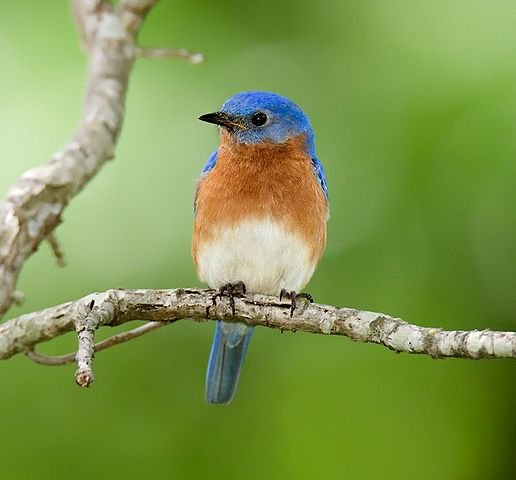
New York’s state bird is the eastern bluebird, a small songbird with a bright blue back and an orange-red chest. Its state flower is the rose, and its state song is “I Love New York”.
The state flag is dark blue, with New York’s coat of arms in the middle. The coat of arms shows a shield held by two figures, Liberty and Justice, with the word Excelsior on a banner below.
Food
New York’s food is as varied as its people. New York City is famous for bagels, hot dogs from street carts and big, thin slices of pizza.
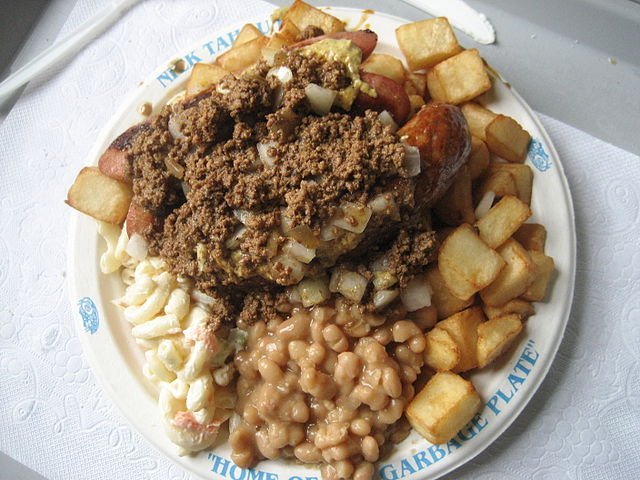
Upstate cities have their own specialities. Buffalo gave its name to Buffalo wings, spicy fried chicken wings. Rochester is known for the Garbage Plate, a heaped plate of meat, potatoes, macaroni salad and beans, all piled together.
Farms across the state grow apples, grapes and vegetables, and New York is famous for its apple orchards.
Work and business
New York is one of the richest places in the world. Britannica says its economy is bigger than that of all but a handful of countries.
New York City is the centre of much of America’s business and banking, and many of the country’s newspapers, publishers, television companies and fashion houses are based there.
For more than two centuries, canals, railways and highways have made New York a gateway between the Atlantic coast and the rest of the country. Goods and people have passed through it from all over the world.
Celebrations
New York City hosts some of the country’s best-known celebrations. Every Thanksgiving, giant balloons float through the streets of Manhattan in the famous Macy’s Thanksgiving Day Parade.
At Christmas, a huge Christmas tree is lit at Rockefeller Center, and crowds gather in Times Square to see in the New Year.
Three things people get wrong
New York City is not the capital of New York state. The capital is Albany.
New York is not only a city. The state has mountains, forests, farmland, about 8,000 lakes and Niagara Falls.
Manhattan was not simply sold. The Native Americans who dealt with Peter Minuit most likely saw his trade goods as a gift to seal an agreement to share the land.
Did you know? The Dutch settlers who came to Manhattan in the 1600s were surprised by its freezing winters, because it lies about as far south as the Mediterranean.
Try it
Find New York on a map of the United States. Trace its borders with your finger and name what lies on each side: the Great Lakes, Canada, New England, New Jersey, Pennsylvania and the Atlantic.
Knowledge check
What is the capital of New York state?
Show answer
Albany.
What was New York City called when it was a Dutch town?
Show answer
New Amsterdam.
Frequently asked questions
What is the capital of New York?
The capital of New York state is Albany, on the Hudson River. Many people think it is New York City, but the city is the state’s largest, not its capital.
Why is New York called the Empire State?
New York’s official nickname is the Empire State. Its motto is Excelsior, meaning ever upward, and the state has long been a centre of American business and culture.
How many people live in New York?
About 20.2 million people lived in New York state in 2020, and about 19.9 million in 2024. About 8.8 million of them lived in New York City.
What are the five boroughs of New York City?
New York City’s five boroughs are Manhattan, Brooklyn, the Bronx, Queens and Staten Island.
When did New York become a state?
New York became a state on 26 July 1788, when it ratified the US Constitution. It was one of the 13 original colonies.
What did Peter Minuit do?
Peter Minuit was the leader of the Dutch colony on Manhattan from 1626. He is remembered for buying Manhattan for goods worth 60 guilders, though Native Americans probably saw it as sharing the land.
Sources
- Encyclopaedia Britannica: New York (state) — location, borders, landscape, lakes and rivers, climate, cities and population
- Encyclopaedia Britannica: New York facts and stats — capital, population, admission date, nickname, motto, state bird, flower and song, and area
- Encyclopaedia Britannica: New York City — the five boroughs, population and the city’s place in American life
- Encyclopaedia Britannica: Peter Minuit — the Dutch colony on Manhattan and the so-called purchase of the island