
An adaptation is an inherited feature that helps a living thing survive and have young, shaped by natural selection over many generations. Adaptations can be structural (a camel’s broad feet), behavioural (penguins huddling) or physiological (a kangaroo rat’s water-saving kidneys). Animals do not choose to adapt.
Adaptation quick facts
- Polar bear hairs are clear, hollow tubes, not white.
- Merriam’s kangaroo rats can live without ever drinking water.
- A drought in 1977 made Galápagos finches evolve bigger beaks within a few years.
- The gene change that made peppered moths black began around 1819.
- A cactus’s spines are leaves that changed over time.
Adaptation in nature at a glance
Why does a polar bear not freeze? How does a camel cross a desert? Why do some finches have thick beaks and others thin ones? The answer to all three is adaptation in nature: the way species become suited to where they live.
This guide explains what an adaptation is and how natural selection makes one. It also covers the three main kinds. It uses real examples, from Darwin’s finches to the peppered moth. The facts come from a UC Berkeley teaching site, National Geographic, the San Diego Zoo and university studies.
| Adaptation at a glance | |
|---|---|
| What it is | An inherited feature that helps a living thing survive and have young |
| How it happens | Natural selection, over many generations |
| Structural example | A camel’s broad feet for walking on sand |
| Behavioural example | Emperor penguins huddling for warmth |
| Physiological example | Kangaroo rats that never need to drink |
| Famous case study | Darwin’s finches on the Galápagos Islands |
What is an adaptation?
An adaptation is a feature that helps a living thing survive and have young in its environment. Understanding Evolution, a teaching site from the University of California, Berkeley, adds one more part. The feature must have been shaped by natural selection.
Scientists use four tests. First, the feature must be passed from parent to young. It must do a job. It must help the animal or plant live or breed. And it must have been shaped by selection for that same job.
That last test matters. Some features do a useful job today, but first evolved for something else. We will see an example with feathers later in this guide.
How natural selection works
Natural selection is the process that builds adaptations. Understanding Evolution breaks it into three simple steps.
First, living things vary. No two animals of the same kind are exactly alike. Second, some of those differences help an animal survive and have more young. Third, those helpful features are passed on to the young.
Over many generations, the helpful features become more common. The whole population changes a little at a time. That is how a new adaptation spreads.
The idea is linked to Charles Darwin. Princeton University says Darwin visited the Galápagos Islands in 1835. He collected finches there that later became famous.
The three kinds of adaptation
Teachers usually split adaptations into three kinds. National Geographic Education describes the first two. They are structural and behavioural adaptations. The third kind, physiological adaptation, is about how the body works inside.
| Kind | What it means | Example |
|---|---|---|
| Structural | A body part or shape | Thick water-storing stems in desert plants |
| Behavioural | Something an animal does | Grey whales migrating each year |
| Physiological | How the body works inside | Kangaroo rats’ water-saving kidneys |
Structural adaptations
A structural adaptation is a physical part of the body. National Geographic Education gives the example of desert plants with thick stems that store water.
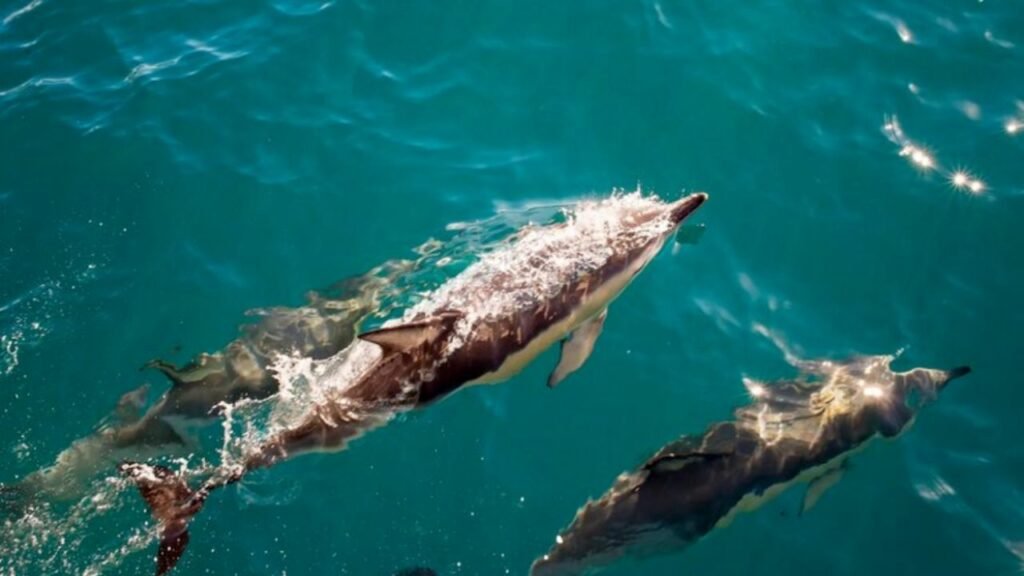
The dolphin is full of structural adaptations. The San Diego Zoo says its smooth, streamlined body helps it swim fast. It breathes through a blowhole on top of its head. A flap opens when it comes up for air.
A dolphin’s eyes can move separately, and it sees well both underwater and in air. The San Diego Zoo says dolphins also make clicking sounds and listen for the echoes. This is called echolocation. It helps them find food, even in murky water.
Behavioural adaptations
A behavioural adaptation is something an animal does. National Geographic Education says grey whales migrate thousands of kilometres each year. They travel from the Arctic to warm waters off Mexico.
Emperor penguins give another example. In the Antarctic winter, they huddle together to share body heat. No single penguin could stay warm alone in such cold.
Some behaviour saves water. Animal Diversity Web says kangaroo rats stay in cool burrows during the day and come out at night. The night air is cooler, so they lose less water.
Physiological adaptations
A physiological adaptation is about how the body works on the inside. You cannot see it by looking at the animal.
Merriam’s kangaroo rat is a star example. Animal Diversity Web says it can live without drinking water at all. It gets water from the seeds it eats. Its special kidneys get rid of waste using very little water, and it neither sweats nor pants.
People have physiological adaptations too. National Geographic Education gives an example. Tibetan people live high in the mountains, and their genes help them use oxygen well. The air there has about 40% less oxygen than at sea level.
Polar bears: built for the cold

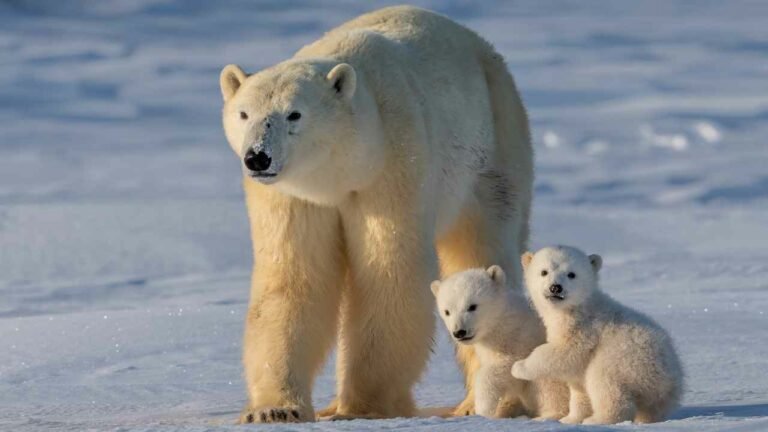
Polar bears live in some of the coldest places on Earth. The San Diego Zoo explains how their bodies cope.
Polar bear hairs look white, but each one is actually a clear, hollow tube filled with air. Long guard hairs stick together when wet. They protect a thick, woolly undercoat.
Under the fur is a layer of fat 5 to 10 cm (2 to 4 inches) thick. The San Diego Zoo says it keeps the bear warm, stores energy and helps it float. Small bumps and stiff fur on its large paws help it grip slippery ice.
Polar bears are also built for hunting. A polar bear can smell a seal on the ice from 32 km (20 miles) away. Polar bears have swum more than 100 km (60 miles) without resting.
Camels: built for the desert
The camel is famous for its hump. The San Diego Zoo says the hump stores fat, not water. The fat is used for energy when food is short.
Camels cope with water in other ways. A camel can drink up to 145 litres (32 gallons) in one go. It can survive losing 40% of its body weight through lack of water before it must drink.
Their bodies also fight sand. Camels have two rows of extra-long eyelashes and can close their nostrils. Their broad, tough feet spread out when they step, which helps them walk on sand.
Camels can handle huge changes in temperature. The San Diego Zoo says they survive from −29°C (−20°F) up to 49°C (120°F).
Cacti: plants adapt too
Adaptation is not just for animals. The San Diego Zoo says a cactus’s spines are really its leaves. They changed over time to suit dry places.
The spines shade the stem and break up drying winds. The cactus stores water in its thick stem, and a tough, waxy skin stops the water escaping.
Cacti also open their tiny pores only at night. That lets them take in the gas they need without losing water in the daytime heat. Most cacti have shallow, spreading roots to soak up rain quickly.
Darwin’s finches
Princeton University says there are about 15 species of Darwin’s finches. They have lived on the Galápagos Islands for roughly 1 million years.
Their beaks are very different. Some are blunt for crushing seeds. Others are pointed for probing cactus flowers. In 2015, scientists found that a gene called ALX1 helps control the shape of finch beaks.
Each beak suits a different food.
Watching evolution happen
Scientists Peter and Rosemary Grant began studying finches on the tiny island of Daphne Major in 1973. Princeton Alumni Weekly says they planned to stay two years. They kept going for 40 years.
In 1977 a drought struck. Only 24 mm (about 1 inch) of rain fell in the wet season. Most medium ground finches died. The birds that survived had bigger beaks, which could crack large, hard seeds.
Beak size is inherited. So the next generations of finches had measurably bigger beaks. The Grants had seen evolution happen in just a few years.
Then the weather flipped. After very heavy rain in 1982 and 1983, small seeds were plentiful. Smaller-beaked finches did better, and the average beak size went down again.
The peppered moth
The peppered moth has a pale form and a dark form. National Geographic Education explains that during the Industrial Revolution, soot darkened the trees in parts of Britain.
Dark moths were better hidden from birds on sooty trees. So they survived more often and became more common. The first completely black peppered moth was recorded in Manchester in 1848.
The University of Liverpool reported in 2016 that the gene change behind the black colour first happened around 1819. It took about 30 years for black moths to become common enough for people to notice.
The black colour comes from a “jumping gene” that landed inside a gene called cortex. The moths did not choose to change. Dark moths already existed, and birds simply ate more of the pale ones.
Camouflage and mimicry
Camouflage helps animals hide. National Geographic Education says the leafy sea dragon’s colour and shape blend in with seaweed. Understanding Evolution adds that some katydids look like leaves.
Mimicry means copying something else. Harmless king snakes look like deadly coral snakes, so predators leave them alone. The mimic octopus can copy the look and movements of sea snakes, flatfish, jellyfish and shrimp.
Both tricks are adaptations. Each one helps an animal stay alive when hungry hunters are near. Both are part of every ecosystem.
What is not an adaptation?
Understanding Evolution warns that not every feature is an adaptation. Cave fish, for example, still have eyes that no longer work. They are left over from ancestors that could see. They are not adaptations for cave life.
Changes in one animal’s life are not adaptations either. Sometimes one person gets used to thin mountain air. National Geographic Education says scientists call this acclimation. Adaptation happens to whole populations over many generations.
Feathers show why the history matters. Understanding Evolution says feathers were found on dinosaurs that could not fly. So feathers probably first evolved for warmth or display, not for flight.
Three things people get wrong
Myth: animals choose or try to adapt. Understanding Evolution says living things do not want or try to change. Natural selection only acts on differences that already exist in a population.
Myth: one animal can adapt during its life. National Geographic Education says only populations adapt, over many generations. A change in one animal’s lifetime is called acclimation.
Myth: camels store water in their humps. The San Diego Zoo says a camel’s hump stores fat, which gives it energy. Camels save water in other ways, and can drink 145 litres at once.
Did you know? Scientists Peter and Rosemary Grant planned to study finches on Daphne Major for two years. They kept going for 40 years and watched evolution happen.
Try it
Pick an animal you know well. List one structural, one behavioural and one physiological adaptation it has, and explain the job each one does.
Knowledge check
What are the three kinds of adaptation?
Show answer
Structural (body parts), behavioural (actions) and physiological (how the body works inside).
What happened to finch beaks after the 1977 drought?
Show answer
The survivors had bigger beaks, so the next generations had bigger beaks too.
Frequently asked questions
What is an adaptation in nature?
An adaptation is an inherited feature that helps a living thing survive and have young. Understanding Evolution says it must have been shaped by natural selection.
What are the three types of adaptation?
The three types are structural adaptations, such as body shapes, behavioural adaptations, such as migration, and physiological adaptations, such as water-saving kidneys.
How does natural selection cause adaptation?
Living things vary. Those with helpful features survive and breed more, passing the features on. Over many generations, the features become common in the population.
Can an animal adapt during its own life?
No. Adaptation happens to populations over many generations. National Geographic Education says a change in one animal’s lifetime is called acclimation.
What is an example of adaptation happening quickly?
After a drought in 1977, Galápagos finches with bigger beaks survived best. Princeton researchers measured bigger beaks in the next generations within a few years.
Do camels store water in their humps?
No. The San Diego Zoo says a camel’s hump stores fat for energy. Camels can drink up to 145 litres of water in one go.
Sources
- Understanding Evolution (UC Berkeley): adaptation — what an adaptation is, the four tests and features that are not adaptations; its misconceptions pages were also used
- National Geographic Education: adaptation and survival — structural and behavioural adaptations, the peppered moth and mimicry; its adaptation page was also used
- San Diego Zoo Wildlife Alliance: polar bear — polar bear adaptations; its camel, dolphin and cactus pages were also used
- Princeton University: gene shaped evolution of Darwin’s finches — Darwin’s finches and the ALX1 gene; Princeton Alumni Weekly’s article on the Grants was also used
- University of Liverpool: jumping gene took peppered moths to the dark side — when and how peppered moths turned black
- Animal Diversity Web: Merriam’s kangaroo rat — how kangaroo rats live without drinking