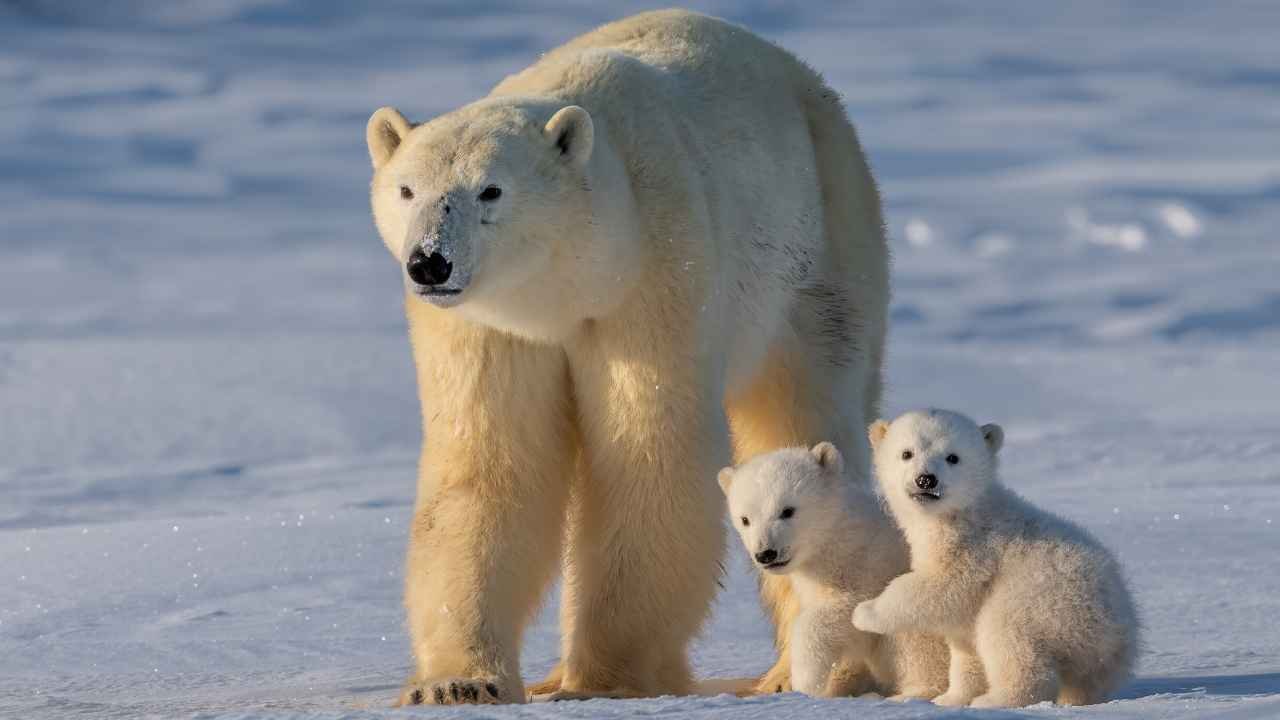
No, polar bears cannot survive in the desert for long. Their thick fur and fat hold in heat, so a hot desert would make them overheat. A desert also has no sea ice to hunt from and no seals to eat, so a bear there would starve. Oddly, much of the Arctic is itself a cold polar desert.
Polar bears and heat quick facts
- In a 2022 study of zoo polar bears, a stress hormone rose once the air passed 20°C (68°F).
- Parts of the Arctic get as little rain and snow as the Sahara Desert.
- Polar bear hairs have no colour. Each one is clear, with a hollow core.
- In western Hudson Bay, polar bears now spend about 130 days a year on land, waiting for the sea to freeze.
- In a 2024 study, 19 of 20 polar bears on land lost weight, even the ones that ate berries and birds.
Why a polar bear could not survive in a desert
Nobody has ever tested how long a polar bear would last in a hot desert, and nobody should. Scientists still know enough about the animal to answer the question. Two problems would hit a polar bear at once: heat and hunger.
Heat is the first problem. Polar bears are built to keep heat in. Their fur and fat work like a sleeping bag that can never be unzipped. In the Arctic that coat keeps them alive, but in a hot desert it would make them dangerously hot.
The second problem is food. Polar bears hunt seals, and they catch them from floating sea ice. A desert has no ice and no seals. Seals are also one of a polar bear’s main sources of water, so a bear without them would go thirsty as well as hungry. Both problems would strike together.
There is a twist to the story. Much of the Arctic is itself a kind of desert, because very little rain or snow falls there. So polar bears cannot survive in a hot desert, yet they already live in a cold one.
| What a polar bear needs | On the Arctic sea ice | In a hot desert |
|---|---|---|
| A way to lose extra heat | Cold air and icy water all around | Summer days can pass 49°C (120°F) |
| A hunting platform | Sea ice over the ocean | No sea ice |
| Fatty food | Ringed and bearded seals | No seals at all |
| Water | Seal meat, snow and ponds | Very little water of any kind |
| Somewhere to cool off | Chilly seawater close by | Hot sand and rock |
Scientists cannot say exactly how long a polar bear would last. It would depend on the bear, the heat, the shade, the water and whether people stepped in to help. Putting a polar bear in a desert to find out would be cruel, so the experiment has never been done. The question stays a thought experiment.
How polar bears are built for the cold
Winter in the Arctic is brutal. Polar Bears International says the air can drop to -40°C (-40°F), or even -46°C (-50°F), and stay there for days or weeks. Features that help an animal survive where it lives are called adaptations, and a polar bear is covered in them.
Fur. A polar bear has two layers of fur, and together they stop almost all of the bear’s body heat from escaping.
Hairs. The hairs are not white. Each one has no colour at all. It is clear, with a hollow core that scatters light, and that scattering makes the coat look white.
Skin. Under the fur, a polar bear’s skin is black. Polar Bears International says scientists have two main ideas about why. Nobody is completely sure yet. Dark skin is good at soaking up heat from the sun, and it may also protect the bear from harmful ultraviolet light.
Blubber. Under the skin lies a thick layer of fat called blubber. San Diego Zoo Wildlife Alliance says it can be 5 to 10 cm (2 to 4 inches) thick. At its thickest, that is about the height of a mug. Blubber stores energy for later.
Size. Adult males usually weigh 350 to 600 kg (775 to 1,300 lb). That is as heavy as a grand piano, or heavier. That is a lot of bear. Adult females are smaller, usually 150 to 290 kg (330 to 650 lb).
Every one of these features helps in the cold, but almost every one would work against a bear in the heat.
Why heat is dangerous for polar bears
A polar bear’s coat keeps heat in so well that the bear can overheat even in the Arctic. Polar Bears International says adult males can quickly overheat when they run. Running makes heat inside the muscles, and the thick fur stops that heat from getting out. The coat cannot be switched off.
So how warm is too warm? In 2022, scientists published a study of polar bears living in zoos in Canada and the United States. They measured a stress hormone called cortisol in the bears’ droppings, and cortisol helps the body cope with stress, including keeping cool.
In adult bears, cortisol went up when the air was warmer than 20°C (68°F). Twenty degrees is not very hot. It is only a pleasant summer day in Britain. The study did not show that the bears were harmed at 20°C. It showed that their bodies had to work harder to stay cool.
Now compare that with a hot desert. The US National Park Service says summer temperatures in Death Valley, California, often top 49°C (120°F) in the shade. Even summer nights there often stay above 32°C (90°F). The hottest air temperature ever recorded in Death Valley was 57°C (134°F), in July 1913. That is real desert heat.
That daytime heat is more than double the temperature at which the zoo bears’ bodies began to strain. And a wild bear in the desert could never take its fur coat off.
Warmer days are reaching the edge of the polar bear’s range too. The 2022 study found that days reaching 20°C have become at least 30% more common over 30 years. It looked at May to September near Churchill, Manitoba, and Arviat, Nunavut. Both places are in Canada, in the far south of the polar bear’s range.
Polar bears have one simple way to cool down. San Diego Zoo Wildlife Alliance says that bears built for the cold sometimes overheat and have to cool off in chilly water. In the Arctic, cold water is always close by. In a desert, it would not be.
Why polar bears need sea ice
Polar bears are marine mammals, which means they depend on the sea for their food. Their scientific name, Ursus maritimus, means “sea bear”. The name fits them well. The 2016 US Fish and Wildlife Service conservation plan for polar bears calls them top predators of the Arctic’s ocean life.
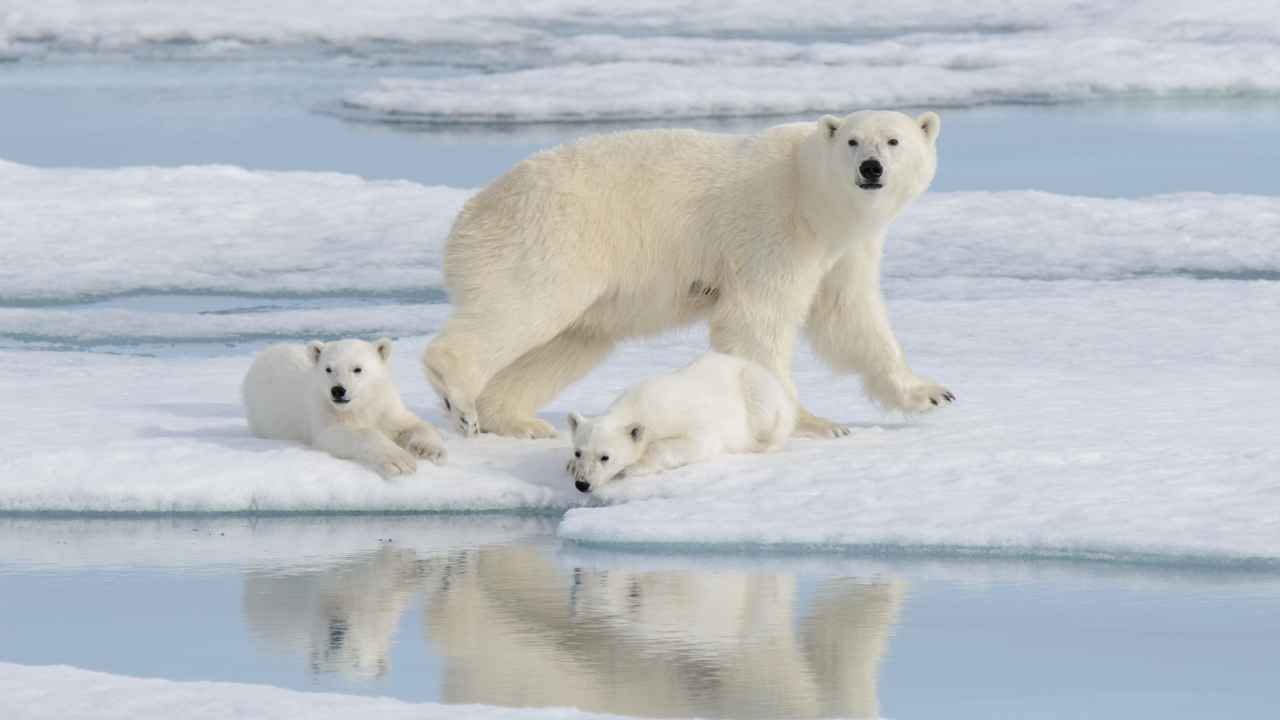
The US Fish and Wildlife Service says polar bears live around the Arctic, mostly north of the Arctic Circle. They are split into 19 groups called subpopulations, spread across five countries: Canada, Greenland, Norway, Russia and the United States. The two United States subpopulations live in and around Alaska. There are no polar bears in Antarctica, at the other end of the Earth.
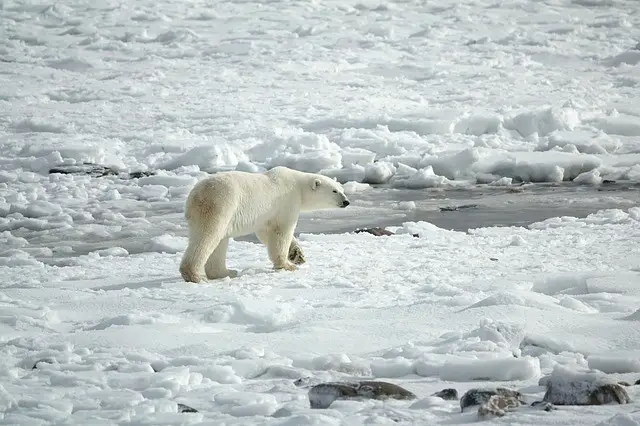
The places where polar bears live all have one thing in common: they have sea ice for at least part of the year. Sea ice is simply frozen seawater. It covers much of the Arctic Ocean in winter and shrinks back each summer.
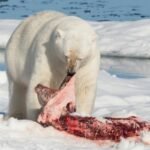
For a polar bear, sea ice is a hunting platform. Seals climb out onto the ice to rest, and cracks in the ice are good places for bears to hunt them. The US Fish and Wildlife Service says polar bears prey heavily on ringed seals and, less often, on bearded seals. Ringed seals matter most of all.
Seals are wrapped in thick blubber, and blubber is packed with energy. The 2016 plan says an adult polar bear needs to eat about 2 kg (4.4 lb) of fat a day to survive. That is about the weight of two bags of sugar. And that is every single day.
In summer, most seals are out in open water, where polar bears can very rarely catch them. The plan says hunting in open water cannot make up for the lost sea ice. No ice means no seal hunting.
What a polar bear would eat and drink in a desert
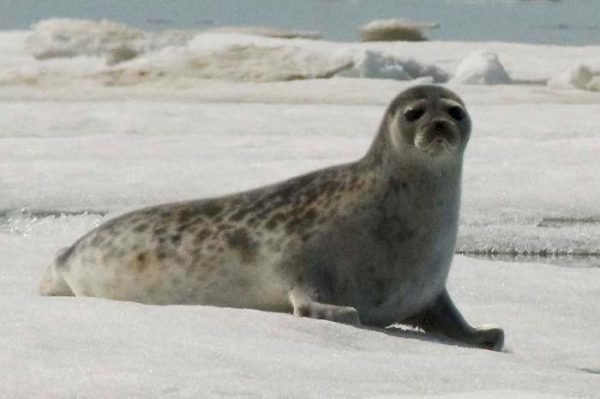
What polar bears eat in the wild is mostly seal. A desert has no seals at all. So what could a polar bear find to eat there? Almost nothing that would keep it going.
Polar bears are not fussy. When they are stuck on land for a long time, they will eat plants and other land foods. The 2016 plan says these foods, such as birds’ eggs, help only a little. They are patchy, which means hard to find in one place, and they are not very nutritious. Berries cannot replace seal fat.
Desert animals such as camels and fennec foxes are suited to heat and dry ground. A polar bear is suited to the opposite.
Water would be another problem. Seawater is too salty to drink, so polar bears get fresh water in other ways, says Polar Bears International. Seal meat is about 70% water, and seal blubber is about 10% water. Bears also eat some snow and drink from ponds, and cubs drink their mother’s milk.
Their bodies make a little water too, when they break down food for energy. Scientists once thought that burning fat gave polar bears lots of water. Newer research suggests they mostly survive by losing very little water in the first place.
Take away the seals, the snow and the ponds, and most of those water sources vanish. A hot, dry desert would offer almost none of them. The desert fails on water too.
What happens when the sea ice melts in summer
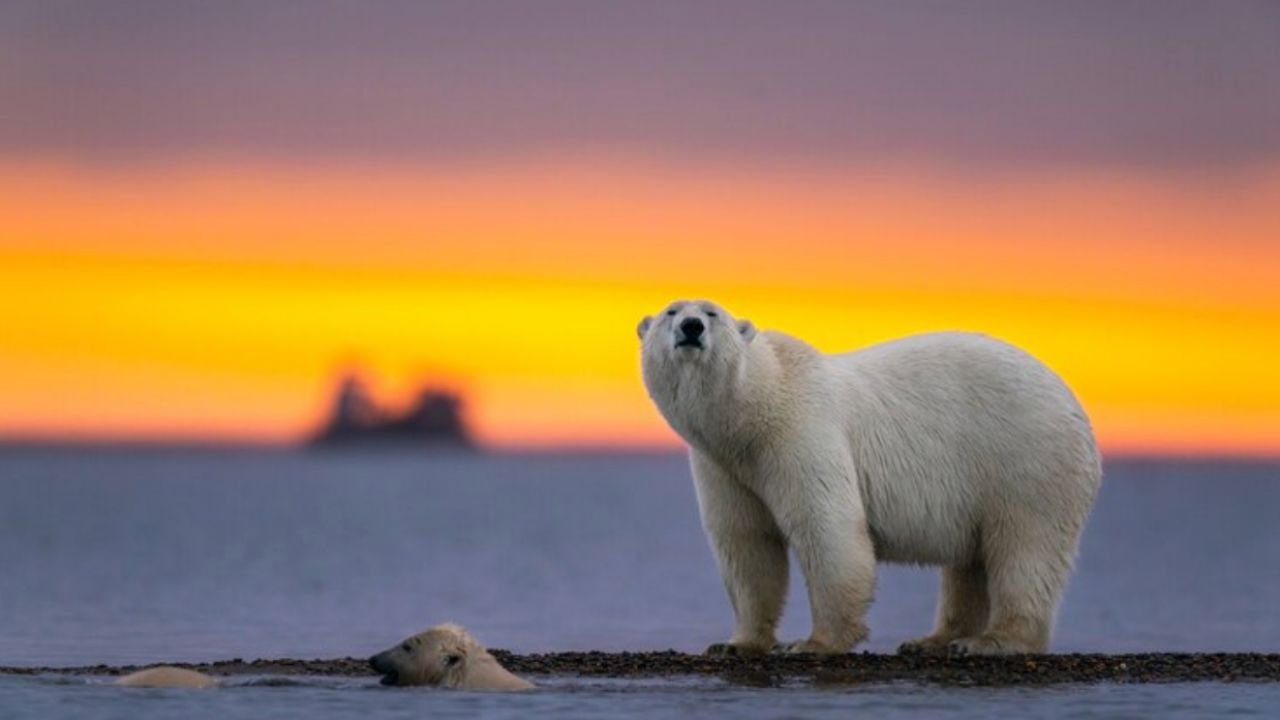
In some parts of the Arctic, all the sea ice melts each summer. Polar bears there have no choice. They come ashore and wait on land until the sea freezes again. San Diego Zoo Wildlife Alliance says they may scavenge, or they may fast, which means going without food until the ice returns.
Western Hudson Bay, in Canada, is one of the best-studied places. There, the ice-free season grew by three weeks between 1979 and 2015. Bears now spend about 130 days on land each year, which is more than four months. That is a long wait.
In 2024, scientists led by Anthony Pagano of the US Geological Survey studied 20 polar bears near Churchill, Manitoba. Between 2019 and 2022, they tracked each bear on land for about three weeks in August and September. They measured how much energy the bears used, what they ate and how their bodies changed.
The bears behaved in very different ways. Some rested so much that their energy use looked like a hibernating bear’s. Others roamed widely and searched hard for food. They ate berries, plants, birds, bones, antlers, and scraps of seal and beluga whale.
That made little difference in the end. Nineteen of the 20 bears lost weight, between 0.4 and 1.7 kg (about 1 to 4 lb) a day. The food the active bears found mostly paid for the energy they spent finding it. The scientists warn that longer summers on land raise the risk of starvation, especially for young bears.
Even the Arctic shore in summer, with cool air and water close by, is a hungry place for a polar bear. A desert would be far worse.
Sea-ice loss and the threatened polar bear
The summers on land are getting longer because the Arctic is warming, part of wider global warming. Less sea ice means fewer weeks to hunt and more weeks to go hungry.
In May 2008, the US government listed the polar bear as a threatened species under the Endangered Species Act. Threatened means a species is likely to become endangered in the foreseeable future. Polar bears are not yet endangered. The 2016 plan names the loss of sea ice, caused by a changing climate, as the main threat to polar bears.
In September 2023, the US Fish and Wildlife Service reviewed the polar bear’s status again. It decided the bear is still threatened. The service said sea ice is still being lost as the Arctic warms quickly, and that most subpopulations are expected to decline.
About 26,000 polar bears were thought to be alive in 2023, according to the service. That figure is only an estimate. Some subpopulations have little data, and several have never been counted at all.
Western Hudson Bay shows what can happen. Polar Bears International reports that the group there fell from about 1,185 bears in 1987 to 618 in 2021. That is close to half. A bear that cannot hunt on the ice for long enough cannot build up the fat it needs to last the summer.
Heat on its own is not the main danger to wild polar bears today. The main danger is losing the ice they hunt from. The ice is what matters most.
Do zoo polar bears live in warm places?
Some polar bears do live in warm places, but only with a lot of help. San Diego is in sunny southern California, thousands of kilometres from the Arctic. The San Diego Zoo has cared for polar bears since 1917. Keeping them cool takes real effort.
In 2018, San Diego Zoo Wildlife Alliance explained how it keeps its polar bears, Chinook, Kalluk and Tatqiq, cool. Their pool holds 130,000 US gallons (about 490,000 litres), roughly a fifth of an Olympic swimming pool. The water runs through a chiller that keeps it at 13 to 16°C (55 to 60°F). That is a very cold bath.
Large shade structures cover parts of their home, and snow machines give the bears snow every day of the year. When the air outside rises above 24°C (75°F), Kalluk and Chinook like to nap right under an air-conditioning vent. Keepers also hand out frozen treats, such as fish ice lollies.
A zoo like this is almost the opposite of a desert. It gives the bears cold water, shade, snow and food every day, and a wild desert would give them none of those things.
Polar bears already live in a desert
Here is the part most people miss. Polar bears already live in a desert. It is just a very cold one.
To scientists, a desert is a place that gets very little precipitation, which means rain, snow, sleet or hail. A desert does not have to be hot or sandy. The Arctic fits that description.
The National Snow and Ice Data Center says precipitation is low over much of the Arctic. Some areas are even called polar deserts, and they get as little precipitation as the Sahara Desert.
That sounds strange for a place covered in snow and ice. But very cold air holds little moisture, so not much new snow falls. The snow that does fall can stay frozen for a very long time, so it builds up instead of melting away.
Hot deserts are dry too. Death Valley gets less than 5 cm (2 inches) of rain in an average year, the US National Park Service says. The big difference between the two kinds of desert is temperature, not dryness.
Animals such as the Arctic fox live in these cold, dry lands. Polar bears live there too, as long as there is sea ice nearby. So the honest answer depends on which desert you mean. A hot, sandy desert is no place for a polar bear. A cold polar desert beside a frozen sea is home.
Three things people get wrong
1. Polar bears have white fur. The coat only looks white. Polar Bears International says each hair is clear and has no colour, with a hollow core that scatters and reflects light. Under the fur, the skin is black.
An old idea said the hollow hairs carried sunlight down to the black skin, like the fibre-optic cables used for fast internet. In 1998, a physicist at St Lawrence University in the United States tested the idea on real polar bear hairs. Almost none of the light travelled the length of a hair, so the idea was wrong.
2. Polar bears can get by on land food in summer. In the 2024 Manitoba study, 19 of 20 bears lost weight on land. That included bears that ate berries, birds and scraps. Land food is not enough. It did little to hold off starvation.
3. Polar bears only overheat in hot places. Adult males can overheat when they run, even in the freezing Arctic. Heat can come from inside. Their working muscles make it, and the fur traps it. A hot desert would be dangerous for that reason: the bear could not escape the heat around it or the heat inside it.
Did you know? A polar bear’s paw can measure up to 30 cm (12 inches) across, about the length of a school ruler. Big paws help the bear walk on thin ice without falling through.
Try it
Put on your thickest coat, a hat and gloves indoors, then do star jumps for one minute. Stop and notice how hot you feel, and how long it takes to cool down in a cool room. A polar bear can never take its coat off. Stop straight away if you feel dizzy.
Knowledge check
Why can a polar bear overheat even in the freezing Arctic?
Show answer
Its fur and fat hold in heat so well that running makes the bear too hot.
What is a polar desert?
Show answer
A cold place that gets very little rain or snow, like much of the Arctic.
Frequently asked questions
Could a polar bear live somewhere hot?
A wild polar bear could not live long somewhere hot. Its thick fur and fat trap heat, and a hot place has no sea ice or seals. A 2022 study of zoo polar bears found that a stress hormone rose once the air passed 20°C (68°F).
How do polar bears keep cool, and do they overheat?
Polar bears cool off mainly by swimming in cold water. Adult males can overheat quickly when they run, because their two layers of fur stop almost all body heat escaping. Zoo polar bears in warm places also use chilled pools, shade and air conditioning.
What would a polar bear eat and drink in the desert?
A polar bear in the desert would find almost nothing to eat or drink. Polar bears live mainly on ringed and bearded seals, which live around Arctic sea ice. Seal meat is about 70% water, so without seals a bear would also lose one of its main water supplies.
Do zoo polar bears live in warm countries?
Some zoo polar bears live in warm places, such as the San Diego Zoo in southern California. Keepers there give the bears a chilled pool, shade, air conditioning, frozen treats and machine-made snow. A zoo with that much cooling is very different from a wild desert.
Why can’t polar bears live in the desert?
Polar bears cannot live in the desert because they are built to hold in heat and to hunt seals from sea ice. A hot desert would overheat them, and it has no sea ice, no seals and very little water.
Are polar bears endangered?
Polar bears are listed as threatened under the US Endangered Species Act, meaning they are likely to become endangered. In September 2023 the US Fish and Wildlife Service said they are still threatened because the Arctic’s sea ice is melting. About 26,000 polar bears were thought to be alive in 2023.
Is the Arctic a desert?
Much of the Arctic counts as a polar desert, a cold place that gets very little rain or snow. The National Snow and Ice Data Center says some parts of the Arctic get as little precipitation as the Sahara Desert.
Sources
- U.S. Fish and Wildlife Service: Polar bear — the range across five countries, the 19 subpopulations, ringed and bearded seals as main prey, and the estimate of 26,000 bears (2023)
- U.S. Fish and Wildlife Service (25 September 2023): polar bear status remains threatened — the threatened status, sea-ice loss as the main threat, and the forecast that most subpopulations will decline
- Polar Bears International: adaptations and characteristics — the two layers of fur, clear hollow hairs, overheating when running, body weights, paw size and Arctic winter temperatures
- National Snow and Ice Data Center: the science of Arctic weather and climate — low precipitation over much of the Arctic, and polar deserts that get as little as the Sahara
- Pagano and others (2024), Nature Communications: polar bear strategies on land — the 20 bears tracked near Churchill, their foods, swims and weight loss, and the 130-day ice-free period in western Hudson Bay
- Leishman and others (2022), Animals: cortisol and temperature in polar bears — the rise in a stress hormone above 20°C in adult zoo bears, and more 20°C days near Churchill and Arviat