
us-states quick facts
- The US bought Alaska from Russia on 30 March 1867 for $7.2 million.
- That works out at roughly two cents per acre.
- Alaska became the 49th state on 3 January 1959.
- Denali is 20,310 ft, a figure re-measured by satellite GPS in 2015.
- You cannot drive to Juneau, the state capital. No road connects it.
Alaska at a glance
| Alaska | |
|---|---|
| Became a state | 3 January 1959, the 49th |
| Bought from Russia | 30 March 1867, for $7.2 million |
| Capital | Juneau |
| Largest city | Anchorage, 291,247 people in 2020 |
| Total area | 665,588 square miles, the largest US state |
| Population | 733,391 in 2020 |
| Highest point | Denali, 20,310 ft |
| Borders | Canada by land, and three seas |
The United States bought Alaska for about two cents an acre, and people at the time thought it was a waste of money.

Where Alaska is
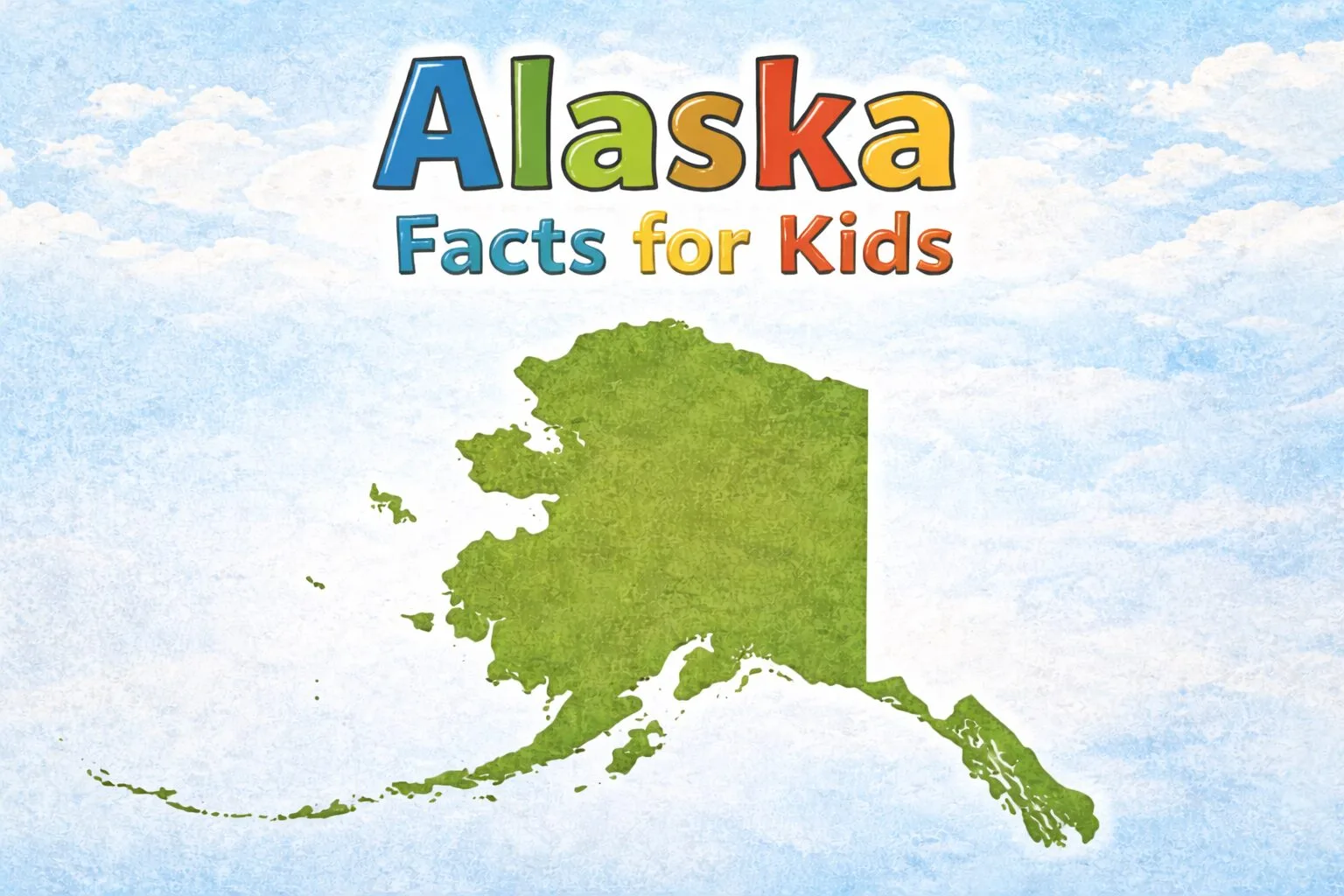
Alaska sits in the far northwest corner of North America, and it does not touch any other US state.
To the east is Canada: the Yukon territory and British Columbia. To the north is the Beaufort Sea and the Arctic Ocean. To the south is the Gulf of Alaska and the Pacific. To the west are the Bering Strait and the Bering Sea, and to the northwest the Chukchi Sea.
That is a lot of coast. Alaska has more coastline than any other state, by a wide margin.
It is also enormous. At 665,588 square miles it is the largest state in the country, with about 571,000 square miles of that being land.
Bought for two cents an acre
Alaska used to belong to Russia.
On 30 March 1867, the United States agreed to buy it for $7.2 million. The formal handover took place on 18 October that year.
The deal was arranged by the Secretary of State, William H. Seward.
Seven point two million dollars sounds like a lot until you divide it by the size of Alaska. It works out at roughly two cents per acre.
At the time, plenty of Americans thought buying a distant, frozen territory was ridiculous, and the purchase was mocked.
Then gold was found, and later oil, and the mockery stopped.
The 1867 Purchase
- Which country owned Alaska before the United States?
- Who arranged the deal to buy Alaska?
- When did the formal handover of Alaska take place?
- Why did people stop mocking the purchase?
Becoming the 49th state
Alaska was a US territory for over 90 years before it became a state.
It was admitted to the Union on 3 January 1959 as the 49th state. Hawaii followed later that year as the 50th.
The population figures show how much changed. In 1880 there were 33,426 people counted in Alaska. By 1960, just after statehood, there were 226,167. By 2020 there were 733,391.
Even so, Alaska is the largest state with one of the smallest populations. There is a great deal of space and not many people in it.
Most of those people are in a few places. Anchorage had 291,247 residents in 2020. Fairbanks had 32,515 and the state capital, Juneau, 32,255.
The capital is unusual in another way: you cannot drive to Juneau. There is no road connecting it to the rest of the state.
Match the Alaska Places
- Juneau — The state capital, with no road to the rest of Alaska
- Anchorage — The largest city in Alaska
- Fairbanks — A city with about 32,500 people in 2020
- Hawaii — Became the 50th state later in 1959
Denali, and the name that came back
The highest mountain in North America is in Alaska.
For a long time it was officially called Mount McKinley. In 2015 the federal government gave it back its traditional Koyukon Athabascan name: Denali. In 2025 a new order brought back Mount McKinley as the federal name. Alaska still calls it Denali, and so do most people who live there.
The same year, its height was measured again.
The old figure, 20,320 feet, had been worked out with 1950s technology. A team from the US Geological Survey, NOAA, the National Park Service and the University of Alaska Fairbanks re-measured the summit using satellite GPS.
The new official height is 20,310 feet. The mountain had not shrunk. The measurement had simply got better by ten feet.

The animals
Alaska is one of the few places in the United States where the big animals are still all there.
Grizzly bears, which our grizzly bear guide covers, live across much of the state. Polar bears live along the northern coast, on and around the sea ice.
Moose are everywhere, and they are bigger than most people expect. A bull moose with a full set of antlers is taller at the shoulder than a horse.
The seas are just as busy, with whales, seals, sea otters and salmon runs that feed almost everything else.
Alaska Animals: Fact or Myth?
- Polar bears in Alaska live along the northern coast, on and around the sea ice.
- Grizzly bears live in only one small corner of Alaska.
- A bull moose with full antlers is taller at the shoulder than a horse.
- Alaska's seas are mostly empty of wildlife because the water is so cold.


Ice, and a lot of it
Alaska is one of the best places on Earth to see a glacier without mounting an expedition.
A glacier is a river of ice. Snow piles up over centuries, squashes into ice, and then slowly flows downhill under its own weight.
Some Alaskan glaciers reach the sea, where great blocks break off the front and float away. That is called calving, and it is the noisiest thing a glacier does.
The Mendenhall Glacier near Juneau is one of the easiest to visit, which is why it appears in so many photographs of Alaska.
Glacier Check
- What makes a glacier move?
- What is it called when big blocks of ice break off a glacier into the sea?
- Which easy-to-visit glacier is near Juneau?
The people who were there first
People lived in Alaska for thousands of years before Russia claimed it or the United States bought it.
Alaska Native peoples include many distinct groups with their own languages, territories and ways of living, spread across a territory the size of a large country.
The 2020 census counted 133,311 people identifying as Alaska Native alone, of whom 102,765 lived in Alaska.
That is a much larger share of the population than Indigenous peoples make up in most other US states. Our guide to Native American peoples covers the wider picture across the continent.
It is worth being careful with the wording. Alaska was bought from Russia, but Russia was selling land that other people were already living on.
Weather, and the long days
Alaska is famous for being cold, and much of it is. But the state is so big that it has several different climates.
The south coast, around Juneau, is wet and relatively mild, warmed by the Pacific. The far north is Arctic, frozen for most of the year. The middle is drier, with hot summers and brutally cold winters.
The strangest thing is the daylight.
Because Alaska sits so far north, summer days are extremely long and winter days extremely short. In the far north the sun does not set at all for weeks in summer, and does not rise for weeks in winter.
That is why Alaska is nicknamed the Land of the Midnight Sun. Imagine trying to get to sleep at ten at night with the sun still up, and then, six months later, walking to school in the dark at noon.
It is also one of the best places on Earth to see the aurora, the northern lights, because the dark winter skies last so long.
Daylight and Weather
- Why are Alaska's summer days so long?
- What is Alaska's nickname?
- Which part of Alaska is wet and fairly mild?
- Why is Alaska one of the best places to see the northern lights?
Records and oddities
A state this size collects a lot of superlatives.
It is the largest US state by area, at 665,588 square miles.
It is the northernmost state and the westernmost. It is also the only state that borders no other state, and the only one you can reach from the rest of the country only by sea, air, or by driving through Canada.
It has the highest mountain in North America.
Do the arithmetic on the census figures and you get roughly one person for every square mile of land. More of those people live in Anchorage than anywhere else.
Anchorage alone holds 291,247 of the state’s 733,391 people. That is about two in every five Alaskans living in a single city, and almost all the rest of that enormous territory nearly empty.
Gold, then oil
Two discoveries changed Alaska completely.
The first was gold. Strikes in the late 1800s brought thousands of people north in a hurry, and the mockery of the 1867 purchase began to look foolish.
The population figures show the rush clearly. In 1890 the census counted 32,052 people. By 1900 it was 63,592, almost double in ten years.
The second was oil, found on the North Slope in the far north. Alaska today is strongly shaped by it: by the pipeline that carries it south, by the jobs it creates, and by the arguments about drilling in wild places.
Look at the census numbers again. From 128,643 people in 1950, Alaska reached 401,851 by 1980 and 550,043 by 1990. That growth is the oil era.
Both stories are the same story really. A place people once dismissed turned out to be worth a great deal, and each time the reason was something buried in the ground.
Put Alaska’s Story in Order
- Russian Alaska Alaska belongs to Russia.
- The deal The United States agrees to buy Alaska.
- The handover Alaska is formally handed over in October.
- Gold rush Gold strikes bring thousands of people north.
- Statehood Alaska becomes the 49th state.
- Oil era Oil from the North Slope helps the population pass 400,000.
Three things people get wrong
“Denali got shorter.” It did not. The official height changed from 20,320 to 20,310 feet in 2015 because the mountain was re-measured with satellite GPS instead of 1950s equipment.
“Alaska is part of Canada.” It is the 49th US state, admitted on 3 January 1959. It borders Canada but is not part of it.
“Buying Alaska was a famous bargain everyone recognised.” At the time it was widely mocked. The $7.2 million price only looked clever later, once gold and then oil were found.
Did you know? The mountain has two names. Its federal name has been Mount McKinley again since 2025, but Alaska calls it Denali, its traditional Koyukon Athabascan name.
Try it
Alaska cost $7.2 million for 665,588 square miles. Work out the cost per square mile.
Knowledge check
How did Alaska become part of the United States?
Show answer
It was bought from Russia on 30 March 1867 for $7.2 million, with the formal handover on 18 October that year. It became the 49th state on 3 January 1959.
Why did Denali’s official height change in 2015?
Show answer
Because it was re-measured with satellite GPS rather than 1950s equipment. The figure went from 20,320 ft to 20,310 ft; the mountain itself did not change.
Frequently asked questions
When did Alaska become a state?
On 3 January 1959, as the 49th state. Hawaii became the 50th later the same year.
How much did the United States pay for Alaska?
$7.2 million, agreed on 30 March 1867. Given the size of Alaska, that is roughly two cents per acre.
What is the capital of Alaska?
Juneau, which had 32,255 residents in 2020. Anchorage is much larger, with 291,247. No road connects Juneau to the rest of the state.
How big is Alaska?
665,588 square miles in total, making it the largest state in the United States, with about 571,000 square miles of land.
How tall is Denali?
20,310 feet. That official figure comes from a 2015 satellite GPS survey, which replaced the older 20,320 ft measured with 1950s technology.
What animals live in Alaska?
Grizzly bears, polar bears along the northern coast, moose, wolves, whales, seals, sea otters and huge runs of salmon.
Sources
- US Census Bureau: Alaska and its people — the 1867 purchase date and price, William H. Seward, the statehood date, the population figures from 1880 to 2020, the total area, the largest cities and the Alaska Native counts
- US Geological Survey: new elevation for the nation’s highest peak — the 20,310 ft figure, the older 20,320 ft measurement and the agencies that carried out the 2015 GPS survey
- US Department of the Interior: the nation’s highest peak will now bear its native name — the 2015 renaming from Mount McKinley to Denali and the Koyukon Athabascan origin of the name
Final Alaska Quiz
- Which country borders Alaska by land?
- Which of these does NOT border Alaska?
- Which state has more coastline than any other?
- Alaska is the only state that…
- Alaska is the northernmost state. Which other record does it hold?
- About how many people are there for every square mile of land in Alaska?
- Why must we be careful saying the US simply bought Alaska?
- What happened to Alaska's population between 1890 and 1900?
- Where in Alaska was oil found?
- What is the highest mountain in North America?


