
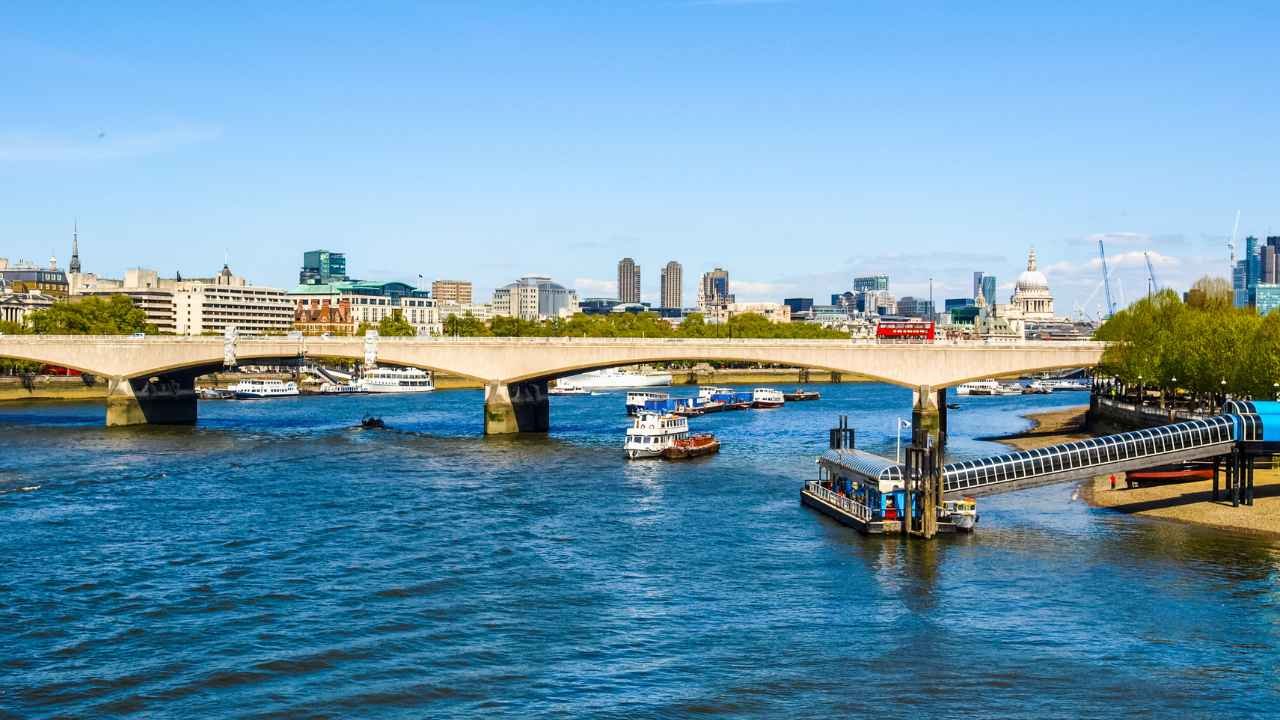
The River Thames is the longest river in England, at 346 km (215 miles). It rises in the Cotswold Hills in Gloucestershire and flows east through Oxford and London to the North Sea. Declared biologically dead in 1957, it now has seals and seahorses again, helped by a new super sewer finished in 2025.
River Thames quick facts
- The Thames Barrier’s gates were inspired by the taps on an engineer’s gas cooker.
- Bazalgette’s Victorian sewers used 318 million bricks.
- The Thames froze over about 24 times between the 1600s and the 1800s.
- The Tideway super sewer had captured over 7 million tonnes of sewage by June 2025.
- The Thames Barrier had closed 221 times by November 2025.
The River Thames at a glance

The River Thames flows right through the middle of London. It has frozen solid for frost fairs, flooded homes and been declared dead. Today it is cleaner than it has been for well over a century.
This guide follows the river from its source to the sea. It covers its famous bridges, the Great Stink, the Thames Barrier and the new super sewer. The facts come from the Environment Agency, the London Museum, Tideway and other official bodies.
| The River Thames at a glance | |
|---|---|
| Length | 346 km (215 miles) |
| Source | The Cotswold Hills, Gloucestershire |
| Mouth | The North Sea |
| Locks from Cricklade to Teddington | 45 |
| Thames Barrier opened | 1984 (working from 1982) |
| Tideway super sewer | 25 km (15.5 miles), fully connected in 2025 |
| Declared “biologically dead” | 1957 |
How long is the River Thames?
Spelthorne Borough Council says the River Thames is 346 km (215 miles) long. That makes it the longest river in England.
Different sources measure the river slightly differently. The answer depends on exactly where you decide the river ends, because it widens gradually into the sea. Most official figures stay close to 346 km.
Spelthorne Borough Council says the river flows east through London and ends in the North Sea. The Thames Path National Trail follows it for most of the way.
Where does the Thames start?
The Thames starts in the Cotswold Hills in Gloucestershire, Spelthorne Borough Council says. Its official source is a spot called Trewsbury Mead.
At the source, the Thames is tiny. It grows as streams and smaller rivers join it on its way east.
The Thames Path National Trail starts at the source. It follows the river for 298 km (185 miles), all the way to the Thames Barrier in London. Walkers can follow almost the whole river on foot.
Locks on the upper river
The upper Thames is a busy river for boats. The Environment Agency says boats pass through 45 locks between Cricklade and Teddington.
A lock is a chamber with gates at each end. Boats go in, the gates close, and water is let in or out. This lifts or lowers the boat to the level of the next stretch of river.
Teddington Lock is the last lock on the Environment Agency’s stretch of the river. Its largest chamber, the barge lock, is about 198 metres (650 feet) long. Below Teddington, the river runs on through London towards the sea.
The Great Stink of 1858
For centuries, London’s waste went straight into the Thames. The London Museum says London’s population doubled between 1800 and the 1850s. The river could not cope.
In the summer of 1858, temperatures reached about 30°C (86°F). The heat baked the sewage in the river. The smell was so bad that people called it the Great Stink.
People soaked curtains and blinds in a chemical called chloride of lime to try to block the smell. The London Museum says a law to pay for new sewers passed in just 18 days.
At the time, many people believed that bad smells spread disease. In fact, illnesses such as cholera spread through dirty water. Cleaning the river would help with both problems.
Bazalgette’s sewers
The engineer chosen to fix the problem was Joseph Bazalgette. The London Museum says he built about 132 km (82 miles) of new brick main sewers.
His system also linked about 1,770 km (1,100 miles) of street drains. It used 318 million bricks. Pumping stations at Deptford, Crossness and Abbey Mills helped carry the waste east, away from the city centre.
Building the sewers under new embankments also claimed about 9 hectares (22 acres) of land from the river. The project was finished in 1875.
When the Thames was “biologically dead”
The Victorian sewers helped, but pollution kept building up. Smithsonian Magazine reports that in 1957, scientists declared long stretches of the Thames “biologically dead”.
That meant the water held too little oxygen for most animals to survive. Few fish could live in the river as it passed through London.
Smithsonian Magazine describes the river’s recovery since then as remarkable. It is one of the great clean-up stories of modern times.
Wildlife comes back

Smithsonian Magazine says seals, sharks, eels and seahorses have all returned to the Thames. The river ecosystem is far healthier than it was in 1957.
In November 2021, the Zoological Society of London (ZSL) published its first State of the Thames report. Smithsonian Magazine says the report found good news and warnings.
One warning was about heat. The report said parts of the Thames have been warming by about 0.19°C (0.34°F) a year since 2007. It also found that the number of fish species had fallen since the early 1990s, and that nitrate pollution had risen.
So the Thames is not fully healed. It is much cleaner than before, but scientists keep watching it closely.
The Tideway super sewer
Bazalgette built his sewers for about 4 million people. Tideway says London now has more than 9 million. When heavy rain overloads the old sewers, they overflow into the river.
To stop this, a giant new tunnel was built deep under the Thames. It is called the Thames Tideway Tunnel, or the super sewer. Tideway says the main tunnel is 25 km (15.5 miles) long.
Work began in 2016. More than 25,000 people worked on the project. The last of 21 connections between the old sewers and the new tunnel was made in February 2025.
Tideway says the super sewer stops about 95% of sewage spills from the sewers it is connected to. By June 2025, it had captured more than 7 million tonnes of sewage that would otherwise have reached the river.
The Thames Barrier
London faces another danger from the river: flooding. Storms in the North Sea can push a surge of seawater up the Thames. The Thames Barrier is there to stop it.
The Environment Agency says the barrier began working in 1982. It was officially opened by the Queen on 8 May 1984. It took eight years to build and cost £535 million, about £2.4 billion in today’s money.
The barrier has 10 steel gates and stretches 520 metres (1,706 feet) across the river. Each main gate weighs 3,300 tonnes. When raised, it stands as tall as a five-storey building.
The engineer Charles Draper got the idea for the rotating gates from the taps on his gas cooker. The gates lie flat on the riverbed most of the time, so ships can pass over them.
How often the barrier closes
The Environment Agency says the barrier and other estuary defences protect 125 square km (48 square miles) of London. That area is home to 1.42 million people.
By 17 November 2025, the barrier had closed 221 times to protect London from flooding. In the winter of 2013 to 2014 alone, it closed 50 times in 13 weeks.
The barrier was designed to last until 2030. Its life has now been extended to 2070, the Environment Agency says.
Famous Thames bridges

London’s bridges are some of the most famous in the world. The City Bridge Foundation looks after five of them: Tower Bridge, London Bridge, Southwark Bridge, the Millennium Bridge and Blackfriars Bridge.
Tower Bridge opened in June 1894, after eight years of building.
London Bridge has a very long history. The City Bridge Foundation says the first stone London Bridge was begun in 1176 and finished in 1209. It stood for more than 600 years.
Today’s London Bridge was built between 1967 and 1972, and it opened in 1973. The Millennium Bridge, a footbridge, opened on 10 June 2000.
A river full of history

The Thames has been at the centre of London’s life for centuries. The stone London Bridge alone stood for more than 600 years, the City Bridge Foundation says.
The London Museum’s history of the Great Stink shows how much the city depended on the river, even when it was filthy. Engineers had to solve the river’s problems again and again, from sewage to floods.
Frost fairs on the frozen river

The Thames sometimes froze solid. The London Museum says it froze over about 24 times between the early 1600s and the early 1800s.
The first recorded frost fair on the frozen river was in the winter of 1607 to 1608. Londoners went skating and bowling on the ice. Traders sold food, drinks and printed souvenirs.
The last frost fair was in early 1814. The London Museum says colder winters were only part of the story. After a new London Bridge opened in 1831 with 5 arches instead of 19, the river flowed faster and was harder to freeze. Later dredging and embankments helped too.
Three things people get wrong
Myth: the Thames is too dirty for wildlife. The river was declared biologically dead in 1957. Smithsonian Magazine says seals, sharks, eels and seahorses have all come back.
Myth: the Thames Barrier is always closed. The barrier’s gates lie on the riverbed so ships can pass. The Environment Agency says it had closed 221 times by November 2025, only when floods threatened.
Myth: frost fairs stopped only because winters got warmer. The London Museum says a new London Bridge, dredging and embankments made the river deeper and faster. That made it much harder to freeze.
Did you know? During the Great Stink of 1858, people soaked their curtains in chloride of lime to try to block the smell from the river.
Try it
Draw the Thames from source to sea. Mark Trewsbury Mead, Oxford, Teddington, London and the Thames Barrier, and add one fact beside each place.
Knowledge check
How long is the River Thames?
Show answer
About 346 km (215 miles), making it the longest river in England.
What does the Thames Barrier protect London from?
Show answer
Surge tides pushed up the river from the North Sea during storms.
Frequently asked questions
How long is the River Thames?
Spelthorne Borough Council says the River Thames is 346 km (215 miles) long, which makes it the longest river in England.
Where does the River Thames start and end?
The Thames starts at Trewsbury Mead in the Cotswold Hills, Gloucestershire. It flows east through Oxford and London and ends in the North Sea.
What was the Great Stink?
The Great Stink was a terrible smell from sewage in the Thames during the hot summer of 1858. It led to Joseph Bazalgette’s new sewers.
What does the Thames Barrier do?
The Thames Barrier closes its 10 steel gates when a storm surge threatens. The Environment Agency says it protects 1.42 million people in London.
Are there animals living in the River Thames?
Yes. Smithsonian Magazine says seals, sharks, eels and seahorses have returned to the Thames, which was declared biologically dead in 1957.
What is the Thames Tideway Tunnel?
The Thames Tideway Tunnel is a 25 km super sewer under the river. It was fully connected in February 2025 and stops most sewage spills.
Sources
- Environment Agency: the Thames Barrier — the barrier’s size, gates and closures to November 2025; its 40th anniversary news and river distances pages were also used
- London Museum: the Great Stink of 1858 — the Great Stink; its Bazalgette and frost fair pages were also used
- Tideway: London’s super sewer now fully connected — the tunnel’s length and 2025 connection; its 2025 annual report was also used
- City Bridge Foundation: our bridges — Tower Bridge, London Bridge and the Millennium Bridge
- Smithsonian Magazine: the Thames is recovering — the 1957 declaration and the 2021 State of the Thames report
- Spelthorne Borough Council: about the River Thames — length, source and route


