What do polar bears eat? Quick answer
| Food | Importance | How it is obtained |
|---|---|---|
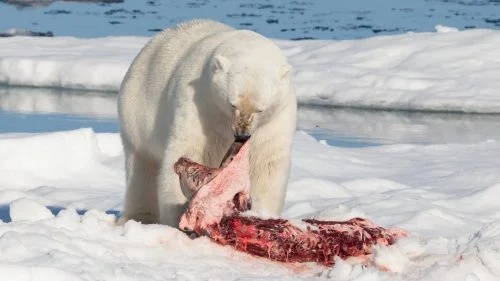
| Ringed seals | Primary prey in many regions | Ambushed at breathing holes or ice edges |
| Bearded seals | Important larger prey | Caught from the sea-ice platform |
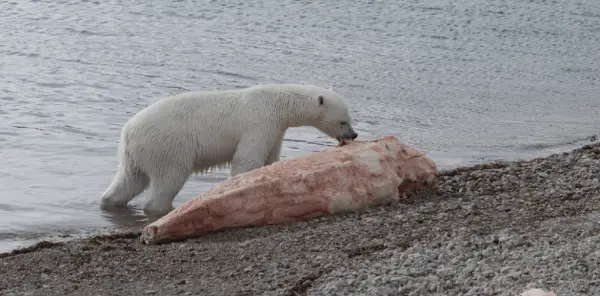
| Whale or walrus remains | Seasonally valuable in some places | Scavenged when available |
| Birds, eggs and vegetation | Occasional land foods | Opportunistic and usually lower-energy |
| Zoo diet | Professionally managed nutrition | Designed by veterinary and animal-care teams |
Why blubber matters
- Fat-rich marine prey provides much more usable energy than most Arctic land foods.
- Diet varies between subpopulations and seasons, so ringed seals are central but not exclusive prey.
- Finding a bear eating berries or eggs does not prove land food can support the population long-term.
- Sea-ice loss affects diet by reducing access to seals, not merely by making the environment warmer.
How polar bears hunt seals
Polar bears are solitary ambush hunters. A bear may wait quietly beside a seal breathing hole or approach a seal resting on the ice. It needs the sea-ice surface because seals are faster and more agile in open water.
Hunting success changes through the year. Late spring and early summer can be especially important because young seals and seal pups are available. Bears build fat reserves when feeding is good and may later face long periods with little food.
Other marine and land foods
A carcass from a whale or walrus can provide a large seasonal meal and may support several bears. Polar bears can also take other marine mammals when an opportunity occurs, but availability differs greatly by location.
On land, some bears eat birds, eggs, berries or vegetation. USGS research finds that these foods are generally too scarce or low in energy to compensate for lost seal-hunting opportunities across a population.
Diet in managed care
A zoo is not a natural Arctic food web. Accredited institutions provide a balanced programme that may include meat, fish, specially formulated feeds, bones and enrichment. Veterinarians adjust the plan for age, condition and health.
School reports should separate a wild diet from a managed diet. Listing a food used by one zoo does not mean every institution feeds the same menu or that it is appropriate outside professional care.
Picture guide

Continue the learning path
Did you know? A polar bear may wait motionless beside a seal breathing hole for hours, using patience rather than a long chase.
Try it
Create an Arctic food chain from algae to zooplankton, fish, seal and polar bear. Explain how sea ice supports more than the top predator.
Knowledge check
Why can berries and bird eggs not simply replace seals in a polar bear’s diet?
Show answer
They are usually less energy-rich and too scarce to replace regular access to fat-rich marine prey for a large bear population.
Sources
These government, museum, zoo and scientific resources support the key facts and uncertainty statements in this guide.
- U.S. Fish and Wildlife Service: Polar bear — Official account of primary prey and sea-ice dependence.
- USGS: Polar bear foraging behavior — Scientific summary of hunting, seasonal feeding and fat reserves.
- USGS: Polar bears unlikely to thrive on land foods — Reviews the nutritional limits of terrestrial foods.