Cheetahs are carnivores that mainly eat small and medium-sized antelope, such as gazelles, impala and springbok, plus hares, rabbits, birds and young warthogs. They hunt in the daytime, stalking close and then sprinting at more than 110 km/h. Only about half their chases succeed, and they often lose their kills to lions and hyenas.
what cheetahs eat quick facts
- Cheetahs mostly eat small and medium antelope such as gazelles and impala.
- A cheetah can reach more than 110 km/h in just over three seconds.
- Only about half of a cheetah’s chases end in a catch.
- Cheetahs lose about half their food to bigger predators such as lions and hyenas.
- Cheetahs can get the moisture they need from their prey, so they do not need to drink.
What do cheetahs eat?
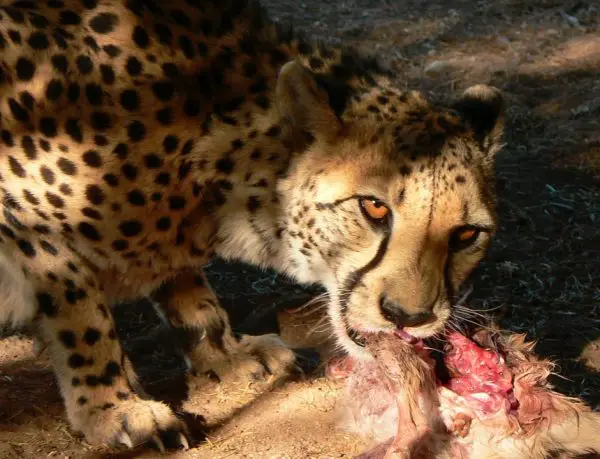
Cheetahs are carnivores, which means they eat meat. They mostly hunt small and medium-sized antelope, such as gazelles, impala, springbok, steenbok and duikers.
They also hunt hares, rabbits, game birds and rodents, and sometimes the young of bigger animals, such as warthogs, kudu and oryx.
What a cheetah eats depends on where it lives. In East Africa, its favourite prey is often the Thomson’s gazelle. In southern Africa it might be springbok or impala.
For everything else about these fast cats, read our cheetah facts for kids.
| Prey | Examples |
|---|---|
| Small and medium antelope | Thomson’s gazelles, impala, springbok, steenbok, duikers |
| Young of larger animals | warthog, kudu, hartebeest, oryx |
| Small animals | hares, rabbits, rodents, porcupines |
| Birds | game birds and ground-dwelling birds, even ostriches |
Why cheetahs choose smaller prey
Cheetahs are built for speed, not strength. They are slim and light, with long legs, a small head and a flexible back.
That makes them brilliant sprinters, but not great fighters. Big, strong animals such as adult buffalo or zebra would be too dangerous for a cheetah to tackle.
So cheetahs go for animals that are fast and nimble but small enough to overpower. Those prey animals have evolved speed and agility of their own to escape, which is why a cheetah needs to be even faster.
A body built for the chase
Everything about a cheetah’s body helps it catch fast prey.
Its long legs and bendy spine let it take huge strides. Its claws do not pull all the way in like a pet cat’s, so they grip the ground like the spikes on running shoes.
Its long tail works like a rudder, helping it balance and turn sharply when a gazelle zigzags. Large nostrils and lungs take in plenty of air during the sprint.
The dark tear lines running down from its eyes may help cut the glare of the sun, a bit like the black marks some sports players wear under their eyes.
How cheetahs hunt
Cheetahs hunt by sight. They often climb onto a termite mound or a low branch to scan the grassland for prey.
When a cheetah spots an animal, it creeps as close as it can without being seen. It stalks in a half-crouch, with its head held low, and freezes or drops to the ground if the prey looks up.
Once it is within about 100 yards (91 m), it explodes into a sprint. A cheetah can go from standing still to more than 110 km/h (70 mph) in just over three seconds.
It cannot keep up that speed for long. A full sprint usually lasts about 20 seconds, and the prey must be caught within about 30 seconds.
To catch its target, the cheetah trips it with a swipe of its front paw. Then it holds the animal by the throat, cutting off its breathing, until it dies. Small animals such as hares are killed with a quick bite. Find out how fast they really go in our guide to how fast a cheetah can run.
When cheetahs hunt
Most big cats, such as lions and leopards, like to hunt at night. Cheetahs are different.
Cheetahs are active in the daytime, especially in the early morning and late afternoon. They do not hunt at night.
Hunting by day helps them avoid lions and hyenas, which are more active in the dark. It also suits their sharp daytime eyesight, which they use to spot prey from a long way off.
Do cheetahs always catch their prey?
No. Even the fastest land animal misses a lot. Only about half of a cheetah’s chases end in a catch.
After a hard chase, a cheetah is exhausted. It can take about 20 minutes for its breathing and body temperature to return to normal. It needs that time to rest before it can eat.
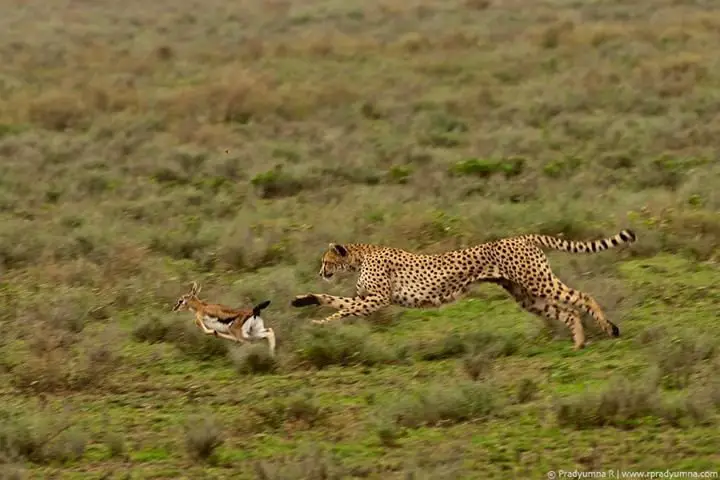
Losing a meal
Catching a meal is only half the battle. Keeping it is the other half.
Cheetahs are not strong enough to fight off bigger predators. Lions, hyenas, leopards, baboons and jackals, and even groups of vultures, can drive a cheetah away from its kill.
The Smithsonian’s National Zoo says cheetahs lose about half of their food this way. So a cheetah eats quickly, before others arrive, and often has to hunt more often than it would like.
Cheetahs usually eat the meat and leave most of the skin and bones. Lions, by contrast, can hold on to their food. Compare their diet in our guide to what lions eat.
Cheetah or lion: who eats what?
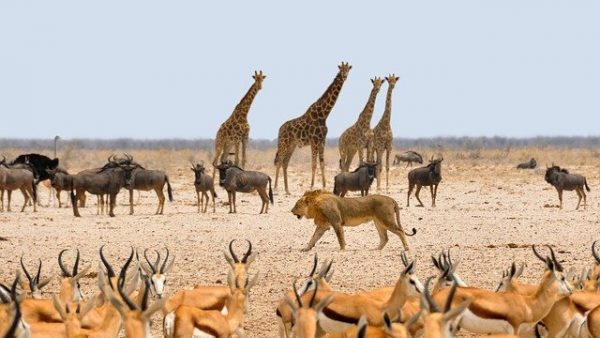
Cheetahs and lions often share the same grasslands, but they eat in different ways.
Lions live in groups called prides and hunt together, so they can bring down big animals such as zebra, wildebeest and even buffalo. Cheetahs usually hunt alone, so they stick to smaller, faster prey.
Male cheetahs sometimes live in small groups, often brothers, which helps them hunt slightly larger animals. But they still cannot match a pride of lions, which is why cheetahs keep out of their way.
Do cheetahs drink water?
Cheetahs will drink when they find water, but they do not need to. San Diego Zoo Wildlife Alliance says they can get all the moisture they need from their prey.
That is very useful in dry places, where water holes may be far apart, or where lions and other predators gather around them.
How cubs learn to hunt
Cheetah cubs drink their mother’s milk at first. As they grow, their mother brings back meat for them to eat.
When the cubs are about six months old, their mother starts teaching them how to hunt. She brings them live prey so that they can practise catching and killing it themselves.
Learning to hunt takes a long time, and young cheetahs make lots of mistakes before they get it right. Cubs usually stay with their mother for about a year and a half, learning everything they need to survive.
What do cheetahs eat in zoos?
Zoos do not let cheetahs hunt, but they make sure they get the right food. Their diets are planned carefully by vets and nutrition experts.
At the Smithsonian’s National Zoo, each cheetah gets about 3.5 pounds (1.6 kg) of specially prepared meat a day, split into two meals. They also sometimes get frozen rabbits or big beef bones to chew on, which keeps them busy and helps keep their teeth and jaws healthy. Some zoos also pull a lure along a track, so that their cheetahs can sprint after it, just as they would in the wild.
At the Cheetah Conservation Fund’s centre in Namibia, cheetahs eat between 2 and 4 pounds (0.9 to 1.8 kg) of meat a day.
Do cheetahs eat farm animals?
Some farmers fear that cheetahs will kill their animals. In fact, cheetahs rarely go after livestock.
The Cheetah Conservation Fund says that the cheetahs that do take livestock are usually young, old or injured, and the animals they take are often already weak.
Helping farmers protect their animals, for example with guard dogs, is one way conservation groups are helping farmers and cheetahs to live side by side.
Cheetahs in danger
Cheetahs are in trouble. Today they are found in only 9% of the land where they once lived, and there are fewer than 7,100 adult and young cheetahs left in the wild.
Losing their habitat also means losing their prey. Protecting wild land and the animals cheetahs eat is an important part of saving them. Read about one rare group in our Northwest African cheetah facts.
Three things people get wrong
Cheetahs do not hunt at night. Unlike most big cats, they hunt in the daytime, mostly in the early morning and late afternoon.
Cheetahs do not catch everything they chase. Only about half of their chases are successful.
Cheetahs are not fierce fighters. They are built for speed, and they often lose their meals to lions, hyenas and other bigger predators.
Did you know? Cheetahs hunt in the daytime, unlike most big cats. It helps them avoid lions and hyenas, which are more active at night.
Try it
Time yourself running as fast as you can for 20 seconds. That is about as long as a cheetah’s full sprint lasts before it has to stop.
Knowledge check
When do cheetahs hunt?
Show answer
In the daytime, especially early morning and late afternoon.
Why do cheetahs eat quickly?
Show answer
Because bigger predators such as lions and hyenas often drive them away from their kills.
Frequently asked questions
What do cheetahs eat?
Cheetahs mainly eat small and medium antelope, such as Thomson’s gazelles, impala, springbok and duikers. They also eat hares, rabbits, birds and the young of larger animals.
How do cheetahs hunt?
Cheetahs hunt by sight. They stalk to within about 100 yards of their prey, sprint at more than 110 km/h, trip it with a paw and kill it with a bite to the throat.
How often do cheetahs catch their prey?
Only about half of a cheetah’s chases are successful. After a chase, it may need about 20 minutes to recover before it can eat.
Do cheetahs drink water?
Cheetahs drink when they can, but they do not need to. They can get the moisture they need from the animals they eat.
Do lions steal food from cheetahs?
Yes. Lions, hyenas, leopards and even groups of vultures often drive cheetahs away from their kills, and cheetahs lose about half their food this way.
What do cheetahs eat in zoos?
In zoos, cheetahs eat carefully planned meat diets. At the Smithsonian’s National Zoo, each gets about 3.5 pounds of prepared meat a day, plus bones and rabbits for enrichment.
Sources
- Smithsonian’s National Zoo: cheetah — prey, stalking, the kill, success rate, food stolen by other predators, zoo diet and cubs
- Cheetah Conservation Fund: about cheetahs — prey, daytime hunting, chase length and speed, livestock, food theft and population
- San Diego Zoo Wildlife Alliance: cheetah — hunting by sight, stalking, recovery after a chase, water, cubs and predators