Owl speed quick facts
- In a 2010 German test, a gliding barn owl averaged about 12 mph (19 km/h), about the same as a kestrel on the same course.
- A radar study of the cruising speeds of 138 bird species did not include a single owl.
- A cruising peregrine falcon flies at only about 27 mph (44 km/h); its 200 mph speed comes from diving.
- Owls turn their heads up to 270 degrees each way because their eyes cannot move.
- Fish-eating owls have narrower noise-cutting combs on their wings than owls that hunt mammals.
How fast can an owl fly?
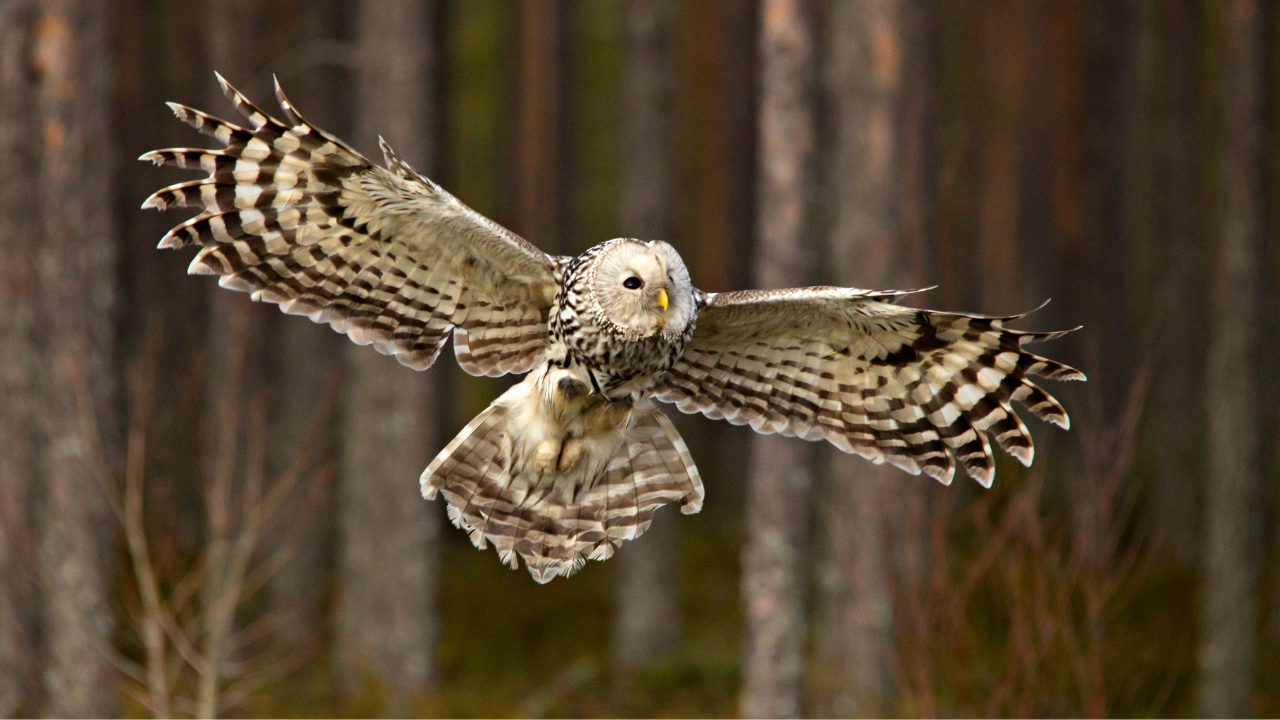
Owls are slow fliers. Most of the time, an owl moves through the air at about the speed of a child riding a bike.
Very few owls have ever had their speed properly measured. Most figures online are guesses. One of the best measurements comes from a 2010 study at the Brandenburg University of Technology in Germany. Scientists set up 92 microphones and two video cameras outdoors. Then falconers flew trained birds over them.
A barn owl glided past the microphones 14 times. Its average speed was about 12 mph (19 km/h). Its slowest glide was about 10 mph (17 km/h), and its fastest was about 15 mph (24 km/h).
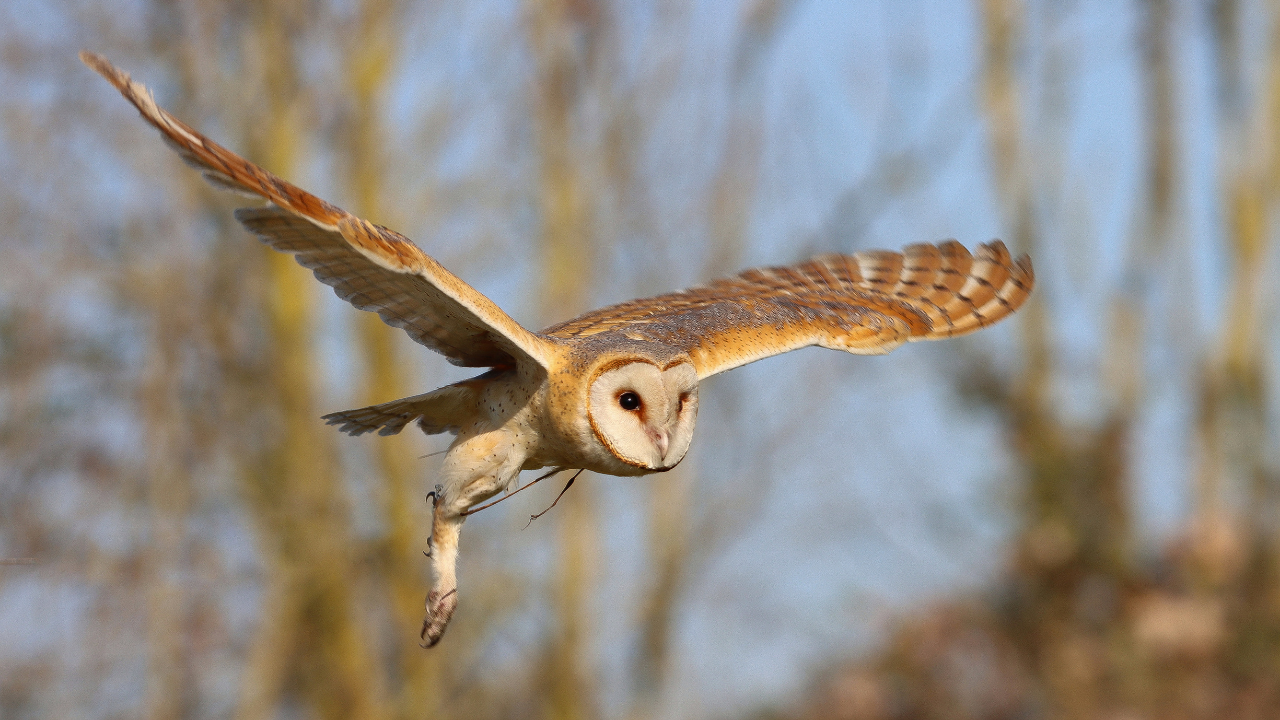
A kestrel and a Harris’s hawk flew the same course at almost exactly the same speed. The scientists pointed out that both hawks could have flown much faster. The course was short, so there was no reason to hurry.
That is worth remembering. A bird’s speed depends on what it is doing.
Speed is not what owls are built for. They are built to fly slowly, quietly and low. Slow flight gives them time to hear and pinpoint small animals on the ground below.
Owl speeds by species
The table shows every owl speed we could find in a scientific source. It is a short list. For most owl species, nobody has published a measured speed at all.
| Owl | Kind of flight | Speed | How it was measured |
|---|---|---|---|
| Barn owl | Gliding past microphones | about 12 mph (19 km/h) on average, 10 to 15 mph (17 to 24 km/h) in all | Two video cameras, trained owl, Germany (2010) |
| Barn owl | Hunting | 2.5 to 11 mph (4 to 18 km/h) | GPS tracker on a wild owl, Argentina (2015) |
| Barn owl | Travelling in straight lines | faster than 11 mph (18 km/h) | The same GPS study |
| Barn owl | Slowest glide | as slow as about 2 mph (3 km/h) | Stated by Audubon, with no study named |
| Tawny owl | Normal flight | about 16 to 19 mph (25 to 30 km/h) | An older German figure, quoted in the 2010 study |
| Great horned owl | Any | No measured figure found | “40 mph” is repeated online without a source |
| Snowy owl | Any | No measured figure found | “46 mph” is repeated online without a source |
Notice the last two rows. Many websites say the great horned owl flies at 40 mph (64 km/h) and the snowy owl at 46 mph (74 km/h). We could not find a study that measured either number. Until someone does, treat them as guesses.
Which is the fastest owl?
Nobody knows which owl is the fastest. To name a winner, scientists would need to measure many species in the same way. That has not been done.
Of the owls in the table, the tawny owl has the highest figure, at about 16 to 19 mph (25 to 30 km/h). That number comes from an older German study, quoted by the 2010 researchers. It describes normal flight, not a top speed. The GPS study gave no top figure for a travelling barn owl, so that owl may have flown faster.
Big, powerful owls such as the great horned owl might fly faster when they need to. But that is a guess, not a measurement.
The 2010 study tried to measure two eagle-owls as well. They would not fly close enough to the microphones. Once they had eaten enough food for the day, they refused to fly at all. Measuring an owl is harder than it sounds.
Hunting speed and cruising speed
An owl flies more slowly when it hunts than when it travels. A GPS study in Argentina shows the difference clearly.
In 2015, scientists fitted a small GPS tracker to a wild male barn owl living on farmland. Over eight nights, it logged 12,501 positions. From these, the team could sort the owl’s movements into three kinds by speed.
- Resting on a perch: slower than 4 km/h (2.5 mph), which mostly means sitting still.
- Hunting: 4 to 18 km/h (2.5 to 11 mph), in winding, back-and-forth paths.
- Travelling: faster than 18 km/h (11 mph), in straight lines.
Hunting is slow, careful work. A hunting barn owl is slower than a cyclist. At the bottom of its range, it is moving at about walking pace.
This matches what the Barn Owl Trust, a UK charity, sees in Britain. Hunting barn owls fly low, up to about 3 metres (10 feet) above the ground. They drift slowly back and forth over rough grassland, listening. This is called quartering. When they hear a small mammal, they often hover, then drop into the grass.
Travelling is different. Barn owls often leave their roost at dusk and commute across farmland that is no good for hunting. They are heading for a favourite patch of rough grass. On that trip there is nothing to listen for, so they fly straight and faster.
Why owls fly so slowly
Owls have very large wings for the weight of their bodies. Scientists call this low wing loading. A light body on big wings can stay up at slow speeds without stalling. Stalling means the air stops holding the wings up, and the bird drops.
The Barn Owl Trust says low wing loading lets barn owls fly very slowly and hover with little effort. Audubon, the American bird charity, says a barn owl can glide as slowly as about 2 mph (3 km/h), barely flapping. That is slower than you walk.
Slow flight gives an owl time. It can listen, pinpoint a sound and choose the right moment to strike. A fast bird would have flown past before it heard anything.
The feathers help too. Barn owl flight feathers are covered in fine, hair-like structures that trap air. According to the Barn Owl Trust, this keeps the air flowing smoothly over the wing. The owl can then fly very slowly without stalling.
Birds of prey in general are not built for high cruising speeds. A large radar study of migrating birds found that hawks, eagles and falcons flew at the slower end of the range. The authors said this is because they are built for hunting and for carrying heavy prey.
How owls fly silently
Most owls fly almost without a sound. Three features of their feathers make this possible.
- A comb on the front edge. The leading edge of the outermost flight feather carries a row of tiny, comb-like points. The Barn Owl Trust describes them as tiny hooks that deaden the sound of air hitting the wing.
- A velvety surface. A soft, downy layer covers each flight feather and smooths the air flowing over it.
- A soft fringe on the back edge. The trailing edge of the wing ends in a loose fringe instead of a hard edge. This softens the air as it leaves the wing.
Air rushing over a bird’s wing breaks into swirls called turbulence. Turbulence is what makes the swooshing sound you hear when most birds fly past. Audubon explains that the comb breaks the rushing air into smaller streams. The velvety surface and the fringe then soak up the sound.
Is an owl quiet only because it is slow? The 2010 German study tested exactly that. The barn owl, the kestrel and the Harris’s hawk all glided at about the same speed. Even so, the owl was quieter at higher pitches. On the recordings, its flyover could not be heard at all. The kestrel made a faint swish.
So the feathers themselves do the work. Engineers have noticed. Designs copied from owl wings, such as comb-like and saw-toothed edges, have been tested to make quieter wings and machines.
Not every owl is equally quiet. Owls live on every continent except Antarctica, and they hunt many kinds of prey. Krista Le Piane, a researcher at the University of California, Riverside, measured the feather combs of 70 owl species.
Her results showed a clear pattern. Owls that hunt mammals had wider combs than owls that hunt insects. Mammals hear well, so a quiet approach matters. Fish-eating owls had narrower combs. The tawny fish owl and the insect-eating burrowing owl had almost no comb at all. A fish cannot hear an owl coming.
Silence has a cost. Barn owl feathers are soft but not very waterproof. Wet feathers are noisier and work less well, so barn owls cannot hunt in heavy rain.
How owls hunt at night
How fast does an owl fly at night? No faster than by day, as far as anyone has measured. The GPS barn owl in Argentina was tracked through the night. It hunted at 2.5 to 11 mph (4 to 18 km/h). It became active at about 6.30 in the evening. It was still moving after 7 in the morning, when its tracker switched off.
At night, an owl’s ears matter more than its speed. A barn owl’s heart-shaped face is called a facial disc. It works like a satellite dish, collecting sound and guiding it towards the ears.
The ears themselves are lopsided. One sits higher than the other, so a sound reaches each ear slightly differently. The owl’s brain uses that difference to work out exactly where the sound came from.
Experiments have shown that barn owls can catch prey in total darkness by hearing alone. The Barn Owl Trust says their hearing is one of the most sensitive of any animal ever tested.
Eyes help as well. Owl eyes are large and fixed in place, so an owl must turn its whole head to look sideways. Barn owls notice anything that moves. A mouse that keeps still and silent is usually ignored.
How much better than ours are owl eyes in dim light? Sources disagree. The Barn Owl Trust says a barn owl’s eyes are about twice as sensitive to light as human eyes. A National Park Service page about owls says 100 times. The safest thing to say is that owls see better than we do in dim light.
Barn owls hunt mostly over rough grassland, where voles are plentiful. In winter they spend more time hunting from posts. Waiting on a post saves energy and stops them losing heat in cold air.
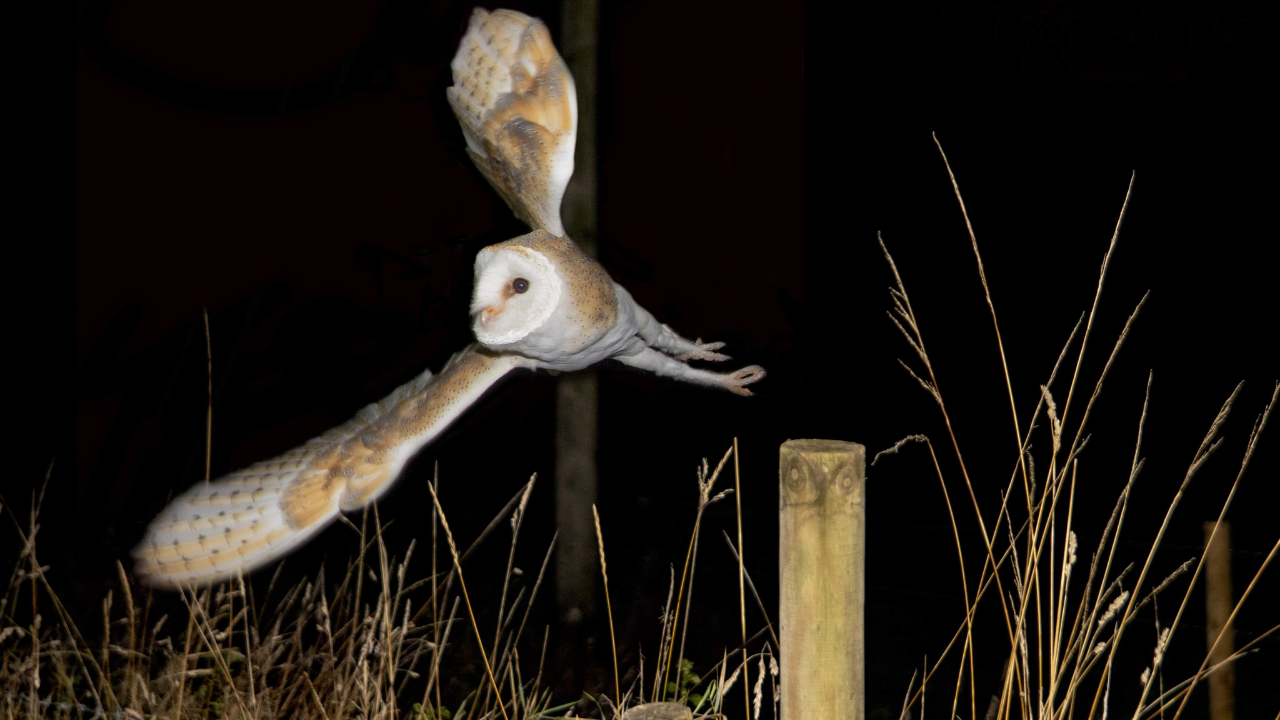
A barn owl usually eats three or four small mammals a night, mostly voles, shrews and mice. Our guide to what barn owls eat has the full menu. You can compare it with what owls eat in other parts of the world.
Owls that hunt by day
Not all owls wait for dark. Snowy owls breed in the Arctic, where the Sun does not set for weeks in summer. They have to hunt in daylight, because there is no night.
In winter, snowy owls may hunt by day or by night. It depends on where they are and what they are catching. Many sit in one spot for most of the day and become active near dusk.
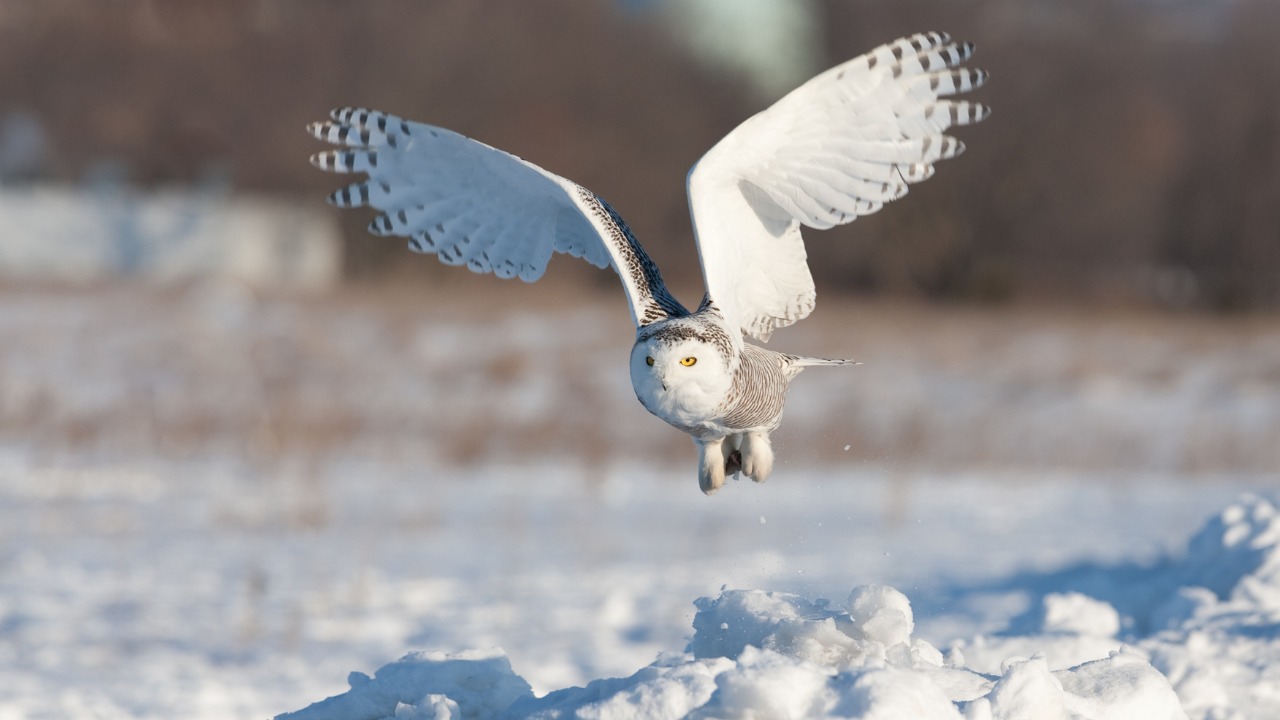
Other owls blur the line too. Barn owls are most active at dusk and dawn, not in the middle of the night. Great horned owls sometimes hunt in broad daylight.
Daytime hunting even shows in the feathers. Krista Le Piane found that owls active by day, such as snowy owls and burrowing owls, have narrower combs than night hunters. At night an owl depends on its ears. A noisy wing would drown out the tiny sounds it is listening for.
How far owls travel
Some owls hardly travel at all. The Barn Owl Trust describes barn owls as sedentary, which means they stay in one area. The GPS owl in Argentina used a home range of about 17 square kilometres (almost 7 square miles) over its eight nights. That is roughly the area of 2,400 football pitches.
Snowy owls are the opposite. They are nomads, which means they wander rather than keeping to one home. Researchers with Project SNOWstorm fit small solar-powered GPS trackers to snowy owls. By 2016 they had tagged more than 40 owls in 10 US states, from North Dakota to Maine.
One male, nicknamed Baltimore, was tagged on the coast of Maryland. His tracker followed him for more than 6,000 miles between the US East Coast and northern Canada. On one trip north he perched at midnight on the roof of a skyscraper in Manhattan.
Baltimore spent one summer wandering more than 1,500 miles across the Ungava Peninsula in northern Quebec, beside the Hudson Strait. Caribou, polar bears and wolves share that tundra.
How far can an owl fly in one day? We could not find a reliable daily figure for any owl. Snowy owl tracks show that some cover long distances quickly, but we found no published daily total.
Hunting in winter snow
Snow and cold make hunting much harder for barn owls. They cannot store much body fat, and their soft feathers are not very waterproof. Deep snow hides voles. Heavy rain or strong wind can stop them hunting altogether.
That is why many barn owls starve in long spells of bad weather. A barn owl that makes a catch in the snow has done well.
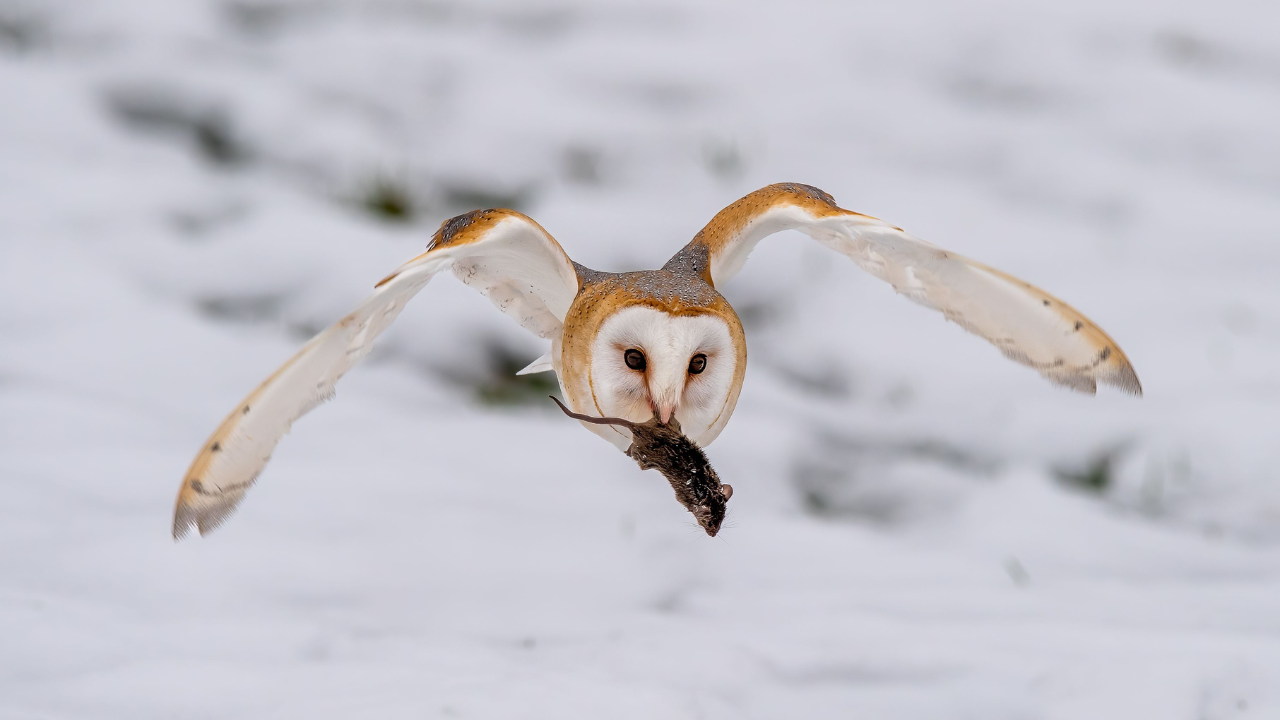
Some owls are snow specialists. The great grey owl can hear small rodents deep under the snow. It hovers or makes a short flight, then plunges feet first. Great grey owls have broken through snow crust strong enough to hold up an 80 kg (176 lb) person.
Owls compared with fast birds
Next to fast birds, owls are slow. Some of the numbers below may still surprise you.
| Bird | Kind of flight | Speed | Where the figure comes from |
|---|---|---|---|
| Barn owl | Gliding | about 12 mph (19 km/h) | German microphone study (2010) |
| Kestrel and Harris’s hawk | Gliding on the same short course | about 12 mph (19 km/h) | German microphone study (2010) |
| Peregrine falcon | Cruising on migration | about 27 mph (44 km/h) | Radar study, Lund University (2007) |
| White-tailed eagle | Cruising on migration | about 30 mph (49 km/h) | Radar study, Lund University (2007) |
| Raven | Cruising on migration | about 32 mph (51 km/h) | Radar study, Lund University (2007) |
| Wood pigeon | Cruising on migration | about 36 mph (59 km/h) | Radar study, Lund University (2007) |
| Mallard duck | Normal flight | about 37 to 47 mph (60 to 75 km/h) | Older German figure, quoted in the 2010 study |
| Peregrine falcon | Hunting dive | more than 200 mph (320 km/h) | Scientists’ estimate, National Park Service |
The radar figures come from a 2007 study led by Lund University in Sweden. Scientists measured the cruising speed of 138 bird species on migration. Their speeds ranged from about 18 to 51 mph (29 to 83 km/h). Not one owl was among them.
Look at the peregrine falcon first. A cruising peregrine falcon flies at about 27 mph (44 km/h). That is only about twice as fast as the barn owl glided in the German test.
The peregrine’s famous speed comes from its hunting dive, called a stoop. It dives onto other birds from high above and strikes them in mid-air. The National Park Service says scientists estimate a diving peregrine can pass 200 mph (320 km/h). That is far faster than a cheetah can run, and much faster than any owl has been measured.
The white-tailed eagle, a close relative of the bald eagle, cruised at about 30 mph (49 km/h). Ravens and wood pigeons were faster still. An owl would lose all of these races. Racing is not its job.
Why owl speeds are hard to find
Measuring a bird’s speed properly takes special equipment. Scientists use radar, GPS trackers, or cameras that film a bird from two angles. Owls fly mostly at night, low down and often alone. That makes all three methods harder.
Radar studies like the Lund one track birds on migration. Barn owls mostly stay in one area, so they are not the birds such studies catch.
Wind causes trouble too. A GPS tracker measures speed over the ground. A tailwind makes a bird look faster, and a headwind makes it look slower. The German microphone study measured speed through the air, so the two kinds of number are not quite the same.
Because real measurements are rare, many websites repeat the same round numbers without saying where they came from. When you see an owl speed, ask who measured it and how. If nobody did, it is a guess.
Three things people get wrong
1. Owls cannot turn their heads all the way round. They can turn them up to 270 degrees in either direction, which is three-quarters of a full circle. Owls have 14 neck bones. They need that bendy neck because their eyes are fixed in place and cannot move.
2. Not all owls are nocturnal. Nocturnal means active at night. Snowy owls hunt in the round-the-clock daylight of the Arctic summer. Barn owls are busiest at dusk and dawn, and great horned owls sometimes hunt in broad daylight.
3. Owls are not quiet just because they fly slowly. In the 2010 German test, a barn owl, a kestrel and a Harris’s hawk glided at about the same speed. The owl was still the quietest. Its feathers, not only its speed, keep it silent.
Did you know? A great grey owl can hear a vole deep under the snow. Great grey owls have broken through snow crust strong enough to hold up an 80 kg (176 lb) adult.
Try it
Measure 5 metres on the floor or in the garden, using a tape measure or five big steps. A gliding barn owl covers that distance in about one second. Ask someone to time you walking it, then jogging it. Were you faster or slower than the owl?
Knowledge check
Why can owls fly so slowly without falling?
Show answer
Their big wings carry a light body, which is called low wing loading, so they can fly slowly and even hover without stalling.
Which owl hunts in daylight in the Arctic summer, and why?
Show answer
The snowy owl, because the Sun does not set there for weeks in summer.
Frequently asked questions
How fast can an owl fly?
Owls fly slowly for birds of prey. A barn owl gliding past microphones in a 2010 study averaged about 12 mph (19 km/h). A GPS-tracked barn owl hunted at 2.5 to 11 mph (4 to 18 km/h).
What is the fastest owl?
Nobody knows for sure, because almost no owl has had its top speed measured. Websites often name the great horned owl at about 40 mph, but no study we could find backs that figure.
How fast does an owl fly at night?
Owls fly at night at much the same slow speeds as by day. A GPS-tracked barn owl in Argentina hunted at night at 2.5 to 11 mph (4 to 18 km/h). The owl flew faster only when travelling in straight lines.
Do owls fly faster when hunting or when travelling?
Owls fly faster when travelling. A GPS study of a wild barn owl found hunting flights of 4 to 18 km/h (2.5 to 11 mph). Its straight travelling flights were faster than 18 km/h (11 mph).
Why are owls so quiet when they fly?
Owl flight feathers have a comb-like front edge, a soft fringed back edge and a velvety surface. Together these break up and soak up the rushing air that makes other birds’ wings swoosh.
Are owls faster than peregrine falcons?
No. A cruising peregrine falcon flies at about 27 mph (44 km/h). A diving peregrine can pass 200 mph (320 km/h), far faster than any owl has been measured.
Can owls turn their heads all the way round?
No. Owls can turn their heads up to 270 degrees in either direction, which is three-quarters of a circle. Fourteen neck bones make this possible, and owls need it because their eyes cannot move.
Sources
- Sarradj, Fritzsche and Geyer (2010), Brandenburg University of Technology: Silent owl flight, bird flyover noise measurements (AIAA 2010-3991) — the barn owl, kestrel and Harris’s hawk gliding speeds, the older tawny owl and mallard figures it quotes, the eagle-owls that would not fly, and the finding that owls are quieter even at the same speed
- Massa, Gabelli and Cueto (2015), El Hornero: GPS tracking of a common barn owl in Argentina — hunting, travelling and resting speeds, the 12,501 positions over eight nights, activity times and the 1,746-hectare home range
- Alerstam and others (2007), Lund University, PLOS Biology: Flight speeds among bird species — cruising speeds of 138 species by radar, birds of prey at the slow end of the range, and the peregrine, white-tailed eagle, raven and wood pigeon figures in its supplementary table
- The Barn Owl Trust: Barn owl adaptations — low wing loading, hovering, feather structure, the comb of tiny hooks, hearing, the facial disc, lopsided ears and eyesight; its hunting and feeding page and kids’ fact page were also used for quartering height, dusk and dawn activity, winter hunting and prey eaten each night
- National Park Service, Big Bend National Park: Owls — the 270-degree head turn, 14 neck bones, fixed eyes and eye sensitivity; the service’s peregrine falcon, great grey owl and Acadia owl pages were also used for the 200 mph dive, hunting under snow and great horned owls hunting by day
- Audubon: The silent flight of owls, explained (2017) — the comb, velvety surface and fringe, the 2 mph barn owl glide, and Krista Le Piane’s study of 70 owl species; Audubon’s snowy owl articles (2013, 2015 and 2025) were also used for daytime hunting and tracked movements