Sloths move extremely slowly. An average sloth travels only about 0.24 km (0.15 miles) a day, roughly two and a half football pitches. They are slow because their leafy diet gives them very little energy, so their metabolism runs at only about 40 to 45% of the expected rate. On the ground they can barely drag themselves along, but they are good swimmers.
how fast sloths move quick facts
- An average sloth moves only about 0.24 km in a day.
- A two-toed sloth’s metabolism is about 40 to 45% of the expected rate for its size.
- Sloths sleep about 15 to 18 hours a day.
- Sloths come down from the trees only about once a week.
- Sloths move more easily in water than on land.
How fast can a sloth move?

Very, very slowly, as it turns out. Sloths are famous for being among the slowest mammals on Earth.
Instead of measuring their speed in kilometres per hour, it makes more sense to ask how far they go in a whole day. The Jaguar Rescue Center in Costa Rica, which cares for injured sloths, says an average sloth moves only about 0.24 km (0.15 miles) in a day.
That is about two and a half football pitches, in a whole day. A person walking at a normal pace could cover the same distance in about three minutes.
Sloths can move a little faster if they need to, for example when food runs low and they have to find a new tree. But slow and steady is how they spend most of their lives.
Why are sloths so slow?
Sloths are slow because of what they eat. They live mostly on leaves, which are tough, hard to digest and give very little energy.
To live on so little energy, a sloth’s body works slowly. The Smithsonian’s National Zoo says a two-toed sloth’s metabolism, the rate at which its body uses energy, is only about 40 to 45% of what you would expect for an animal of its size.
Moving slowly saves energy. Sleeping a lot saves energy as well. Two-toed sloths sleep about 15 to 18 hours a day, mostly during the daytime, and wake up at night to feed.
Being slow is not the same as being lazy. It is a clever way of surviving on a diet that would leave most animals hungry.
A very slow meal
A sloth’s digestion is slow too. Sloths have big stomachs with several chambers, and their food is broken down very gradually.
Britannica says a meal can take up to a week to process. The National Zoo says food can stay in a two-toed sloth’s gut for about a month.
Because their stomach is always full of slowly digesting leaves, its contents can make up about 30% of a sloth’s body weight.
A low body temperature
Most mammals keep their bodies at a steady, warm temperature. That takes a lot of energy, energy that sloths do not have.
Instead, a sloth’s body temperature changes with its surroundings. It usually stays between about 25 and 35°C, and it can drop as low as 20°C. San Diego Zoo Wildlife Alliance says the two-toed sloth has the lowest and most changeable body temperature of any mammal.
When a sloth gets cold, it becomes even slower. That is why sloths often climb up into the sunshine at the top of the forest to warm up.
A body built for hanging

A sloth’s body is designed for hanging from branches, not for running. Its long, curved claws work like hooks.
Hanging takes very little effort, so a sloth can dangle from a branch for hours, even while it sleeps. It eats, sleeps, mates and even gives birth upside down.
Its limbs are built to hold its weight from above, not to support it from below. That is one reason it moves so slowly and carefully through the trees.
Almost stuck on the ground
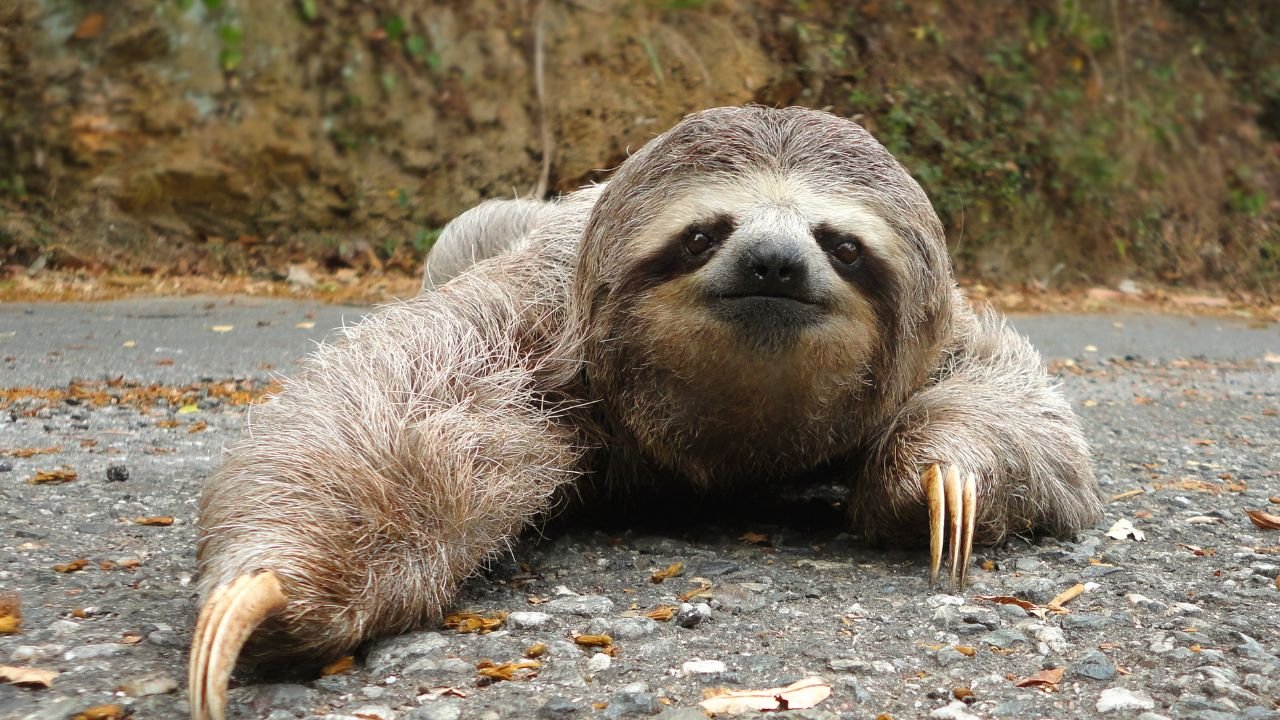
If sloths are slow in the trees, they are even slower on the ground. Their legs are not built for walking, and their long claws get in the way.
Britannica says sloths are almost helpless on the ground unless there is something to grip. They can only drag themselves along with their claws.
That is why sloths come down as rarely as they can. They climb down only to move to a new tree or to go to the toilet, about once a week.
How a sloth climbs
A sloth climbs very carefully. It usually moves one limb at a time, keeping a firm grip with the others.
It reaches out slowly with a hooked claw, checks that the branch is safe, then hauls itself along. Because it is so careful, it rarely falls, even from the tops of tall trees. Its long, curved claws work like hooks over the branch, so a sloth can hang there for hours.
Its grip is so strong and so natural that a sloth can hang on even when it is fast asleep.
Better in the water

Here is a surprise: sloths are good swimmers.
In the water, a sloth does not have to hold up its own weight. It can paddle along with its long arms, moving much more easily than it can on land.
Sloths sometimes drop from branches into rivers and swim across to reach new trees.
Why slow is safe
You might think that being slow would make sloths easy for predators to catch. In fact, it can help keep them safe.
Many predators, such as jaguars and big eagles, spot their prey by movement. An animal that barely moves is much harder to notice.
Sloths also have green algae growing in the grooves of their fur. In the wet season it gives them a greenish tint, which helps them blend in with the leaves. A still, greenish sloth high in the canopy can be almost invisible.
A day in the life of a sloth
A two-toed sloth spends most of the day asleep, curled up or hanging from a branch high in the canopy.
As night falls, it wakes up and begins to feed, slowly reaching for leaves, shoots and fruit. It might move a short way to another part of the same tree, or on to the next tree.
About once a week, it makes the long, slow trip down to the ground to go to the toilet, then climbs all the way back up again. That trip is the riskiest part of its week, because on the ground a sloth can only drag itself along. Once it is safely back in the branches, it can rest, digest and stay hidden from hungry eyes.
A slow animal in a fast world
Being slow works well in a quiet forest. But it causes problems in a world full of roads, cars, dogs and power lines.
A sloth cannot hurry across a busy road, and it may try to climb along electricity cables. The Sloth Conservation Foundation estimates that more than 3,000 sloths are lost every year in Costa Rica alone.
To help, conservation groups have put up hundreds of wildlife bridges, ropes stretched above roads so that sloths and other animals can cross safely. The foundation has installed 409 of them and has helped reconnect thousands of hectares of broken-up rainforest.
Find out more about sloth habitats in our guide to where sloths live.
Just how slow is slow?
Here are some ways to picture a sloth’s pace.
In the time a sloth moves the length of a football pitch, you could walk it dozens of times over. In a whole day, a sloth covers about as much ground as you might walk from one end of a long street to the other.
Even so, sloths get everything they need done. They find food, stay safe and raise their young, all at their own gentle speed.
Three things people get wrong
Sloths are not lazy. They move slowly to save energy, because leaves give them so little.
Sloths are not slow at everything. They are good swimmers and move more easily in water than on land.
Being slow does not make sloths easy prey. Their stillness and green-tinged fur help them hide from predators that hunt by movement.
Did you know? More than 3,000 sloths are thought to be lost every year in Costa Rica, many on roads and power lines, so conservationists build rope bridges to help them cross.
Try it
Measure out 240 metres, or about two and a half football pitches, and walk it. That is roughly how far an average sloth travels in a whole day. How long did it take you?
Knowledge check
Why do sloths move so slowly?
Show answer
Because their leafy diet gives them very little energy, so they save it by moving slowly.
Where does a sloth move most easily?
Show answer
In the water, where it can swim with its long arms.
Frequently asked questions
How fast can a sloth move?
Sloths move extremely slowly. An average sloth travels only about 0.24 km (0.15 miles) in a whole day, about two and a half football pitches.
Why are sloths so slow?
Sloths are slow because they eat leaves, which give very little energy. Their metabolism runs at only about 40 to 45% of the expected rate, so they save energy by moving slowly.
Can sloths walk on the ground?
Only just. Sloths’ limbs are built for hanging, so on the ground they are almost helpless and can only drag themselves along with their claws.
Can sloths swim?
Yes. Sloths are good swimmers. In the water they do not have to hold up their weight, so they can paddle along with their long arms.
How often do sloths come down from the trees?
Sloths come down from the trees only to move to a new tree or to go to the toilet, about once a week.
Does being slow make sloths easy prey?
Not really. Many predators spot prey by movement, so a still sloth is hard to see, and the green algae in its fur help it blend in with the leaves.
Sources
- Jaguar Rescue Center: how far does a sloth travel daily? — how far a sloth moves in a day and how often it comes down
- Smithsonian’s National Zoo: two-toed sloth — metabolism, sleep, digestion, swimming and algae
- Encyclopaedia Britannica: sloth — limbs built for hanging, movement on the ground, digestion, toilet trips and body temperature
- The Sloth Conservation Foundation — sloths lost in Costa Rica and wildlife bridges