
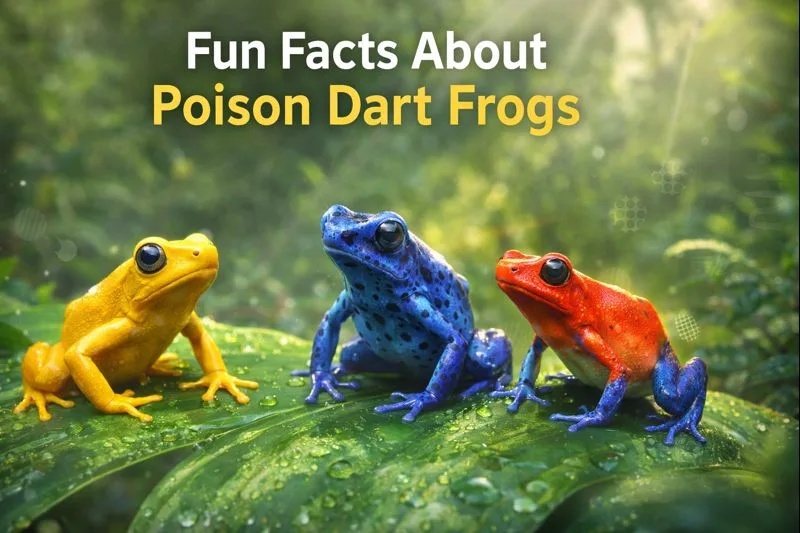
poison-dart-frogs quick facts
- One golden poison frog carries about 1,900 micrograms of batrachotoxin. As little as 2 micrograms may be deadly to a person.
- Poison dart frogs kept in zoos are not poisonous at all, because their food does not contain the right chemicals.
- Only about three species were ever used to poison hunting darts, and none of them is the famous bright Dendrobates.
- A strawberry poison frog mother carries her tadpoles up a plant one at a time, then feeds each one eggs every morning.
- A group of poison dart frogs is called an army.
Poison dart frogs at a glance
| Poison dart frogs | |
|---|---|
| Family | Dendrobatidae |
| Species | 214 in 16 genera, says AmphibiaWeb |
| Where they live | Tropical forests of Central and South America |
| Length | Usually 20 to 40 mm (0.8 to 1.6 in) |
| Weight | About 0.5 to 4 g (0.02 to 0.14 oz) |
| Food | Ants, termites, mites, centipedes and tiny beetles |
| Lifespan | About 3 to 15 years in the wild |
Poison dart frogs are small, bright and famous. Almost everything most people think they know about them turns out to be half right. This guide sorts out which parts are true.
Where poison dart frogs live
Poison dart frogs live in the warm, wet tropical forests of Central America and South America. The Smithsonian’s National Zoo is clear that this is the only place they are found naturally.
So there are no wild poison dart frogs in Africa. None in Asia, and none in Australia either. If you see one outside the Americas, it is in a zoo or a tank.
Their forest home is soaking wet. The Smithsonian says the golden poison frog’s corner of Colombia gets at least 1.25 metres of rain a year, and sometimes as much as 5 metres. That is rain measured in metres, not millimetres.
You can read more about that kind of habitat in our guide to tropical rainforests.
How big is a poison dart frog?
Smaller than you are picturing. Most are 20 to 40 mm long, which is under two centimetres for many of them. That is smaller than a matchbox.
Across the whole family the San Diego Zoo Wildlife Alliance gives a range of 10 to 60 mm. A poison dart frog weighs about 0.5 to 4 grams. A teaspoon of sugar weighs more than most of them.

Why they are so brightly coloured
National Geographic Kids lists their colours as yellow, orange, red, green and blue. Those colours are not camouflage. They are a warning.
The message to a predator is simple. I taste terrible, and eating me is a mistake. Scientists call this kind of warning colouring aposematism, and plenty of animals use it.
It works because predators learn. A bird that tries one bright frog does not try a second.
Where the poison actually comes from
Here is the part that surprises people. The frogs do not make their poison from nothing.
The San Diego Zoo Wildlife Alliance explains that they take chemicals called alkaloids out of the tiny creatures they eat. The frog then stores those alkaloids in glands just under its skin.
Every species ends up with a slightly different mixture. What a frog eats decides what it becomes.
That also means the poison is on the outside. A poison dart frog is poisonous, not venomous. It has no fangs and no sting, so the danger is only in touching it.
Why frogs in a zoo are not poisonous
Follow that idea to its end and you get a strange result. Take away the wild insects and you take away the poison.
Zoo frogs are fed crickets, bean beetles, black worms and fruit flies. None of those carry the right alkaloids. The Smithsonian states plainly that poison dart frogs raised in zoos and aquariums are not poisonous.
The National Aquarium in Baltimore said the same thing in July 2025. Its frogs eat pinhead crickets and fruit flies, so they do not produce toxins.
Those frogs also live a long time. Some in the aquarium’s rainforest exhibit have passed 25 years.
The golden poison frog
One species stands apart. The golden poison frog, Phyllobates terribilis, is the most poisonous of them all.
It is big for a poison dart frog at 47 to 55 mm, and females are usually larger than males. Most are a deep yellow, though some are mint green, orange or nearly white.
It lives along the Pacific coast of Colombia. Animal Diversity Web names the upper Rio Saija area and a place called La Brea as its strongholds.
How strong is the poison?
Strong enough that the numbers are worth reading slowly.
Animal Diversity Web reports that one adult golden poison frog carries about 1,900 micrograms of batrachotoxin. It also reports that somewhere between 2 and 200 micrograms is thought to be deadly to a person.
A microgram is a millionth of a gram. So the whole dangerous amount is far too small to see, and one frog carries many times over that amount.
The same source says golden poison frog toxin is roughly twenty times stronger than any other poison dart frog’s. It is not just the worst of a bad bunch. It is in a class of its own.
The truth about poison darts
The name says dart frog, so people assume every bright frog ended up on the tip of a dart. That is not what happened.
The Smithsonian says only about three species were really used to poison hunting darts. All three belong to the genus Phyllobates.
The famous flashy frogs that appear in books and films are usually Dendrobates. Those are not the dart species.
When one of the right frogs was used, the San Diego Zoo Wildlife Alliance says a single golden poison frog could supply enough poison for 30 to 50 darts, and that the poison could stay strong on a dart for up to a year.
The strawberry poison frog and its blue jeans
The strawberry poison frog, Oophaga pumilio, lives in Nicaragua, Costa Rica and Panama. It is tiny, at 17 to 24 mm.
Its best known look is a red body with blue legs. People call it the blue jeans morph, because the frog appears to be wearing a pair.
That is only one version of it. Animal Diversity Web calls this one of the most variable frogs known. Depending on where it lives it can be red, blue, yellow, white, green, black or orange.
A mother who delivers packed lunches
The strawberry poison frog is also one of the best parents in the forest.
A female lays only 3 to 5 fertilised eggs in damp leaf litter. Those become tadpoles in 10 to 14 days.
Then the work starts. She carries her tadpoles up into the plants, one to four at a time, and puts each one in its own small pool of water. Often that pool sits in the cup of a bromeliad.
Every morning she visits each tadpole and feeds it one to five unfertilised eggs. The genus name Oophaga means egg eater, which is exactly what those tadpoles are.
In many other poison dart frogs, adults carry tadpoles on their backs to water. Both mothers and fathers may guard eggs and carry young.
What poison dart frogs eat
Wild poison dart frogs eat ants, termites, mites, centipedes and tiny beetles. The Smithsonian lists small insects such as ants and termites as the main food.
That diet is the whole story of the poison. The alkaloids travel from the insects into the frog.

It is a good reminder that an animal is partly made of whatever it eats. Change the menu and you change the animal.
From egg to frog
Poison dart frog eggs are only 2 to 3 mm across. A clutch can hold anywhere from 1 to 40 eggs, depending on the species.
Eggs take two to four weeks to develop. A tadpole then takes six to twelve weeks to turn into a small frog.
Most are ready to breed at about one and a half to two and a half years old. Golden poison frogs can manage it sooner, at 12 to 18 months.

Medicines that came from frog poison
Poison is only poison at the wrong dose. Scientists study these frogs because their chemicals do useful things to nerves and muscles.
The Smithsonian says batrachotoxin is studied to help make muscle relaxants, heart medicines and anaesthetics.
A painkiller called epibatidine came out of this work. It is based on a chemical from the phantasmal poison frog, and the San Diego Zoo Wildlife Alliance says it is about 200 times stronger than morphine.
Why poison dart frogs are in trouble
The two big dangers are habitat destruction and the illegal pet trade, according to the Smithsonian.
Forest gets cleared for farming, and the frogs lose the damp, shaded ground they need. Blue poison frogs have also been smuggled to pet shops around the world, and their wild numbers fell quickly.
A frog this fussy about where it lives cannot simply move somewhere else. Our guide to how living things fit together, ecosystems, explains why that matters.
Never pick up a frog you find
This one is not really about poison. It is about germs.
The US Centers for Disease Control and Prevention says amphibians often carry Salmonella even when they look perfectly clean and healthy. Its advice is simple and worth following.
Never pick up a wild frog. Never kiss one or hold one near your face. Wash your hands with soap and running water after touching any amphibian, its tank, its water or its food, and always before you eat.
Children under five should not handle amphibians at all. Nor should their tanks go anywhere near a kitchen.
Three things people get wrong
“Poison dart frogs live in jungles everywhere.” They live only in the tropical forests of Central and South America. There are no wild ones in Africa, Asia or Australia.
“The frogs make their own poison.” They collect alkaloids from the ants, mites and other small creatures they eat. That is why a frog raised in a zoo on crickets and fruit flies is not poisonous at all.
“All the bright ones are dart frogs.” Only about three species were ever used on hunting darts, and all three are Phyllobates. The famous colourful Dendrobates were not the ones used.
Did you know? The genus name Oophaga means “egg eater”. It is named for tadpoles that are fed on their own mother’s unfertilised eggs.
Try it
Measure 25 mm on a ruler. That is the length of a typical poison dart frog, nose to tail end. Now find something in the room that is the same size.
Knowledge check
Why is a poison dart frog in a zoo not poisonous?
Show answer
Its poison comes from the wild insects it eats. Zoo frogs are fed crickets and fruit flies, which do not contain those chemicals.
Are poison dart frogs poisonous or venomous?
Show answer
Poisonous. The chemicals sit in glands under the skin, so the danger is in touching the frog, not in being bitten or stung.
Frequently asked questions
Where do poison dart frogs live?
Poison dart frogs live in the warm, wet tropical forests of Central America and South America. They are found naturally nowhere else, so there are no wild poison dart frogs in Africa, Asia or Australia.
Why are poison dart frogs poisonous?
They take chemicals called alkaloids from the ants, mites, termites and other small creatures they eat, then store them in glands just under the skin. Each species ends up with its own mixture.
Are poison dart frogs in zoos poisonous?
No. Zoo frogs are fed crickets, fruit flies and other insects that contain none of the right chemicals, so they never build up any poison. The Smithsonian and the National Aquarium both say so plainly.
Which poison dart frog is the most poisonous?
The golden poison frog of Colombia. One adult carries about 1,900 micrograms of batrachotoxin, and its toxin is roughly twenty times stronger than that of any other poison dart frog.
Were poison dart frogs really used on darts?
Only about three species were, and all three belong to the genus Phyllobates. One golden poison frog could supply enough poison for 30 to 50 darts, and that poison could stay strong for up to a year.
How big is a poison dart frog?
Most are 20 to 40 mm long, which is smaller than a matchbox, and weigh between 0.5 and 4 grams. Across the whole family, lengths run from about 10 to 60 mm.
Sources
- Smithsonian’s National Zoo: poison frogs — range, size, diet, rainfall, why zoo frogs are not poisonous, the three dart species and parental care
- San Diego Zoo Wildlife Alliance: poison frog — family size, weight, how alkaloids are stored, darts per frog, epibatidine and the egg and tadpole timings
- Animal Diversity Web: Phyllobates terribilis — the golden poison frog’s size, range, batrachotoxin amounts and the human lethal dose
- Animal Diversity Web: Oophaga pumilio — the strawberry poison frog’s size, colour variation, egg-feeding and tadpole transport
- AmphibiaWeb: Dendrobatidae — the current species and genus counts for the poison dart frog family
- US Centers for Disease Control and Prevention: reptiles and amphibians — the Salmonella risk from amphibians and the handwashing rules for children


