anacondas quick facts
- The green anaconda is the heaviest snake in the world, at up to about 250 kg.
- In 2024 scientists split the green anaconda into northern and southern species.
- An anaconda’s eyes and nostrils are on top of its head, so it can hide underwater.
- Female anacondas are much bigger than males.
- A mother anaconda can give birth to dozens of live babies at once.
What is an anaconda?
An anaconda is a huge, water-loving snake from South America. It belongs to the boa family, and like other boas it is a constrictor. That means it kills by squeezing, not with venom.
Anacondas are not venomous at all. Their small, backward-curving teeth are for gripping prey, not for injecting poison.
The green anaconda is the heaviest snake in the world. It can weigh up to 550 pounds (about 250 kg), as much as three grown men.
Their scientific name is Eunectes, from Greek words meaning “good swimmer”. It suits them perfectly.
How many kinds are there?
Scientists count between three and five kinds of anaconda, depending on how they divide them up.
Until recently, everyone talked about just one green anaconda. But in 2024, scientists split it into two species after finding genetic differences between the northern and southern populations. They are now called the northern green anaconda, Eunectes akayima, and the southern green anaconda, Eunectes murinus.
The yellow anaconda is much smaller. The biggest females reach about 4.4 to 4.6 metres long. Two more forms, the Beni anaconda and the dark-spotted anaconda, have been counted as separate species, but some scientists think they are really yellow anacondas.
| Anaconda | Where it lives | Worth knowing |
|---|---|---|
| Northern green anaconda | from Ecuador, Peru and northern Brazil north to Colombia, Venezuela, the Guianas and Trinidad | named as its own species in 2024 |
| Southern green anaconda | from eastern Peru and northern Brazil south to Bolivia, Paraguay and southern Brazil | prefers marshes and wet places |
| Yellow anaconda | the Paraguay River basin south to north-eastern Argentina | much smaller, with pairs of black spots |
| Beni and dark-spotted anacondas | north-central Bolivia; the lower Amazon | may be kinds of yellow anaconda |
How big do anacondas get?
Green anacondas are among the biggest snakes in the world. They can grow up to 9 metres (about 30 feet) long, as long as a bus, and as thick as 30 cm (12 inches) around.
That is the very biggest, though. Most adult green anacondas are no more than 5 metres (16 feet) long. Stories of much bigger snakes are hard to prove.
The reticulated python, from Asia, can be as long as an anaconda. But the green anaconda is much heavier and bulkier, which is why it holds the record as the heaviest snake.
Female anacondas are much larger than males. That is the opposite of many animals, where males are bigger.
What anacondas look like
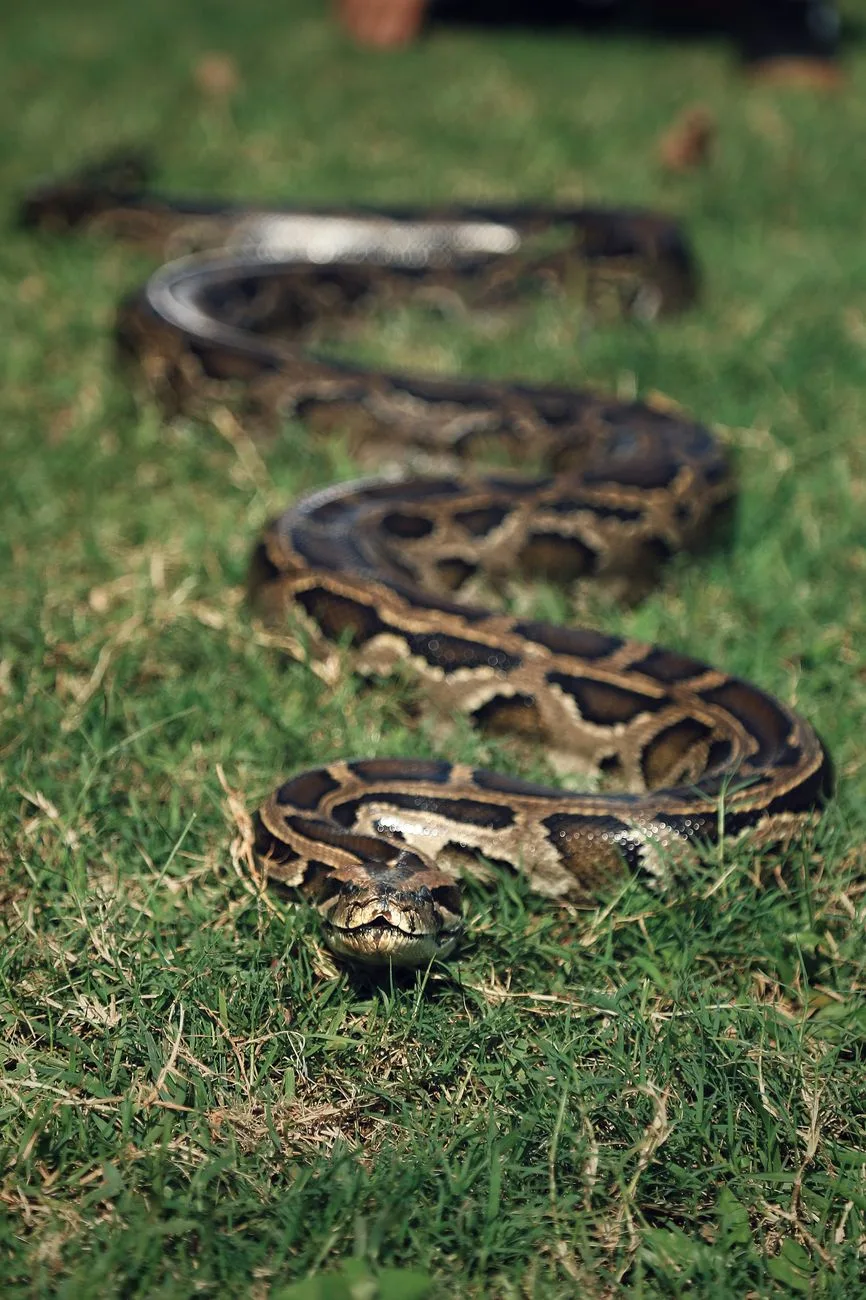
A green anaconda is olive green, with rows of dark, oval spots. The colours help it hide among the plants and muddy water where it lives.
Its eyes and nostrils sit on the top of its head. That means it can lie almost completely underwater, with just its eyes and nose showing, watching and breathing while it waits.
Like other boas, anacondas have two tiny spurs near the tail. These are all that is left of the back legs their ancient ancestors once had.
Where anacondas live
Anacondas live in the tropical rivers and swamps of South America, east of the Andes mountains.
Green anacondas are most common in the Orinoco basin in Colombia, the Amazon River basin in Brazil, and the flooded grasslands of Venezuela, called the Llanos.
They like shallow, slow-moving water, such as streams, rivers and flooded grassland. On land they are slow and heavy, but in water they are fast, powerful swimmers.
You can find out more about their home in our Amazon rainforest facts for kids.
Built for the water
On land, an anaconda moves slowly and heavily. Its huge weight makes it clumsy out of the water.
In the water it is a different animal. The water holds up its heavy body, and it can glide along with hardly a ripple. It can also stay underwater for a long time, holding its breath while it waits for prey.
Like all snakes, anacondas are cold-blooded. Their bodies take on the temperature of their surroundings, so they often bask in the sun on riverbanks or in shallow water to warm up.
As they grow, anacondas shed their old skin in one piece, just like other snakes. Underneath is a fresh, shiny new skin.
How anacondas hunt
An anaconda is an ambush hunter. It waits, hidden in the water, for an animal to come close to drink.
Then it strikes. It grabs the animal with its strong jaws and wraps its muscular body around it. Every time the animal breathes out, the anaconda squeezes a little tighter, until the animal can no longer breathe.
Then the anaconda swallows its meal whole, usually head first. Its jaws are joined by stretchy ligaments, so it can open its mouth wider than its own head.
What anacondas eat
Adult green anacondas eat big animals. Their prey includes deer, wild pigs, turtles, large birds and caimans, which are relatives of alligators.
One of their favourite foods is the capybara, the world’s largest rodent, which lives in the same rivers and swamps.
Anacondas have even been known to kill jaguars. After a big meal, an anaconda may not need to eat again for a long time.
Anaconda babies
Anacondas do not lay eggs. Instead, the female gives birth to live babies, in the water.
In the breeding season, several males may wrap around one female in a tangle called a breeding ball. San Diego Zoo Wildlife Alliance says a ball can hold 2 to 12 males, and the Smithsonian’s National Zoo says males gather in groups of up to 13.
A mother is pregnant for about seven months. Then she has a big litter: the National Zoo says 20 to 40 babies, and San Diego Zoo Wildlife Alliance says 24 to 50.
The babies can be as long as 60 cm (2 feet) at birth. They can swim and hunt straight away, and they look after themselves from the start.
How long do anacondas live?
In the wild, green anacondas live about 10 years on average. They live much longer in zoos, and some have reached their late twenties. San Diego Zoo Wildlife Alliance gives a lifespan of about 30 years.
Anacondas usually live alone, each in its own hunting area, and only come together in the breeding season.
Anaconda or python?
Anacondas and pythons are often mixed up, because both are giant snakes that kill by squeezing. But there are some big differences.
Anacondas live in South America. Pythons live in Africa, Asia and Australia. So you would never find the two living wild in the same place.
Anacondas give birth to live babies. Pythons lay eggs, and many python mothers coil around their eggs to protect them.
And while the longest pythons can match an anaconda for length, the green anaconda is far heavier.
Anacondas and people
Anacondas have a scary reputation. Films and stories show them as man-eating monsters. The truth is much less dramatic.
Anacondas are shy, and they would much rather catch a capybara than meet a person. Real attacks on people are very rare. Most stories of giant, people-eating anacondas are legends.
Even so, a large anaconda is very strong. Like any wild animal, it should always be watched from a safe distance.
Are anacondas in danger?
Green anacondas are listed as Least Concern, which means they are not in danger of dying out right now.
But they are threatened by the loss of their wetland and rainforest homes, and by people catching them to sell. Their skins have been traded around the world.
Scientists are still learning about anacondas. Because they live hidden in remote swamps and rivers, they are hard to study, and new discoveries, like the northern green anaconda in 2024, are still being made. Protecting the wetlands where they live helps anacondas and every other animal that shares their home.
Three things people get wrong
Anacondas are not venomous. They kill by squeezing, and their teeth are only for gripping.
Anacondas are not 50-foot monsters. The biggest reach about 9 metres, and most adults are under 5 metres.
Anacondas do not lay eggs. The mother gives birth to live babies in the water, sometimes dozens at once.
Did you know? Anacondas have two tiny spurs near the tail, all that is left of the back legs their ancient ancestors had.
Try it
Measure 5 metres and then 9 metres along a corridor or playground. Most adult green anacondas are no longer than the first line; the very biggest reach the second.
Knowledge check
How does an anaconda kill its prey?
Show answer
By wrapping around it and squeezing until it can no longer breathe; anacondas are not venomous.
Why can an anaconda hide in water so well?
Show answer
Its eyes and nostrils sit on top of its head, so it can watch and breathe while almost all of it stays underwater.
Frequently asked questions
Is the anaconda the biggest snake in the world?
The green anaconda is the heaviest snake in the world, weighing up to about 250 kg. The reticulated python can be as long, but it is much lighter.
Are anacondas venomous?
No. Anacondas are not venomous. They are constrictors, which kill by wrapping around their prey and squeezing until it cannot breathe, then swallow it whole.
Where do anacondas live?
Anacondas live in the tropical rivers, swamps and flooded grasslands of South America, east of the Andes. Green anacondas are common in the Amazon and Orinoco basins.
What do anacondas eat?
Anacondas eat large animals such as capybaras, deer, wild pigs, turtles, large birds and caimans. They have even been known to kill jaguars.
How many babies does an anaconda have?
A female green anaconda gives birth to live young in the water, usually 20 to 40 at a time according to the National Zoo, and sometimes up to 50.
What is the northern green anaconda?
The northern green anaconda, Eunectes akayima, was named as a separate species in 2024, after scientists found genetic differences between northern and southern green anacondas.
Sources
- Encyclopaedia Britannica: anaconda — the species, the 2024 split, ranges, size, colouring and newborn size
- Smithsonian’s National Zoo: green anaconda — size, range, habitat, hunting, diet, breeding, lifespan and status
- San Diego Zoo Wildlife Alliance: anaconda — the species, eyes and nostrils, how they kill, diet, live birth, breeding balls and lifespan