
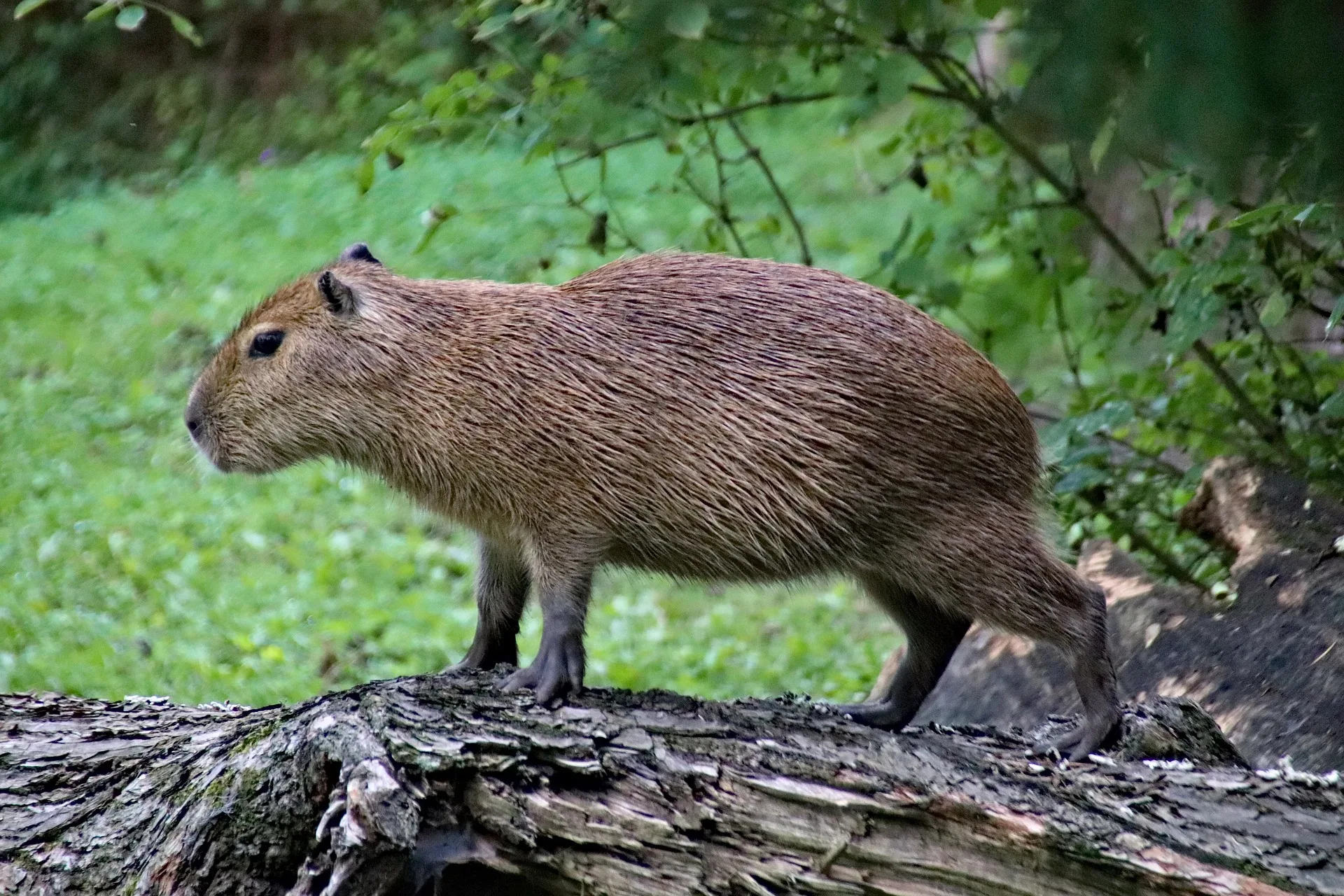
The capybara is the largest rodent in the world, weighing up to 79 kg. It lives near rivers, lakes and swamps in Central and South America. It eats grass and water plants, lives in friendly groups of about 10, and is a strong swimmer that can stay underwater for up to five minutes to hide from predators.
capybaras quick facts
- The capybara is the world’s largest rodent, weighing up to 79 kg.
- A capybara’s eyes, ears and nostrils are on top of its head.
- Capybaras can stay underwater for up to five minutes.
- An adult capybara can eat 2.7 to 3.6 kg of grass a day.
- Capybaras bark to warn their group of danger.
What is a capybara?
The capybara is the largest rodent in the world. Rodents are mammals with front teeth that never stop growing, such as mice, squirrels and guinea pigs. The capybara is like a giant cousin of the guinea pig.
Capybaras live in South America, near rivers, lakes and swamps. They love water and spend a lot of time in it, so they are called semi-aquatic animals.
There are two species, and the capybara is the bigger one. The lesser capybara is smaller and lives further north. The name capybara comes from the Tupi language of Brazil, and it is often said to mean “grass eater”.
| Capybara at a glance | |
|---|---|
| Length | about 1 to 1.3 m (3.2 to 4.3 feet) |
| Height | about 60 cm (2 feet) at the shoulder |
| Weight | 27 to 79 kg (60 to 174 pounds) |
| Food | grass and water plants |
| Group size | usually about 10 |
| Babies | 2 to 8 pups at a time |
| Lifespan | up to about 10 years in the wild |
How big is a capybara?
A capybara stands about 60 cm (2 feet) tall at the shoulder and is about 1 to 1.3 m long, about the size of a big dog.
It can weigh anything from about 27 to 79 kg (60 to 174 pounds). That is heavier than many adult people. The lesser capybara is smaller, about 1 m long and 28 kg.
Capybaras have short brownish fur, a blunt nose, short legs, small ears and almost no tail at all.
Where do capybaras live?
Capybaras live in forests and wetlands from Panama, in Central America, all the way south to Argentina. The bigger capybara lives from Venezuela to northern Argentina and across the Amazon River basin, while the lesser capybara lives from central Panama into Colombia and Venezuela.
They like places where there is grass to eat and water all year round, such as flooded grasslands, the edges of marshes and lowland forests beside rivers and lakes. Many live in and around the Amazon rainforest.
Made for the water
Capybaras are brilliant swimmers. Their feet are slightly webbed, which helps them paddle. They have four toes on each front foot and three on each back foot.
Their eyes, ears and nostrils are all near the top of the head. So a capybara can float with almost its whole body underwater, and still see, hear and breathe, a bit like a hippo or a crocodile.
When danger is near, a capybara dives. It can stay completely underwater for up to five minutes, hiding until the danger has passed.
What do capybaras eat?
Capybaras are herbivores, which means they eat plants. They graze mainly on grasses and water plants, and sometimes eat bark and fruit.
An adult capybara can eat about 6 to 8 pounds (2.7 to 3.6 kg) of grass a day. Its front teeth keep growing all its life, so all that chewing never wears them away.
Near farms, capybaras sometimes eat crops such as melons, grain and squash, which can make them unpopular with farmers.
Picky eaters
Capybaras eat huge amounts of grass, but they are surprisingly choosy about which plants they eat. San Diego Zoo Wildlife Alliance says three quarters of a capybara’s diet comes from just three to six kinds of plants.
In many parts of South America, capybaras are the only large grazing animals. So they can have a big effect on the plants in an area, keeping the grass short along the edges of rivers and lakes.
A surprising way to digest grass
Grass is tough and hard to digest. So capybaras have a surprising trick: they eat some of their own droppings.
That might sound disgusting, but it helps. Their droppings contain helpful bacteria, and eating them lets the capybara break down the tough fibres in its food and get more goodness from it. Rabbits do something very similar with their own droppings.
A capybara’s day
Capybaras usually feed in the morning and evening, when it is cooler. In the heat of the day, they rest in the shade along riverbanks, or cool off in the water.
Animal Diversity Web says they often spend the hottest part of the day in the water, and they are most active around dawn and dusk.
They are shy animals, and they always stay close to water, ready to dive in if something frightens them.
Friendly groups
Capybaras are very social. They usually live in groups of about 10 adults, though groups can have anything from 3 to 30. Sometimes as many as 40 capybaras gather together.
They keep in touch with lots of sounds, including clicks, whistles and purrs. If one spots danger, it gives a loud bark to warn the rest of the group.
Capybaras are famous for being calm. Birds often perch on their backs, and many other animals seem happy to share their space.
Smelly signals
Capybaras send messages with smells. A male capybara has a large, bare bump on the top of its snout, called a morillo. It is a scent gland that makes a white liquid.
Males rub the morillo on plants to leave their scent. Both males and females also have scent glands near their tails. These smells tell other capybaras who has been there and who belongs to the group.
Who is in charge?
A capybara group usually has one top male, several females, their young and a few other males lower down the order. Among the males there is a strict ranking. The top male keeps his place mostly by chasing the others, and real fights are rare.
Capybaras do almost everything near water. They even mate in the water, where the female can easily escape if she wants to.
Capybara Words
- Herbivore — An animal that eats only plants
- Semi-aquatic — Living partly on land and partly in water
- Webbed feet — Help a capybara paddle
- Morillo — A scent gland on top of a male's snout
- A loud bark — Warns the group that danger is near
- The top male — Keeps his place mostly by chasing other males
Capybara babies
Capybaras can have babies at any time of year, but many are born at the start of the rainy season. A mother has one litter a year, of 2 to 8 babies, usually around 4 or 5.
The babies are called pups. San Diego Zoo Wildlife Alliance says a capybara mother is pregnant for 5 to 6 months, although other sources give a shorter time. The pups are born on land, close to the water.
A newborn pup weighs about 1 to 1.5 kg, and it can walk, swim and even nibble grass within days. The pups drink milk until they are about three months old. Young capybaras stay with their parents’ group until they are about a year old, and living in a big group means lots of eyes and ears are watching for danger.
A Capybara Pup Grows Up
- Start of the rainy season Many capybara pups are born.
- Within a week The pups can walk and start to nibble grass.
- About 3 months The pups stop drinking their mother's milk.
- About 1 year A young capybara is ready to look after itself.
- Up to about 10 years The longest a capybara lives in the wild.
Predators
Capybaras have many enemies. Jaguars hunt adult capybaras, and caimans, ocelots, harpy eagles and anacondas catch young ones.
Diving into water is their best escape, although that does not always help against caimans and anacondas, which also hunt in the water.
In the wild, capybaras live about 6 years on average, and up to about 10. In zoos, they can live up to 12 years.
Just how big is the biggest rodent?
It can be hard to picture how big a capybara really is. A pet guinea pig, its small cousin, fits in your two hands and weighs about as much as a bag of sugar. A big capybara can weigh as much as an adult person.
If a capybara stood next to a big dog, the two would be about the same height. But the capybara would be much heavier, with a barrel-shaped body and short, sturdy legs.
Capybara by Numbers
- Up to 79 kg — The weight of the biggest capybaras
- About 60 cm — How tall a capybara is at the shoulder
- 2.7 to 3.6 kg — The grass an adult can eat in a day
- 1 to 1.5 kg — What a newborn pup weighs
- Up to 40 — How many capybaras sometimes gather together
Capybaras and people
Capybaras are listed as Least Concern, which means they are not in danger of dying out. In some parts of South America they are hunted or farmed for their meat and for leather.
In recent years, capybaras have become internet stars, thanks to videos of them relaxing calmly in hot springs and sitting peacefully beside other animals. Their gentle nature has made them one of the most-loved animals online.
Three things people get wrong
Capybaras are not pigs. They are sometimes called water hogs, but they are rodents, related to guinea pigs.
Capybaras do not live in Africa or Asia. Wild capybaras live only in Central and South America.
Capybaras are not clumsy in water. They are strong swimmers and can stay underwater for up to five minutes.
Did you know? Capybaras eat some of their own droppings, because the helpful bacteria in them help break down tough grass.
Capybaras: Fact or Myth?
- Wild capybaras live in Africa.
- A capybara can stay underwater for up to five minutes.
- Capybaras usually live alone.
- Capybaras eat some of their own droppings.
- Capybaras are an endangered species.
- Jaguars hunt adult capybaras.
- Capybaras have a long, bushy tail.
- Capybaras sometimes eat farmers' melons and grain.
Try it
Find South America on a map and trace the Amazon River. Capybaras live beside rivers and wetlands across much of this area.
Knowledge check
Why are a capybara’s eyes, ears and nostrils on top of its head?
Show answer
So it can see, hear and breathe while almost its whole body is underwater.
What family of animals is the capybara related to?
Show answer
Rodents, especially guinea pigs.
Frequently asked questions
What is the largest rodent in the world?
The capybara is the largest rodent in the world. It can be up to 1.3 metres long and weigh up to 79 kg (174 pounds).
Where do capybaras live?
Capybaras live in Central and South America, from Panama to Argentina, in grasslands, marshes and forests near rivers, lakes and swamps.
What do capybaras eat?
Capybaras are herbivores. They eat mainly grasses and water plants, and sometimes bark and fruit. An adult can eat 2.7 to 3.6 kg of grass a day.
Can capybaras swim?
Yes. Capybaras are excellent swimmers with slightly webbed feet. They can stay completely underwater for up to five minutes to hide from predators.
How many babies do capybaras have?
A capybara mother has one litter a year of 2 to 8 pups, usually four or five. The pups can walk and swim within days of being born.
What eats capybaras?
Jaguars hunt adult capybaras, while caimans, ocelots, harpy eagles and anacondas catch young ones. People also hunt and farm them.
Sources
- San Diego Zoo Wildlife Alliance: capybara — size, habitat, swimming, diet, eating droppings, teeth, groups, pups, predators and lifespan, choosy diet and pregnancy
- Encyclopaedia Britannica: capybara — the two species, size, range, behaviour, diet, litters and status
- Animal Diversity Web, University of Michigan: capybara — size, range, habitat, diet, groups, warning barks, breeding, lifespan and predators, the morillo scent gland, ranking among males, mating in water and effect on plants
Capybara Final Challenge
- When do capybaras usually feed?
- Three quarters of a capybara's food comes from how many kinds of plants?
- Why do a capybara's front teeth never wear away?
- How many litters does a capybara mother usually have in a year?
- Where do capybaras mate?
- What are capybaras farmed for in parts of South America?
- How is the lesser capybara different?
- Why is living in a big group good for capybara pups?