
reptiles quick facts
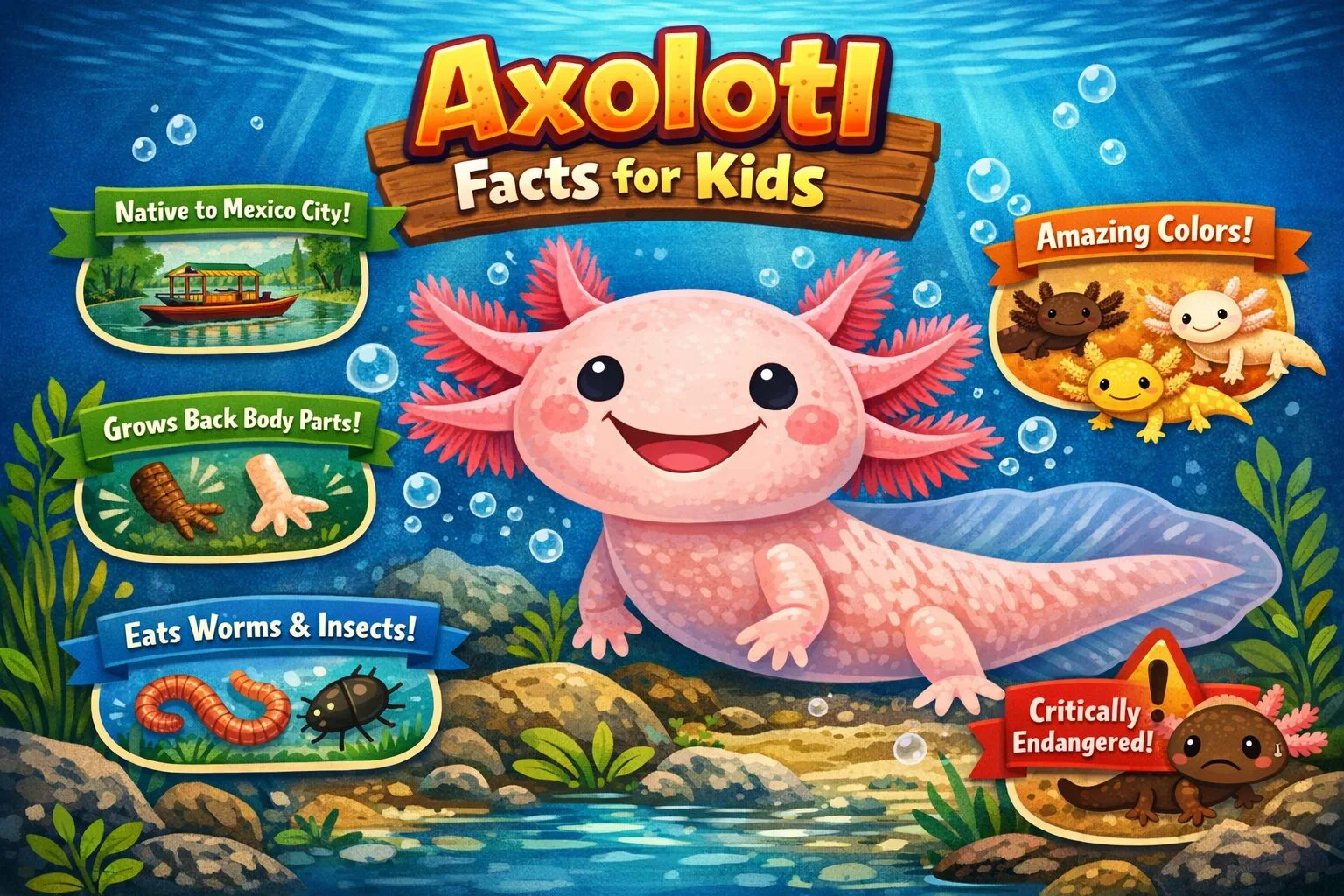
- An axolotl keeps its baby gills and stays in water for its whole life.
- It can regrow limbs, eyes and even parts of its brain.
- Wild axolotls are mottled brown-grey, not pink.
- Only 50 to 1,000 adults are left in the wild.
- It is named after Xolotl, the Aztec god of fire and lightning.
Axolotls at a glance
| Axolotl | |
|---|---|
| Scientific name | Ambystoma mexicanum |
| What it is | A salamander that never grows up |
| Length | Up to 30 cm |
| Weight | 50 to 200 g |
| Lifespan | 10 to 15 years |
| Wild home | Lake Xochimilco, Mexico City |
| Wild population | Only 50 to 1,000 adults |
| Status | Critically Endangered |
There may be fewer than a thousand axolotls left in the wild, and hundreds of thousands in tanks around the world.

The animal that never grows up
Most salamanders start life in water, with feathery gills. The young ones look a bit like tadpoles. Then they change completely. They lose the gills, grow lungs and crawl out onto land.
The axolotl simply skips that last part of the story.
It keeps its frilly outside gills and its other baby features. It stays in the water all its life. Scientists have a word for that, and the word is neoteny.
The odd part is that it grows up in every other way. An axolotl becomes an adult and can have babies of its own. It just keeps the body of a youngster.
Those feathery branches behind its head are the gills. They make an axolotl look as if it is smiling under a fancy hat.

It can regrow its own body parts
This is the fact that makes scientists pay attention.
An axolotl can regrow a lost leg. It does not just heal over the stump. It builds the whole leg again, with bones, muscles, nerves and skin, in the right shape.
And it does not stop at legs. Axolotls can regrow eyes, and even parts of the brain.
Nobody fully understands how it works. Genes usually switch off once an animal has grown. One idea is that an injury switches some of them back on. The body then builds the part again, the way it did the first time.
Work is still going on. If we ever learn the trick, it could matter a great deal for medicine.
What does an axolotl look like?
Smaller than most people expect, and usually the wrong colour.
An axolotl grows up to 30 centimetres, about the length of a school ruler. It weighs between 50 and 200 grams.
Now think about the colour. The famous pink-white axolotl with dark eyes looks nothing like a wild one.
Wild axolotls are a blotchy brown-grey. That hides them well in a muddy canal. The pale pink ones were bred by people for the pet trade.
So almost every axolotl you have seen in a photograph is a colour that barely exists in the wild.

What do axolotls eat?
They are hunters, and in their home waters they are at the top of the food chain.
An axolotl eats snails and worms. It also takes insect grubs, shellfish and even small fish.
It does not chew its food. It snaps its mouth open fast. Water rushes in, with the food in it, and the axolotl swallows the lot.
Being top hunter in a lake sounds grand. Then you learn how small that lake has become.
Where do axolotls live?
In one place, and almost nowhere else.
Wild axolotls live in the lakes and marshes of southern Mexico City. Lake Xochimilco and Lake Chalco are the main ones.
Those lakes are not what they were. Mexico City grew over them, and what is left of Xochimilco is mostly canals.
Our guide to Mexico covers the country it comes from. The axolotl holds just one small corner of it.
How many are left?
Between 50 and 1,000 adults in the wild. That is the whole wild population.
The axolotl is listed as Critically Endangered. Only one step is worse: extinct in the wild. That is what happened to the dodo, which is gone for good.
The reasons all come back to the city. It grew, and it took the water. Pollution spoiled what was left. Fish brought in from elsewhere eat the young axolotls.
Here is the strange part, and scientists call it a conservation paradox.
Huge numbers of axolotls are alive today. They live in zoos, in laboratories and in homes all over the world.
But those animals do not save the wild ones. Years of breeding have made them close cousins. So they carry very little variety in their genes, and none of them lives in Xochimilco.
An animal can be very common and still be close to extinct. It happens when all the common ones live in tanks.
Where the name comes from
The name axolotl comes from Mexico, and so does the story behind it.
It is thought to be named after Xolotl, the Aztec god of fire and lightning.
In the story, Xolotl did not want to be sacrificed, so he turned himself into a salamander to hide.
It is a good name. The animal’s whole trick is refusing to change into what it should become.
Baby axolotls
Axolotls hatch from eggs laid in the water, and they are tiny to begin with.
A newly hatched axolotl is only a few millimetres long. It cannot swim well at first. It spends its early days resting on plants.
It grows quickly after that. By about a year old it is grown up and can have young of its own.
Here is the part that catches people out. A baby axolotl looks like a small adult, gills and all. The adult never changes shape. Most animals look different as babies. This one really does not.
That is the same strange fact from another side. In a way, an axolotl is a baby salamander all its life.
Can they be saved?
People are trying, and the work is happening in Xochimilco itself.
Some of it is about the water. Clean canals, with the pollution kept out, make the place liveable again.
Some of it is about the introduced fish, which eat young axolotls and do not belong in the lake.
And some of it is farming. Xochimilco has floating gardens called chinampas, used for centuries. Looking after them keeps the canals healthy.
Axolotls bred in tanks have been let go in mended and man-made marshes. Scientists have followed them to see how they settle in.
None of this is finished. Only hundreds of axolotls are left in the wild. Their chances are far better with people working on it than without.
Axolotls as pets
Axolotls are popular pets. They need more care than their cheerful face suggests.
They are water animals for life. They need a proper tank, not a tub, and they never come out onto land.
They also need the water kept cool. Axolotls come from cool canals, and warm water makes them ill.
Their skin is soft and easy to damage. They have no scales to guard it. So they should not be handled the way you would hold a hamster.
And they should not share a tank with fish. Fish nibble those feathery gills. An axolotl may also try to swallow a fish that is too big for it.
If you ever keep one, here is the honest summary. An axolotl is not a hard pet, but it is a fussy one. Nearly everything it needs comes down to the water.
Three things people get wrong
“Axolotls are pink.” Wild ones are blotchy brown-grey. People bred the pale pink one for the pet trade, and it is hardly ever found in the wild.
“Axolotls are fish.” They are amphibians, and salamanders at that. Those frills behind the head are gills, and most salamanders lose them as they grow up.
“There are loads of axolotls, so they are fine.” There are lots in tanks. In the wild there are only 50 to 1,000 adults, and the species is Critically Endangered.
Did you know? There are huge numbers of axolotls in tanks around the world and almost none left in the wild. Scientists call this a conservation paradox.
Try it
An axolotl grows up to 30 cm. Hold a school ruler up and that is a full-grown axolotl.
Knowledge check
What does neoteny mean?
Show answer
Keeping baby features into adult life. An axolotl keeps its feathery gills and stays in the water. It still grows up enough to have young of its own.
Why does having many pet axolotls not save the species?
Show answer
Because years of breeding have made them close cousins. They carry very little variety in their genes, and none of them lives in the wild lakes the species needs.
Frequently asked questions
What is an axolotl?
A salamander from Mexico that never finishes its change into a land animal. It keeps its outside gills and stays in the water all its life. The word for that is neoteny.
Can axolotls really regrow body parts?
Yes. They can regrow legs, eyes and even parts of the brain. Scientists think an injury may switch genes back on that are usually off in adults.
How big do axolotls get?
Up to 30 cm long, weighing between 50 and 200 grams. They live 10 to 15 years and can breed after about a year.
Are axolotls pink?
Wild ones are not. They are blotchy brown-grey, which hides them well. People bred the pale pink-white axolotl for the pet trade.
Where do axolotls live?
Only in the lakes and marshes of southern Mexico City. Lake Xochimilco and Lake Chalco are the main ones, and most of that water is now canals.
Are axolotls endangered?
Yes, Critically Endangered. Only 50 to 1,000 adults are thought to be left in the wild. The threats are the growing city, pollution and fish brought in from elsewhere.
Sources
- Natural History Museum: axolotls, the amphibians that never grow up — neoteny, size and weight, lifespan, diet, regeneration, the wild range, the 50 to 1,000 population, the conservation paradox and the origin of the name
- IUCN Red List: axolotl (Ambystoma mexicanum) — the Critically Endangered listing and the threats from urban growth, water quality and introduced species
- Britannica: axolotl — background on the species, its habitat and its biology


