box jellyfish quick facts
- There are about 50 species of box jellyfish.
- Some box jellyfish eyes have a lens, cornea, iris and retina.
- Box jellyfish can swim at almost four knots.
- Chironex fleckeri has tentacles up to 10 feet (3 m) long.
- The deadliest box jellyfish live mainly off northern Australia and in the Indo-Pacific.
Stay safe: in places where box jellyfish live, swim only at patrolled beaches, inside stinger nets where they are provided, and always follow the lifeguards’ advice.
What is a box jellyfish?
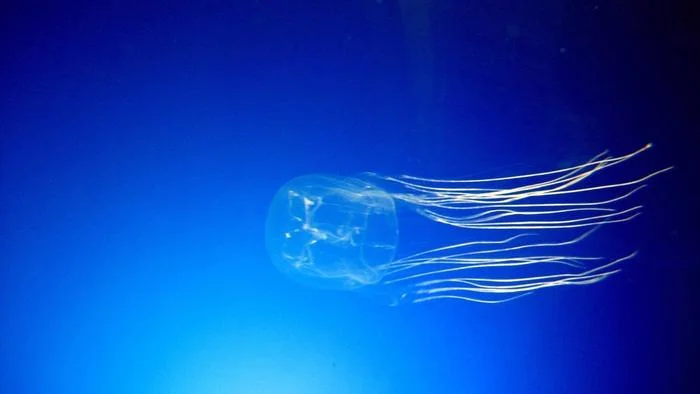
A box jellyfish is a jellyfish with a bell shaped like a cube, or box. Long tentacles trail from each of the four corners of the box.
Box jellyfish are different from most other jellyfish. Scientists put them in their own group, called the Cubozoa, which means “cube animals”. There are about 50 species.
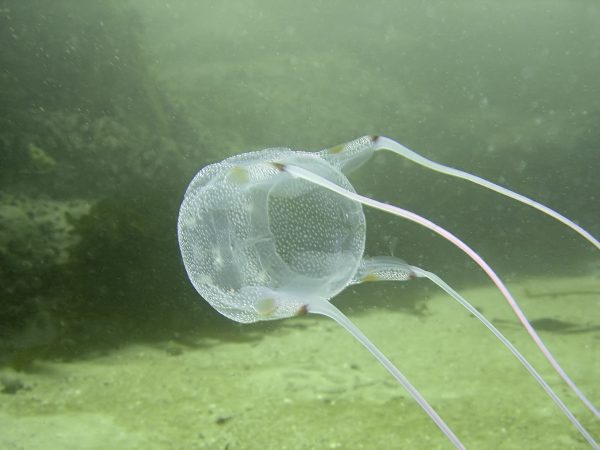
Some box jellyfish are harmless to people. But a few have extremely strong venom. The most dangerous, Chironex fleckeri, lives off the coast of northern Australia and is often called the sea wasp.
What box jellyfish look like
Box jellyfish are almost see-through, which makes them very hard to spot in the water.
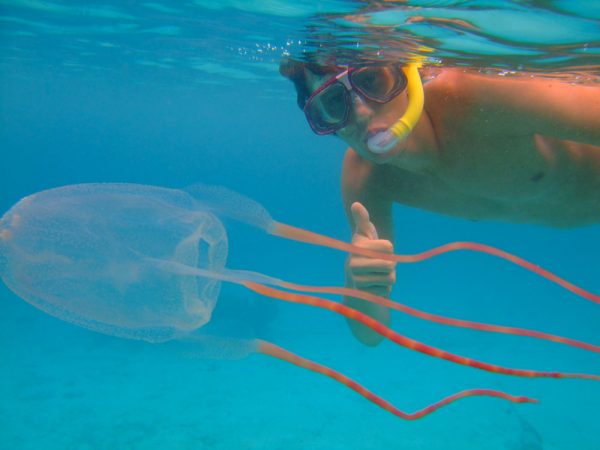
Depending on the species, the bell can be anything from 1 cm to 30 cm across. The largest box jellyfish, Chironex fleckeri, has a bell up to about a foot (30 cm) wide, with thick tentacles up to 10 feet (3 m) long.
Its tentacles hang in clusters from each corner of the bell. They are covered in millions of tiny stinging cells.
Not all box jellyfish are giants. The Caribbean box jellyfish, for example, is a small species that lives in warm Caribbean waters.
| Box jellyfish at a glance | |
|---|---|
| Group | Cubozoa, about 50 species |
| Largest and deadliest | Chironex fleckeri, the sea wasp |
| Bell | from 1 cm to about 30 cm across |
| Tentacles | up to 3 m long in the largest species |
| Speed | almost 4 knots (about 7 km/h) |
| Stinger season in Queensland | usually November to May |
A jellyfish that can see
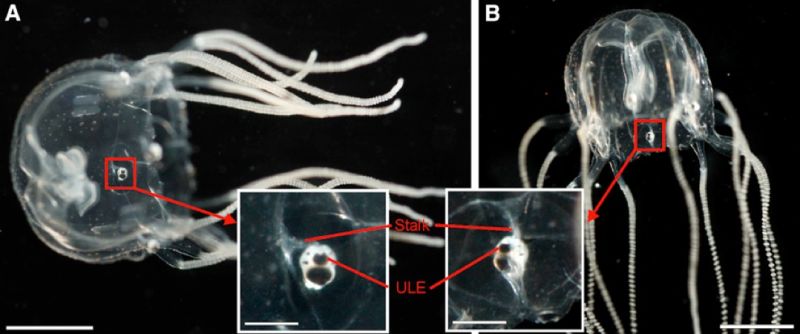
Most jellyfish have no eyes at all. Box jellyfish have 24 of them, in clusters on each side of the box.
Some of these eyes are surprisingly advanced. The US National Ocean Service says they have a lens, a cornea, an iris that can close up in bright light, and a retina, much like our own eyes.
Scientists are still working out how a box jellyfish uses its eyes, since it has no brain like ours. Some of the eyes seem to look upwards, perhaps to help the jellyfish find its way by the shapes of things above the water. They seem to help it steer around objects and find its way.
Swimmers, not drifters
Most jellyfish just drift wherever the water carries them. Box jellyfish can swim.
They move by squeezing their bell to push water out behind them, and they can reach almost four knots, about 7 km/h. That is about as fast as a good human swimmer.
Being able to swim and see lets box jellyfish hunt, rather than just waiting for food to bump into them.
What box jellyfish eat
Box jellyfish eat small crustaceans, such as shrimps, as well as tiny floating animals called plankton, and fish.
When prey touches a tentacle, the stinging cells fire and inject venom, stunning or killing it. The tentacles then pull the food up to the jellyfish’s mouth, under the bell.
How the sting works
The stinging cells on the tentacles are called nematocysts. Each one is like a tiny coiled harpoon, loaded with venom.
When something brushes against a tentacle, thousands of these tiny darts shoot out and inject their venom in a fraction of a second.
A sting from Chironex fleckeri causes sudden, severe burning pain, and it leaves whip-like marks on the skin, often with pieces of tentacle still stuck to it. Its venom can cause paralysis and can stop a person’s heart within minutes. It is thought to be one of the most venomous animals in the world.

Why is the venom so strong?
Why would a jellyfish need such powerful venom? Scientists think it may be because a box jellyfish’s body and tentacles are very delicate.
A fish that struggled for a long time could tear the tentacles. Venom that works in seconds stops prey quickly, before it can do any damage or escape.
Box jellyfish are not dangerous to every animal, though. Some sea turtles eat them, and they do not seem to be harmed by the stings.
Where box jellyfish live
Box jellyfish live in warm coastal waters around the world. The most dangerous kinds are found mainly in the Indian and Pacific Oceans, from Thailand and the Philippines to the waters off northern Australia.
In Australia, Chironex fleckeri lives in shallow tropical waters north of Agnes Water in Queensland, in all the waters of the Northern Territory, and down the coast of Western Australia as far south as Exmouth.
They are most common in the warm, wet months, which Australians call stinger season. It usually runs from November to May. That is when beaches in the north put up warning signs and stinger nets.
Staying safe
People who live in or visit northern Australia know how to stay safe around box jellyfish.
Swim at patrolled beaches: lifeguards know when stingers are about, and they put up flags and signs.
Use stinger nets: some beaches have enclosures in the water that keep most jellyfish out.
Cover up: a full-length stinger suit or wetsuit gives your skin protection.
Get help straight away: anyone who is stung by a box jellyfish needs help at once. Call for a lifeguard and phone for an ambulance.
First aid for a box jellyfish sting
A box jellyfish sting is an emergency. Surf Life Saving Queensland gives this advice, which adults and lifeguards follow.
First, pour vinegar over the sting for at least 30 seconds. The vinegar stops any stinging cells that have not yet fired. Then carefully pick off any tentacles.
If the person stops breathing, start CPR straight away. Call the emergency number, 000 in Australia, and get help from a lifeguard if one is nearby.
There is an antivenom for Chironex fleckeri stings. It is kept at hospitals and ambulance stations in the areas where the jellyfish live.
The tiny Irukandji
Not every dangerous box jellyfish is big. The Irukandji jellyfish are tiny box jellyfish, some no bigger than a fingernail, that also live in the tropical waters of northern Australia.
Their sting may hardly be felt at first. But 5 to 40 minutes later, it can cause terrible muscle pain, headache, vomiting and sweating. Anyone who might have been stung needs to be watched closely for 45 minutes and taken for medical help.
The life of a box jellyfish
Box jellyfish start life as tiny blobs called polyps, which cling to rocks and other surfaces in shallow water.
Each polyp grows and then changes into a single young jellyfish, which swims away. The young jellyfish grows into an adult with a full box-shaped bell and long tentacles.
Box jellyfish and learning
Box jellyfish are fascinating to study. Scientists want to understand their eyes, their venom and how they live with no brain.
Maybe you are a student thinking, “What facts can help me to do my coursework on sea creatures?” The trustworthy sources listed at the end of this guide are a great place to start.
And if you simply love the sea, you can bring it into your bedroom with jelly fish wallpapers and other ocean designs.
More ocean and animal facts
Box jellyfish share the oceans with many other amazing creatures. You can read about another animal of the far north in our polar bear facts for kids.
Box jellyfish are also sometimes found off warm American coasts, though not the deadly Australian kind. Find out about one warm coastal state in our California facts for kids.
Three things people get wrong
Box jellyfish are not just drifting blobs. They can swim at almost four knots and steer using their eyes.
Not all box jellyfish are deadly. There are about 50 species, and only a few, such as Chironex fleckeri, are dangerous to people.
Box jellyfish do not live everywhere. The deadliest kinds are found mainly in the Indian and Pacific Oceans, especially off northern Australia.
Did you know? Box jellyfish have no brain like ours, yet some of their eyes are built like ours, with a lens, iris and retina.
Try it
Draw a box jellyfish: a square bell with clusters of long tentacles at each corner and small dots for eyes on each side. How many eyes can you fit on?
Knowledge check
How is a box jellyfish different from most jellyfish?
Show answer
It can swim and steer instead of just drifting, and it has eyes.
What are nematocysts?
Show answer
Tiny stinging cells on the tentacles that shoot out and inject venom.
Frequently asked questions
Why is it called a box jellyfish?
A box jellyfish is named after its bell, which is shaped like a cube or box. Clusters of tentacles trail from each of its four corners.
How dangerous is a box jellyfish?
Some box jellyfish are harmless, but Chironex fleckeri, from northern Australia, has extremely strong venom. Its sting can cause paralysis and stop the heart within minutes.
Where do box jellyfish live?
Box jellyfish live in warm coastal waters around the world. The most dangerous kinds live mainly in the Indian and Pacific Oceans, especially off northern Australia.
Do box jellyfish have eyes?
Yes. Box jellyfish have clusters of eyes on each side of their bell, and some of the eyes have a lens, cornea, iris and retina.
Can box jellyfish swim?
Yes. Unlike most jellyfish, which drift, box jellyfish can swim by squeezing their bell, reaching speeds of almost four knots.
What should you do if someone is stung by a box jellyfish?
Pour vinegar on the sting for at least 30 seconds, then pick off any tentacles. Start CPR if the person stops breathing, call 000 in Australia and get a lifeguard. Antivenom is kept at hospitals.
Sources
- US National Ocean Service (NOAA): box jellyfish — body shape, stinging cells, the size of Chironex fleckeri, eyes, where they live, venom and swimming
- Encyclopaedia Britannica: box jellyfish — the number of species, bell and tentacle sizes, where they live, diet and the deadliest species
- Surf Life Saving Queensland: marine stingers — where box jellyfish are found, stinger season, sting symptoms, first aid and Irukandji