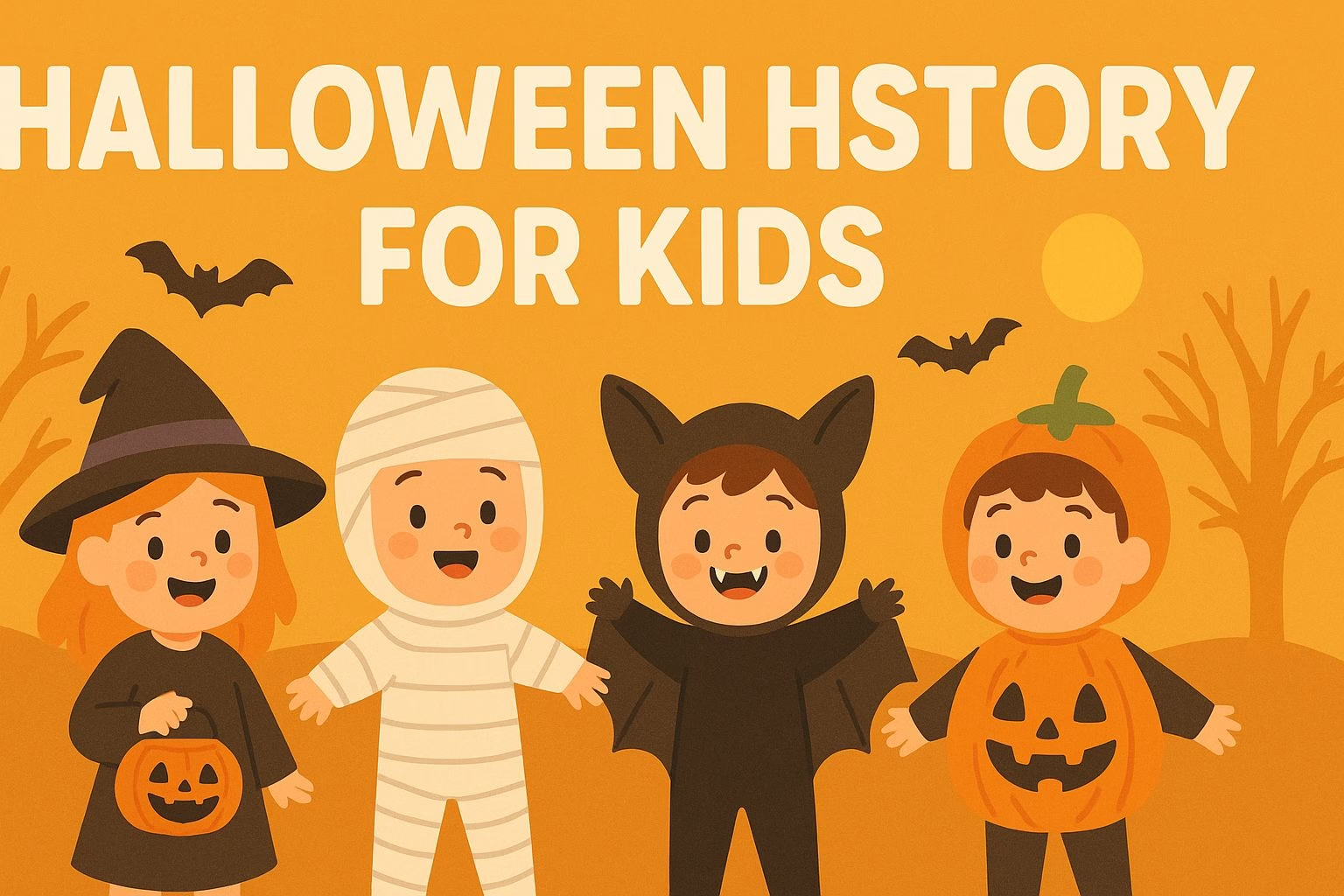
Halloween history goes back to Samhain, a festival of the Celts of ancient Ireland that marked the start of winter. It blended with the Christian All Hallows’ Eve, the night before All Saints’ Day on 1 November. Irish immigrants carried its customs to America in the 1800s, where it became a major holiday.
Halloween history quick facts
- The first jack-o’-lanterns were carved from turnips, not pumpkins.
- All Saints’ Day was first held on 13 May, before it moved to 1 November.
- Halloween was mostly forbidden among the early American colonists.
- Children first collected coins for UNICEF at Halloween in 1950, near Philadelphia.
- In Scotland and Japan, a black cat can be a sign of good luck.
Samhain: where Halloween history begins
Halloween history starts with the Celts of ancient Ireland and their festival of Samhain, which is said “SOW-in”.
Samhain fell on the day we now call 1 November. For the Celts it was the start of a new year and the beginning of winter. Farm animals were brought in from the fields, and land deals were renewed.
People believed that on the night before Samhain, the line between the world of the living and the world of the dead grew thin. Spirits could wander the earth. The souls of people who had died might come back to visit their homes.
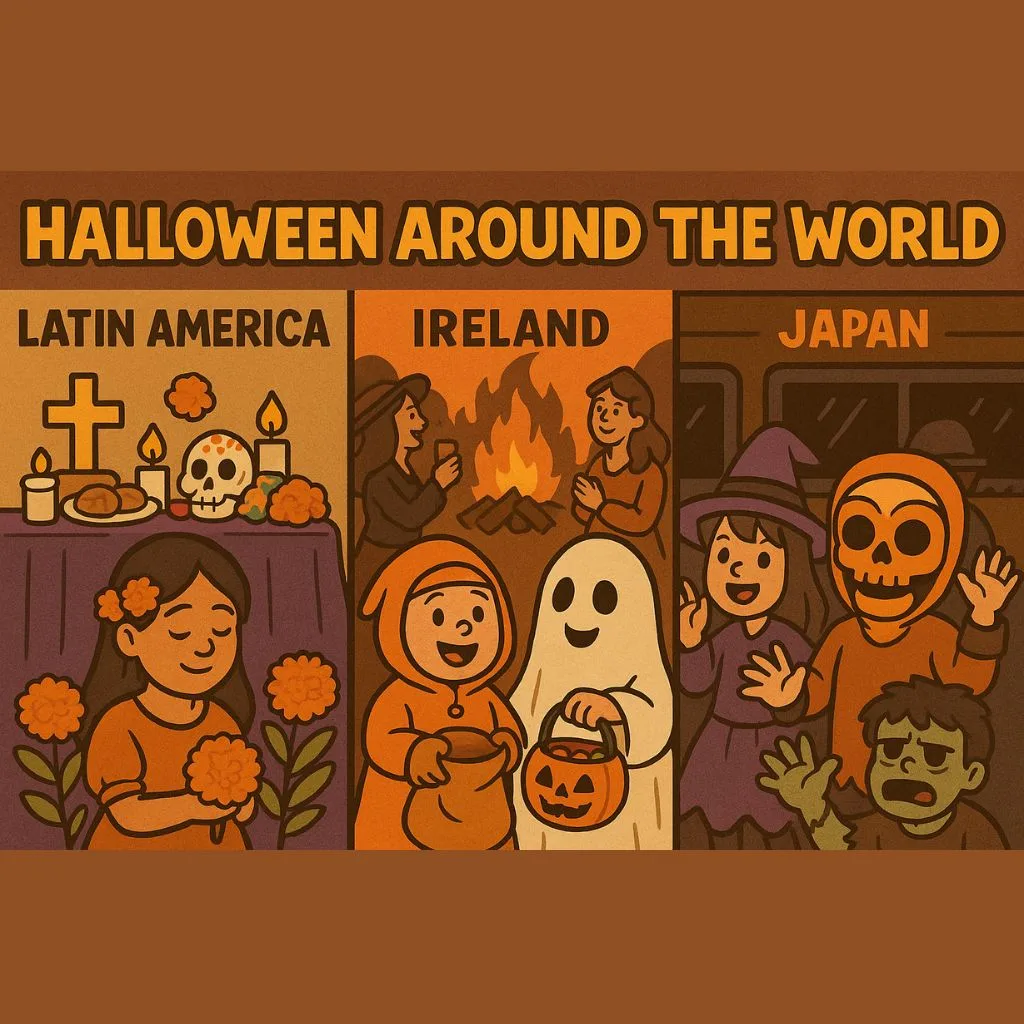
So people lit bonfires on hilltops, to relight their fires at home for the winter and perhaps to scare evil spirits away. Some wore masks and disguises so that the ghosts would not recognise them.
Samhain was also thought to be a good time for telling the future, especially about love, health and death. Many of Halloween’s spooky ideas, such as witches, fairies and goblins, may have come from these beliefs.
Some accounts say that when the Romans conquered the Celts of Britain in the 1st century CE, they brought customs of their own. These included Feralia, a festival remembering the dead, and traditions linked to Pomona, the goddess of fruit trees and orchards.
All Saints’ Day and All Souls’ Day
Christianity added a second layer to the story. In the 7th century, Pope Boniface IV set up All Saints’ Day, a day to remember all the saints of the Christian church. At first it was on 13 May.
In the 8th century, Pope Gregory III moved it to 1 November, the same date as Samhain. He may have hoped to replace the older festival with a Christian one. Later, 2 November became All Souls’ Day, a day to pray for everyone who had died.
Together, these three days are called Allhallowtide. On the night before, people in some places lit candles or lanterns on graves or in windows to guide the souls of the dead.
All Saints’ Day and All Souls’ Day are still important religious holidays in most mainly Catholic countries. In many parts of Europe and Latin America, families visit cemeteries on 1 and 2 November to remember relatives who have died.
How Halloween got its name
All Saints’ Day was also called All Hallows’ Day. “Hallow” is an old word for a saint or a holy person.
The evening before it was All Hallows’ Eve. Say that fast enough and it turns into Hallowe’en, and then Halloween.
Three Days in a Row
- 31 October — All Hallows' Eve, the evening before All Hallows' Day
- 1 November — All Saints' Day, also called All Hallows' Day
- 2 November — All Souls' Day, a day to pray for everyone who has died
- Allhallowtide — The name for all three days together
- Hallow — An old word for a saint or holy person
| When | What happened |
|---|---|
| Ancient times | The Celts of Ireland mark Samhain, the start of winter |
| 7th century | Pope Boniface IV sets up All Saints’ Day, on 13 May |
| 8th century | Pope Gregory III moves All Saints’ Day to 1 November |
| Later | 2 November becomes All Souls’ Day |
| Mid-1800s | Irish immigrants bring Halloween customs to the United States |
| 1950 | Trick-or-Treat for UNICEF begins near Philadelphia |
| 1900s | Halloween becomes one of the main American holidays |
How Halloween reached America
By the end of the Middle Ages, the holy days and the older customs had blended together. After the Reformation, most Protestants stopped keeping the religious festival. In Britain, though, people kept celebrating Halloween just for fun.
In early America, Halloween was mostly forbidden among the colonists. In the 1800s, harvest festivals started to mix in some Halloween ideas.
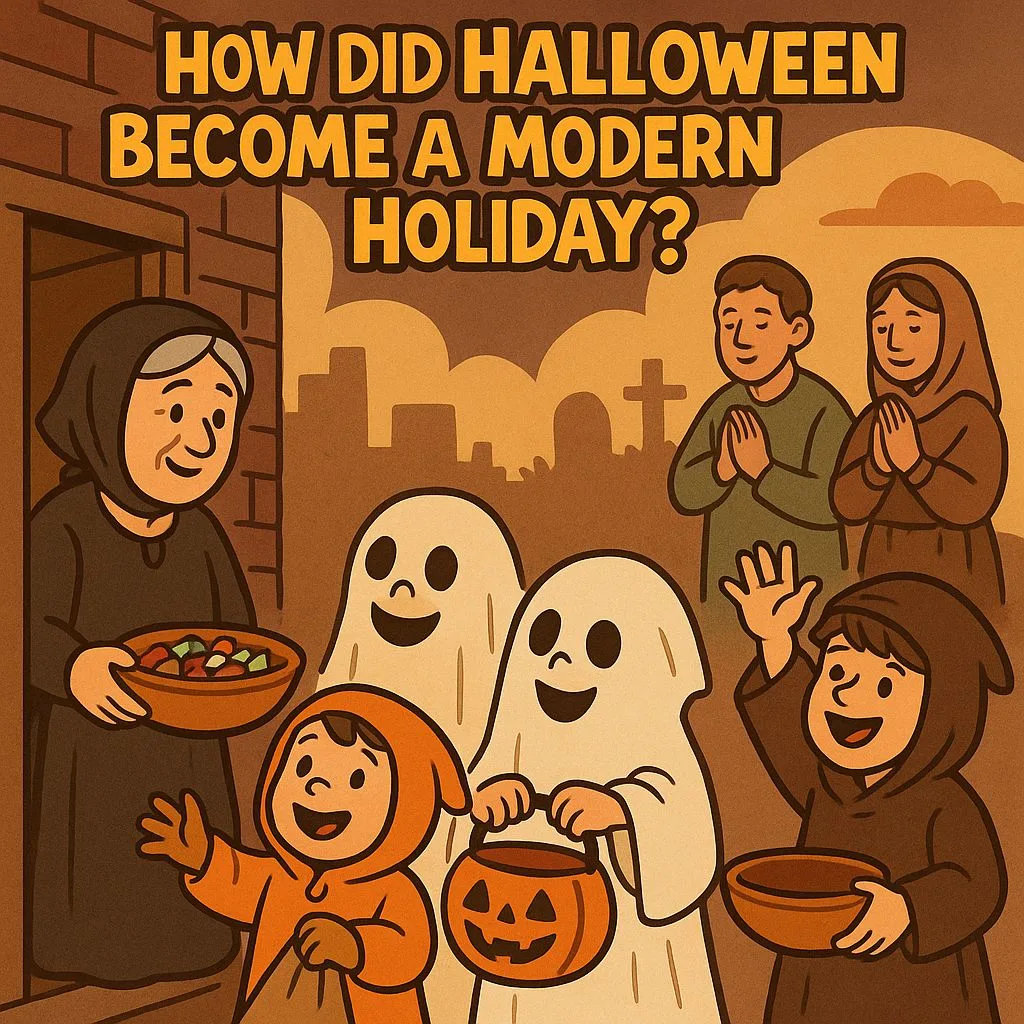
The big change came in the middle of the 1800s. Large numbers of immigrants, including many from Ireland, arrived in the United States, and they brought their Halloween customs with them. In the 20th century, Halloween became one of America’s biggest holidays, especially for children.
Today, in much of Europe and most of North America, Halloween is mostly not religious at all. It is a night of parties, costumes, carved lanterns and trick or treat.
How Halloween Grew
- Samhain The Celts of ancient Ireland light bonfires at their festival of Samhain.
- 13 May Pope Boniface IV sets up All Saints' Day, at first on 13 May.
- 1 November Pope Gregory III moves All Saints' Day to 1 November.
- The Reformation Most Protestants stop keeping the religious festival, but people in Britain keep Halloween for fun.
- Crossing the ocean Immigrants, many of them Irish, bring Halloween customs to the United States.
- A big holiday Halloween becomes one of America's biggest holidays, especially for children.
Turnips came before pumpkins
Today’s jack-o’-lanterns are carved pumpkins. But the tradition began in Ireland and Britain with turnips and other big vegetables.
The National Museum of Ireland keeps a model of a “ghost turnip” in its collection. In 1943, a schoolteacher called Róis Ní Bhraonáin, who worked near Fintown in County Donegal, sent the museum a turnip lantern. She said it was the kind always made in that area around 1900.
People hollowed out the turnips, carved scary faces and put candles inside. On the night of 31 October, they used them to frighten people. The museum says the pumpkin lantern is an American version of this Irish tradition.
The museum’s folklife collection also holds old Halloween masks and a Hallowe’en cross, which show how Irish families marked the night in the past.
The name comes from an Irish folktale about a man called Stingy Jack. First he talked the Devil into turning into a coin, then trapped the coin in his pocket next to a silver cross. Later he tricked the Devil into climbing a tree and carved a cross into the trunk so he could not come down. Because of these tricks, when Jack died, neither heaven nor hell would take him. He was left to wander in the dark with only a glowing coal inside a hollow turnip to light his way. People called him Jack of the Lantern.
Costumes and trick or treat
Dressing up may go back to Samhain, when people might have worn animal skins or disguises to confuse the spirits. Today, costumes can be anything from ghosts and witches to superheroes.
Trick or treat probably comes from an old British custom. Poor people went from house to house asking for food called soul cakes. According to Scottish accounts, on All Saints’ Day, children and poor adults collected food and money in return for saying prayers for the dead.
When the festival stopped being religious, the prayers turned into tricks, songs and jokes. In Ireland there was also mumming, where people dressed as spirits and acted silly in return for food and drink.
In 1947, a teacher and her husband near Philadelphia asked local children to do something good at Halloween. In 1950 they teamed up with UNICEF, the United Nations children’s charity, and the children collected coins instead of sweets, raising $17. The idea spread across the country, and Trick-or-Treat for UNICEF has helped children around the world ever since.
It is now the longest-running campaign of its kind for young people in the United States. Children carry small orange boxes, and the coins they collect help pay for food, medicine and schooling for children in need.
Apples, black cats and bats
Bobbing for apples. In this party game, apples float in a tub of water, and players try to catch one with their teeth without using their hands. It may come from Roman customs linked to Pomona, the goddess of fruit trees.
Black cats. In medieval Europe, people believed witches, or even the Devil, could disguise themselves as black cats, so a black cat crossing your path meant bad luck. Not everyone agrees. In Scotland and Japan, a black cat can be a sign of good luck.
Bats. European folklore said bats carried messages between witches and the Devil. That is why they became another spooky Halloween symbol.
For more spooky facts, read our Halloween facts for kids, or find out what else happens in October.
Customs and Their Roots
- Dressing up — Disguises worn at Samhain so ghosts would not recognise people
- Trick or treat — Poor people going from house to house for soul cakes
- Bobbing for apples — May come from Roman customs linked to Pomona, goddess of fruit trees
- Black cats — Medieval Europeans believed witches could disguise themselves as them
- Bats — Folklore said they carried messages between witches and the Devil
- The name jack-o'-lantern — An Irish folktale about a man called Stingy Jack
Three things people get wrong
The first jack-o’-lanterns were not pumpkins. They were turnips and other vegetables, carved in Ireland and Britain. The pumpkin version grew up in America.
Halloween is not the same as the Day of the Dead. Mexico‘s Día de los Muertos, held mainly on 1 and 2 November, is a separate festival where families build altars with flowers, candles, food and photos to welcome the spirits of loved ones.
Halloween was not always American. It was mostly forbidden among the early colonists. It arrived in force with Irish and other immigrants in the 1800s.
Did you know? The National Museum of Ireland has a model of a turnip lantern, sent in 1943 by a teacher from County Donegal. She said it was the kind made there around 1900.
Halloween History: True or False?
- Halloween is the same festival as Mexico's Day of the Dead.
- Halloween was mostly forbidden among the early American colonists.
- All Saints' Day was first held on 13 May.
- After the Reformation, most Protestants kept the religious festival.
- In some places, people once lit candles on graves or in windows on All Hallows' Eve.
- Halloween has always been one of America's biggest holidays.
- In Scotland and Japan, a black cat can be a sign of good luck.
- Trick-or-Treat for UNICEF asks children to collect sweets for charity.
Try it
Say “All Hallows’ Eve” out loud, faster and faster. Can you hear how it turns into “Hallowe’en”?
Knowledge check
What was Samhain?
Show answer
A festival of the Celts of ancient Ireland that marked the new year and the start of winter, around 1 November.
What were the first jack-o’-lanterns carved from?
Show answer
Turnips and other large vegetables, in Ireland and Britain. Pumpkins came later, in America.
Frequently asked questions
Where did Halloween come from?
Halloween grew from Samhain, a festival of the Celts of ancient Ireland that marked the start of winter. It blended with the Christian All Hallows’ Eve, the night before All Saints’ Day on 1 November.
Why is it called Halloween?
The name Halloween comes from All Hallows’ Eve, the evening before All Hallows’ Day. Hallow is an old word for a saint, and All Hallows’ Day is another name for All Saints’ Day.
Why do people carve pumpkins at Halloween?
Carving jack-o’-lanterns began in Ireland and Britain with turnips and other vegetables, lit with candles. The pumpkin version developed in America.
Where does trick or treat come from?
Trick or treat probably comes from the old British custom of poor people going door to door for soul cakes, and from Scottish and Irish customs of collecting food in return for prayers, songs or jokes.
How did Halloween come to America?
Halloween was mostly forbidden among the early American colonists. It spread when large numbers of immigrants, including many from Ireland, arrived in the mid-1800s and brought their customs with them.
Is Halloween the same as the Day of the Dead?
No. Mexico’s Day of the Dead, held mainly on 1 and 2 November, is a separate festival. Families build altars with flowers, candles, food and photos to welcome the spirits of loved ones.
Sources
- Encyclopaedia Britannica: Halloween — Samhain, All Saints’ and All Souls’ Days, the name, the journey to America, jack-o’-lanterns, costumes, trick or treat, UNICEF and superstitions
- National Museum of Ireland: ghost turnip — turnip lanterns in Ireland and the 1943 model in the museum
- National Museum of Ireland: traditions and customs of Halloween and Samhain — Halloween masks and customs in the museum’s folklife collection
- UNICEF USA: the history of Trick-or-Treat for UNICEF — the Allisons’ idea in 1947 and the first coin collection for UNICEF in 1950.
Halloween History Final Challenge
- Why did the Celts light bonfires on hilltops at Samhain?
- People believed Samhain was a good time for telling the future. About what?
- Where do many families in Europe and Latin America go on 1 and 2 November?
- Who sent the National Museum of Ireland a turnip lantern in 1943?
- What was mumming in Ireland?
- What do the coins collected for Trick-or-Treat for UNICEF help pay for?
- Which Roman festival remembered the dead?
- In most of Europe and North America today, what kind of holiday is Halloween?