Dominican Independence Day quick facts
- Dominican Independence Day is on 27 February.
- The Dominican Republic declared independence from Haiti in 1844.
- Juan Pablo Duarte founded the secret society La Trinitaria in 1838.
- The Dominican flag flew for the first time on 27 February 1844.
- 16 August is Restoration Day, remembering the war against Spanish rule.
Why is it celebrated?
Dominican Independence Day is celebrated every year on 27 February. It marks the day in 1844 when the Dominican Republic declared itself an independent country.
The US Office of the Historian says the Dominican Republic declared its independence from neighbouring Haiti in 1844. The two countries share an island in the Caribbean Sea.
For Dominicans, 27 February is a day of great national pride. They remember the young leaders who planned their country’s freedom, fly their flag and celebrate with parades.
| Date | What happened |
|---|---|
| 1804 | Haiti wins independence from France |
| 1822 to 1844 | the whole island is under Haitian rule |
| 16 July 1838 | Juan Pablo Duarte founds the secret society La Trinitaria |
| 27 February 1844 | the Dominican Republic declares independence |
| 1861 | Spain takes control again |
| 16 August 1863 | the Restoration War begins |
| 1865 | independence is won back |
One island, two countries
The Dominican Republic and Haiti are neighbours on the same island. To understand Independence Day, it helps to know a little about both.
Haiti was once a French colony called Saint-Domingue. The Office of the Historian says its revolution began on 22 August 1791, when enslaved people rose up.
In 1804, Haiti became independent from France. It was the second independent country in the Americas, after the United States. It was born from a revolt by enslaved people.
From 1822 to 1844, the whole island was governed by Haiti. The Dominican Ministry of Culture calls this period 22 years of Haitian occupation. Many histories simply call it Haitian rule. During those years, a group of young people in the east of the island began to plan for a country of their own.
La Trinitaria: a secret society
The most important of these young people was Juan Pablo Duarte. He was born on 26 January 1813, says the CPEP. The CPEP is a Dominican government group that looks after national dates.
On 16 July 1838, Duarte founded a secret society called La Trinitaria. It became the movement that led to independence.
The Dominican Presidency says Duarte also designed the Dominican flag. The members of La Trinitaria approved it on the very day the society was founded.
Planning for freedom was dangerous. On 2 August 1843, Duarte had to leave the country. The CPEP says he went to Venezuela and then to Curaçao, so he was abroad when independence was finally declared.
The Fathers of the Nation
Dominicans honour three men as the Fathers of the Nation: Juan Pablo Duarte, Francisco del Rosario Sánchez and Matías Ramón Mella.
Sánchez was born in Santo Domingo on 9 March 1817. The CPEP says he was one of the first to join La Trinitaria, and he led the movement while Duarte was away.
Mella was born in Santo Domingo on 25 February 1816. The CPEP says Duarte trusted him with secret missions.
Today, the remains of all three men lie together at the Altar de la Patria, a monument in Santo Domingo.
The night of 27 February 1844
On the night of 27 February 1844, the plan was put into action. The CPEP says Mella fired a trabucazo, a blast from an old kind of gun called a blunderbuss. The shot was the signal that the Dominican Republic was free.
Independence was proclaimed at the Puerta del Conde, one of the old gates in the walls of Santo Domingo. The Dominican Presidency says the Dominican flag flew for the first time that day.
Sources differ a little on the details. The Ministry of Culture says Mella’s shot was fired at another gate, the Puerta de la Misericordia, before independence was proclaimed at the Puerta del Conde.
After independence, Sánchez served on the Junta Central Gubernativa, the new country’s first government.
After independence
Duarte came home on 15 March 1844 to a hero’s welcome. The CPEP says Archbishop Portes greeted him with the words “¡Salve, Padre de la Patria!”, which means “Hail, Father of the Nation!” He was made a general of the army.
But the new country’s early years were troubled. Soon afterwards, a military leader named Pedro Santana took power and forced Duarte to leave the country. Mella was sent away too, and returned in 1848.
The United States recognised the Dominican Republic as an independent country on 17 September 1866, the Office of the Historian says.
The Dominican flag
The Dominican flag is a proud symbol of Independence Day. The Presidency says it has a white cross that divides it into four rectangles. Two are blue and two are red, with the country’s coat of arms in the middle.
Each colour has a meaning. According to the Presidency, red stands for the blood of the patriots who died in the fight for independence. Blue stands for the sky and God’s protection over the nation. White stands for peace and unity.
Like the American flag, the Dominican flag is red, white and blue, but its design and meanings are its own.
Other national symbols
The coat of arms shows an open Bible with a cross above it, framed by a laurel branch and a palm branch. The Presidency says the Bible is open at the Gospel of John, chapter 8, verse 32.
The coat of arms also carries the national motto: “Dios, Patria, Libertad”, which means “God, Homeland, Liberty”.
The national anthem has words by Emilio Prud’Homme and music by José Reyes, written in 1883. The Presidency says Congress made it the official anthem in 1934.
Freedom won twice
Independence did not last without a struggle. The Office of the Historian says that in 1861, the Dominican Republic came under Spanish rule again.
Sánchez fought against it. The CPEP says he was captured and executed on Santana’s orders on 4 July 1861.
On 16 August 1863, a call to arms started a war to win back independence. It was called the Grito de Capotillo, or Cry of Capotillo. It is called the Restoration War. Mella fought in it and died on 4 June 1864, and Duarte returned in 1864 to join the fight.
In 1865, the Dominican Republic was independent once more. Today, 16 August is remembered as Restoration Day. Duarte died in Venezuela on 15 July 1876.
How Dominicans celebrate today
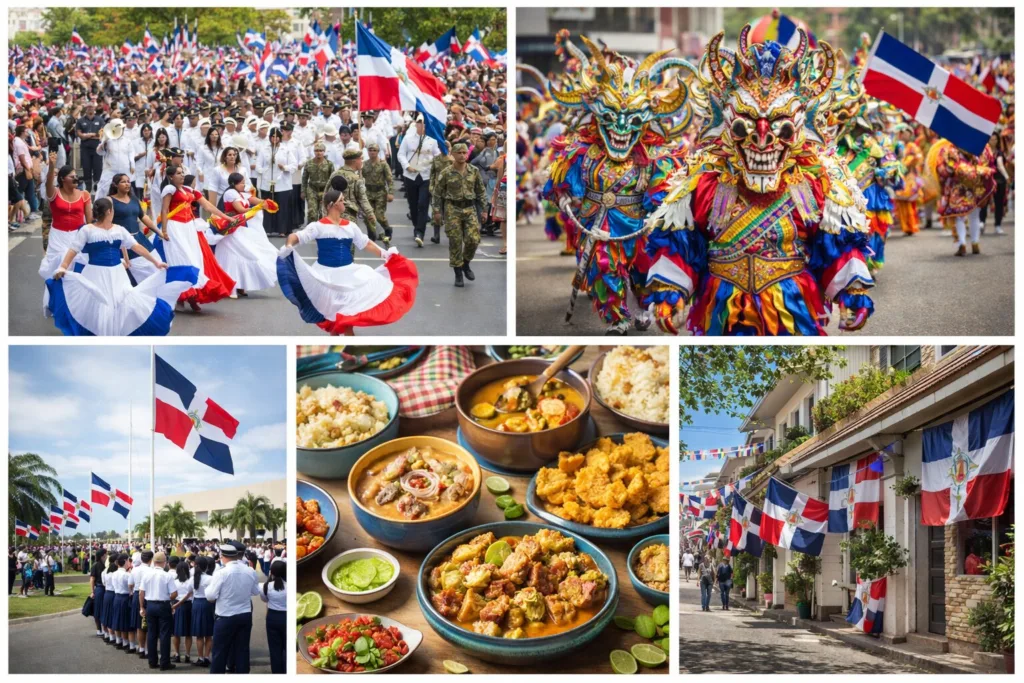
February is known as the Mes de la Patria, the Month of the Homeland. The Dominican Presidency says the celebrations end on 27 February.
On Independence Day, there is a large military parade along the Malecón. This is the seafront road in Santo Domingo, also called George Washington Avenue. The president receives a 21-gun salute and hears the national anthem.
The Presidency says the 2025 parade included the army, navy, air force and National Police, plus visiting soldiers from Colombia, Guatemala and Mexico.
Officials also lay flowers at the Altar de la Patria to honour the Fathers of the Nation. In 2026, the Ministry of Culture did this for the 182nd anniversary of independence.
Carnival time
February is carnival season too. The Dominican tourism ministry says the carnival in the town of La Vega is held every February, and it calls it the oldest in the Americas.
The star of Dominican carnival is the diablo cojuelo, a playful “limping devil”. The Dominican embassy to Belgium says this character came from Spain and appeared in Santo Domingo at the first carnival held in the Americas, in 1520.
Diablos cojuelos wear bright costumes and masks covered in little bells, ribbons and mirrors. They playfully bop people with vejigas, which are inflated animal bladders. The embassy says the Dominican version mixes Spanish traditions with the country’s strong African heritage.
The 2026 National Carnival Parade was held on the Malecón. The Ministry of Culture says it had about 180 carnival groups. More than 9,000 performers came from every province. Groups also came from Brazil, Puerto Rico, Colombia and Ghana.
Words to know
Independence: when a country is free to rule itself.
Patria: the Spanish word for homeland.
La Trinitaria: the secret group that Juan Pablo Duarte started in 1838.
Trabucazo: the blast from an old gun that signalled independence in 1844.
Malecón: the seafront road in Santo Domingo where the big parade is held.
Diablo cojuelo: the playful “limping devil” who stars in carnival.
Friends across the sea
The United States recognised the Dominican Republic as a country on 17 September 1866. The Office of the Historian says the two countries set up formal diplomatic ties in 1884.
Three things people get wrong
27 February is not independence from Spain. It marks independence from Haiti in 1844. Freedom from Spain was won back in 1865.
Duarte did not fire the famous shot. He was abroad; Mella fired the trabucazo.
The story is not about hating Haiti. Haiti won its own freedom in 1804, and the two nations share one island.
Did you know? Juan Pablo Duarte, honoured as the Father of the Nation, was abroad on the night independence was declared.
Try it
Draw the Dominican flag and colour it in. Label what the red, blue and white each stand for.
Knowledge check
From which country did the Dominican Republic declare independence in 1844?
Show answer
Haiti.
Who fired the trabucazo on 27 February 1844?
Show answer
Matías Ramón Mella.
Frequently asked questions
Why is Dominican Independence Day on 27 February?
On 27 February 1844, the Dominican Republic declared independence from Haiti, after 22 years of Haitian rule of the whole island.
Who are the Fathers of the Nation?
Juan Pablo Duarte, Francisco del Rosario Sánchez and Matías Ramón Mella. Their remains lie together at the Altar de la Patria in Santo Domingo.
What was La Trinitaria?
A secret society founded by Juan Pablo Duarte on 16 July 1838. It became the movement that led to independence.
What do the colours of the Dominican flag mean?
The Presidency says red stands for the blood of patriots, blue for the sky and God’s protection, and white for peace and unity.
Is Dominican Independence Day independence from Spain?
No. 27 February marks independence from Haiti. Independence from Spain was won back in the Restoration War of 1863 to 1865.
How is Dominican Independence Day celebrated?
With a military parade on the Malecón in Santo Domingo, flowers at the Altar de la Patria, flags and February carnival celebrations.
Sources
- US Office of the Historian: the Dominican Republic — independence from Haiti in 1844, Spanish rule in 1861, the restoration in 1865 and US recognition; its Haiti pages were also used
- Comisión Permanente de Efemérides Patrias (Dominican government): Juan Pablo Duarte — Duarte, La Trinitaria and his exile and return; its pages on Sánchez and Mella were also used
- Presidency of the Dominican Republic: national symbols — the flag, its colours, the coat of arms, the motto and the anthem; its report on the 2025 parade was also used
- Dominican Ministry of Culture: flowers at the Altar de la Patria — the period of Haitian rule, the city gates and the anniversary; its report on the 2026 carnival parade was also used
- Dominican Foreign Ministry: Restoration Day — the Grito de Capotillo and 16 August; the ministry’s embassy page on the diablo cojuelo was also used
- Dominican Ministry of Tourism: La Vega — the February carnival in La Vega