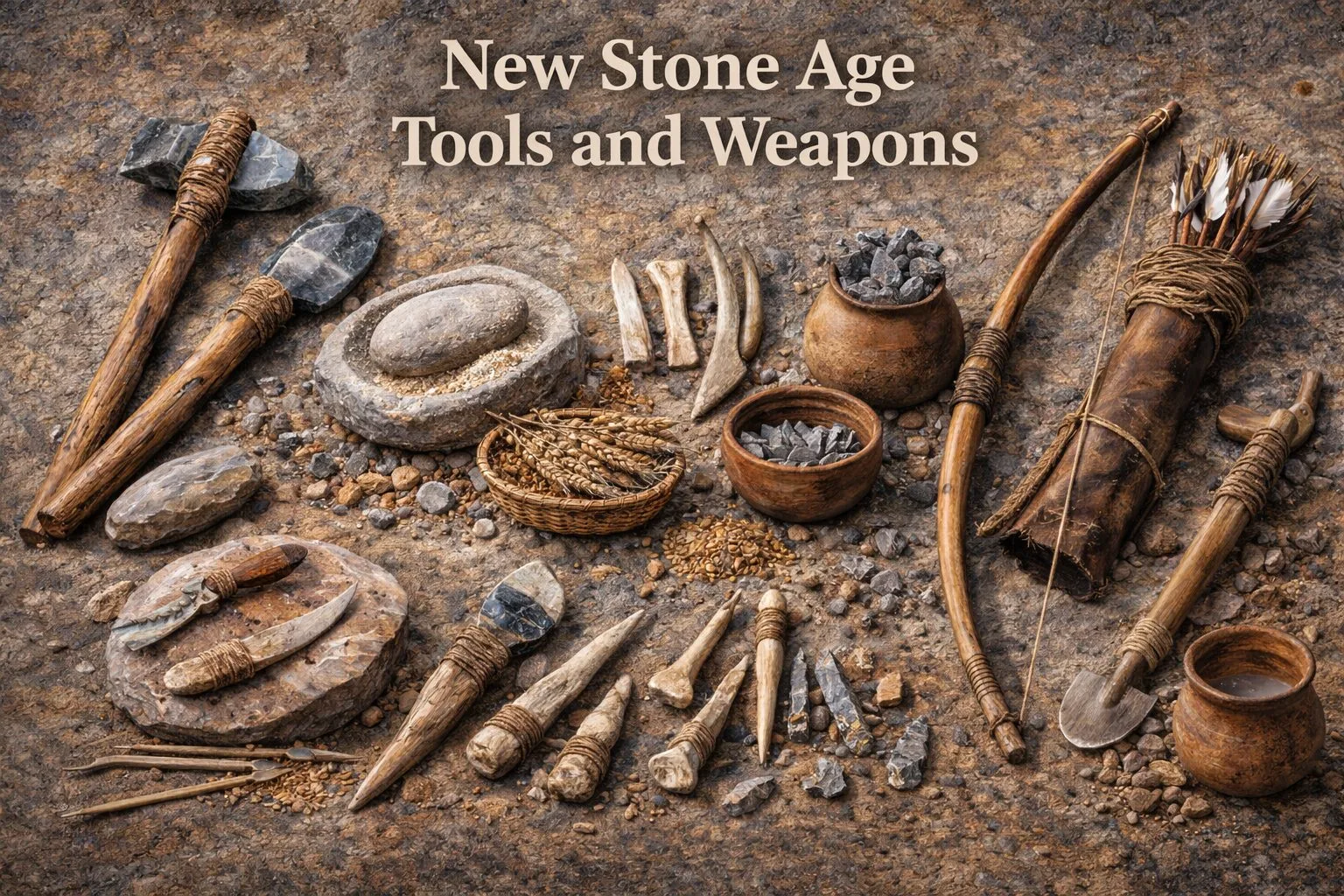
The New Stone Age, or Neolithic, was when people first became farmers, starting about 10,000 BCE in the Middle East and about 4000 BCE in Britain. Its tools included polished stone axes for clearing land, sickles for harvesting, grinding stones for flour and flint-tipped arrows. People also made pottery and cloth, and built monuments like Stonehenge.
New Stone Age tools quick facts
- The Neolithic began about 10,000 BCE in the Middle East.
- Farming reached Britain from about 4000 BCE.
- New Stone Age people shaped tools by grinding and polishing hard stone.
- At Grime’s Graves in Norfolk, people dug mines to reach good flint.
- Stonehenge was built in stages between about 3000 and 1520 BCE.
What was the New Stone Age?
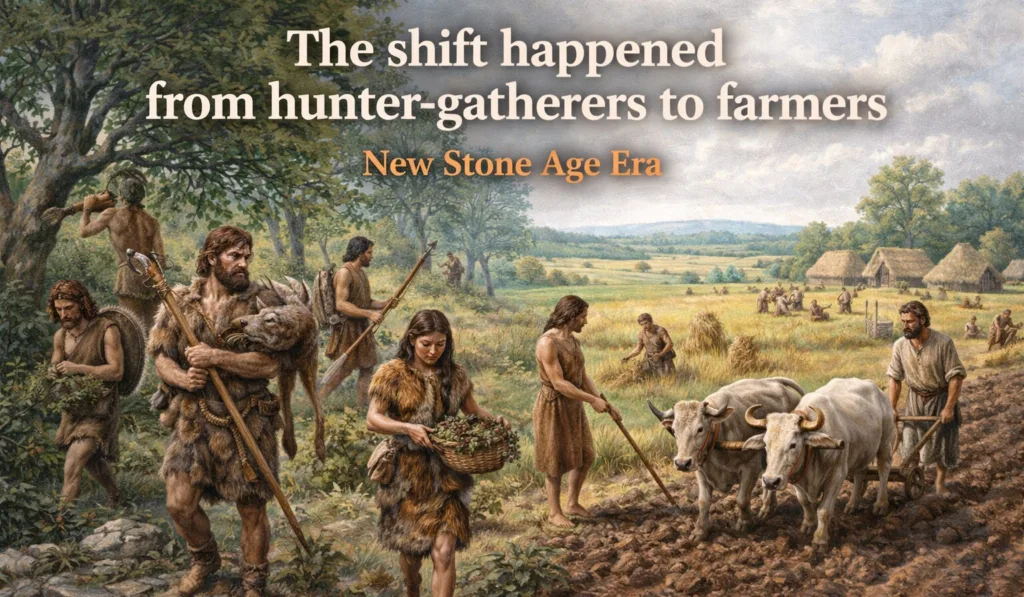
The New Stone Age was the last part of the Stone Age. Its scientific name is the Neolithic, from Greek words meaning “new stone”.
It was the time when people first became farmers. Instead of moving from place to place to hunt animals and gather wild plants, they began to grow crops, keep animals and live in villages all year round.
That change was so important that it is sometimes called the Neolithic Revolution. It changed what people ate, where they lived and the tools they needed.
For the whole story of the Stone Age, read our Stone Age facts for kids.
When was the New Stone Age?
The New Stone Age did not start at the same time everywhere. Different parts of the world began farming at different times.
The earliest New Stone Age began about 10,000 BCE in the Middle East. The first signs of farming there date to about 9500 BCE. By 7000 BCE, farming villages were well established in the river valleys of what are now Iraq and Iran, and in what are now Syria, Israel, Lebanon and Jordan.
Farming reached Greece by about 7000 BCE and slowly spread north across Europe. It arrived in Britain from about 4000 BCE.
In the Indus River valley, in what is now Pakistan and India, New Stone Age ways of life had appeared by 5000 BCE. In China, farmers grew wheat and millet in the north and rice in the south.
| Place | Farming began around |
|---|---|
| The Middle East | 9500 BCE |
| Greece | 7000 BCE |
| The Indus River valley | by 5000 BCE |
| Britain | 4000 BCE |
The first farmers
The earliest farmers, in the Middle East, grew barley and wheat. They kept sheep and goats, and later cattle and pigs.
Farming meant people could grow more food in one place, so they no longer needed to follow wild animals and plants. They could stay put, build proper houses and live in villages.
Growing food also gave some people time to do other jobs. In farming villages, some people could become skilled craftworkers, making pots, cloth or tools for others.
Taming animals
New Stone Age people did not just grow plants. They also tamed animals and kept them on their farms. This is called domestication.
In the Middle East, the first farm animals were sheep and goats, followed by cattle and pigs. In the Indus River valley, farmers came to rely on humped cattle, which were probably first tamed there.
Farm animals gave people meat, milk, wool and leather, and cattle could pull heavy loads. Having animals close by also meant that people did not have to go out hunting every time they needed food.
Farming spread slowly
Farming did not sweep across the world all at once. It spread from the Middle East into Europe along two main routes: one across Turkey and Greece into central Europe, and the other across Egypt and North Africa to Spain.
It took about four thousand years for farming to spread right across Europe. In Britain and Scandinavia, the change was not complete until after 3000 BCE. For a long time, some people farmed while their neighbours still hunted and gathered.
New Stone Age tools
Stone Age people had been making tools for millions of years by chipping stone. You can read about those in our guide to Old Stone Age tools and weapons.
New Stone Age people still used chipped stone tools. But they also learned something new. They shaped hard stones by grinding and polishing them against other rocks.
Polished tools were smooth and strong, and their edges were less likely to chip. It was slow work, but a good polished axe could last for years.
Polished stone axes were fitted onto wooden handles. Farmers used them to cut down trees and clear land for their fields and villages.
Sickles were curved tools for cutting crops. Sharp stone blades were fixed into a handle of wood or bone.
Grinding stones were used to turn grain into flour. Grain was placed on a flat stone and crushed with a smaller stone rubbed back and forth.
Chisels and polishing tools were used for shaping wood and other materials. Museums hold New Stone Age axe heads, chisels and polishing stones found as far apart as Greece and Britain.
New Stone Age weapons
Even after farming began, people still hunted. They also needed to protect their animals and crops.
They used bows and arrows, with arrowheads made from sharp flakes of flint. They used spears too, and polished stone axes could be used as weapons as well as tools.
Many of the same tools were used for work and for fighting. An axe that cut down a tree could also be used to defend a village.
Mining for flint
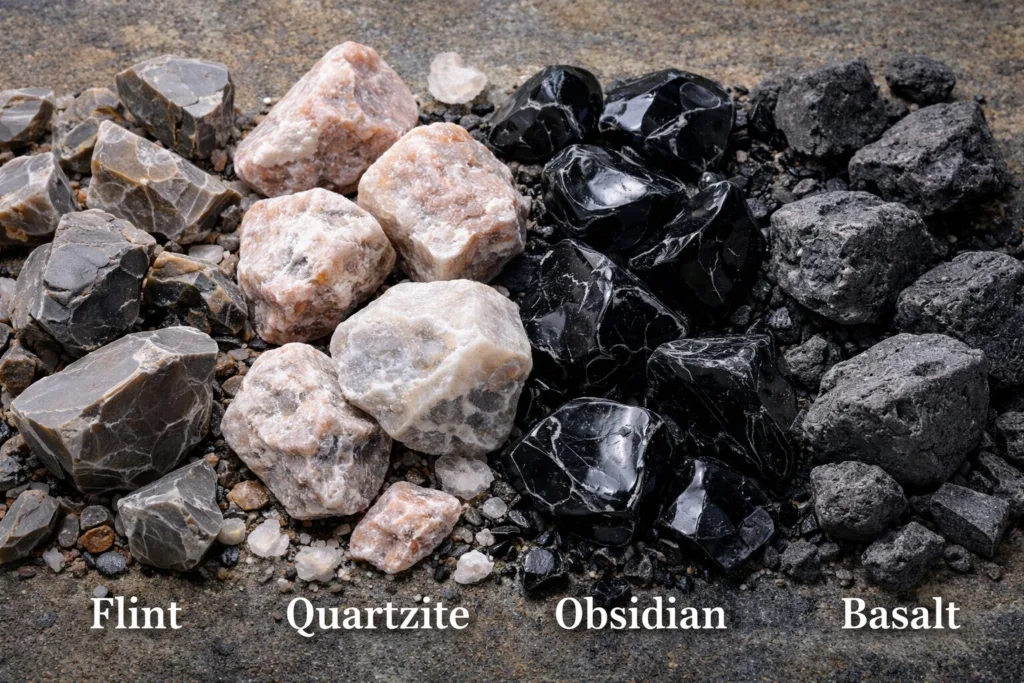
Flint is a hard stone that breaks with very sharp edges, so it was perfect for tools. The best flint was often buried deep in chalk.
To reach it, New Stone Age people dug mines. At Grime’s Graves in Norfolk, England, you can still see the hollows left by hundreds of flint mine shafts.
Good flint and fine polished axes were valuable. Some were carried and traded over long distances, far from where the stone was found.
Pots and cloth
Pottery and weaving are two of the crafts that appeared in the New Stone Age.
People who move around a lot find heavy clay pots hard to carry. But farmers living in one place could make and use pottery to store grain, cook food and carry water.
Pieces of broken pottery are among the most common things archaeologists find from this time. People also learned to weave cloth, spinning thread from plant fibres or animal wool. Cloth clothes were lighter than animal skins, and could be made from crops and animals they looked after themselves.
Great monuments
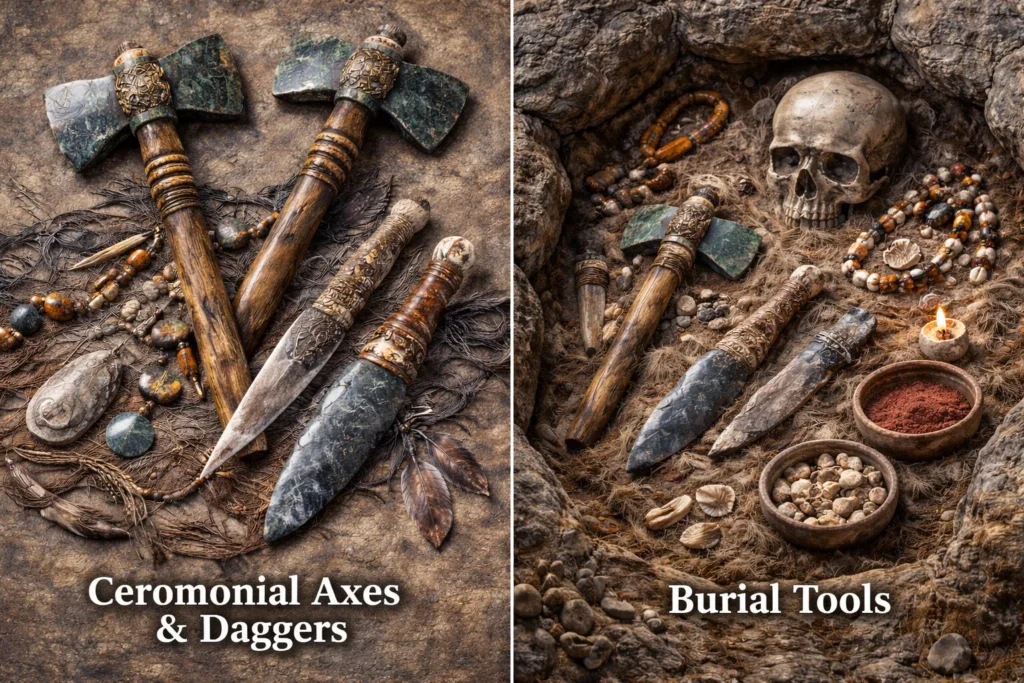
New Stone Age people also built huge monuments. In Britain they built stone circles, henges, which are circular banks and ditches, and long barrows, which were burial mounds.
In Ireland, Newgrange is a great mound with a passage tomb inside, built in the New Stone Age.
The most famous of all is Stonehenge, on Salisbury Plain in England. It was built in stages between about 3000 and 1520 BCE, as the New Stone Age gave way to the Bronze Age. Its smaller stones, called bluestones, were brought from South Wales, 160 to 240 km away.
Stonehenge was lined up with the Sun. Its entrance points towards the midsummer sunrise, and the other way towards the midwinter sunset. Nobody knows exactly what it was for, but it was probably a religious site.
The end of the Stone Age
The New Stone Age ended when people learned to make tools from metal. By mixing copper with tin, they made bronze, which was harder than copper and easier to shape than stone.
Stone tools did not vanish overnight, though. For a long time, people used stone and metal side by side. In Asia and Europe, the New Stone Age was followed by the Bronze Age, and later by the Iron Age. Find out what came next in our guide to Iron Age tools and weapons.
To compare all the Stone Age tools, see our guide to Stone Age tools and weapons.
Three things people get wrong
The New Stone Age did not start everywhere at once. It began about 10,000 BCE in the Middle East, but not until about 4000 BCE in Britain.
New Stone Age people did not stop using chipped stone tools. They kept using them, alongside their new polished tools.
Stonehenge was not built all at once. It was built in stages over about 1,500 years.
Did you know? Stonehenge’s smaller stones, the bluestones, were brought from South Wales, 160 to 240 kilometres away.
Try it
Rub a rough pebble against a flat stone or a paving slab for five minutes. Look at how slowly it smooths. That gives you an idea of how long it took to polish a stone axe.
Knowledge check
What new way of shaping tools did New Stone Age people learn?
Show answer
Grinding and polishing hard stone against other rocks.
Why was pottery useful for farmers?
Show answer
Because farmers stayed in one place, so they could store grain, cook and carry water in heavy clay pots.
Frequently asked questions
What was the New Stone Age?
The New Stone Age, or Neolithic, was the last part of the Stone Age, when people began farming, keeping animals, living in villages and making pottery and cloth.
When did the New Stone Age start?
The New Stone Age started about 10,000 BCE in the Middle East. It began at different times elsewhere, reaching Greece about 7000 BCE and Britain from about 4000 BCE.
What tools did people use in the New Stone Age?
New Stone Age people used polished stone axes, sickles for cutting crops, grinding stones for making flour, chisels, and chipped flint tools such as arrowheads.
What weapons were used in the New Stone Age?
New Stone Age people used bows and arrows with flint arrowheads, spears, and polished stone axes, which could be used as weapons as well as tools.
What is the difference between Old and New Stone Age tools?
Old Stone Age tools were made by chipping stone. New Stone Age people also ground and polished stone to make smoother, stronger tools such as polished axes.
Was Stonehenge built in the New Stone Age?
Stonehenge was begun in the New Stone Age. It was built in stages between about 3000 and 1520 BCE, as the New Stone Age gave way to the Bronze Age.
Sources
- Encyclopaedia Britannica: Neolithic — what the Neolithic was, when it began in different regions, early farming, tools and crafts
- English Heritage: prehistory — the arrival of farming in Britain, monuments, Stonehenge and Grime’s Graves
- Encyclopaedia Britannica: Stonehenge — when and how Stonehenge was built, its stones and its alignment with the Sun