How to make a Stone Age weapon quick facts
- In 2025 the famous Schöningen spears were re-dated to about 200,000 years old, half the age first given.
- Neanderthals made glue by heating birch bark about 200,000 years ago.
- At Sibudu Cave, 70,000-year-old glue was a mix of tree gum, red ochre and sometimes beeswax.
- The oldest known poison arrows are about 60,000 years old and come from South Africa.
- Ötzi the Iceman was carrying an unfinished bow 1.82 metres long when he died.
How a Stone Age weapon was made, at a glance
Nobody in the Stone Age bought a spear. Every hunter, or someone they knew, made one by hand. It took several different skills, a good eye for stone and some clever chemistry.
This guide follows the steps in order. It starts with finding the right rock and ends with a finished spear, arrow or axe. Each step is backed by real finds from archaeologists, the scientists who study the past through the things people left behind.
| Step | What people did | Tools they used | Oldest evidence |
|---|---|---|---|
| 1. Find stone | Chose rock that breaks cleanly, like flint | Hands, antler picks for mining | Flint mines about 4,600 years old |
| 2. Knap it | Chipped the stone into a sharp shape | A hammerstone | At least 2.6 million years ago |
| 3. Finish the edge | Took off tiny flakes to sharpen it | Antler or bone tools | Ötzi carried one, about 5,300 years ago |
| 4. Make a shaft | Carved a straight wooden pole | Sharp stone flakes | Wooden spears about 400,000 years old |
| 5. Fix the point | Glued and tied the point to the shaft | Birch tar, tree gum, plant fibre | Hafted points about 500,000 years old |
The word for step 5 is hafting. A haft is a handle or shaft, and hafting means fixing a stone point or blade onto one. It turned a sharp stone into a real weapon.
Why you should never try knapping at home
Making stone tools is called knapping. It looks simple. It is not safe for children.
Every blow sends off flakes of stone as sharp as glass. They can fly into your eyes or cut your hands badly. Breathing in fine flint dust over many years also harmed the lungs of people who knapped for a living in England.
People who knap today are trained adults. They wear safety glasses, thick gloves and a leather pad across their lap. If you want to see it done, look for a demonstration at a museum or a heritage site. The model in the Try it box on this page shows you how a spear fits together with no sharp stone at all.
Step 1: finding the right stone
Not just any rock will do. Most stones crumble or split along lines when you hit them. Toolmakers wanted stone that breaks like thick glass.
Flint, chert and obsidian all do this. Flint and chert are made of quartz crystals too tiny to see. Obsidian is glass made naturally by volcanoes. The University of Texas explains that when you strike stones like these, the force spreads out in a curved ripple from the spot you hit. That is why a flake comes off with a smooth, curved face and a razor edge.
The best flint was often buried deep underground. So in the New Stone Age, people dug mines for it. At Grime’s Graves in Norfolk, English Heritage counts 433 mines and pits. Some shafts go down 13 metres (43 feet). That is deeper than a four-storey building is tall.
The miners dug with picks made from red deer antlers. Mining there began around 2600 BC and stopped around 2100 BC. The shiny black flint they reached was turned into arrowheads and axes. You can read more about that period in our guide to New Stone Age tools and weapons.
Step 2: knapping the stone into shape
Knapping starts with a hammerstone. This is a hard, rounded pebble that fits in the hand. The knapper holds a lump of flint, called a core, and strikes its edge with the hammerstone.
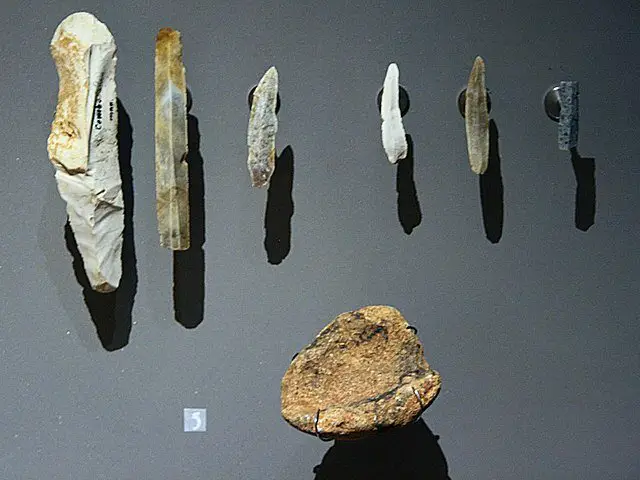
A sharp flake breaks away. Where the blow landed, the flake has a small swelling that experts call a bulb of percussion. Finding that bulb is one way archaeologists can tell a flake was made by a person and not broken by nature.
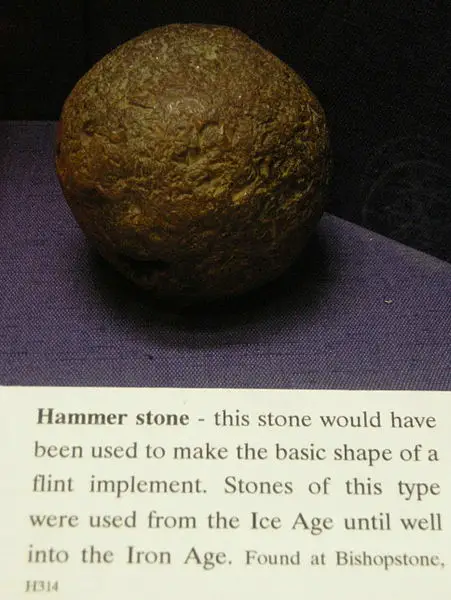
Some flakes were useful straight away as knives. For a weapon point, the knapper kept going. Blow by blow, they turned the core into the shape they had pictured before they started.
This is very old knowledge. The Smithsonian’s Human Origins Program says stone toolmaking began at least 2.6 million years ago. Some scientists put it even earlier, at about 3.3 million years, because of finds in Kenya. The oldest tools are covered in our guide to Old Stone Age tools and weapons.
Step 3: finishing the edge with antler and bone
A hammerstone is good for rough shaping. It is too heavy for fine work. So knappers switched to a soft hammer made of antler, bone or wood.
A soft hammer takes off thinner, flatter flakes. It lets the maker thin a point without snapping it.
The last stage is pressure flaking. Instead of hitting the stone, the knapper presses a pointed tool hard against the edge. A tiny flake pops off. Done again and again, this gives a neat, sharp, even edge.
Ötzi, a man who died in the Alps about 5,300 years ago, carried one of these tools. The South Tyrol Museum of Archaeology describes it as 12 centimetres long, about the length of a pencil, with a piece of antler set into a wooden handle. He could have sharpened his flint tools anywhere he stopped.
Baking stone to make it easier to work
Some Stone Age toolmakers had a trick for poor stone. They cooked it.
At Pinnacle Point in South Africa, people lived about 72,000 years ago. The local stone, silcrete, was hard to shape. Researchers found that the people there buried it under a fire and dug it up the next day. The heat changed it into a deep red stone that flaked beautifully, according to a 2009 report on the study.
That is a lot of planning. You have to gather the stone, build the fire, wait a day, and only then start knapping.
Step 4: making the wooden shaft
The oldest weapons of all were wooden. Wood rots, so very few survive. The ones that do were saved by luck, sealed in wet mud where there was no air.
The Clacton spear point was found in Essex in 1911. It is about 400,000 years old. The University of Reading and the Natural History Museum call it the world’s earliest known weapon. Scans of the wood show its makers understood how the grain would behave.
A much bigger set of wooden spears was found at Schöningen in Germany in the 1990s. The spears were long, balanced and pointed. For years they were said to be about 400,000 years old. That figure was later cut to about 300,000.
Then, in May 2025, a team from the University of York and the University of Mainz dated them again. This time they tested tiny snail shells from the same layer as the spears. The new answer is about 200,000 years. Many books and websites still give the old date.
The new date means the spears were probably made by early Neanderthals. The hunters at Schöningen killed at least 50 horses. The York team says this shows people working together and planning, not lonely brutes.
Step 5: fixing the point to the shaft
A plain wooden point works. A stone point cuts far deeper. Joining the two was one of the great inventions of the Stone Age.
The oldest known stone spear tips come from Kathu Pan in South Africa. They are about 500,000 years old. That is around 200,000 years earlier than scientists had expected.
How can anyone tell a loose stone was once on a spear? Researchers at Arizona State University made copies of the points and fixed them to shafts. They fired them from a crossbow into an animal carcass. Then they compared the damage on their copies with the damage on the ancient points. The marks matched.
A point had to be fixed on tightly, or it would twist off on impact. Stone Age makers used two things together: glue and binding.
Stone Age glue: birch tar and tree gum
Neanderthals made glue from birch bark. When birch bark is heated with very little air, it gives off a sticky black tar. Leiden University reports that the oldest known examples come from Campitello in Italy and are about 200,000 years old.
Another piece, a flint with tar still on it, was found in the sea off the Dutch coast in 2016. It is about 50,000 years old. Leiden explains that making tar meant doing the right steps in the right order. You could call it early chemistry.
In Africa, people used a different recipe. At Sibudu Cave in South Africa, about 70,000 years ago, toolmakers mixed tree gum with ground red ochre, a kind of coloured earth. Sometimes they added beeswax. A study in the journal PNAS found these mixes still stuck to the stone tools.
When the researchers copied the glue, they dried it near a fire for about a minute and a half. Too much heat spoiled it. Too little left it soft. The Sibudu toolmakers must have learned that by practice.
| Glue | Made from | Where found | How old |
|---|---|---|---|
| Birch tar | Heated birch bark | Campitello, Italy | About 200,000 years |
| Birch tar | Heated birch bark | North Sea, off the Netherlands | About 50,000 years |
| Gum and ochre | Tree gum, red ochre, sometimes beeswax | Sibudu Cave, South Africa | About 70,000 years |
Throwing further with a spear-thrower
A hand-thrown spear only goes so far. Later hunters found a way to send a light spear, called a dart, much further and harder.
The answer was the spear-thrower, also called an atlatl. It is a stick about 60 centimetres (2 feet) long with a hook at the back. The end of the dart rests against the hook.
The hunter swings the spear-thrower like a longer arm. An expert at Harvard’s Peabody Museum explains that this extra leverage greatly increases the force of the throw. It let hunters strike big animals, such as mammoths, from a safer distance.
Nobody is sure exactly when spear-throwers were first made. Wooden ones rot away, and studies of the oldest antler hooks disagree about their age.
The first bows and arrows
A bow stores the energy of your arms and releases it all at once. It could fire small, light arrows fast and far.
Bows are made of wood and string, so they almost never survive. Scientists look for arrowheads instead, and for the damage that only a fast arrow leaves.
At Grotte Mandrin in France, a team found hundreds of tiny stone points about 54,000 years old. They made copies and tested them on a goat carcass. Shot from a bow, the copies went right through. Thrown by hand, they did not even break the skin. So the tiny points must have been arrowheads.
There is older evidence in Africa. A bone point from Sibudu Cave, about 61,700 years old, has tiny cracks that match an arrow strike. In January 2026, scientists reported the oldest known poison arrows. Five quartz arrowheads from Umhlatuzana Rock Shelter in South Africa, about 60,000 years old, still carried poison from a plant called gifbol.
In Sri Lanka, the Max Planck Institute reports bone arrow points about 48,000 years old at Fa-Hien Lena cave. The people there used them to hunt monkeys and squirrels in the rainforest.
The oldest bows found so far come from Holmegaard in Denmark. The National Museum of Denmark says they date to about 7000 BC and were made of elm. Each was about as long as a man is tall. The makers used the springy outer wood on one side and the hard inner wood on the other.
What Ötzi the Iceman carried
Ötzi gives us a rare look at a complete weapon kit. He died high in the Alps around 3300 BC, and ice kept his body and belongings for over 5,000 years.
He lived at the very end of the Stone Age, when the first copper tools were appearing. His kit mixes old and new: a copper axe, and flint for almost everything else.
| Item | What it was made of | Why it is interesting |
|---|---|---|
| Bow | Yew wood, 1.82 m (6 ft) long | Unfinished, with no string yet |
| Quiver | Deer hide | Held 12 shafts but only 2 finished arrows |
| Arrowheads | Flint | Tied on with plant fibre |
| Arrow feathers | Feather, birch tar, fibre | Glued and bound so the arrow flew straight |
| Bowstring | Animal fibre, about 2 m long | Carried rolled up in the quiver |
| Dagger | Flint blade, ash wood handle | 13 cm long, about the length of a hand |
His bow is taller than most grown-ups. It still needed to be rubbed down and polished before it could be strung. The South Tyrol Museum of Archaeology says a copy of it has killed at 30 to 50 metres in tests.
Why was Ötzi carrying an unfinished bow and mostly unfinished arrows? Nobody knows. It is one of the open questions about him.
Polished stone axes of the first farmers
When people began farming, they needed to clear forests. That called for a tougher tool: the polished stone axe.
Instead of only chipping the stone, makers ground and polished it smooth. It took far longer than chipping. The finished axe could fell trees, and it could also be used as a weapon.
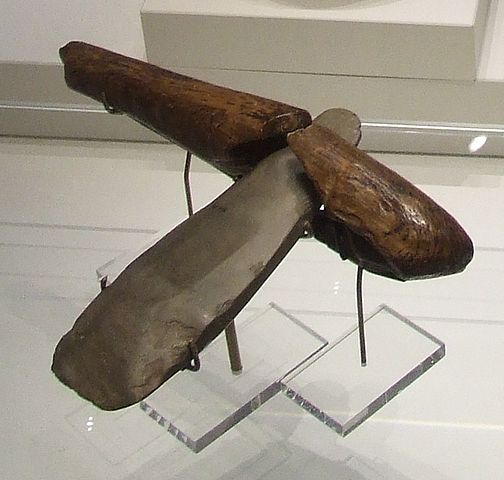
Some of the best stone came from remote places. Bridport Museum describes an axe made about 6,000 years ago from greenstone quarried high on Pike O’Stickle in the Lake District. Axes from there spread across Britain by land, river and sea.
Others came from much further away. Salisbury Museum holds an axehead made from stone quarried in the Italian Alps between 4000 and 3000 BC. It is so highly polished that it may never have been used. Axes like this seem to have stood for power and were traded over long distances.
Metal slowly replaced stone after this. Our guides to the Bronze Age and to Iron Age tools and weapons take the story on from here.
How archaeologists work out how weapons were made
No Stone Age maker left instructions. Everything in this guide has been pieced together from clues.
| Method | What it means | Example |
|---|---|---|
| Experimental archaeology | Making copies and testing them | Crossbow tests at Kathu Pan, arrow tests at Grotte Mandrin |
| Use-wear | Studying the tiny damage a tool gets from use | Impact cracks on the Sibudu bone point |
| Residue analysis | Testing what is stuck to a tool | Gum and ochre glue at Sibudu, poison at Umhlatuzana |
| Dating | Working out how old something is | Snail shells used to re-date the Schöningen spears |
Answers change as the methods improve. The Schöningen spears lost half their age in 30 years of study. That does not mean the scientists were careless. It means they kept checking.
If you are doing a school project, the guides to Stone Age tools, Stone Age people and Stone Age food show what these weapons were used for day to day.
Three things people get wrong
“Stone Age people were not very clever.” Making birch tar, mixing gum with ochre, or baking stone to improve it all took planning and careful steps. The team that re-dated the Schöningen spears says the Neanderthals who made them were cooperative hunters, not the brutish loners of old pictures.
“Stone Age spears were just sharpened sticks.” Some were. But hunters were fixing stone points onto wooden shafts about 500,000 years ago at Kathu Pan. Later they added glues, spear-throwers and bows.
“Stone Age weapons were mostly for fighting.” Nearly all the evidence points to hunting. The Schöningen spears were found with horse bones. The Sri Lankan arrows were for monkeys and squirrels. People did fight, but for most of the Stone Age a weapon was mainly a way to get food.
Did you know? At Grotte Mandrin in France, copies of 54,000-year-old stone points went right through a goat carcass when shot from a bow. Thrown by hand, the same points did not even break the skin.
Try it
Make a safe model spear. Cut a triangle from card for the point and tape it to the end of a pencil. Now wind string or wool tightly around the join, the way Stone Age hunters tied points on with plant fibre. Wiggle the point. Does it stay put? Try it with only tape, then with only string, and see which holds better.
Knowledge check
What does hafting mean?
Show answer
Fixing a stone point or blade onto a wooden shaft or handle, usually with glue and binding.
Why did toolmakers choose flint and obsidian?
Show answer
They break like glass, so a blow knocks off flakes with smooth faces and very sharp edges.
Frequently asked questions
How did Stone Age people make weapons?
Stone Age people made weapons by chipping flint or similar stone into a sharp point, then fixing it to a wooden shaft with birch tar or tree-gum glue and tying it tight with plant or animal fibre.
What is knapping?
Knapping is the skill of shaping stone by striking it with a hammerstone, then with softer antler or bone tools, so that sharp flakes break off. It is dangerous and is only done by trained adults.
What glue did Stone Age people use?
Stone Age people used birch tar, made by heating birch bark, from about 200,000 years ago. In Africa, toolmakers at Sibudu Cave mixed tree gum with red ochre and sometimes beeswax about 70,000 years ago.
What is the oldest spear ever found?
The Clacton spear point from Essex, about 400,000 years old, is the oldest known wooden spear. The Schöningen spears in Germany were re-dated in 2025 to about 200,000 years old.
When were bows and arrows invented?
Bows and arrows were in use in Africa by about 60,000 years ago, and probably earlier. Tiny arrowheads show them in France about 54,000 years ago. The oldest surviving bows, from Denmark, date to about 7000 BC.
Did Stone Age people use weapons for war?
Stone Age weapons were used mainly for hunting. Most finds come with the bones of animals such as horses, monkeys and squirrels, although people sometimes fought as well.
Sources
- University of York: new age for the Schöningen spears — the 2025 re-dating of the spears to about 200,000 years and the horse hunt at the site
- Arizona State University: oldest spear points date to 500,000 years — the hafted spear tips from Kathu Pan and the crossbow tests
- PNAS (Wadley and colleagues, 2009): compound glues at Sibudu Cave — the gum, ochre and beeswax glues and how they were dried by the fire
- South Tyrol Museum of Archaeology: Ötzi’s equipment — Ötzi’s bow, arrows, bowstring, dagger and retoucher
- English Heritage: history of Grime’s Graves — the number and depth of the flint mines, the antler picks and the dates of mining
- Smithsonian Magazine: archery in Europe 54,000 years ago — the Grotte Mandrin arrowheads and the goat-carcass test; its report on the Umhlatuzana poison arrows was also used