
Cave Paintings in the Stone Age quick facts
- Many stories of hunts, animals and family were painted onto walls in caves.
- Stone Age cave paintings are among the earliest forms of human communication and have been found on cave walls across Europe, Africa, and Asia.
- Keep reading to learn how, why, and where these mysterious artworks were made and what story they represent.
- Most cave paintings were created during the Upper Paleolithic Period, from 40,000 to 10,000 BCE.
When Were Cave Paintings Made?
Most cave paintings were created during the Upper Paleolithic Period, from 40,000 to 10,000 BCE. These ancient artworks connect directly to human evolution, created by Homo sapiens and possibly the Neanderthals. These paintings represent humanity’s first attempts to leave a lasting mark on the world and among the earliest discovered examples are:
- Chauvet Cave (France): over 30,000 years old.
- El Castillo Cave (Spain): contains red dots over 40,000 years old.
- Sulawesi (Indonesia): features hand stencils that date back to 45,000 years old.
What Were Cave Paintings Made Of?
Cave paintings were primarily made of various materials for different purposes like:
- Brushes were made from materials like:
- Sticks
- Animal hair
- Feathers
- Moss
- Natural pigments were used for color, like:
- Hematite
- Manganese
- Clay
- Animal fat (from hunted animals)
- Red/yellow ochre (iron oxide).
- Charcoal (burned wood)
The caves were lit through burned wood and animal fat was primarily mixed with plant sap to create a mix of colors. It is also predicted that stencils were used like artists blew pigment through hollow bones to create a unique design.
What Did Stone Age Cave Paintings Display?
The subject and themes displayed in stone age cave paintings were varied among these symbols and things:
- Animals like bison, horses, mammoths, deer, and lions have been found in cave paintings like in Altamira (Spain), realistic bison were painted in motion. Another example of animals in cave paintings is the Lascaux Cave, France where there are 2,000 animal images.
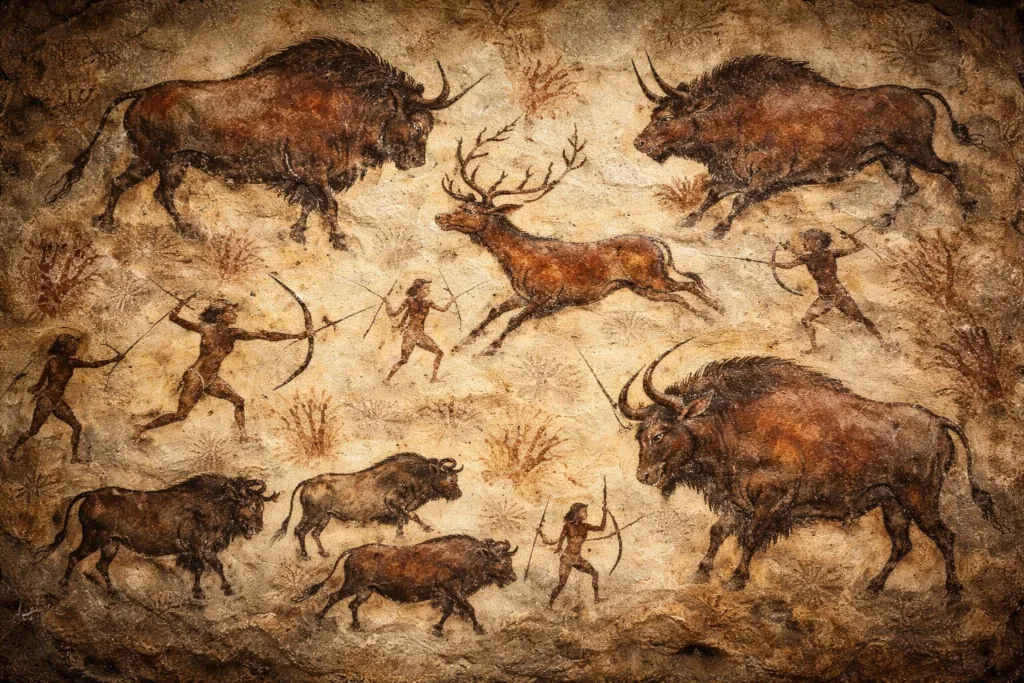
- Human figures that were displayed as stick-like hunters or dancers, this could be portraits of families or drawn for respecting elders and important members of tribes
- Symbols like dots, spirals, handprints were found often in stone age cave paintings
- Scenes like hunting, rituals and movement were found in cave paintings that show the complex way of thinking of the ancient civilizations and people.
Why Did Stone Age People Paint in Caves?
The true purpose behind cave paintings still remains as one of the most intriguing mysteries posed for archaeologists. Though scientists have developed several compelling theories that help us understand the purpose behind cave paintings like:
- Rituals and magic: The stone age people could have drawn paintings of animals like bison, mammoths, etc. for successful hunts.
- Spiritual or religious expression: According to shamanic theory of caves deep, dark caves were seen as entrances to spirit worlds. Shamans performed rituals, experienced altered states, communicated with ancestors or deities, and journeyed to the underworld for healing or guidance.
- Story telling and Communication: The purpose of cave paintings could have been story telling or teaching young hunters about animals through visual drawings etc.
- Expression of imagination: Archaeologists also claim that due to constant human innovation the birth of this sort of art could also be explained by art for the sake of expression
How Were Cave Paintings Made?
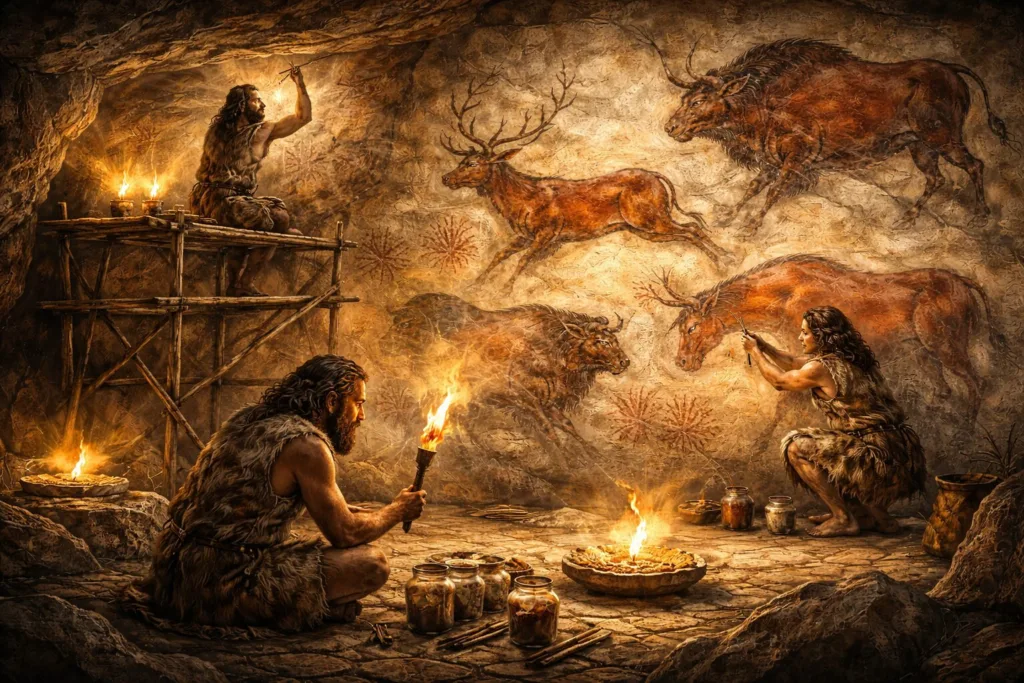
Cave paintings were painted deep inside the caves, which were lit by torches or stone lamps filled with animal fat. It is predicted that artists used scaffolds or rocks to reach high ceilings and engraved outlines before painting, and then filled them with color. The artist’s work displays how they used shading, perspective, and motion which gives us proof of intelligence and planning of the stone age people.
Who Were The Artists of The Cave Paintings?
The artists behind the cave painting artwork were mostly modern humans, the Homo sapiens while some may have been created by Neanderthals as well. Evidence suggests that different age ranges and gender made the paintings, from women to children and it is
Famous Stone Age Cave Paintings Around the World
| Cave & Details | Location | Approximate Age |
| Lascaux Cave, contains 2,000+ animal images; hall of bulls | France | 17,000 years |
| Altamira Cave, contains Multicolored bison using natural rock curve | Spain | 20,000 years |
| Chauvet Cave, contains depictions of Lions, rhinos, horses in motion | France | 30,000–32,000 years |
| El Castillo, contains Hand stencils and red dots | Spain | 40,000+ years |
| Sulawesi Cave, contains World’s oldest known hand stencil | Indonesia | 45,000+ years |
What Tools Were Used For Cave Paintings?
Stone age artists used various tools to create their beautiful cave paintings. They used flint tools to carve outlines and brushes made out of animal hair and feathers. The artists used stone lamps to provide light in the darkness, these lamps were fueled by animal fat which was multi purpose and mixed with charcoal for black paint.
What Do Cave Paintings Tell Us About Early Humans?
These ancient paintings reveal the history of our ancestors and how they processed the world a long time ago. These cave paintings display that humans had imagination, empathy, and awareness of nature, the artists of that time understood anatomy, and colors as well. These abstract cave paintings display the emotional and abstract thinking of the people.
Facts About Stone Age Cave Paintings
- Archaeologists in South Africa have found that the pigment ocher was used in caves 164,000 years ago for cave paintings!
- The earliest known cave painting of an animal is believed to be at least 45,500 years old
- Did you know artists of that time used torches and animal fat lamps as a source of light for the caves
- There have not been discoveries of rivers, trees, or mountains, but mostly depictions of animals and people.
- It is suggested that the 13,000-year-old cave art in the Cave of a Hundred Mammoths in Rouffignac, France has finger streaks made by children as well!
How Cave Paintings Are Studied Today
With technological advancements the way cave paintings were studied evolved. Archaeologists use:
- Carbon dating and uranium-series dating to determine ages.
- 3D scans and digital reconstructions preserve artwork without damage.
- DNA and soot analysis to reveal who painted them and what torches were made of.
Conclusion – Modern Importance and Preservation
Today, many caves are closed to the general public to protect the paintings from damage caused by human breath, body heat and exposure to light. However, there are replicas like Lascaux II and Altamira Museum that allow safe viewings for the public. It is important to understand that learning about ancient cave art teaches us about appreciating and respecting history and expressing ourselves creatively like the way our ancestors did. Never forget that the Stone Age may have ended, but art always lives on!
External Links
- History – What Prehistoric Cave Paintings Reveal About Early Human Life
- Smithsonian magazine – A Journey to the Oldest Cave Paintings in the World
- The History Blog – Stone Age children finger painted on cave walls
Keep learning
Continue with Miami Tribe Facts for Kids and Stone Age Facts For Kids – Learn All About Stone Age.
Did you know? Many stories of hunts, animals and family were painted onto walls in caves.
Try it
Build a short timeline or concept map for History using four important details from this guide.
Knowledge check
Cave Paintings in the Stone Age: what is one important fact from this guide?
Show answer
Many stories of hunts, animals and family were painted onto walls in caves.