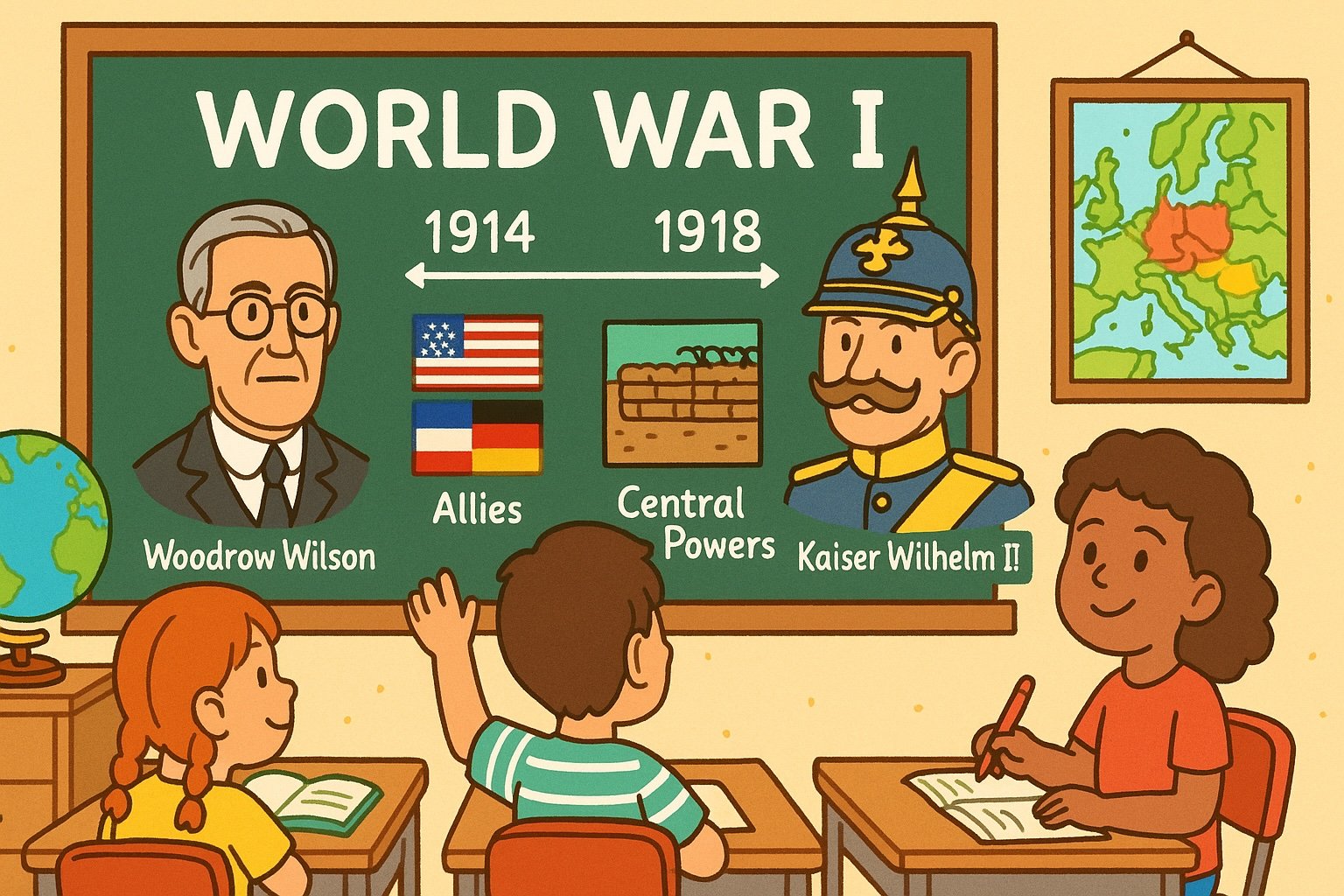
World War I was a huge war from 1914 to 1918 between the Central Powers, mainly Germany, Austria-Hungary and the Ottoman Empire, and the Allies, mainly France, Britain, Russia, Italy, Japan and, from 1917, the USA. It began after Archduke Franz Ferdinand was shot and ended with the Armistice at 11 a.m. on 11 November 1918.
World War I quick facts
- World War I lasted from 1914 to 1918.
- It began after Archduke Franz Ferdinand was shot on 28 June 1914.
- About 8.5 million soldiers died.
- The USA joined the war in April 1917.
- The fighting stopped at 11 a.m. on 11 November 1918.
What was World War I?
World War I was a huge war that lasted from 1914 to 1918. Britannica says it drew in most of the countries of Europe, along with Russia, the United States, the Middle East and other parts of the world.
At the time, people called it the Great War, because nothing like it had ever happened before. It was only called World War I later, after a second world war broke out.
Britannica says about 8.5 million soldiers died from wounds or disease, and perhaps as many as 13 million civilians died too. New weapons and ways of fighting made it far deadlier than any earlier war.
| World War I at a glance | |
|---|---|
| When | 1914 to 1918 |
| War declared | 28 July 1914 |
| Central Powers | mainly Germany, Austria-Hungary and the Ottoman Empire (Turkey) |
| Allies | mainly France, Britain, Russia, Italy, Japan and, from 1917, the USA |
| Soldiers who died | about 8.5 million |
| Fighting stopped | 11 a.m., 11 November 1918 |
| Peace treaty | Treaty of Versailles, 28 June 1919 |
Why did World War I start?
The spark came on 28 June 1914. In Sarajevo, in Bosnia, Archduke Franz Ferdinand, who was next in line to rule Austria-Hungary, was shot dead with his wife, Sophie.
Britannica says the killer was Gavrilo Princip, a young Bosnian Serb. Austria-Hungary blamed Serbia and sent it a list of harsh demands. Serbia agreed to most of them, but not all.
On 28 July 1914, Austria-Hungary declared war on Serbia. Within days, other countries were pulled in, because they had promised to defend each other.
Russia supported Serbia, and Germany supported Austria-Hungary. France was allied with Russia, and Britain joined the war after Germany invaded Belgium.
The deeper causes
The assassination was only the spark. For years, the big powers of Europe had been building up their armies and navies, competing for land and power, and forming alliances.
Strong feelings of national pride, called nationalism, also played a part. By 1914, Europe was like a pile of dry wood waiting for a match.
Who fought?
The war was fought between two groups of countries. Britannica says the Central Powers were mainly Germany, Austria-Hungary and Turkey, which was then the Ottoman Empire.
The Allies were mainly France, Great Britain, Russia, Italy and Japan. The United States joined them in 1917.
Soldiers came from all over the world, including from the colonies and dominions of the British and French empires, such as India, Canada, Australia and parts of Africa.
Life in the trenches
On the Western Front, which ran through Belgium and France, both sides dug long lines of trenches facing each other. The land between them was called no man’s land.
Life in the trenches was miserable. Soldiers lived with mud, rats, lice and freezing cold, and they could be hit by shells at any time.
Attacks usually meant climbing out of the trench and running across no man’s land towards enemy machine guns and barbed wire. Huge numbers of soldiers died trying to gain just a few metres of ground.
Soldiers took turns in the front line, then moved back to rest in safer trenches behind.
New weapons
World War I saw many new and terrible weapons. Machine guns could fire hundreds of bullets a minute, and heavy guns called artillery fired shells from far away.
Poison gas was used for the first time on a large scale, and soldiers had to carry gas masks. Tanks were invented to cross trenches and barbed wire.
Aeroplanes were used to spy on the enemy and, later, to fight each other and drop bombs. Under the sea, German submarines called U-boats attacked ships.
Britannica says these new technologies are a big reason why so many more people died than in any earlier war.
The Christmas truce
In December 1914, something surprising happened on parts of the Western Front. On and around Christmas Day, some British and German soldiers stopped fighting.
They climbed out of their trenches, met in no man’s land, swapped small gifts and sang carols. In some places, they even played football.
The truce was not planned by the generals, and it did not last. But it showed that the soldiers on both sides were ordinary people, many of whom wished the war would end.
Animals at war
Millions of animals worked in World War I. Horses and mules pulled heavy guns and carts of food and ammunition through the mud.
Dogs carried messages and helped find wounded soldiers. Carrier pigeons flew messages back from the front line when other ways of sending news failed.
Life at home
The war changed life at home too. With so many men away fighting, women took on jobs they had rarely been allowed to do before, working in factories, on farms and on buses and trains.
Many women worked in factories making shells and bullets, which was dangerous work. Others served as nurses close to the front line.
Food became scarce in some countries. In Britain, foods such as sugar, meat and butter were rationed in 1918, so everyone got a fair share.
The United States joins the war
At first, the United States stayed out of the war. The US National Park Service says American opinion began to turn because of reports of German cruelty and submarine attacks on ships.
In February 1917, Britain passed on a secret German message, called the Zimmermann Telegram. Britannica says it offered to help Mexico win back Texas, Arizona and New Mexico if Mexico joined Germany against the United States.
Germany also started sinking American ships again. On 2 April 1917, President Woodrow Wilson asked Congress to go to war, saying “The world must be made safe for democracy.” Congress declared war on Germany on 6 April.
Americans in battle
American soldiers fought in several major battles in France, including Belleau Wood, Château-Thierry and St Mihiel.
The biggest was the Meuse-Argonne Offensive. The National Park Service says that over 47 days, 1.2 million American troops pushed the Germans back 64 km (40 miles). More than 26,000 American soldiers died.
The National Park Service says 53,402 Americans died in battle, in less than six months of fighting. Another 63,114 died from accidents and disease.
The Armistice
By autumn 1918, Germany was losing the war. An armistice, an agreement to stop fighting, was signed early in the morning of 11 November 1918.
The National WWI Museum and Memorial says it was agreed at 5 a.m. in a railway carriage in the Forest of Compiègne, in France. The fighting stopped at 11 a.m.: the eleventh hour of the eleventh day of the eleventh month.
Germany had to hand over its weapons, leave France, Belgium and Alsace-Lorraine, and free all Allied prisoners at once.
People reacted in different ways. Civilians in Paris and London celebrated in the streets. Many soldiers could hardly believe the guns had fallen silent after years of noise.
The Treaty of Versailles
The formal peace treaty was signed at the Palace of Versailles, near Paris, on 28 June 1919, exactly five years after the assassination. The National Park Service says the US Senate refused to approve it.
The war changed the map of Europe. Britannica says four great empires collapsed as a result: Austria-Hungary, Germany, the Ottoman Empire and Russia.
The United States came out of the war as a world power. Britannica also says the war left Europe unsettled, which helped lay the groundwork for World War II.
Important people
Archduke Franz Ferdinand: heir to the throne of Austria-Hungary, whose murder sparked the war.
Gavrilo Princip: the young Bosnian Serb who shot him.
Kaiser Wilhelm II: the emperor of Germany.
Woodrow Wilson: the US president who led America into the war in 1917.
Marshal Ferdinand Foch: the French commander who agreed the armistice for the Allies.
How World War I is remembered
Every year on 11 November, many countries remember the soldiers who died. In the UK and Commonwealth countries, it is Remembrance Day, and people wear red poppies and keep two minutes’ silence at 11 a.m.
In the United States, 11 November is Veterans Day, which honours everyone who has served. Americans remember those who died in all wars on Memorial Day, in May.
Three things people get wrong
One assassination did not cause the whole war. Alliances, rivalry and an arms race had set the stage.
The USA did not fight for the whole war. It joined in April 1917.
The armistice was not the peace treaty. It stopped the fighting; the Treaty of Versailles came in 1919.
Did you know? The Treaty of Versailles was signed on 28 June 1919, exactly five years after Franz Ferdinand was shot.
Try it
Build a model trench in a shoebox with soil, lolly sticks and cardboard. Label the front line, the support trench and no man’s land.
Knowledge check
What event sparked World War I?
Show answer
The assassination of Archduke Franz Ferdinand on 28 June 1914.
When did the fighting stop?
Show answer
At 11 a.m. on 11 November 1918.
Frequently asked questions
When did World War I start and end?
World War I began in 1914, when Austria-Hungary declared war on Serbia on 28 July. The fighting stopped on 11 November 1918.
What caused World War I?
The spark was the assassination of Archduke Franz Ferdinand in June 1914. Alliances, military rivalry and nationalism turned it into a world war.
Who fought in World War I?
The Central Powers, mainly Germany, Austria-Hungary and the Ottoman Empire, fought the Allies, mainly France, Britain, Russia, Italy, Japan and the USA.
Why did the United States join World War I?
German submarine attacks on ships and the Zimmermann Telegram, which offered Mexico US land, led the USA to declare war in April 1917.
How many people died in World War I?
About 8.5 million soldiers died from wounds or disease, and perhaps as many as 13 million civilians also died, according to Britannica.
What was the Armistice?
The Armistice was the agreement that stopped the fighting. It took effect at 11 a.m. on 11 November 1918, the eleventh hour of the eleventh day.
Sources
- Encyclopaedia Britannica: World War I — the sides, the assassination, the ultimatum, deaths, the Zimmermann Telegram, US entry and the war’s results
- US National Park Service: the United States and the First World War — why the USA joined, the Meuse-Argonne Offensive, American deaths, the Armistice and the Treaty of Versailles
- National WWI Museum and Memorial: Armistice — when and where the Armistice was agreed, its terms and how people reacted