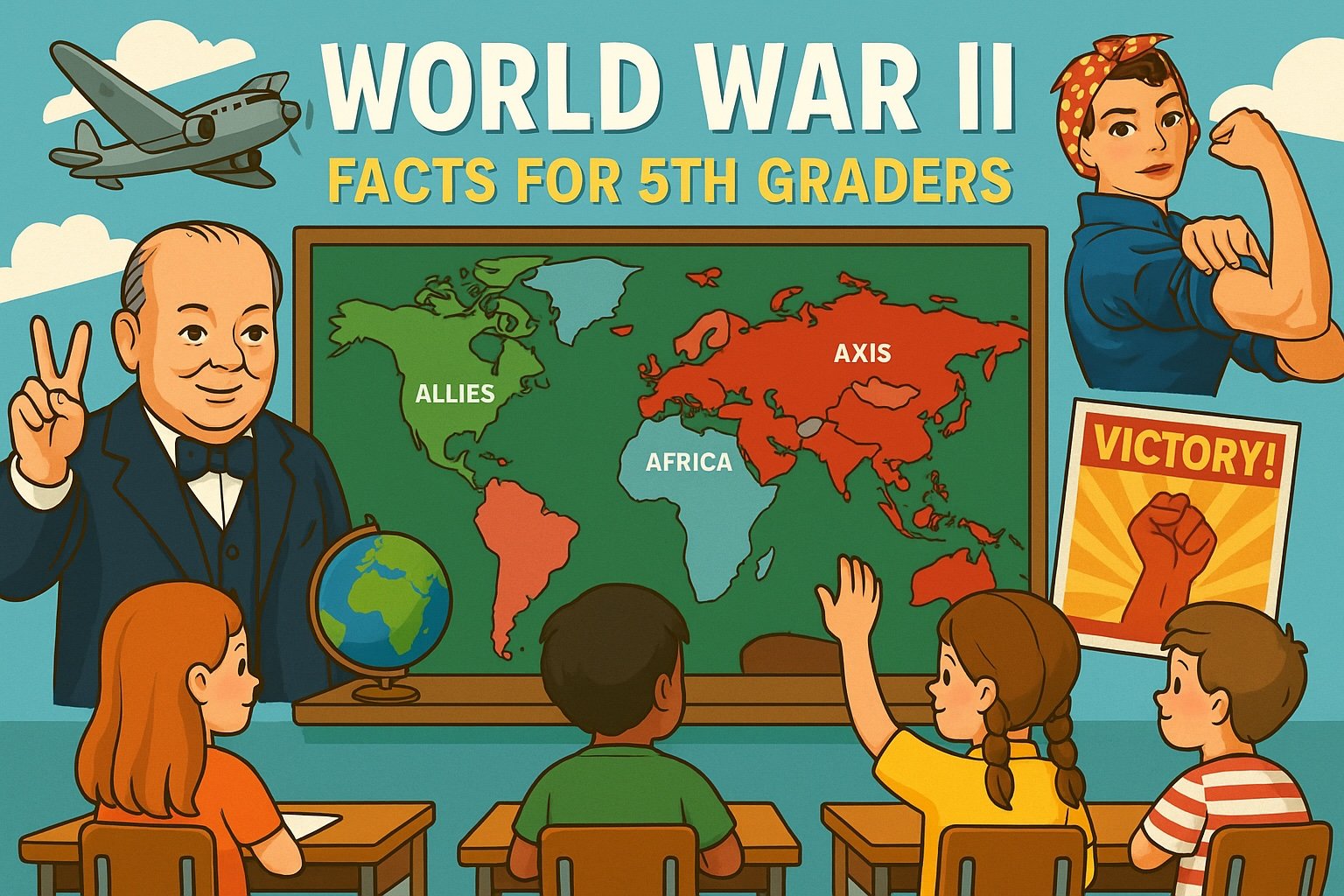
World War II was fought from 1939 to 1945 between the Allies, including Britain, the Soviet Union, the United States and China, and the Axis powers, led by Germany, Italy and Japan. It began when Germany invaded Poland on 1 September 1939. The United States joined after Pearl Harbor in 1941, and the war ended when Japan formally surrendered on 2 September 1945.
World War II quick facts
- World War II began on 1 September 1939, when Germany invaded Poland.
- The attack on Pearl Harbor on 7 December 1941 brought the USA into the war.
- D-Day, the Allied landing in Normandy, was on 6 June 1944.
- The war in Europe ended on 8 May 1945, V-E Day.
- The United Nations began on 24 October 1945.
What was World War II?
World War II was the biggest war in history. It began in 1939 and ended in 1945. It was fought across Europe, Asia, Africa and the oceans in between.
On one side were the Allies, including Britain, France, the Soviet Union, the United States and China. On the other side were the Axis powers, led by Germany, Italy and Japan.
The war changed the world. Tens of millions of people died, and cities were destroyed. Afterwards, countries worked together to try to stop such a war from happening again.
| World War II at a glance | |
|---|---|
| Began | 1 September 1939, when Germany invaded Poland |
| USA joined | December 1941, after Pearl Harbor |
| D-Day | 6 June 1944 |
| War in Europe ended | 8 May 1945 (V-E Day) |
| War ended | 2 September 1945, when Japan formally surrendered |
| Americans in uniform | more than 12 million by 1945 |
How did World War II start?
The roots of World War II go back to the end of the First World War. The National WWII Museum says the Treaty of Versailles officially ended that war in June 1919.
The treaty was very hard on Germany. Germany had to accept it without any say. It had to give up land and shrink its army. It also had to pay huge sums of money for the damage the war had caused.
Then Germany’s money crashed. The National WWII Museum says runaway price rises in 1923 made German money almost worthless. Later, the Great Depression wrecked the economy, and about 35% of workers lost their jobs.
Many people were angry and afraid. Some turned to a leader who promised to make Germany strong again. The National WWII Museum says that by 1932, Adolf Hitler’s Nazi Party was the largest party in Germany. In January 1933, Hitler became head of the government.
Hitler rebuilt Germany’s army, with tanks and aircraft. France built a line of forts along its border. The United States tried to stay out of Europe’s problems.
Giving in to Hitler
Britain and France did not want another war. The National WWII Museum says they tried to keep the peace by giving Hitler what he asked for. This is called appeasement.
In September 1938, Britain and France met Hitler in Munich. They agreed that Czechoslovakia must hand a border region, called the Sudetenland, to Germany. Nobody from Czechoslovakia was allowed to join the talks.
The British prime minister, Neville Chamberlain, flew home and said he believed he had brought “peace for our time”. But Hitler broke his promise. On 15 March 1939, German troops took over the rest of Czechoslovakia.
The war begins
On 1 September 1939, Germany invaded Poland. The US Holocaust Memorial Museum says Britain and France declared war on Germany two days later, on 3 September 1939. World War II had begun.
German forces swept across much of Europe. In June 1940, they conquered France. Britain was left fighting almost alone.
On 22 June 1941, Germany invaded the Soviet Union, a huge country that included Russia. The fighting there would become some of the fiercest of the whole war.
Pearl Harbor
The United States had stayed out of the fighting. That changed on the morning of Sunday, 7 December 1941.
The National WWII Museum says that Japanese planes from six aircraft carriers attacked the US Navy base at Pearl Harbor, in Hawaii. In less than 90 minutes, 19 US warships and 300 aircraft were destroyed or damaged. More than 2,400 Americans were killed.
Pearl Harbor brought the United States into the war. The US Holocaust Memorial Museum says that on 11 December 1941, Germany and Italy declared war on the United States too.
The home front
The war changed life at home for Americans. The National WWII Museum says that by 1945, more than 12 million Americans were serving in the armed forces. About six in ten of them were drafted, which means they were called up by the government.
Food and supplies were needed for the troops, so some things were rationed. The National Archives says a government office handed out ration books with coupons. Families could only buy small amounts of goods like sugar, meat and coffee.
Millions of women went to work in factories, building ships and aircraft. The National WWII Museum says a character called Rosie the Riveter became the symbol of these workers. American factories built nearly 100,000 aircraft in 1944 alone.
Families helped too. Many grew their own vegetables in victory gardens. The National Archives says these gardens may have grown about 40% of America’s fresh fruit and vegetables during the war. Children collected scrap metal, rubber and paper to be recycled for the war effort.
D-Day
To free Western Europe, the Allies planned a huge invasion. The National WWII Museum says D-Day, the landing in Normandy, France, took place on 6 June 1944. Its code name was Operation Overlord.
The “D” in D-Day simply stands for “day”. The exact date was kept flexible, because it depended on the weather.
The Allied troops landed on five beaches along about 80 km (50 miles) of coast. The Americans landed at Utah and Omaha beaches. The British landed at Gold and Sword, and the Canadians at Juno. The Supreme Commander was the American general Dwight D. Eisenhower.
The National WWII Museum says about 23,400 soldiers also landed by parachute and glider. The fighting was fierce: more than 10,300 Allied soldiers were killed, wounded or missing on D-Day. But the landings succeeded, and by the end of June, more than 850,000 Allied troops had come ashore.
Paris, the capital of France, was freed on 25 August 1944.
The Holocaust
During the war, something terrible happened that we must never forget. The US Holocaust Memorial Museum explains what the Holocaust was. Nazi Germany and those who helped it planned to persecute and murder Europe’s Jews. Six million Jewish people were killed.
The Holocaust lasted from 1933, when Hitler came to power, until 1945. The US Holocaust Memorial Museum says about 9 million Jews lived in Europe in 1933. Nearly two out of every three of them were killed.
The Nazis also targeted millions of other people. They included Roma people, disabled people and people who spoke out against them. In 1944 and 1945, British, American and Soviet soldiers freed the survivors of the camps. Many survivors had lost their families and homes.
Anne Frank
One of the best-known stories from this time is that of Anne Frank. She was born on 12 June 1929 in Germany, the US Holocaust Memorial Museum says. Her Jewish family moved to Amsterdam, in the Netherlands, to get away from the Nazis.
In July 1942, Anne’s family went into hiding in secret rooms behind her father’s office, which she called the Secret Annex. Eight people hid there for about two years, helped by brave Dutch friends.
The hiding place was discovered on 4 August 1944. Anne died in a camp in early 1945, aged 15. Her father, Otto, survived, and in 1947 he published the diary she had kept. Today, millions of people around the world have read it.
How the war ended
By 1945, the Allies were closing in on Germany from the east and the west. Germany surrendered, and the war in Europe ended on 8 May 1945. That day is remembered as V-E Day, or Victory in Europe Day.
The war with Japan went on. The National WWII Museum says that on 6 August 1945, a US bomber dropped an atomic bomb on the Japanese city of Hiroshima. Three days later, on 9 August, another atomic bomb was dropped on Nagasaki. Tens of thousands of people died in each city.
Japan announced its surrender on 14 August 1945. The US Holocaust Memorial Museum says the formal surrender was signed on 2 September 1945. World War II was over.
The cost of the war
The war cost an enormous number of lives. The National WWII Museum says about 407,000 American servicemen and women were killed, and about 671,000 were wounded.
Around the world, tens of millions of people died, soldiers and ordinary people alike. The US Holocaust Memorial Museum estimates 55 million deaths. The Soviet Union and China suffered some of the greatest losses.
The United Nations
After the war, countries wanted to make sure nothing like it ever happened again. The United Nations says that representatives of 50 countries met in San Francisco in 1945 and wrote the United Nations Charter.
The United Nations officially began on 24 October 1945. Today, it brings countries together to talk, keep the peace and help people in need.
Remembering World War II
Many museums help us remember the war and the people who lived through it. You can explore the National WWII Museum in New Orleans, or the Smithsonian National Museum of American History in Washington, D.C.
In the United States, Memorial Day is a day to remember the service members who died in wars, including World War II.
Learning about the war helps us understand why peace, fairness and standing up for others matter so much. You can also read about other key moments in history in our Civil War facts and Cold War facts.
Three things people get wrong
World War II did not start with Pearl Harbor. It began in 1939, two years earlier.
The “D” in D-Day does not stand for a special word. It simply means “day”.
The United States was not in the war from the start. It joined in December 1941.
Did you know? The “D” in D-Day simply stands for “day”, because the exact date depended on the weather.
Try it
Ask an older relative or neighbour what their family remembers about World War II, and write down their story.
Knowledge check
What event brought the United States into World War II?
Show answer
The Japanese attack on Pearl Harbor on 7 December 1941.
What was D-Day?
Show answer
The Allied landing in Normandy, France, on 6 June 1944.
Frequently asked questions
When did World War II start and end?
World War II started on 1 September 1939, when Germany invaded Poland, and ended on 2 September 1945, when Japan formally surrendered.
Who fought in World War II?
The Allies, including Britain, France, the Soviet Union, the United States and China, fought the Axis powers, led by Germany, Italy and Japan.
Why did the United States join World War II?
Japan attacked the US naval base at Pearl Harbor, Hawaii, on 7 December 1941. Days later, Germany and Italy also declared war on the United States.
What was the home front?
The home front was life back home during the war: rationing, women working in factories, victory gardens and collecting scrap for the war effort.
What was the Holocaust?
The Holocaust was the planned persecution and murder of six million European Jews by Nazi Germany and those who helped it, from 1933 to 1945.
How did World War II end?
Germany surrendered in May 1945. After atomic bombs were dropped on Hiroshima and Nagasaki, Japan surrendered, signing on 2 September 1945.
Sources
- National WWII Museum: from war to war in Europe, 1919 to 1939 — the Treaty of Versailles, inflation, the Depression and Hitler’s rise; its pages on appeasement, Pearl Harbor, the atomic bombs and US numbers were also used
- National WWII Museum: D-Day research starter — D-Day beaches, troops, commanders and casualties
- US Holocaust Memorial Museum: World War II in depth — the main events of the war, the surrender dates and the death toll
- US Holocaust Memorial Museum: introduction to the Holocaust — what the Holocaust was, its dates and liberation; its Anne Frank biography was also used
- National Archives: the home front — rationing and women war workers; its article on victory gardens was also used
- United Nations: history of the UN — the San Francisco conference and the founding of the UN