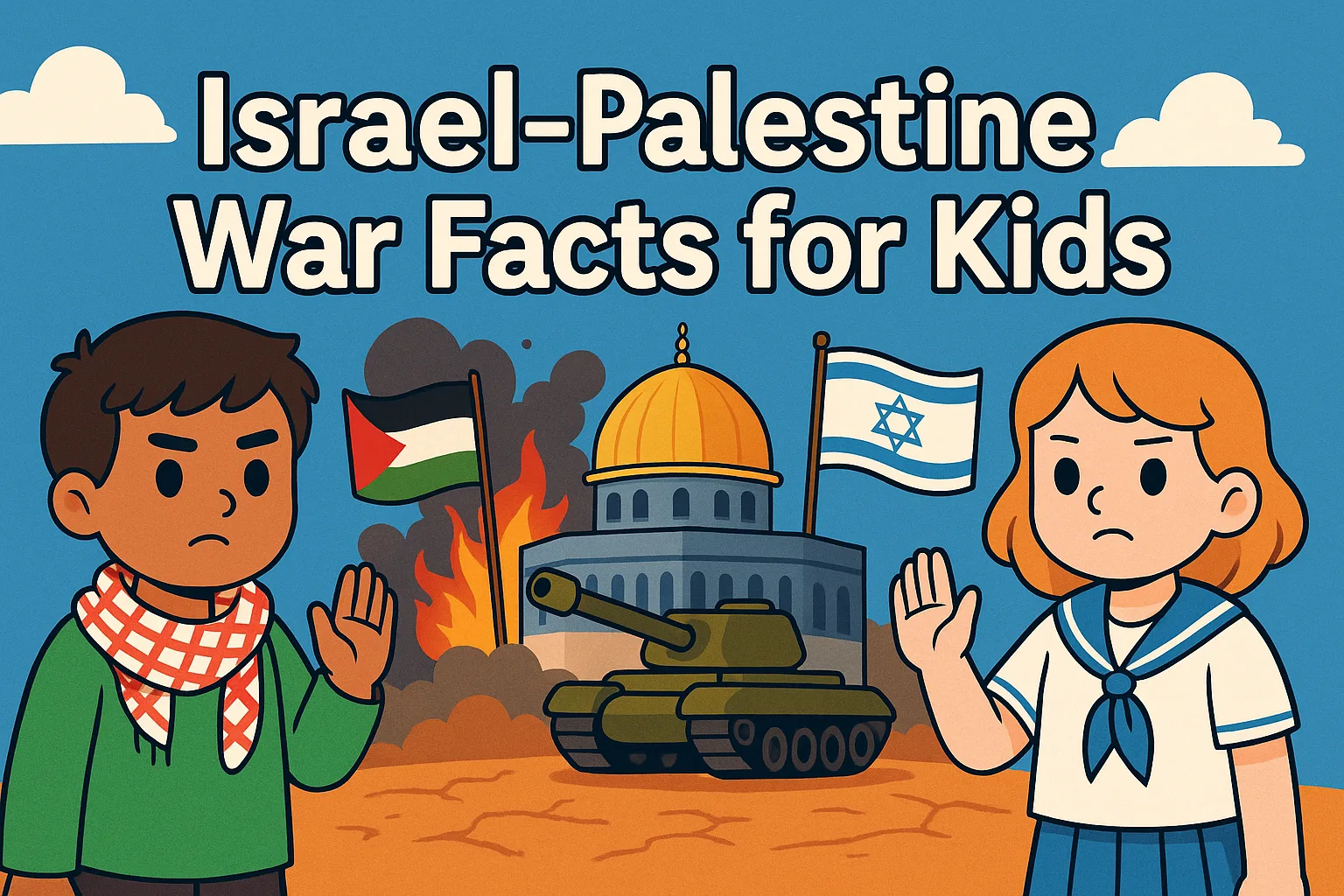
the Israel–Palestine conflict quick facts
- The conflict is mainly about land, borders, security and self-government.
- In 1947 the United Nations voted to divide the land into two states.
- Israel was declared in May 1948.
- Israel has occupied the West Bank since the Six-Day War of 1967.
- A ceasefire between Israel and Hamas began on 10 October 2025.
What is the Israel–Palestine conflict?
The Israel–Palestine conflict is a long-running dispute between Israelis and Palestinians over land in the Middle East, at the eastern end of the Mediterranean Sea.
Both peoples have deep ties to this land that go back many centuries. Both want to live there safely, in a country of their own, with their own government.
The conflict has lasted for more than 75 years. It has caused wars, great loss of life and deep suffering on both sides. Some of the facts in this guide are sad or upsetting. If anything worries you, talk about it with a parent, carer or teacher.
| Place | Where it is | People living there |
|---|---|---|
| Israel | on the Mediterranean coast | about 9.1 million (2026 estimate) |
| West Bank | west of the Jordan River | about 4.2 million (2026 estimate) |
| Gaza Strip | on the Mediterranean, next to Egypt | about 2.2 million (2023 estimate) |
Key places
Israel: a country bordered by Lebanon, Syria, Jordan and Egypt, with a long coast on the Mediterranean Sea. It has a coastal plain, hills in the north and centre, and the Negev desert in the south.
The West Bank: an area of about 5,660 square kilometres to the west of the Jordan River. Britannica says Israel has occupied it with its army since the Six-Day War of 1967. Most people there are Palestinians, but there are also many Israeli settlements.
The Gaza Strip: a small strip of land, about 365 square kilometres, along the Mediterranean Sea next to Egypt. Before the war, about 2.2 million people lived there, which made it one of the most crowded places on Earth.
Jerusalem: a very old city that is holy to Jews, Christians and Muslims. Learn about two of these faiths in our Judaism and Christianity guides. Israel calls Jerusalem its capital, but Britannica notes that most countries do not recognise this. Palestinians want East Jerusalem as the capital of a future state of their own.
How the conflict began
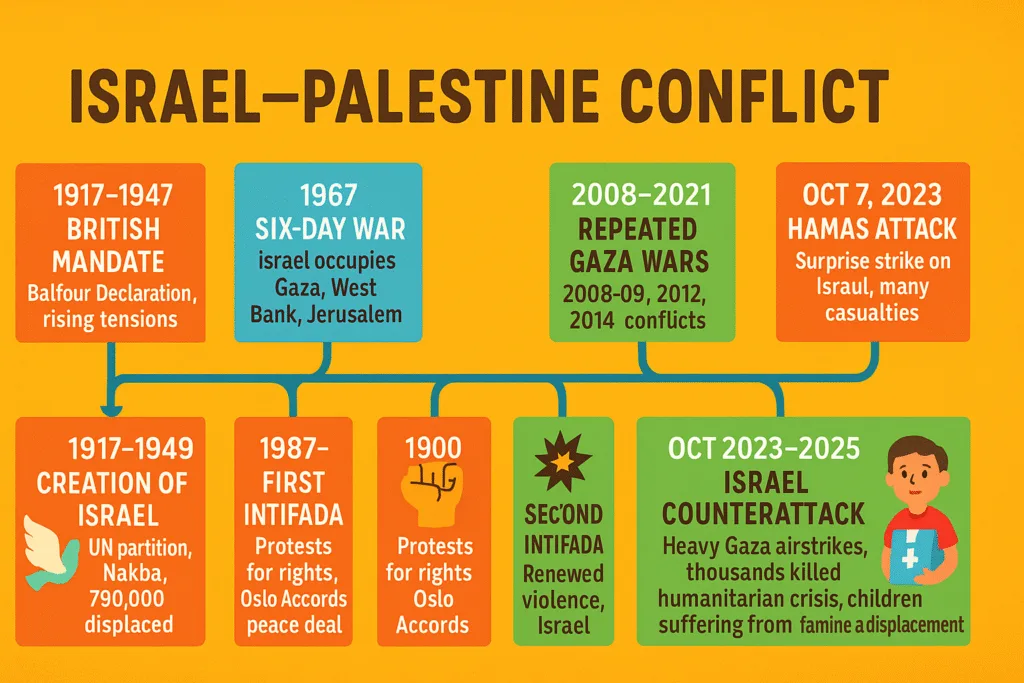
For hundreds of years, the land was ruled by the Ottoman Empire. After the Ottomans were defeated in World War I, Britain took control of the area. It was then called Palestine.
Under British rule, both the Arabs and the Jews living there wanted to govern themselves. Tension between the two communities grew, and there were many violent clashes.
In 1947, the United Nations voted to divide the land into two states, one Jewish and one Arab. Britannica says the plan was accepted by much of the world but rejected by the Arab side.
In May 1948, as British forces left, the State of Israel was declared. Neighbouring Arab countries, including Egypt, Jordan, Iraq, Syria and Lebanon, went to war with the new country.
Israelis call this war their War of Independence. Palestinians call it the Nakba, which means “the catastrophe”, because hundreds of thousands of Palestinians fled or were forced from their homes and became refugees.
When the fighting ended, Jordan controlled the West Bank and Egypt controlled the Gaza Strip.
Wars from the 1950s to the 1990s
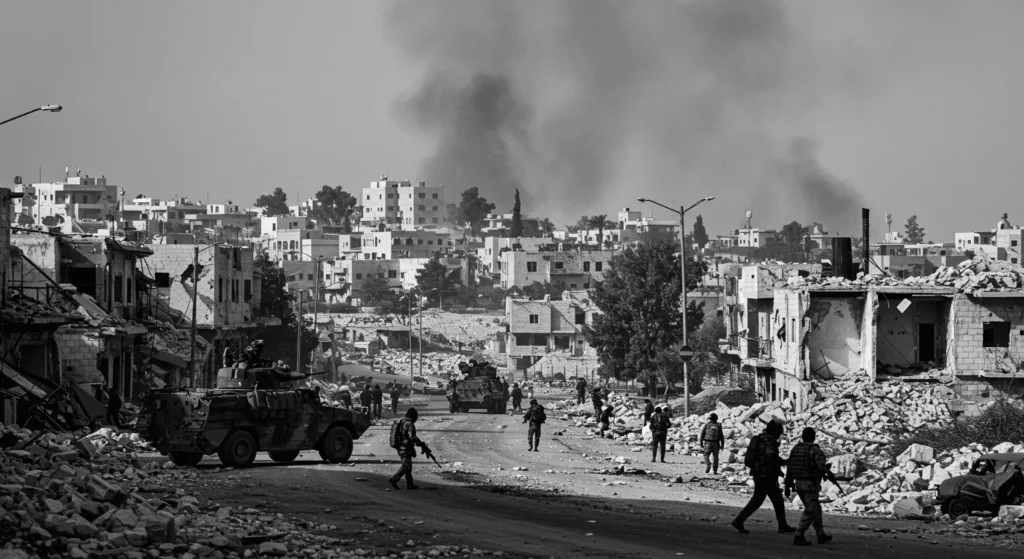
1956: the Suez Crisis, when Israel fought Egypt after Egypt took control of the Suez Canal.
1967: the Six-Day War. Israel fought Egypt, Jordan and Syria. It took control of the Gaza Strip, the West Bank including East Jerusalem, the Golan Heights and the Sinai Peninsula.
1973: the Yom Kippur War, also called the October War or the Ramadan War, between Israel and Egypt and Syria. It led to talks that ended with a peace treaty between Israel and Egypt.
1982: Israel went to war in Lebanon.
1990s: Israel and the Palestine Liberation Organization signed agreements called the Oslo Accords. These set up the Palestinian Authority to run some Palestinian towns and cities in the West Bank and Gaza.
Between these wars, there were also Palestinian uprisings, called intifadas, as well as many attacks and military operations in which both Israelis and Palestinians were killed.
The Israel–Hamas war
Hamas is a Palestinian armed group. Britannica says it won elections in 2006 and took control of the Gaza Strip in 2007. Israel and Egypt then blockaded Gaza, strictly limiting what could go in and out.
There were several short wars between Israel and Hamas, including in 2008, 2012, 2014 and 2021.
On 7 October 2023, Hamas and other armed groups from Gaza launched a surprise attack on Israel. Britannica says about 1,200 people were killed, most of them Israeli civilians, and more than 240 people were taken into Gaza as hostages. It was the deadliest day for Jewish people since the Holocaust, during World War II.
Israel declared war the next day. Its aims were to destroy Hamas and bring the hostages home. It carried out a huge campaign of air strikes and ground attacks in Gaza.
The war caused enormous loss of life and destruction in Gaza. Britannica says the death toll there passed 70,000 by November 2025, and much of the Gaza Strip was destroyed.
Pressure grew from other countries. Many Israelis also wanted the hostages home. In October 2025, Israel and Hamas agreed a ceasefire. It began on 10 October, and the last surviving hostages were released on 13 October. Deadly attacks have still been reported since then.
Everyday life
Even before the war, life in the Gaza Strip was hard. Britannica says the area had poor water, sewage and electricity services, and many people could not find work.
Many families in Gaza farmed, growing crops such as citrus fruits, olives and wheat. During the war, huge numbers of homes, schools and hospitals were damaged or destroyed. UNICEF describes families being forced to move again and again.
In the West Bank, Palestinians live under Israeli military occupation. The growth of Israeli settlements there is one of the main causes of tension. Britannica says that from 2022, the West Bank saw some of the worst clashes between Israelis and Palestinians in decades.
In Israel, people have lived for years with the threat of rockets fired from Gaza. Many homes and schools have bomb shelters, and a defence system called the Iron Dome shoots down many rockets before they land.
How the war has affected children
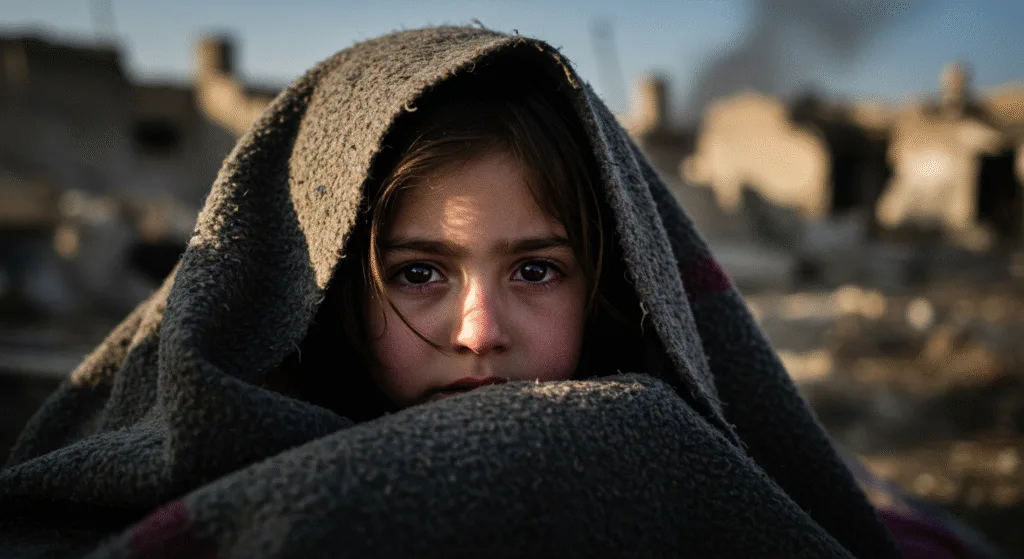
Children have suffered terribly in this conflict. On 7 October 2023, Israeli children were among those killed and among those taken hostage.
In Gaza, UNICEF, the United Nations agency for children, said in May 2025 that more than 50,000 children had reportedly been killed or injured since October 2023.
Many children in Gaza have lost family members and homes, and have missed school for long periods. They have also faced a shortage of food, clean water and medicine.
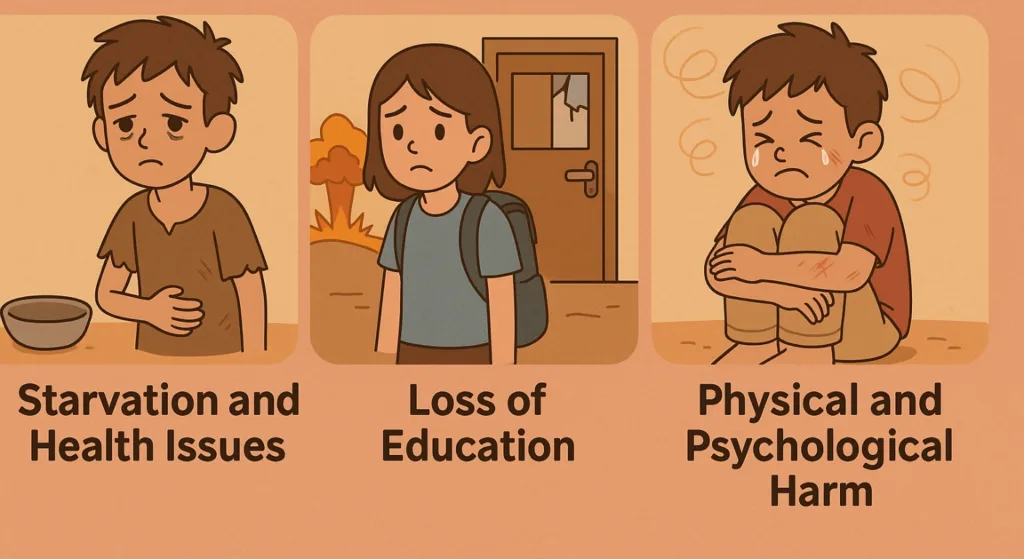
In August 2025, a group of experts that measures hunger around the world confirmed that there was famine in part of Gaza. The World Health Organization said more than half a million people were trapped in famine.
UNICEF has urged all sides to end the violence, protect civilians, let aid in and release all hostages.
Efforts to make peace
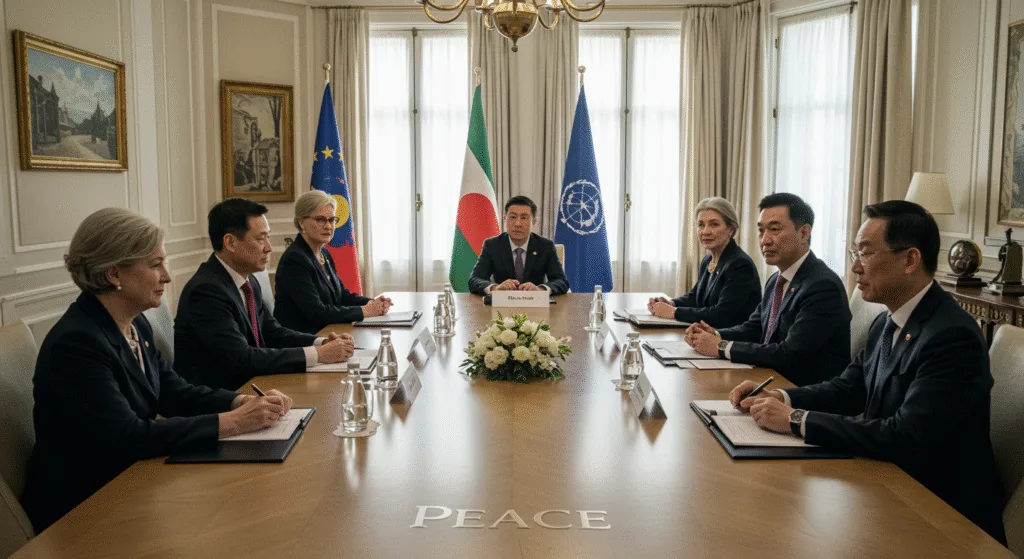
People have tried many times to bring peace to the region.
In 1967, the United Nations passed Resolution 242. It set out the idea of “land for peace”: Israel would give back land it had taken, and in return its neighbours would accept Israel and live in peace with it.
In 1978, talks called the Camp David Accords led to a peace treaty between Israel and Egypt. In the 1990s, the Oslo Accords were meant to be a first step towards a lasting agreement between Israel and the Palestinians.
In 2020, Israel agreed to set up normal relations with several Muslim-majority countries, in deals called the Abraham Accords. In October 2025, other countries helped Israel and Hamas reach a ceasefire.
Many countries support a “two-state solution”, with an independent Palestinian state living alongside Israel. But the two sides still disagree about borders, security, Jerusalem, Israeli settlements and Palestinian refugees.
How kids can help
It is natural to feel sad, worried or confused when you hear about war. Talking to a trusted adult about your feelings can really help.
Learn about the conflict from reliable sources, and remember that most news is written for adults. Asking questions is a good way to understand.
Be kind and respectful to everyone at school, whatever their background. Jewish, Muslim, Arab, Israeli and Palestinian children should all feel safe and welcome.
If your family wants to help children affected by war, an adult can look into well-known humanitarian organisations that provide food, medicine and care.
Words to know
Ceasefire: an agreement to stop fighting.
Hostage: a person captured and held by force, often so the captors can make demands.
Occupation: when an army takes control of an area and rules it, without that area becoming part of its own country.
Refugee: someone forced to leave their home to escape war or danger.
Humanitarian aid: food, water, medicine and shelter given to people in a crisis.
Famine: an extreme lack of food, so that many people go hungry and some die.
Three things people get wrong
The conflict did not start in 2023. Its roots go back more than 100 years, to the early 1900s.
It is not only about religion. It is mainly a dispute over land, borders, security and the right to self-government.
Hamas is not the same as all Palestinians. Hamas is one armed group. Most Palestinians, like most Israelis, are ordinary people who want to live in safety.
Looking ahead
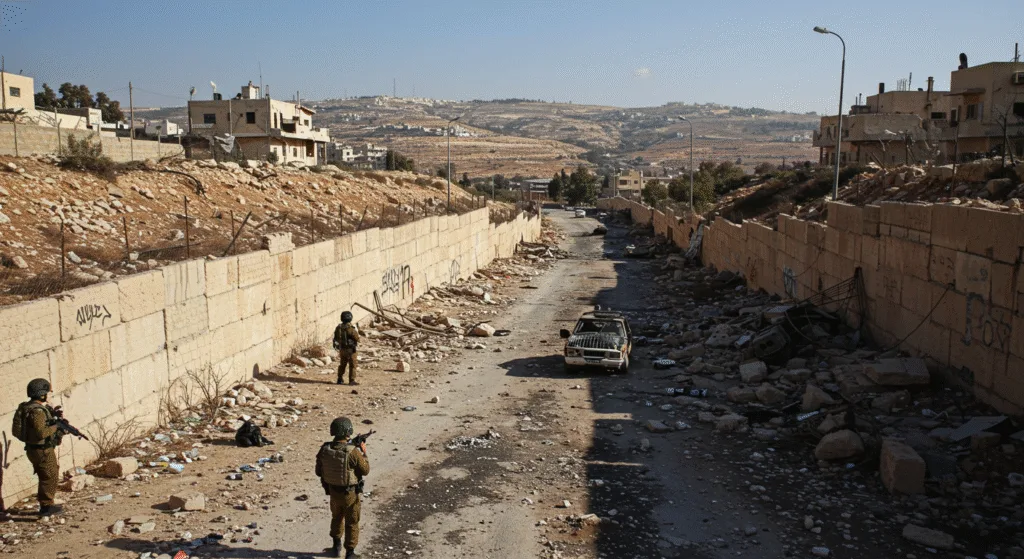
The Israel–Palestine conflict is one of the hardest problems in the world to solve. But people on both sides, and around the world, keep working for a future in which Israelis and Palestinians can live in peace and safety.
Did you know? Jerusalem is holy to three religions: Judaism, Christianity and Islam.
Try it
Find Israel, the West Bank and the Gaza Strip on a map of the Middle East. Which countries and seas are nearby?
Knowledge check
What did the United Nations vote for in 1947?
Show answer
To divide the land into a Jewish state and an Arab state.
What is a ceasefire?
Show answer
An agreement to stop fighting.
Frequently asked questions
What is the Israel–Palestine conflict about?
It is a long-running dispute between Israelis and Palestinians over land, borders, security and the right of each people to govern themselves in the same region.
When did the Israel–Palestine conflict start?
Tension grew under British rule after World War I. War broke out in 1948 when Israel was declared, and there have been many wars and uprisings since.
What happened on 7 October 2023?
Hamas and other armed groups from Gaza attacked Israel. About 1,200 people were killed, most of them civilians, and more than 240 were taken hostage.
How has the war affected children in Gaza?
UNICEF said in May 2025 that more than 50,000 children in Gaza had reportedly been killed or injured since October 2023. Many lost homes and schooling.
Is there a ceasefire in Gaza?
Israel and Hamas agreed a ceasefire in October 2025. It began on 10 October, and the last surviving hostages were released on 13 October.
What is the two-state solution?
The two-state solution is the idea of an independent Palestinian state alongside Israel. Many countries support it, but the two sides disagree about borders, security and Jerusalem.
Sources
- Encyclopaedia Britannica: Israel–Hamas War — the 7 October attack, hostages, the war in Gaza, the death toll and the October 2025 ceasefire
- Encyclopaedia Britannica: Arab–Israeli wars — the 1947 UN plan, 1948 war and the Nakba, and the wars of 1956, 1967, 1973 and 1982
- Encyclopaedia Britannica: Gaza Strip — area, population and living conditions
- Encyclopaedia Britannica: West Bank — area, population, occupation, the Oslo Accords and the Palestinian Authority
- UNICEF: more than 50,000 children reportedly killed or injured in the Gaza Strip — children killed and injured, and UNICEF’s call to all parties
- World Health Organization: famine confirmed for the first time in Gaza — the August 2025 famine finding