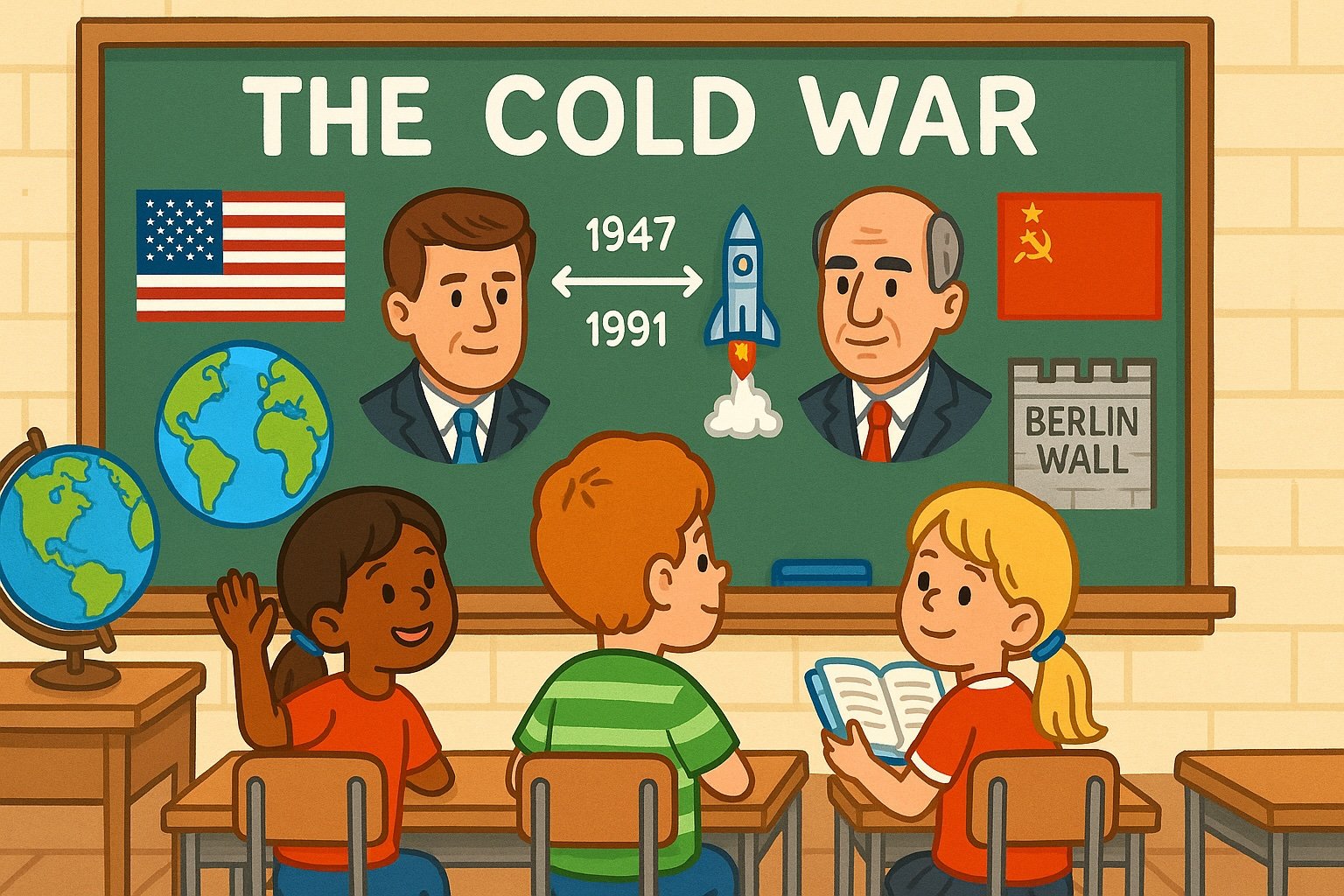
The Cold War was a long rivalry between the United States and the Soviet Union, from about 1947 to 1991. The two sides never fought a full war with each other. Instead, they built nuclear weapons, raced into space and competed for allies. Key moments include the Berlin Wall and the Cuban Missile Crisis of 1962. It ended when the Soviet Union broke apart in 1991.
the Cold War quick facts
- The Cold War lasted from about 1947 to 1991.
- The Soviet Union launched the first satellite, Sputnik 1, in 1957.
- The Berlin Wall stood from 1961 to 1989.
- In 1962, US forces reached DEFCON 2, one step below nuclear war.
- The Soviet Union ended on 25 December 1991.
What was the Cold War?
The Cold War was a long rivalry between two powerful countries, the United States and the Soviet Union. It began soon after World War II ended. Historians usually date it from about 1947 to 1991.
It is called “cold” because the two sides never fought each other in a full war. Instead, they competed in other ways. They built huge numbers of weapons, raced each other into space and tried to win other countries over to their side.
It was also a clash of ideas. The United States was a democracy, where people vote for their leaders. The Soviet Union had a communist government, where one party controlled the country.
The Cold War was very different from wars like the American Civil War, where armies met on battlefields. But it was still dangerous. At times, the world came frighteningly close to a nuclear war.
| Date | What happened |
|---|---|
| 12 March 1947 | The Truman Doctrine: the USA promises to help countries resist communism |
| 1948 to 1949 | The Berlin Blockade and the Berlin Airlift |
| 1949 | NATO is founded, and the Soviet Union tests its first atomic bomb |
| 4 October 1957 | The Soviet Union launches Sputnik 1, the first satellite |
| 12 April 1961 | Yuri Gagarin becomes the first person to orbit the Earth |
| 13 August 1961 | Building of the Berlin Wall begins |
| October 1962 | The Cuban Missile Crisis |
| July 1969 | Apollo 11 lands astronauts on the Moon |
| 9 November 1989 | The Berlin Wall opens |
| 25 December 1991 | The Soviet Union comes to an end |
The two sides
After World War II, the United States and the Soviet Union were the two strongest countries in the world. They had been on the same side in the war, but they did not trust each other.
The Soviet Union was a huge country made up of many parts. When it broke apart in 1991, the US Office of the Historian says, the United States recognised 12 new independent countries that had been part of it. They included Russia, Ukraine, Belarus and Kazakhstan.
Trouble started quickly. The Office of the Historian says that during 1946, the Soviet Union would not pull its troops out of Iran and put pressure on Turkey. It also turned down an American plan to control nuclear weapons.
A divided Germany
At the end of World War II, Germany was split into four zones. The Office of the Historian says the United States, the United Kingdom, France and the Soviet Union each ran one of them.
Germany’s capital, Berlin, sat deep inside the Soviet zone. The city was split into four sectors too. That meant the Western powers held only the western part of a city surrounded by land the Soviets controlled.
The Truman Doctrine
On 12 March 1947, President Harry S. Truman asked the US Congress for $400 million to help Greece and Turkey. The Office of the Historian says this became American policy: to help countries resist being taken over by communists.
Truman pledged to “support free peoples who are resisting attempted subjugation”. Subjugation means being forced under someone else’s control. The idea became known as containment, because it aimed to hold back the spread of communism.
The Office of the Historian says the Truman Doctrine also ended America’s habit of staying out of quarrels in faraway places.
The Berlin Airlift
In 1948, the Western powers brought in a new money for West Germany, called the Deutschmark. The Soviet Union reacted angrily.
On 24 June 1948, the Office of the Historian says, the Soviets blocked every road, railway and canal into West Berlin. The people of West Berlin could no longer get supplies by land.
So the Western powers flew supplies in instead. American planes began the Berlin Airlift on 26 June 1948, and British planes joined in on 28 June.
It was an enormous effort. When the airlift was at its busiest, the Office of the Historian says, a plane landed at Berlin’s Tempelhof Airport every 45 seconds.
West Berliners stood firm. In September 1948, about 300,000 of them rallied at the Reichstag building against Soviet control. The Soviets finally lifted the blockade on 12 May 1949.
NATO and the Warsaw Pact
In 1949, twelve countries formed a military alliance called NATO. The Office of the Historian lists them as the United States, Canada, Belgium, Denmark, France, Iceland, Italy, Luxembourg, the Netherlands, Norway, Portugal and the United Kingdom.
NATO members made a promise to each other. An attack on one of them would count as an attack on all of them.
West Germany joined NATO in 1955. In response, the Soviet Union set up its own alliance with the countries of Eastern Europe that it controlled. It was called the Warsaw Pact.
The arms race
For a few years after World War II, only the United States had an atomic bomb. That changed in 1949, when the Soviet Union tested its first one.
American leaders were alarmed. In a secret report called NSC-68, written in April 1950, officials urged a rapid build-up of US military strength. The Office of the Historian says US defence spending rose from about 5% to 14.2% of the economy between 1950 and 1953.
The 58-page report stayed top secret until 1975.
Both sides kept building more and more powerful weapons. In the 1950s, NATO’s plan was called massive retaliation. It meant that any attack would be answered with a huge nuclear strike, so that no one would dare to attack first.
The space race
The rivalry reached all the way into space. On 4 October 1957, the Soviet Union launched Sputnik 1, the world’s first artificial satellite. NASA says it was an aluminium ball about 58 cm (22 inches) across that circled the Earth every 96 minutes.
A month later, on 3 November 1957, Sputnik 2 carried a dog named Laika into orbit. NASA says Sputnik shocked many Americans. Some even compared it to the attack on Pearl Harbor, and one adviser warned that the USA could no longer assume it was ahead in technology.
The United States hurried to catch up. Its first satellite, Explorer 1, was launched on 31 January 1958. It discovered belts of radiation around the Earth. NASA was created by a law signed on 29 July 1958 and started work on 1 October 1958.
The Soviet Union scored another first on 12 April 1961. NASA says the cosmonaut Yuri Gagarin became the first human to orbit the Earth, in a flight lasting 108 minutes. His spacecraft, Vostok 1, travelled at about 27,400 km/h.
A few weeks later, on 25 May 1961, President John F. Kennedy set a bold goal: to land astronauts on the Moon and bring them safely home.
Apollo 11 launched on 16 July 1969 with Neil Armstrong, Buzz Aldrin and Michael Collins on board. NASA says Armstrong and Aldrin spent 21 hours and 36 minutes on the Moon’s surface. Read more in our Neil Armstrong facts.
The Berlin Wall
On 13 August 1961, work began on the Berlin Wall. It cut the city in two and stopped people from crossing freely from East Berlin into West Berlin.
The National Museum of American Diplomacy says the wall was more than 4 m (13 feet) high. It was really two walls with a gap between them. The gap was watched from guard towers and was called the death strip.
About 43 km (26.8 miles) of the wall ran through Berlin itself. At least 100 people died trying to cross it, and probably more. Others escaped through tunnels, in specially adapted cars, in hot-air balloons and by boat.
In October 1961, American and Soviet tanks faced each other at Checkpoint Charlie, the US crossing point in Berlin.
Two American presidents made famous speeches in Berlin. On 26 June 1963, John F. Kennedy told the crowd, “Ich bin ein Berliner”, which means “I am a Berliner”. On 12 June 1987, Ronald Reagan said, “Mr. Gorbachev, tear down this wall.”
The Cuban Missile Crisis
The most dangerous moment of the Cold War came in October 1962. The Office of the Historian says that in July 1962, the Soviet leader Nikita Khrushchev and Cuba’s leader Fidel Castro had secretly agreed to put Soviet nuclear missiles in Cuba. Cuba is an island very close to the United States.
On 4 September 1962, President Kennedy publicly warned against putting attack weapons in Cuba. Then, on 14 October, an American U-2 spy plane photographed missile sites being built.
On 22 October, Kennedy ordered a naval quarantine around Cuba. He chose the word quarantine instead of blockade on purpose, because in law a blockade counts as an act of war.
For days, the world held its breath. US forces went on alert at DEFCON 3. On 26 October, they moved to DEFCON 2, the level just below nuclear war.
On 28 October, Khrushchev announced that the missiles would be taken apart and removed. The deal had two sides. The United States promised not to invade Cuba, and in April 1963 it quietly removed its own missiles from Turkey.
After the crisis, the two sides set up the Hotline, a direct link between the White House and the Kremlin, so their leaders could talk quickly in an emergency.
Steps towards peace
The scare of the missile crisis pushed both sides to talk. In 1963, the United States, the Soviet Union and Britain signed the Limited Test Ban Treaty.
The Office of the Historian says the treaty banned nuclear test explosions in the air, in space and under water, but not underground. It was the first arms-control agreement of the Cold War. Others followed, including the Non-Proliferation Treaty in 1968 and a treaty called SALT I in 1972.
Even the space race turned friendly for a while. On 17 July 1975, NASA says, an American Apollo spacecraft and a Soviet Soyuz spacecraft joined up in orbit. The two crews shook hands, shared meals and did experiments together for about two days.
That partnership led to later joint projects, such as the International Space Station.
How the Cold War ended
In the 1980s, a new Soviet leader, Mikhail Gorbachev, loosened Soviet control over Eastern Europe. On 9 November 1989, the crossings in the Berlin Wall opened, and people could pass freely again.
In December 1989, President George H. W. Bush and Gorbachev met at the Malta Summit to talk about weapons and the changes in Europe. On 3 October 1990, East and West Germany officially became one country again, and the united Germany joined NATO.
In July 1991, Bush signed the START treaty in Moscow, which cut the number of nuclear weapons. In August 1991, hard-line communists tried to overthrow Gorbachev. They failed, but Gorbachev was weakened, and another leader, Boris Yeltsin, grew more powerful.
On 25 December 1991, Gorbachev resigned. The Office of the Historian says the Soviet flag over the Kremlin was lowered for the last time, and the Russian flag replaced it. The Soviet Union was gone, and the Cold War was over.
Why the Cold War still matters
The Cold War left behind a dangerous leftover: nuclear weapons in countries that had been part of the Soviet Union. In November 1991, a US law called the Nunn-Lugar Act set up a programme to help keep those weapons safe.
It also changed the map of the world. Germany became one country again, and 12 new countries appeared where the Soviet Union had been.
And the space race led to satellites, Moon landings and, later, space stations where astronauts from many countries live and work together.
Three things people get wrong
The Cold War was not always calm. In 1962, US forces reached DEFCON 2, one step below nuclear war.
America did not lead the space race from the start. The Soviet Union launched the first satellite and sent the first person into orbit.
The Berlin Wall did not vanish in one night. Its crossings opened on 9 November 1989, but Germany was not reunited until 3 October 1990.
Did you know? At the busiest point of the Berlin Airlift, a plane landed in West Berlin every 45 seconds.
Try it
Make a Cold War timeline on a long strip of paper, from 1947 to 1991. Mark the Berlin Airlift, Sputnik, the Berlin Wall and the Moon landing.
Knowledge check
Why was it called the Cold War?
Show answer
The USA and the Soviet Union never fought each other in a full war.
Which country launched the first satellite?
Show answer
The Soviet Union, with Sputnik 1 in 1957.
Frequently asked questions
What was the Cold War?
It was a long rivalry between the United States and the Soviet Union, from about 1947 to 1991, fought with weapons build-ups, the space race and alliances rather than a full war.
Why is it called the Cold War?
Because the two superpowers never fought each other directly in a full war. They competed in other ways instead.
What was the Berlin Wall?
A guarded wall that split East and West Berlin from 1961 to 1989. At least 100 people died trying to cross it.
What was the Cuban Missile Crisis?
In October 1962, the Soviet Union secretly put nuclear missiles in Cuba. After 13 tense days, the missiles were removed.
Who won the space race?
The Soviet Union launched the first satellite and the first person into orbit, but the United States landed the first astronauts on the Moon in 1969.
When did the Cold War end?
It ended as the Berlin Wall opened in 1989, Germany reunited in 1990 and the Soviet Union broke apart on 25 December 1991.
Sources
- US Office of the Historian: the Berlin Airlift — divided Germany, the blockade and the airlift; its pages on the Truman Doctrine, NATO and NSC-68 were also used
- US Office of the Historian: the Cuban Missile Crisis — the missiles, the quarantine, DEFCON levels, the deal and the Hotline; its page on the 1963 test ban was also used
- US Office of the Historian: the collapse of the Soviet Union — Gorbachev, the Malta Summit, START, the 1991 coup, the end of the USSR and the new countries
- National Museum of American Diplomacy: the Berlin Wall — the wall’s size, deaths, escapes, Checkpoint Charlie and the Kennedy and Reagan speeches
- NASA History: Sputnik and the origins of the Space Age — Sputnik 1 and 2, Explorer 1 and the start of NASA; NASA’s Gagarin and Vostok 1 pages were also used
- NASA History: Apollo 11 mission overview — Kennedy’s goal and the Moon landing; NASA’s Apollo-Soyuz page was also used