
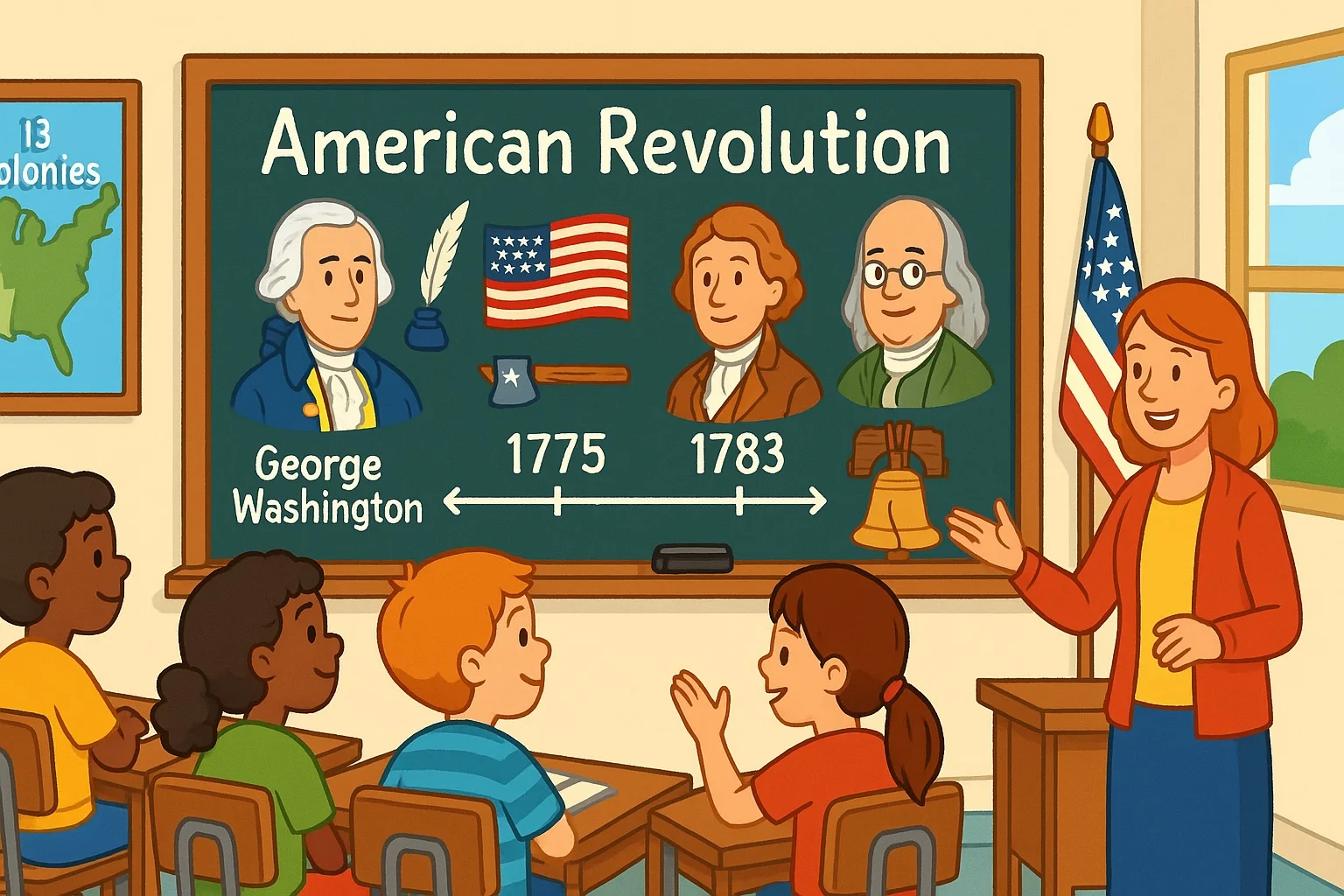
American Revolution quick facts
- The war lasted eight and a half years, from April 1775 to September 1783.
- The colonists’ complaint was “no taxation without representation”: they paid British taxes but had nobody in Parliament.
- The Declaration of Independence was approved on 4 July 1776, but most people signed it on 2 August.
- Saratoga in 1777 was the turning point, because it brought France into the war.
- About a fifth of colonists stayed loyal to Britain and were called Loyalists.
What was the American Revolution?
The American Revolution was a war between thirteen British colonies in North America and the country that ruled them, Great Britain. The colonies won, and became a new country: the United States.
The fighting ran from 1775 to 1783, so eight and a half years. That is longer than most people expect, and longer than the American Civil War, the First World War or the Second World War.
Why it started
It started over money, and then it became about something bigger.
Britain had just fought an expensive war against France and wanted the colonies to help pay for it. So Parliament in London passed new taxes. The Stamp Act of 1765 put a tax on every printed thing in the colonies: newspapers, playing cards, legal papers, even dice.

The colonists were furious, but not only about the cost. The colonies had no members in Parliament. Nobody in London had been elected by them, and nobody there had to listen to them. Their slogan said it exactly: no taxation without representation.
Britain backed down on the Stamp Act and then tried again with other taxes, including one on tea. In December 1773 a group of colonists boarded ships in Boston Harbour and threw 342 chests of tea into the water. Britain answered by closing the port and tightening its grip. By then both sides had stopped listening.
The shot heard round the world
On 19 April 1775, British soldiers marched out of Boston to seize weapons the colonists had stored at Concord. Riders, Paul Revere among them, went ahead in the night to raise the alarm.

At dawn, about seventy colonial militiamen were waiting on the green at Lexington. Someone fired. Nobody knows who, and both sides blamed the other for the rest of their lives. Eight colonists were killed.
The British went on to Concord, found little, and turned back for Boston. The walk back was sixteen miles of militia firing from behind walls and trees, and it cost them badly. The war had started.
A timeline you can remember
| Date | What happened |
|---|---|
| 1765 | The Stamp Act taxes every printed thing in the colonies. |
| 16 December 1773 | Colonists throw 342 chests of tea into Boston Harbour. |
| 19 April 1775 | Fighting starts at Lexington and Concord. |
| 4 July 1776 | The Continental Congress approves the Declaration of Independence. |
| 17 October 1777 | A British army surrenders at Saratoga. |
| Winter 1777–78 | Washington’s army suffers at Valley Forge. |
| 1778 | France enters the war on the American side. |
| 19 October 1781 | Cornwallis surrenders at Yorktown. |
| 3 September 1783 | The Treaty of Paris formally ends the war. |
If you only remember three of those, make them 1775, 1776 and 1781: the war starts, the country declares itself, and the fighting ends.
What the Continental Army was up against
Britain had the best-trained army in the world and by far the strongest navy. The colonies had neither. They had farmers who owned guns, no uniforms worth the name, and almost no money to pay anyone.
Congress could not raise taxes, so it printed paper money instead. So much of it that the phrase “not worth a Continental” became an insult. Soldiers were often paid late, in money that bought less every month, and some units mutinied over it.
Washington understood the one thing that mattered. He did not have to beat the British army. He only had to avoid losing his own, because Britain was fighting three thousand miles from home, and every year the war continued cost it more than it cost him.
The people to know
| Who | What they did |
|---|---|
| George Washington | Commander of the Continental Army for the whole war. He lost more battles than he won and still won the war, by keeping his army alive. |
| Thomas Jefferson | Wrote most of the Declaration of Independence, at 33 years old. |
| Benjamin Franklin | Aged 70, sailed to Paris and spent years persuading France to join the American side. It worked. |
| King George III | King of Britain throughout. He was determined not to lose the colonies. |
| Marquis de Lafayette | A French nobleman who arrived aged 19, fought for the Americans and became one of Washington’s closest officers. |
The Declaration of Independence
On 4 July 1776, the Continental Congress in Philadelphia approved a document announcing that the colonies were no longer British. That is the date the Fourth of July celebrates.

Its most famous sentence says that all men are created equal and have rights that no government may take away. Those words were not true of the country that wrote them. Jefferson owned enslaved people while he wrote them, and slavery continued in the United States for another eighty-seven years. Both things are part of the same history, and neither cancels the other.
One detail worth knowing: the famous Trumbull painting shows the drafting committee presenting the document on 28 June, not people signing it on 4 July. Most of the signing happened on 2 August.
The turning point
For two years the war went badly for the Americans. Washington lost New York and retreated across New Jersey with an army that was shrinking by the day.
Then, in October 1777, an entire British army surrendered at Saratoga in New York. Nearly 6,000 soldiers laid down their weapons.
Saratoga mattered far beyond the battlefield. It convinced France that the Americans could actually win, and France joined the war in 1778, bringing soldiers, money and, most importantly, a navy. Spain and the Dutch Republic joined against Britain too. A colonial rebellion had turned into a world war, and Britain was now fighting in several oceans at once.
How it ended
In 1781 a British army under Lord Cornwallis dug in at Yorktown, Virginia, expecting the Royal Navy to come and fetch it. A French fleet arrived first and blocked the sea. Washington marched his army and a French army down from the north and surrounded the town by land.

Cornwallis was trapped, and surrendered on 19 October 1781. That was effectively the end of the fighting, though the war did not formally finish until the Treaty of Paris was signed on 3 September 1783.
What life was like
Most colonists were farmers. They grew their own food, made their own clothes and mended their own tools, and a letter could take weeks to cross the colonies.
Soldiers had a hard time of it. At Valley Forge in the winter of 1777, Washington’s army had too little food and too few blankets, and some men had no shoes and wrapped their feet in rags. About 2,000 of them died there, almost all of disease rather than battle.
Women ran the farms and the shops while the men were away. Some travelled with the army, cooking and nursing. A few disguised themselves and fought.
Not everyone wanted independence. Roughly a fifth of colonists stayed loyal to Britain and were called Loyalists, and many of them left for Canada when the war ended. Native American nations had to choose sides too, and most who chose fought with the British, who had promised to limit settlement westward.
Why it still matters
The war created the United States, which is the obvious answer. The more interesting one is what it started elsewhere.
The idea that ordinary people could remove a government they had not chosen was genuinely new as a practical fact rather than a theory. France had its own revolution six years after Yorktown. Haiti, then most of South America, followed. The Statue of Liberty was a gift from France partly in memory of that shared history.
Try this: a revolutionary newspaper
Pick one event from the timeline and write the front page a colonial printer might have set the next morning. You need a headline, a short report of what happened, and one drawing.
The interesting part is choosing a side. Write it first as a Boston printer who wants independence, then write the same event again as a Loyalist printer in New York. Same facts, two front pages. Comparing them tells you more about how history works than either one does alone.
Printers mattered enormously in the Revolution. Newspapers carried the arguments between colonies that had no other quick way of talking to each other, which is exactly why the Stamp Act taxed paper.
Things people get wrong
“The Boston Tea Party was about tea.” It was about who had the right to tax. The tea was actually going to be cheaper under the new law.
“The Declaration was signed on 4 July 1776.” It was approved that day. Most of the signatures went on it on 2 August.
“Paul Revere shouted that the British were coming.” He would not have. The colonists thought of themselves as British. He rode quietly, warning specific households that the regulars were out.
“America beat Britain on its own.” It did not. France supplied money, soldiers and the fleet that trapped Cornwallis at Yorktown, and Britain was fighting several countries at once by the end.
Did you know? George Washington lost more battles than he won. He won the war anyway, by refusing to let his army be destroyed and keeping it in the field until Britain gave up.
Try it
Write the five dates from this guide on separate cards, shuffle them, and put them back in order. If you can explain why Saratoga sits where it does, you have understood the war.
Knowledge check
What did “no taxation without representation” mean?
Show answer
The colonies had to pay taxes set by Parliament in London, but had no elected members there. They argued a government you cannot vote for has no right to tax you.
Why was the Battle of Saratoga so important?
Show answer
An entire British army surrendered, which convinced France the Americans could win. France joined in 1778 and brought soldiers, money and a navy.
Frequently asked questions
When did the American Revolution start and end?
The fighting started on 19 April 1775 at Lexington and Concord. The British surrendered at Yorktown on 19 October 1781, and the Treaty of Paris formally ended the war on 3 September 1783.
Who won the American Revolution?
The thirteen colonies, with a great deal of help from France. They became the United States.
What was the first battle?
The Battles of Lexington and Concord, fought on the same day, 19 April 1775.
Why did France help the Americans?
France had lost a war to Britain a few years earlier and wanted to weaken it. After Saratoga showed the Americans might actually win, helping them looked worth the risk.
Did everyone in the colonies want independence?
No. Roughly one colonist in five stayed loyal to Britain. Many Loyalists left for Canada after the war.
How many people fought in the war?
Around 230,000 served in the Continental Army and the militias over the eight years, though Washington rarely had more than about 20,000 men at any one time.
Sources
- Library of Congress: the American Revolution, 1763–1783 — the timeline, the taxes and the primary documents
- National Archives: the Declaration of Independence — the approval on 4 July and the signing on 2 August
- National Park Service, Minute Man: the outbreak of war — the march to Concord, the fighting at Lexington and the retreat to Boston
- National Park Service, Yorktown — the siege, the French fleet and the surrender on 19 October 1781
- National Park Service, Saratoga — the 1777 surrender and why it brought France into the war
- National Park Service, Valley Forge — the winter of 1777–78 and the deaths from disease


