
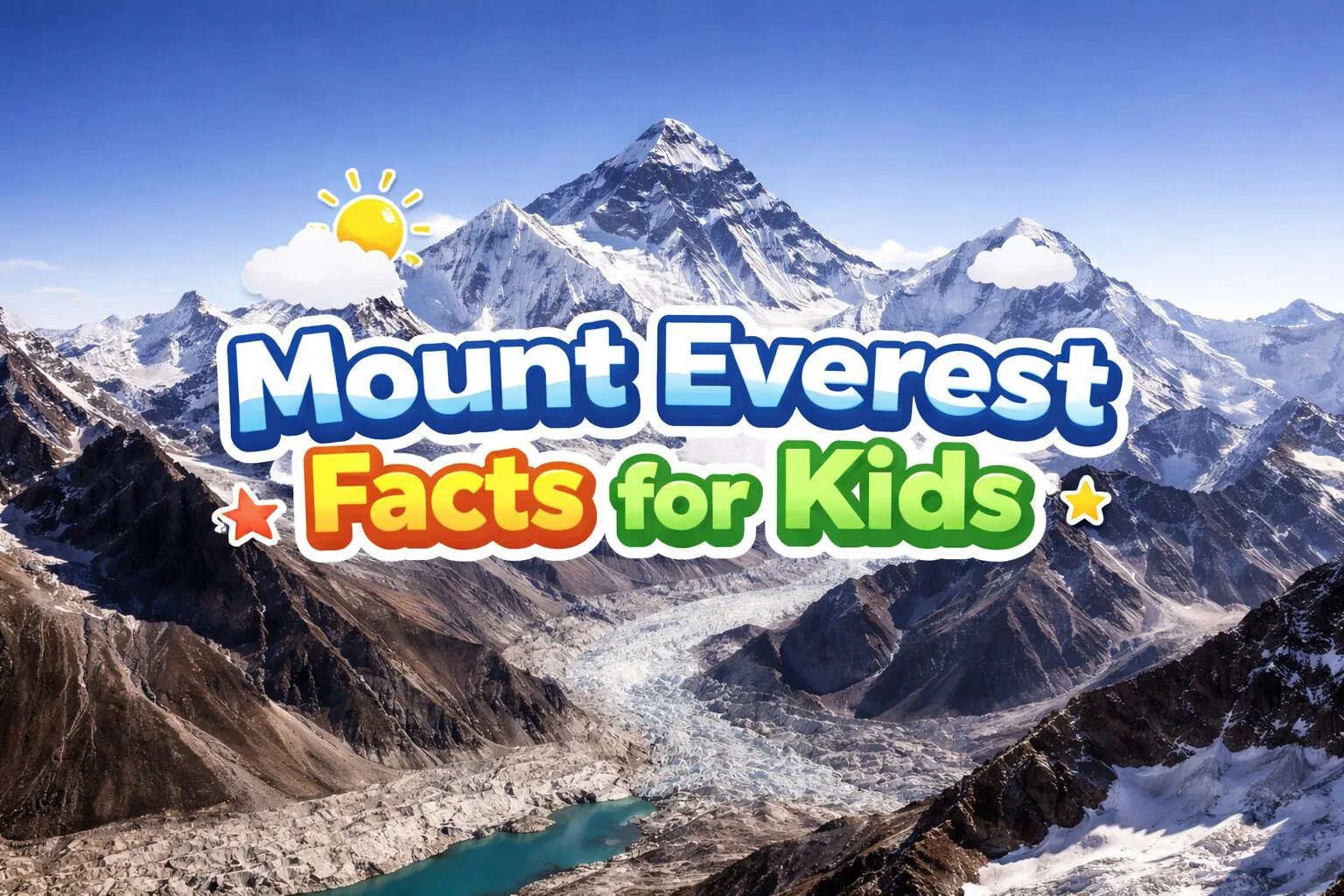
mountains quick facts
- Everest’s official height, agreed in December 2020, is 8,848.86 m.
- The rock high in the Himalayas holds fossils from an ancient sea.
- The Himalayas are still rising by more than 1 cm a year.
- Above 8,000 m is the death zone, where the body cannot survive for long.
- The famous 1953 summit photograph shows Tenzing Norgay, not Edmund Hillary.
Mount Everest at a glance
| Mount Everest | |
|---|---|
| Official height | 8,848.86 m (29,031.69 ft), agreed 8 December 2020 |
| Where | On the border of Nepal and Tibet (China) |
| Nepali name | Sagarmatha |
| Tibetan name | Chomolungma, Mother Goddess of the World |
| Named Everest in | 1865, after Sir George Everest |
| First confirmed ascent | 29 May 1953 |
| Death zone | Above 8,000 m (26,000 ft) |
| Coldest temperatures | As low as −60°C |

How tall is it, exactly?
For decades, Nepal and China disagreed about this, and the argument was not a silly one.
Nepal used 8,848 m. China had measured 8,844.43 m in 2005.
The gap came down to a real question: do you measure to the top of the rock, or to the top of the snow and ice sitting on it?
Nepal measured the snow height. China measured the rock height. Both were correct, and both were answering different questions.
So they went and checked together. A Nepali survey team reached the summit on 22 May 2019, and a Chinese team reached it on 27 May 2020.
On 8 December 2020 the two countries announced a single agreed figure: 8,848.86 metres, or 29,031.69 feet.
That is 86 centimetres higher than Nepal’s old number. After all that, the mountain grew by less than the length of your arm.
Where it is and what it is called
Everest sits on the border between Nepal and Tibet, which is an autonomous region of China. You can climb it from either side.
It has older names than the English one.
In Tibetan it is Chomolungma, which means Mother Goddess of the World. In Nepali it is Sagarmatha.
The name Everest came much later. British surveyors working on the Great Trigonometrical Survey of India had been calling it Peak XV, and in 1865 it was named after Sir George Everest, a former Surveyor General of India.
Some people at the time argued for using a local name instead. They lost that argument.
How a mountain that high gets made
Everest exists because two continents crashed into each other.
Around 80 million years ago, India was an island roughly 6,400 km south of Asia, drifting north at about 9 metres a century.
Between 40 and 50 million years ago, it hit.
Normally when plates meet, one slides underneath the other. That could not happen here, because the rock of both was about equally light.
The US Geological Survey explains what happened instead. With nowhere to go sideways or down, the pressure could only be relieved by thrusting skyward, crumpling the collision zone into the jagged Himalayan peaks.
Our guides to tectonic plates and the geosphere explain how the plates move.
There are sea creatures at the top
Here is the fact that makes the whole story real.
The rock high in the Himalayas contains fossils of plants and animals that were laid down underwater, when a sea called the Tethys covered the region.
The rocks near the top of the world were once the bottom of an ocean.
The mountains are also still growing. The Himalayas continue to rise more than 1 cm a year, which works out at 10 km every million years.
India is still pushing north. Everest is a slow-motion car crash that has been going on for 50 million years.
Who climbed it first
Edmund Hillary of New Zealand and Tenzing Norgay, a Sherpa mountaineer, reached the summit on 29 May 1953.
They set out at 6.30 in the morning on 28 May from a camp high on the mountain, and stood on top at 11.30 the next morning.
Two details usually get told wrong.
Edmund Hillary was not Sir Edmund when he climbed it. He was knighted afterwards, on his return.
And the famous photograph of a climber standing on the summit is not Hillary. It is Tenzing Norgay. Hillary took the picture, because Norgay had never been taught to use a camera, so there is no photograph of Hillary up there at all.

The death zone
Above 8,000 metres, the air is so thin that the human body cannot survive for long, no matter how fit you are. That region is called the death zone.
Some numbers make it clear.
At sea level, your blood is normally about 99 per cent saturated with oxygen. At Everest Base Camp, which is only about 5,200 to 5,400 metres up, that already falls to about 85 per cent.
Your body tries to fix this by breathing harder. A normal rate of 20 to 30 breaths a minute can rise to 80 or 90.
At that point simply breathing is exhausting, and the smallest task becomes hard work.
Altitude sickness can bring confusion, weakness, hallucinations, and fluid building up in the lungs or the brain. The only reliable cure is to go back down.
Most climbers use bottled oxygen. Reinhold Messner and Peter Habeler were the first to reach the summit without it, in 1978.

Cold, wind and danger
Everest never thaws.
Temperatures near the top fall as low as −60°C. Even in July, the warmest month, the average is about −18°C. It never rises above freezing on the mountain.
Storms arrive without warning. Climbers face falls, avalanches, altitude sickness and frostbite, which is what happens when blood stops reaching fingers, toes and nose in extreme cold.
Bright sunlight reflecting off snow can also cause snow blindness, a painful temporary loss of vision.
More than 3,000 people have climbed Everest since 1953, and over 200 are known to have died on it. In April 2014, sixteen people were killed in a single avalanche.
Many bodies are still on the mountain, because conditions are too dangerous to bring them down.

Base camp, and the yaks that supply it
There are two base camps, one on the Nepali side and one in Tibet, both at about 5,200 to 5,400 metres.
The Nepali one is 320 km from Kathmandu. Climbers used to walk the whole way, though small aircraft can now land nearer.
From base camp, teams set up higher camps and then climb up and down between them again and again, carrying tents, food and oxygen, letting their bodies adjust to the thin air.
Much of the heavy carrying is done by yaks: shaggy, powerful animals well suited to altitude. They also plough fields, and their milk becomes butter that is burned in lamps and stirred into tea.
They bring things down as well, including rubbish and human waste, which is later spread on the barley fields.
The coloured flags you see strung across base camp are Buddhist prayer flags.
What lives up there
Almost nothing, but not quite nothing.
Everest itself is bare rock, snow and ice with hardly any plants. Lower down, in the foothills, people farm potatoes, barley, buckwheat, lentils and rice.
The highest permanent resident is tiny. A small black jumping spider has been reported at 6,700 metres, which may make it the highest-living animal on Earth that you can see without a microscope. It eats frozen insects blown up the mountain by the wind.
Birds get higher still. Choughs have been spotted at 7,900 metres.
The people of the Everest region are mainly the Sherpa, who have lived at these altitudes for generations and whose bodies handle thin air far better than most. They do much of the hardest and most dangerous work on the mountain.
Highest, but not tallest
Everest is the highest mountain on Earth, and that word is doing careful work.
Highest means its summit is further above sea level than any other. That is true, and it is why Everest is famous.
But height above sea level is only one way to measure a mountain. You could instead measure from base to peak, or from the centre of the Earth.
Measured either of those ways, other mountains beat it. Everest simply starts from a very high place: the whole Tibetan Plateau is already several kilometres up before the mountain begins.
So Everest wins the contest that people care about, and it wins it because of where it stands as much as how big it is.
Three things people get wrong
“The famous summit photo is Edmund Hillary.” It is Tenzing Norgay. Hillary took the photograph because Norgay had not been taught to use the camera, so no photo of Hillary on the summit exists.
“Everest is 8,848 m tall.” That was Nepal’s old figure. Since 8 December 2020 the agreed height, measured jointly by Nepal and China, has been 8,848.86 m.
“The mountain has always been that height.” The Himalayas are still rising by more than a centimetre a year, because India is still pushing into Asia. The rock at the top holds fossils from an ancient sea.
Did you know? A small black jumping spider has been found at 6,700 m on Everest, living on frozen insects blown up the mountain by the wind.
Try it
Everest grows about 1 cm a year. Work out how much taller it will be when you are 50.
Knowledge check
Why did Nepal and China disagree about Everest’s height?
Show answer
Because Nepal measured to the top of the snow and China measured to the top of the rock underneath. In 2020 they surveyed it together and agreed on 8,848.86 m.
How were the Himalayas formed?
Show answer
India collided with Asia 40 to 50 million years ago. Neither plate could slide under the other, so the rock was forced upwards into mountains.
Frequently asked questions
How tall is Mount Everest?
8,848.86 metres, or 29,031.69 feet. Nepal and China announced this agreed figure on 8 December 2020 after surveying the summit separately in 2019 and 2020.
Where is Mount Everest?
On the border between Nepal and Tibet, an autonomous region of China. It can be climbed from either side.
What is Mount Everest called in Nepal and Tibet?
Sagarmatha in Nepali and Chomolungma in Tibetan, which means Mother Goddess of the World. It was named after Sir George Everest in 1865.
Who climbed Mount Everest first?
Edmund Hillary of New Zealand and the Sherpa mountaineer Tenzing Norgay, who reached the summit on 29 May 1953.
What is the death zone on Everest?
Everything above 8,000 m, where there is too little oxygen for the body to survive long. Even at base camp, blood oxygen falls from about 99 per cent to about 85.
How cold is Mount Everest?
Temperatures near the summit drop as low as −60°C. Even in July, the warmest month, the average is about −18°C, and it never rises above freezing.
Sources
- Royal Geographical Society: Mount Everest factsheet for teachers — the naming after Sir George Everest, the Tenzing Norgay photograph, temperatures, the death zone and blood oxygen figures, base camp, yaks, the jumping spider, choughs, and the climber and death totals
- The Kathmandu Post, 8 December 2020: Mount Everest is 8,848.86 metres tall — the agreed height, the announcement, the earlier Nepali and Chinese figures, the 2019 and 2020 surveys, and the snow-versus-rock dispute
- US Geological Survey: the Himalayas — the India-Asia collision 40 to 50 million years ago, India’s speed, why neither plate subducted, the 1 cm a year uplift and the Tethys Sea fossils
- National Geographic Education: Mount Everest — the location, the Nepali and Tibetan names, the 1953 ascent and the death zone


