
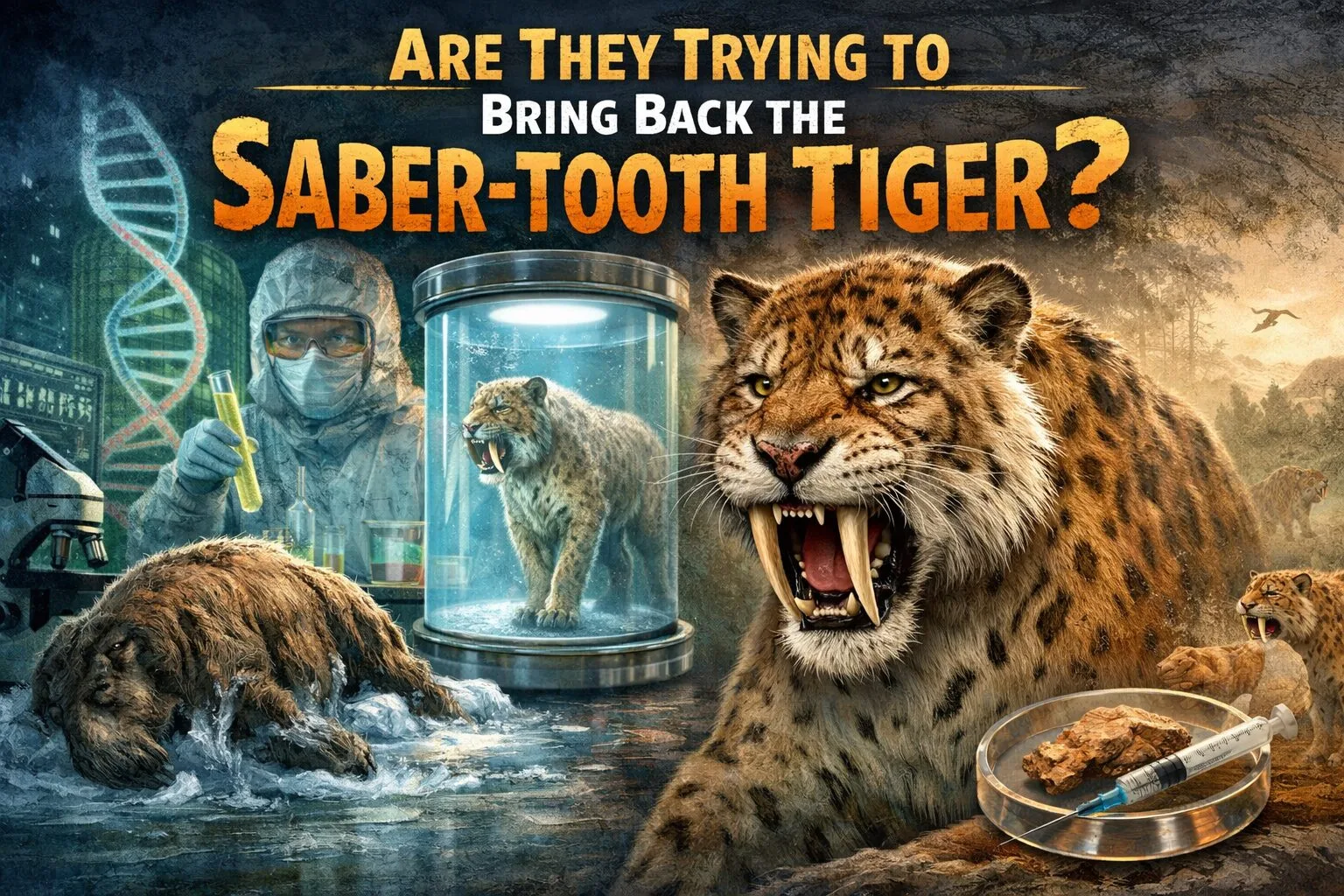
Can you imagine seeing a saber-tooth tiger? 10,000 to 12,000 years ago the Saber-tooth tiger went extinct but with innovation of technology and science the scientific world is exploring ways to bring back extinct species. Currently projects like de-extinction of the Woolly Mammoth are ongoing and it makes us wonder if the Saber-Toothed Tiger (Smilodon) could be next! Keep reading if you want to learn about the process of de-extinction, the possibility of bringing back the extinct creature and fun facts about the Saber-Tooth Tiger species.
What Was the Saber-Tooth Tiger?
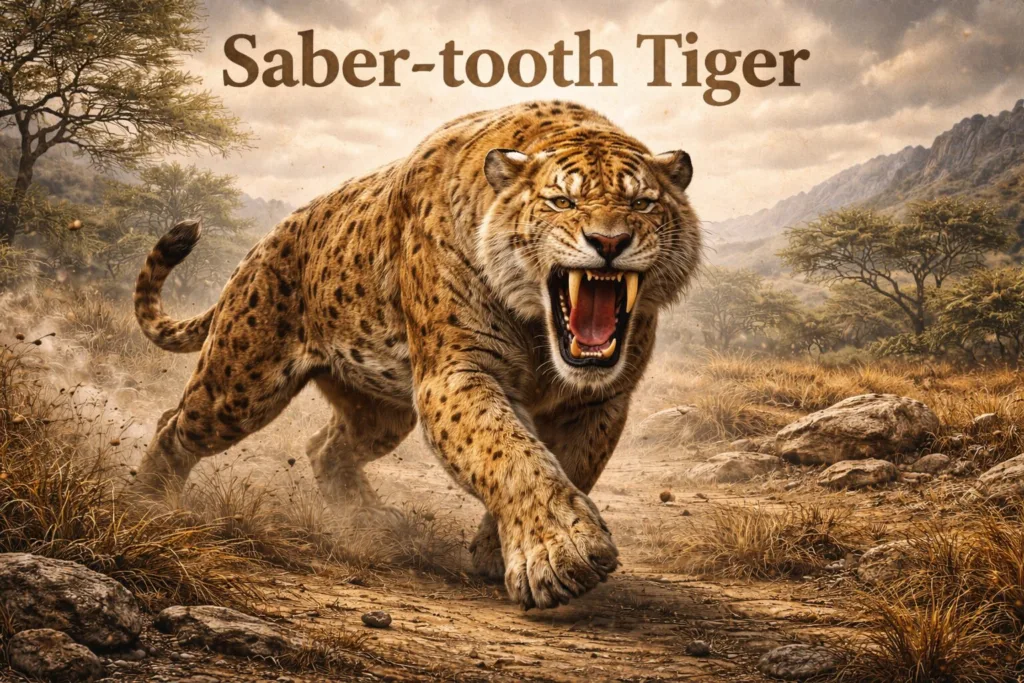
Did you know the Saber-tooth tiger is not related to tigers or lions? Scientifically they belong to a genus called “Smilodon” which belongs to the family Felidae (true cats) and the now-extinct subfamily Machairodontinae. This group included other distinct saber-toothed predators, such as Homotherium and Megantereon, which were not true tigers but shared the distinctive dental adaptation of long, curved canine teeth. There were 3 primary species of Smilodons:
- Smilodon gracilis is referred to as the smallest specie which weighed between 55-100 kilograms (121 to 220 lb)
- Smilodon fatalis weighed between 160 to 280 kg (350 to 620 lb)
- Smilodon populator is referred to as the largest specie which weighed between 220 to 436 kg (485 to 961 lb)
These mighty creatures lived during the Pleistocene and early Holocene epochs (a particular period of time in history) before becoming extinct roughly 10,000 years ago.
What Does Bringing Back Mean? – The Science of De-Extinction
De-extinction is a process of utilising genetic engineering and cloning to recreate organisms that have gone extinct. It is important to note that DNA decays over time which makes full cloning of Ice-Age animals very difficult, but the scientific world has been able to establish 2 processes of de-extinction so far:
- Cloning: Copying of DNA from preserved tissue (used for animals like the Pyrenean ibex).
- Gene editing: Inserting extinct genes into DNA of living relatives (CRISPR technology).
So, Are Scientists Trying to Bring Back the Saber-Tooth Tiger?
No, not yet. Scientists are not actively working on bringing back the saber-tooth tiger right now, but they are studying the possibility and expanding projects on other species. Colossal Biosciences, a biotechnology company founded in 2021, is leading the effort using advanced gene editing tools like Clustered Regularly Interspaced Short Palindromic Repeats (CRISPR) to reintroduce Woolly Mammoths to the world and bring advancement of ancient DNA research. If mammoth de-extinction succeeds, similar methods might one day apply to Smilodon, but so far no high-quality nuclear genome suitable for cloning exists; only limited mtDNA has been recovered, and La Brea material is generally not considered feasible for good endogenous DNA retrieval.
Why Is It So Hard to Clone a Saber-Tooth Tiger?
It is difficult to clone a Saber Tooth Tiger as there are currently no living species that are genetically close to the animal and can act as a surrogate mother for the genetically created fetus. Further on it is important to note that DNA breaks down after death, even frozen specimens rarely keep full genetic code. Saber-tooth fossils are often mineralized bones, not preserved tissue which means the scientific world lacks access to Smilodon DNA.
What Are Scientists Doing Instead?
Biotechnology companies like Colossal Biosciences are focusing on sequencing ancient DNA from Ice-Age fossils like mammoths, cave lions, dire wolves, etc. in order to preserve them and expand on ancient DNA research. So far scientists can create “proxy species” which are living animals engineered with traits of extinct ones, they can also use genetic modeling to reconstruct Smilodon evolutionary traits. Even if in the near future, due to lack of usable DNA of the Smilodon, studying the species DNA fragments will help scientists understand big-cat evolution, even if resurrection isn’t possible.
Could We Ever See a Saber-Tooth Tiger Again?
Theoretically, yes. If in the distant future scientists are able to gain access to viable DNA to map the full genome and engineer a close surrogate species for the fetus of the Saber-tooth tiger it may become possible for humans to witness the extinct creature once again. It is also important that the scientific world expands on the limits on synthetic reconstruction for bringing back the Saber-tooth tiger.
Should We Bring Saber-Tooth Tiger Back? – The Ethical Debate
It is widely debated in the scientific world, whether or not de-extinction of species should take place or not. Hence, here is a list of cons related to bringing back the Saber-Tooth Tiger:
- We can invest in projects like carbon reduction and climate change which is more practical than bringing back an extinct creature like the Saber-tooth tiger.
- Many people believe the project is a cruel and far-fetched idea. Trial and error in such experiments takes many years and causes unnecessary suffering for clones created. Stillbirths, deformities and early death are few of the things that these hybrids suffer.
- The ecosystem that was once inhabited by the Saber-Tooth Tiger has long adapted to the animal’s absence. Reintroduction can cause ecological consequences and distress to the ecosystem and the hybrid alike.
- Taking precious resources into account, that could be invested in saving 47,000 critically endangered species like orangutans, blue whales, sea lions, etc.

Here is a list of pros related to bringing back the Saber-Tooth Tiger:
- Could restore lost ecosystems to their original form.
- Such large-scale projects with significant investment focusing on genetic engineering are bound to expand our limits in this field. Gene editing and de-extinction open new horizons for the scientific community.
- When specific species are used for their genetic similarity to the extinct creatures, investment is made to preserve those endangered species.
What Scientists Have Learned From Saber-Tooth DNA Studies
So far scientist have learned from Saber-tooth tiger DNA that:
- The diet of the species due to the tooth’s micro-wear. They predict that the Smilodon’s teeth show us the type of prey they consumed, like bison, sloths, etc.
- Another important fact about the Saber-tooth tiger is revealed through the fossils which store ancient proteins and collagen. These were to reveal the habits of the extinct species as fossilized injuries that healed overtime and reveal social care behavior.
Saber-Tooth Tigers in Pop Culture and Science Fiction
Saber-Tooth Tigers have been main characters of many movies and pop culture. For example in the Ice Age movies, the main character is a Smilodon (saber-toothed tiger) and his name is Diego. On other platforms like youtube many documentaries are available which depict “reviving” saber-tooths and give a rich history of their rule. This entertainment fuels public interest in real genetic science and it can lead to some de-extinction labs receiving funding thanks to curiosity!
Fun and Surprising Facts
- In the La Brea tar pits of California, scientists have recovered well preserved Smilodon bones.
- No direct descendants survive; its closest living relatives are modern cats, but the saber-tooth line diverged long ago.
- Saber-tooth tigers are not related to tigers and lions, despite their name.
- Unfortunately, DNA from La Brea fossils is too degraded to be used for cloning purposes
- According to National Geographic more than 3,000 fossilized cats have been pulled from the La Brea tar pits in California
Conclusion & Key Takeaways
Scientists are not currently trying to bring back the Saber-tooth tiger, as the technology and DNA for liable clones don’t exist yet. Though there are other ongoing de-extinction processes like the Woolly Mammoth project, that could make bringing back the Saber-Tooth possible. It is also important to note that studying extinct species teaches us about how to protect living ones before they’re gone. For now, the saber-tooth tiger lives only in fossils and they act as a reminder of what extinction really means.
External Links
National Geographic – Sabertooth