
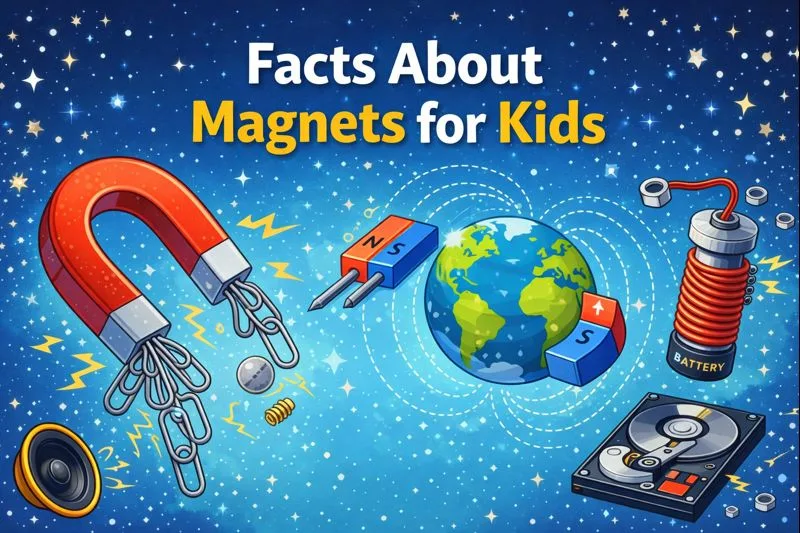
You probably didn’t know that Earth is like a giant magnet due to its core containing iron and nickel that causes a magnetic field to be formed. Keep reading if you want to learn fun and interesting facts about magnets and how they can push and pull things without even touching them!
What Are Magnets?
Magnets are defined as objects that attract (pull) or repel (push) certain metals, for example: the North pole of a magnet pulls towards a South pole, while it pushes away from its own North Pole. The reason why magnets attract or repel is because the electrons in the magnet spin simultaneously which creates a magnetic field. Try to think of magnets like an invisible hand that can drag or pull things without touching them.
How Do Magnets Work?
To simply explain the science behind magnets you need to understand that there are electrons in the magnet that spin simultaneously which creates an invisible magnetic field. There are two sides of a magnet:
- The North Pole
- The South Pole

The History of Magnets
The history of magnets is old and complex so let us take you through the journey of where it all began. According to research the earliest known surviving descriptions of magnets and their properties are from 2,500 years ago from the lands of Anatolia, India, and China. During Middle English time the word magnet was adopted from the Latin word “magnetum” which meant “lodestone”. Originally the word originated from a place called “Anatolia” where lodestones were first discovered.
Types of Magnets
There are various types of magnets like:
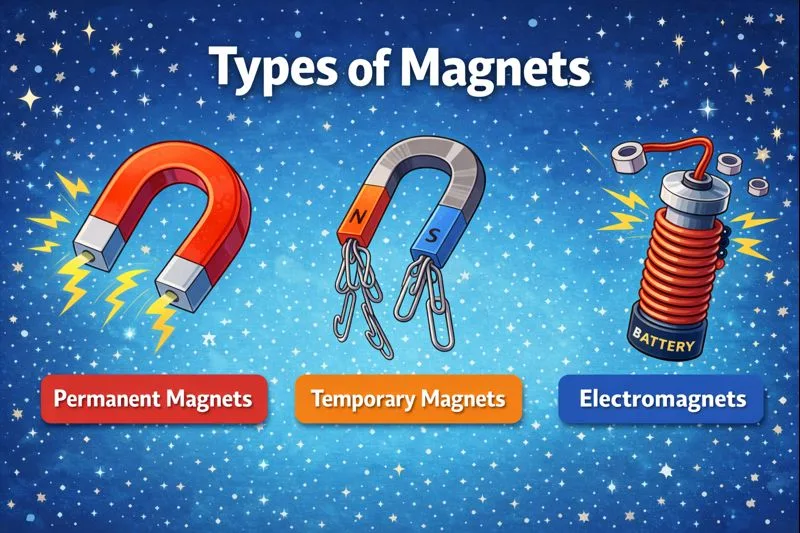
- Permanent Magnets
These magnets always remain magnetic (like fridge magnets)
- Temporary Magnets
These magnets mostly include metals that become magnetic only near a strong magnet.
- Electromagnets
These magnets powered by electricity are very common in everyday machines and gadgets like your cellphone and TV.
Magnets Through Time and Present Day
The use of magnets has evolved with time, they were first used in compasses for navigation and were a very important early discovery in the field of science. Ever since then the use of magnets has changed drastically.
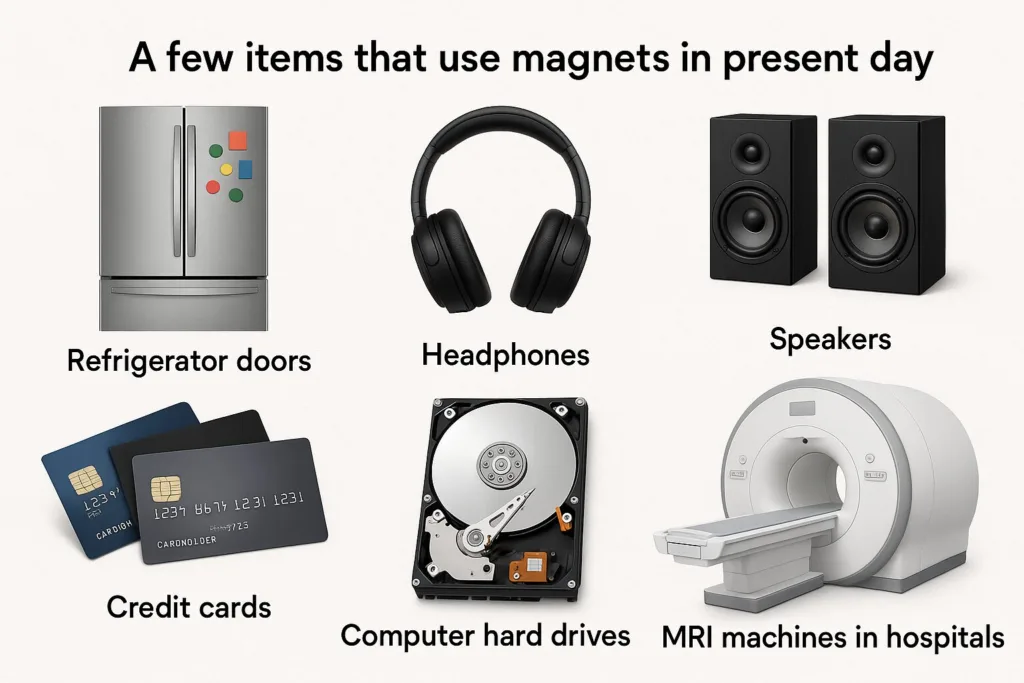
You probably don’t even notice how we are constantly surrounded by magnets in our everyday lives. Here is a list of few items that use magnets in present day:
- Refrigerator doors and magnets
- Headphones
- Speakers
- Credit cards
- Computer hard drives
- MRI machines in hospitals
Fun Magnet Facts For Kids
- Did you know the strongest magnets on Earth are man-made?
- The Sun and other planets in the galaxy also have a magnetic field!
- The force of magnets is referred to as magnetism
- Magnets have a North and a South Pole
- Magnets have invisible magnetic fields
Magnet Experiments for Kids
Here is a list of a few safe and fun experiments with magnets that kids can enjoy:
- Paperclip chain:
Kids can create a paperclip chain by using a magnet to pick up one paperclip and then they can observe it attract more paperclips!
- Magnetic Treasure Hunt:
Kids can safely hide metal objects somewhere and try to find them with a magnet
- Repelling Magnets Trick:
Kids can place two magnets together and see them push away or pull towards one another.

Frequently Asked Questions
What are the two poles of a magnet?
The two poles of a magnet are known as the North Pole and the South Pole.
Do Magnets attract all metals?
No, magnets do not attract all metals, for example: gold, silver and aluminum, etc.
What metals do magnets attract?
Magnets attract metals like iron, nickel, and cobalt.
Conclusion
We hope reading this made you understand why magnets are Magical in Science. These interesting objects are found in nature and are used extensively in modern day technology, even this planet you live on is considered a giant magnet. Next time you notice a fridge magnet, think of the invisible power of the object and recall the fun and interesting facts you read!