Saber-toothed cat extinction quick facts
- At La Brea, scientists radiocarbon-dated 169 fossils to find out when the big animals disappeared.
- Charcoal in lake mud shows fires became about 30 times more common roughly 13,200 years ago.
- Smilodon fatalis means “fate scalpel tooth”. Its upper canines could reach 28 cm.
- The saber-toothed cat has been California’s state fossil since 1973.
- Of all the big mammals at La Brea, only the coyote survived the end of the Ice Age.
When did they die out?
Scientists give two answers, and both are right.
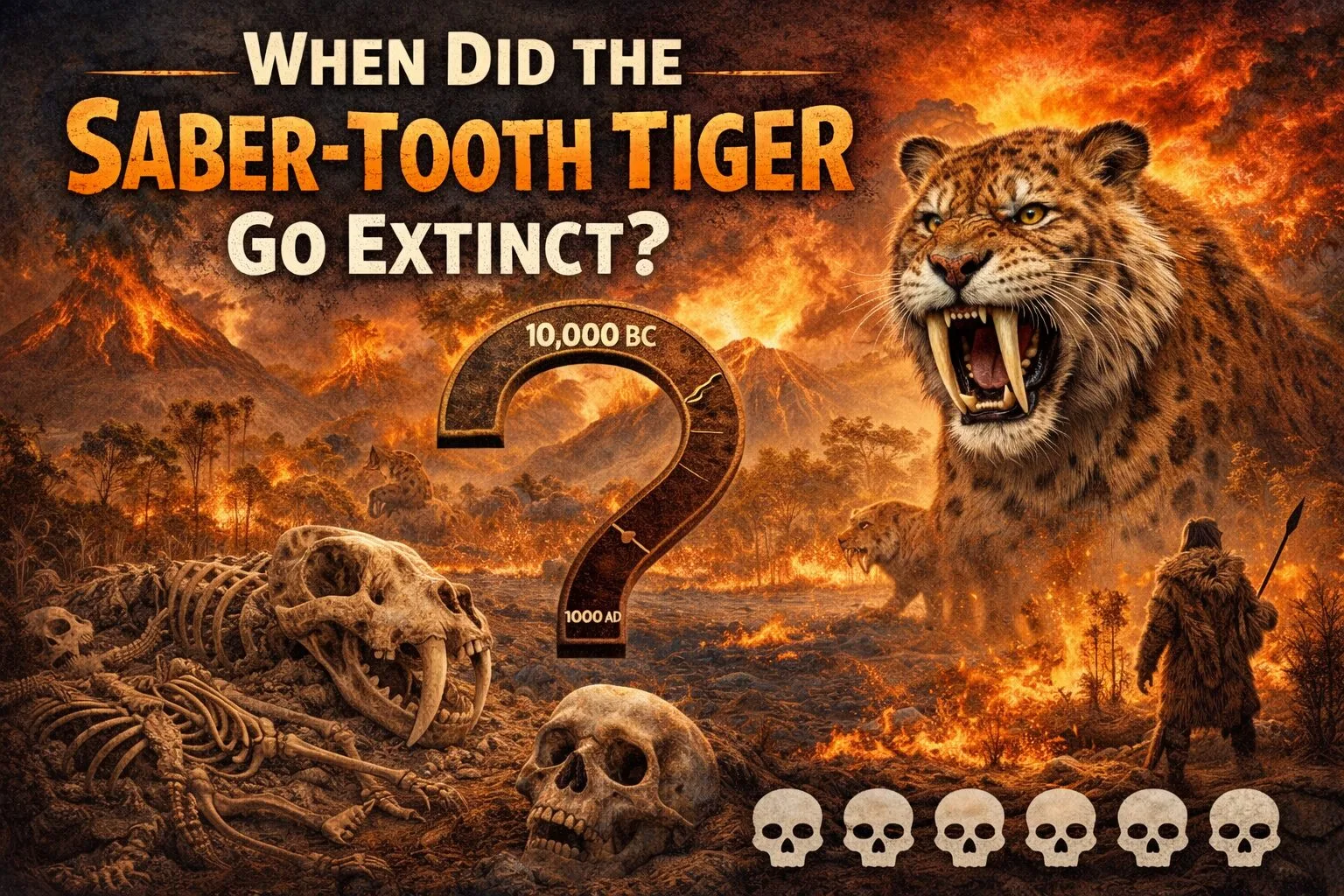
Across the Americas as a whole, the saber-toothed cat Smilodon went extinct roughly 10,000 years ago, near the end of the last Ice Age. That is true for both the North American and the South American species.
But in some places it vanished earlier. At the La Brea Tar Pits in Los Angeles, saber-toothed cats had disappeared by about 12,900 years ago. When an animal dies out in one place but survives elsewhere for a while, scientists call it extirpation. Extinction is when the last one anywhere is gone.
To picture 10,000 years, think of this. The first farming villages were only just appearing in parts of the world. There was no writing yet, and no wheel.
What was a saber-toothed cat?
A saber-toothed cat was a cat, but it was not a tiger. It belonged to a separate branch of the cat family that has no living members today. People call it a saber-toothed tiger because of its size and fangs, not because it was related to tigers.
The best-known species, Smilodon fatalis, stood over a metre tall at the shoulder and was almost 1.8 metres long. It weighed between 160 and 280 kg. Compared with a modern lion, it was shorter, with shorter legs and a stubby tail, but much more heavily built.
Its name means “fate scalpel tooth”. Its upper canines could reach 28 cm, about as long as a school ruler. California’s official guide to its state fossil says they averaged about 20 cm.
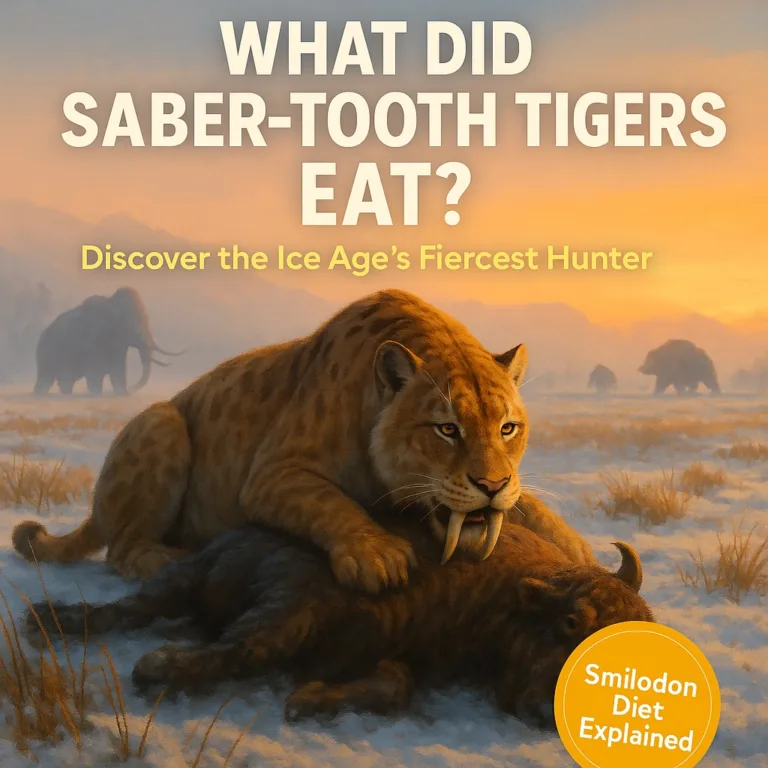
Chemical tests on its bones suggest it hunted large grazing animals such as bison and camels, and forest animals such as deer and tapirs. Scientists think it used its long canines to stab big prey rather than to grab and hold it, though they are still not certain exactly how it hunted. Our guide to what saber-toothed cats ate goes into this in detail.
| Smilodon fatalis | Fact |
|---|---|
| Height at the shoulder | over 1 metre (3 feet) |
| Body length | almost 1.8 metres (6 feet) |
| Weight | 160 to 280 kg (350 to 620 lb) |
| Longest upper canines | up to 28 cm (11 inches) |
| Main prey | bison, camels, deer and tapirs |
| Range | from Alberta in Canada to north-western South America |
| Died out | about 10,000 years ago |
The world at the end of the Ice Age
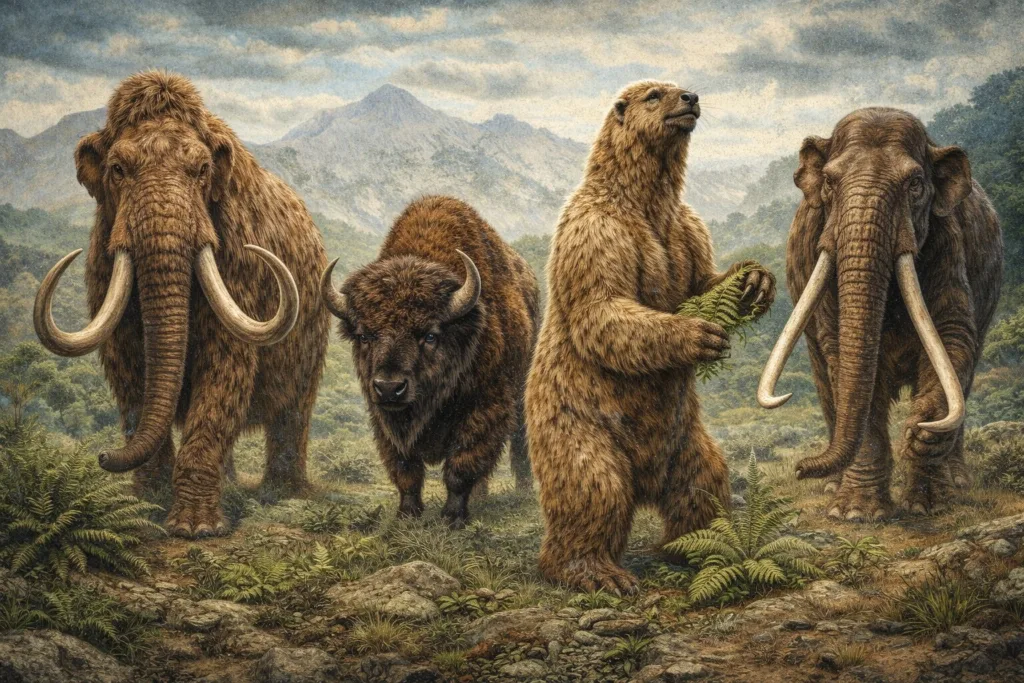
Saber-toothed cats lived alongside giant animals that no longer exist. There were mammoths and mastodons, giant ground sloths, camels and horses in North America, and huge bison. Scientists call these big animals megafauna.
Smilodon fossils have been found from Alberta in Canada all the way to north-western South America. They turn up in Kansas stream banks, in the fossil beds of Tule Springs in Nevada and, most famously, in Los Angeles.
At Tule Springs, the finds include arm bones and bones from the lower back, collected in 2003 and described in detail in 2016.
At La Brea, the fossils cover about the last 50,000 years. Saber-toothed cats are the second most common mammal fossil found there. Researchers there are working to date exactly when four extinct large mammals were trapped: saber-toothed cats, dire wolves, ancient bison and the western horse.
Why so many? The asphalt at La Brea seeps up from underground and pools at the surface. Animals that wandered in got stuck. Scientists think hunters and scavengers, drawn by the trapped animals, often got stuck too. That may explain why meat-eaters such as saber-toothed cats and dire wolves are so common in the pits.
By 12,900 years ago, every one of the big mammal species at La Brea had gone except one. The coyote survived. You can meet some of the others in our guides to woolly mammoths and sloths, whose giant relatives vanished too.
Where Smilodon Fossils Turn Up
- La Brea, Los Angeles — The most famous place to find Smilodon fossils
- Alberta, Canada — The farthest north Smilodon has been found
- North-western South America — The farthest south Smilodon fatalis has been found
- Kansas — Fossils found where streams wear away their banks
How scientists worked out the date
The main tool is radiocarbon dating. Every living thing takes in a little radioactive carbon. When it dies, that carbon slowly breaks down at a steady rate, like a clock that starts ticking at death. Measuring what is left tells scientists how long ago the animal died.
Half of that radioactive carbon disappears roughly every 5,700 years. That makes radiocarbon dating useful for anything up to about 50,000 years old, which covers the whole La Brea story.
La Brea bones are tricky, because they have soaked in natural asphalt, which is full of carbon of its own. So the team used a method developed specially for asphalt-soaked fossils. In a study published in August 2023, they radiocarbon-dated 169 fossils from eight species of large mammal.
They also looked at mud from the bottom of Lake Elsinore, south-east of Los Angeles. Layers of lake mud build up year after year. They trap pollen, which shows which plants grew nearby, and charcoal, which shows how often the land burned.
Put together, the bones and the lake mud gave the clearest timeline yet of what happened in southern California at the end of the Ice Age.
Dating the End of the Ice Age
- Radiocarbon — Breaks down at a steady rate after a living thing dies
- About 5,700 years — The time it takes half the radioactive carbon to disappear
- About 50,000 years — The oldest age radiocarbon dating can measure
- Natural asphalt — Full of its own carbon, so the bones needed a special method
- Pollen in lake mud — Shows which plants grew nearby
- 169 fossils — What the 2023 study dated, from eight species
Why did they disappear?
The 2023 study, led by Robin O’Keefe of Marshall University with scientists at La Brea, pointed to fire.
As the Ice Age ended, southern California warmed quickly and dried out. A drought lasted about 200 years. Then, about 13,200 years ago, the amount of charcoal in the lake mud suddenly shot up about thirty times. It was more fire than at any time in the 33,000-year record.
The fires matched something else: a sharp rise in the number of people living in the area. The study found human population growth was the factor most closely linked to the fires. That suggests people, adding sparks to a landscape already dried out by climate change, set off the blazes.
The study also ruled out one popular idea. A sudden cold snap called the Younger Dryas came after the big animals had already gone from La Brea, so it cannot have caused their disappearance there.
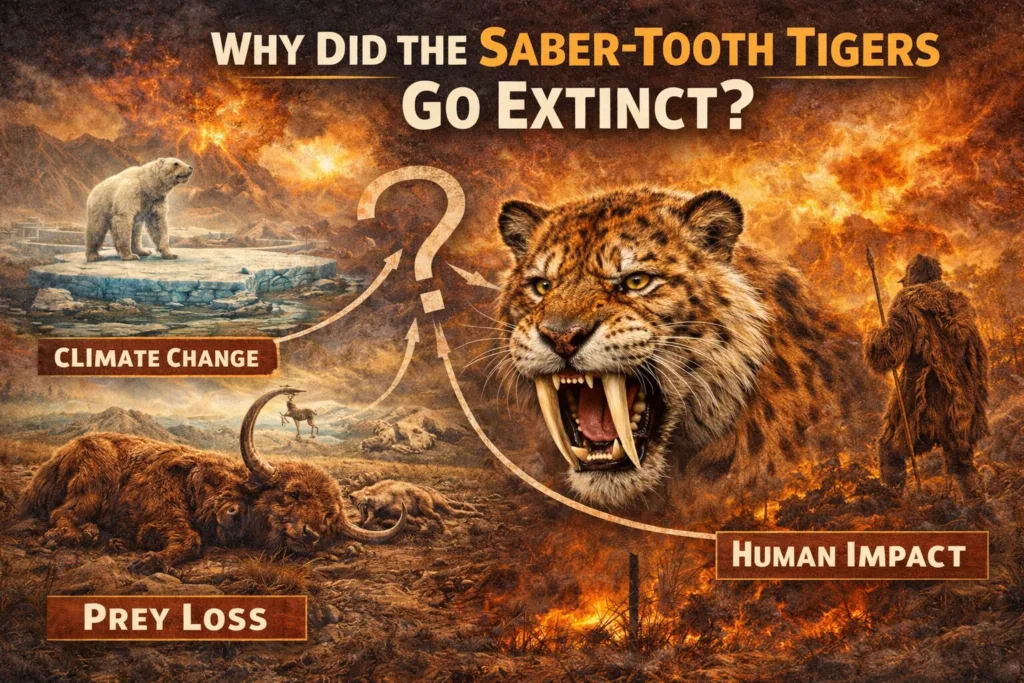
That is the story for one place. Across the rest of the Americas, scientists still argue about the mix of causes. A changing climate, fewer large prey animals and the spread of people probably combined in different ways in different places. Nobody has proved a single cause for the whole continent.
The End of the Ice Age at La Brea
- Trapped in asphalt The oldest fossils in the La Brea asphalt are laid down.
- Warm and dry Southern California warms quickly and dries out, and a long drought begins.
- Fire Huge fires sweep across the dried-out landscape.
- Gone from La Brea Saber-toothed cats and the other giant mammals disappear from La Brea.
- A cold snap The sudden cold snap called the Younger Dryas begins.
- Gone everywhere The last saber-toothed cats anywhere in the Americas die out.
What happened afterwards?
The scientists describe what happened at La Brea as a state shift. The whole ecosystem flipped into a new kind of landscape, and the old one never came back.
With the giant plant-eaters gone, the big predators that hunted them had nothing to eat. Smaller hunters that could eat a wider range of food, such as the coyote, came through.
Could a saber-toothed cat ever be brought back? That question has its own guide: could scientists bring Smilodon back? You can also compare it with a modern big cat in saber-toothed tiger vs lion, or read the full saber-toothed tiger facts for kids.
Three things people get wrong
Saber-toothed tigers were not tigers. They were cats from a separate branch of the family that has completely died out. Tigers and lions are only distant cousins.
The ice did not kill them. Saber-toothed cats lived through many cold spells. At La Brea they vanished as the Ice Age was ending, during warming, drought and fire, and the cold snap came afterwards.
Scientists do not know exactly why they died out everywhere. The La Brea study gives a strong answer for southern California. For the Americas as a whole, the causes are still being studied, and honest scientists say so.
Did you know? Saber-toothed cats are the second most common mammal fossil found at the La Brea Tar Pits in Los Angeles, trapped in natural asphalt over thousands of years.
Saber-Toothed Extinction: Fact or Myth?
- Saber-toothed tigers were a kind of tiger.
- Saber-toothed cats are the second most common mammal fossil at La Brea.
- The cold of the Ice Age killed the saber-toothed cats at La Brea.
- The coyote was the only big mammal at La Brea that survived.
- Scientists know exactly why saber-toothed cats died out everywhere.
- Saber-toothed cats lived through many cold spells before they died out.
- Saber-toothed cats were the only large Ice Age mammals trapped at La Brea.
- When the giant plant-eaters vanished, the big predators that hunted them ran out of food.
Try it
Measure 28 cm with a ruler. That is how long the upper canine of Smilodon fatalis could grow. Then hold the ruler against your own jaw.
Knowledge check
What is the difference between extinction and extirpation?
Show answer
Extirpation is when an animal disappears from one place but lives on elsewhere. Extinction is when the last one anywhere has gone.
What did the 2023 La Brea study find in the mud of Lake Elsinore?
Show answer
A sudden, thirtyfold rise in charcoal about 13,200 years ago, showing that huge fires swept the area just before the big animals disappeared.
Frequently asked questions
When did saber-toothed tigers go extinct?
Saber-toothed cats went extinct about 10,000 years ago, near the end of the last Ice Age. At the La Brea Tar Pits in Los Angeles they had disappeared even earlier, by about 12,900 years ago.
Why did saber-toothed tigers go extinct?
Saber-toothed cats probably died out because of several things together: a warming, drying climate, fewer large prey animals and the spread of people. A 2023 study at La Brea linked their disappearance there to huge wildfires, probably sparked by people.
How do scientists know when saber-toothed tigers went extinct?
Scientists use radiocarbon dating on fossil bones. At La Brea, a 2023 study dated 169 fossils from eight large mammal species using a method designed for bones soaked in asphalt.
Were saber-toothed tigers related to tigers?
Saber-toothed tigers were cats, but not tigers. They belonged to a separate branch of the cat family that has no living members. Tigers and lions are only distant cousins.
How big were saber-toothed tigers?
Smilodon fatalis stood over a metre tall at the shoulder, was almost 1.8 metres long and weighed 160 to 280 kg. It was shorter than a lion but much more heavily built.
What did saber-toothed tigers eat?
Chemical tests on saber-toothed cat bones suggest they hunted large grazing animals such as bison and camels, and forest animals such as deer and tapirs. They probably used their long canines to stab big prey.
Sources
- Natural History Museum of Los Angeles County (2023): new study on Ice Age extinctions at La Brea — the 12,900-year date, the 169 dated fossils, the fires, drought, people and the Younger Dryas
- US National Park Service: the big cats — Smilodon’s size, name, canines, prey, range and extinction about 10,000 years ago
- California State Capitol Museum: the saber-toothed cat, state fossil — its adoption as state fossil in 1973, La Brea fossils and its build
- Kansas Geological Survey: saber-toothed cat — when it lived, what it ate, how it used its canines and Kansas fossils
- La Brea Tar Pits and Museum: our research — the age of the La Brea fossils and the project dating four extinct large mammals
Saber-Toothed Extinction Final Challenge
- About how long ago did saber-toothed cats go extinct across the Americas?
- What does the name Smilodon fatalis mean?
- What do scientists call giant Ice Age animals such as mammoths and giant ground sloths?
- In the 2023 study, what was most closely linked to the fires?
- What is a state shift?
- How do scientists think Smilodon used its long canines?
- About how long did the drought before the fires last?
- About 10,000 years ago, what did the world not have yet?