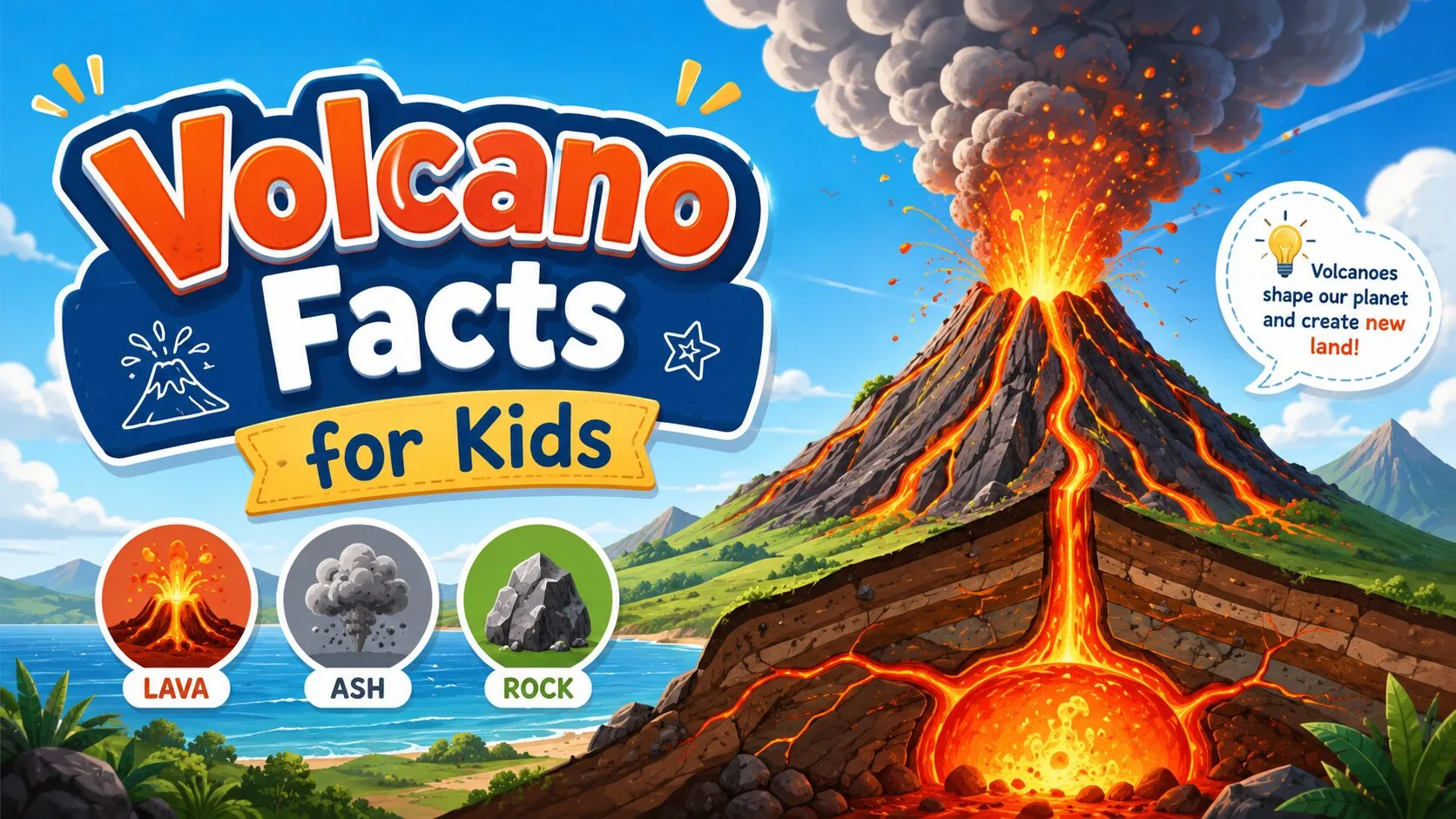
A volcano is an opening in Earth’s surface where melted rock, ash and gas escape. Melted rock is called magma underground and lava at the surface, where it is 700 to 1,200 °C. Most volcanoes form at the edges of tectonic plates or over hot spots. There are more than 1,500 active volcanoes, and about 50 to 70 erupt every year.
volcanoes quick facts
- There are more than 1,500 active volcanoes on Earth.
- Lava is 700 to 1,200 °C.
- The Ring of Fire has more than 450 volcanoes.
- Most active volcanoes are underwater.
- Tambora’s 1815 eruption caused a year without a summer.
What is a volcano?
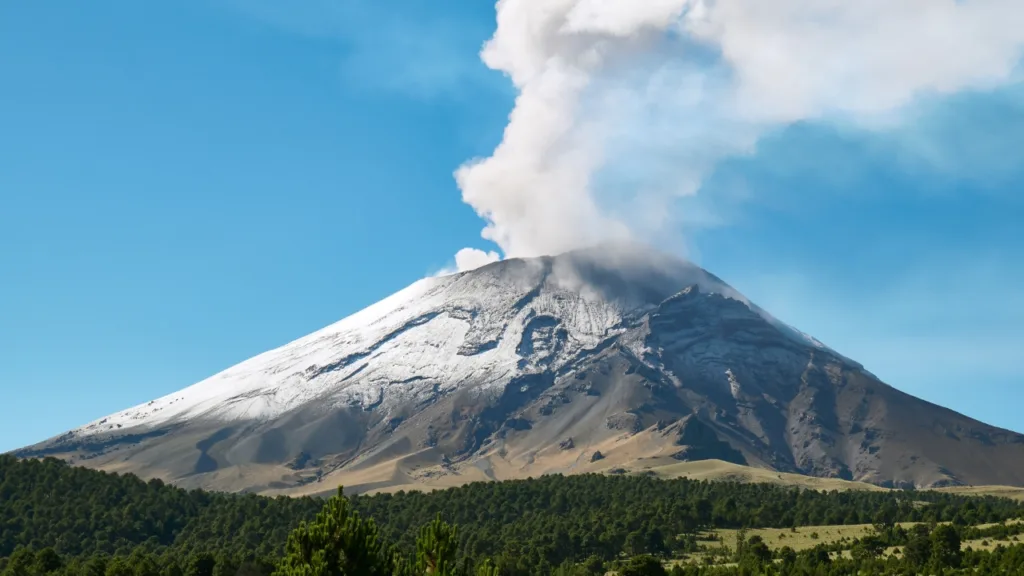
A volcano is an opening in the Earth’s surface where melted rock, ash and gases escape from deep underground. Over time, erupting material can build up into a mountain.
The US National Park Service explains that melted rock underground is called magma. When it comes out at the surface, it is called lava. The opening it comes out of is called a vent.
The British Geological Survey (BGS) says there are more than 1,500 active volcanoes on Earth, and around 50 to 70 of them erupt every year.
| Volcano at a glance | |
|---|---|
| Magma | melted rock underground |
| Lava | melted rock at the surface, 700 to 1,200 °C |
| Active volcanoes | more than 1,500 |
| Eruptions a year | about 50 to 70 |
| Ring of Fire | more than 450 volcanoes around the Pacific |
| Biggest eruption in recorded history | Tambora, Indonesia, 1815 |
How do volcanoes form?
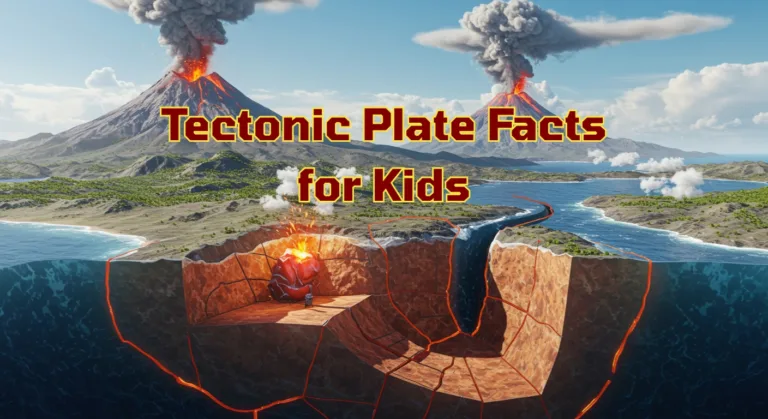
Earth’s outer shell is broken into huge pieces called tectonic plates, which slowly move. The BGS says most volcanoes are found at the edges of these plates. Learn more in our tectonic plate facts.
Where plates pull apart, hot magma rises from the mantle and fills the gap. The BGS says this happens under Iceland and along the ridges in the middle of the oceans. Iceland has more than 100 volcanoes, and over 30 are still active.
Where plates push together, one plate can sink under another. This is called subduction. The BGS says water carried down by the sinking plate lowers the melting point of the rock above it by about 60 to 100 °C, so magma forms and rises.
Some volcanoes form far from plate edges, over a hot spot, where a column of very hot rock rises from deep in the mantle. The BGS says the Hawaiian Islands formed as the Pacific Plate slowly moved over a hot spot, building a chain of volcanic islands.
The heat that powers volcanoes comes from deep inside our planet. Find out what lies beneath your feet in our layers of the Earth facts.
The Ring of Fire
Many of the world’s volcanoes lie in a great horseshoe around the edges of the Pacific Ocean, called the Ring of Fire. NOAA Ocean Exploration, part of the US government, says it stretches for nearly 40,250 km, from South America up through North America, across to Japan and down to New Zealand.
NOAA says the Ring of Fire has more than 450 volcanoes. It also says that most of the active volcanoes on Earth are underwater, hidden beneath the sea.
Europe has volcanoes too. The BGS says Europe has 82 volcanoes, 32 of them in Iceland, and some, like Etna and Stromboli in Italy, are almost always active. Explore more of the continent in our Europe facts.
Types of volcano
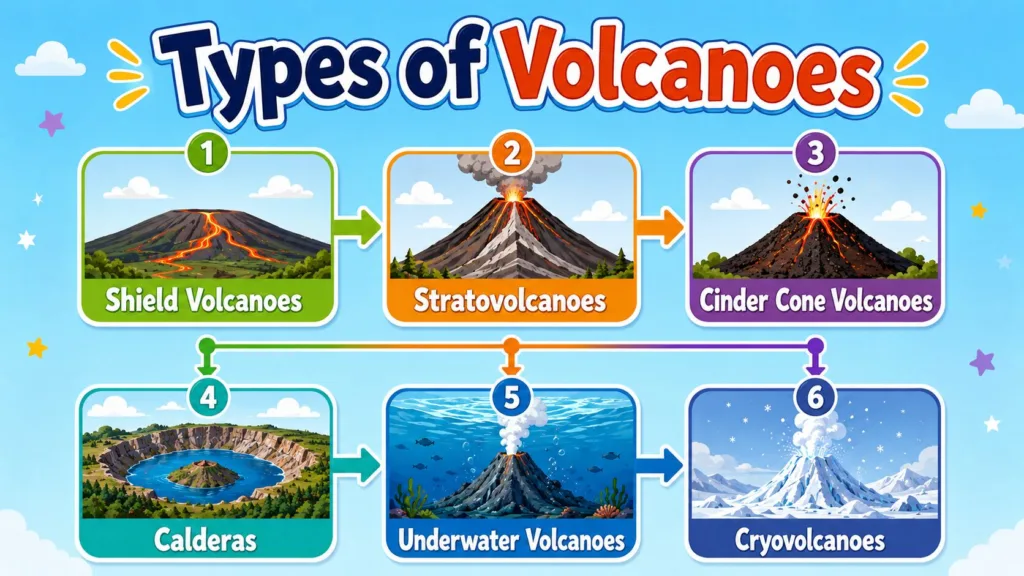
Stratovolcanoes, also called composite volcanoes, are tall and steep, with slopes of about 30 to 35°. The BGS says they are built from layers of sticky lava and ash. Mount Fuji in Japan is one; it last erupted in 1708.
Shield volcanoes have gentle slopes of less than 10°. The BGS says they are built by runny lava flows. Mauna Loa in Hawaii is a shield volcano, and the National Park Service says its runny lava spreads out to give a rounded shape, like a warrior’s shield lying on the ground.
Cinder cones are small volcanoes, often only about 100 m tall, and they usually erupt only once, the National Park Service says.
Lava domes form when thick, sticky lava piles up over the vent instead of flowing away. A caldera is a huge bowl that forms when a giant eruption empties the magma chamber and the ground above collapses. The National Park Service says Crater Lake in Oregon is a caldera.
Fissure volcanoes erupt from a long crack in the ground, rather than a single opening, the National Park Service says.
Why do some volcanoes explode?
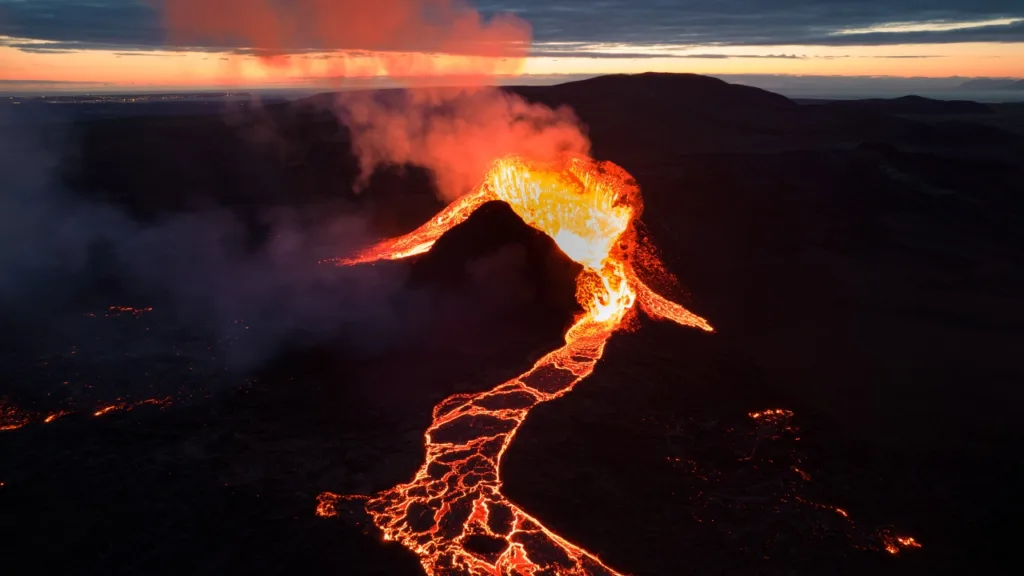
Some eruptions are gentle, while others are violent explosions. The BGS says the difference depends mostly on how much gas is in the magma.
The BGS compares gas in magma to the gas in a shaken bottle of fizzy drink. The gas wants to escape, and pressure builds until it bursts out.
When magma is runny, gas escapes easily and lava pours out gently. The BGS calls these effusive eruptions. When magma is thick and sticky, the gas gets trapped, pressure builds up, and the volcano can explode.
The most explosive eruptions are called Plinian eruptions. The National Park Service says they send ash columns tens of kilometres into the sky. They are named after the eruption of Vesuvius in 79 CE, which buried the Roman town of Pompeii. Read more in our Mount Vesuvius facts.
All about lava
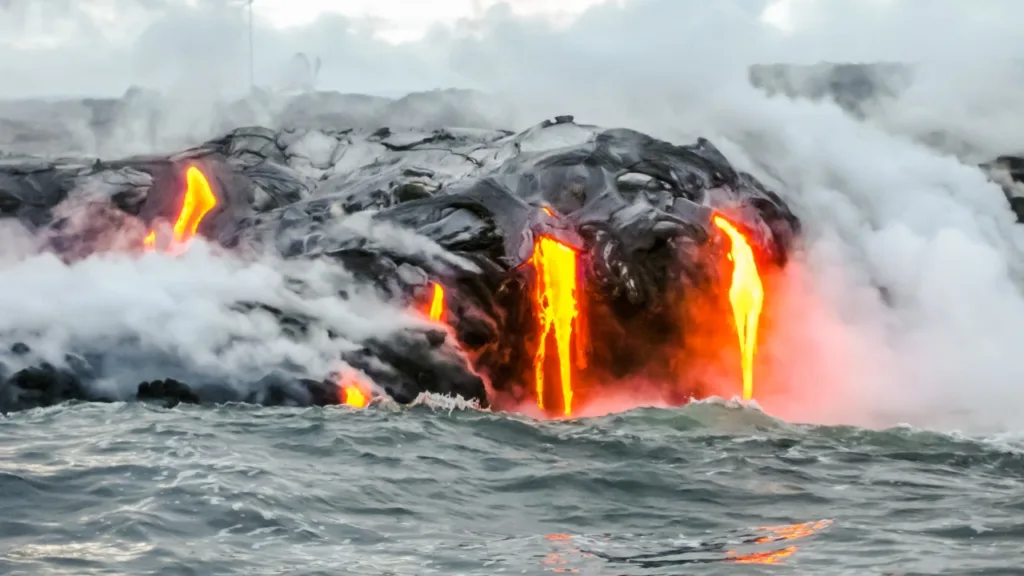
Lava is incredibly hot. The BGS says it is 700 to 1,200 °C, depending on what it is made of. The National Park Service says lava erupting from Kīlauea in Hawaii is about 1,150 °C.
Some lava is fast and some is slow. The BGS says runny basalt lava can flow several kilometres an hour, while thicker lava may move only a few metres an hour.
Lava has Hawaiian names. The National Park Service says pāhoehoe (say “pa-hoy-hoy”) lava has a smooth, ropy surface, while ʻaʻā (say “ah-ah”) lava is rough and chunky. Pāhoehoe can form lava tubes, where a hard crust forms on top and hot lava keeps flowing inside.
The dangers of volcanoes
You might think lava is the most dangerous part of a volcano, but it usually is not. The BGS says lava rarely kills people directly, because it usually moves slowly enough to get out of the way.
Much more dangerous are pyroclastic flows, fast avalanches of hot ash, rock and gas. The BGS says they are 100 to 600 °C and usually travel at 110 km/h or faster.
Volcanic ash can travel thousands of kilometres. The BGS says that in 2010, ash from Eyjafjallajökull in Iceland closed UK airspace from 15 to 20 April.
Volcanoes can also cause mudflows called lahars. The BGS says a lahar from Nevado del Ruiz in Colombia killed 23,000 people in 1985, and tsunamis from the 1883 eruption of Krakatau in Indonesia killed more than 36,000.
Famous eruptions
The biggest eruption in recorded history happened at Tambora in Indonesia on 10 April 1815. NASA’s Earth Observatory says it blasted out about 150 cubic kilometres of rock and ash, and blew off the top of the mountain.
Ash from Tambora dimmed the Sun and cooled the whole planet, NASA says, causing 1816’s “year without a summer”.
On 15 June 1991, Mount Pinatubo in the Philippines put about 15 million tons of sulphur dioxide high into the sky. NASA says Earth’s average temperature dropped by about 0.6 °C over the next 15 months.
On 15 January 2022, an underwater volcano called Hunga Tonga–Hunga Haʻapai exploded in the Pacific. NASA says its plume reached 58 km high, about one and a half times as high as Pinatubo’s.
Earth is not the only planet with volcanoes. The biggest known volcano in the solar system, Olympus Mons, is on Mars; see our Mars facts.
How scientists watch volcanoes
Scientists keep a close eye on active volcanoes to warn people before an eruption. The National Park Service says the US Geological Survey watches 161 volcanoes in the United States from five volcano observatories.
Seismometers pick up small earthquakes caused by moving magma, and tiltmeters and GPS stations measure whether a volcano is swelling up, the National Park Service says. Satellites can spot swelling from space.
Scientists also measure gases. The US Geological Survey says they use ultraviolet scanners to measure sulphur dioxide, and gas “sniffers” to compare different gases coming from vents.
Living with volcanoes
Volcanoes are not all bad news. The BGS says volcanic ash makes soil rich in minerals, which is good for farming.
They can provide energy too. The BGS says Iceland gets about 25% of its electricity from geothermal energy, the heat from underground.
Volcanoes can even make new land. The BGS says the 1973 Eldfell eruption in Iceland added more than 2 km² of new land to the island of Heimaey.
Staying safe
Ready.gov, the US government’s emergency advice website, says families who live near volcanoes should find out whether their area is at risk and make a plan for leaving home.
If officials tell you to leave, do it early. Stay away from areas downwind of the volcano and from river valleys below it. In falling ash, wear a well-fitting mask, stay indoors and close windows and doors, Ready.gov says.
Three things people get wrong
Lava is not the most dangerous thing about a volcano. Pyroclastic flows, lahars and tsunamis kill far more people.
Magma and lava are not exactly the same. It is magma underground and lava once it reaches the surface.
Most volcanoes are not on land. Most active volcanoes are underwater.
Did you know? The 2022 Hunga Tonga–Hunga Haʻapai eruption sent a plume 58 km high, into the mesosphere.
Try it
With an adult, gently shake a bottle of fizzy water and then open it slowly. The escaping bubbles show how gas in magma drives eruptions.
Knowledge check
What is the difference between magma and lava?
Show answer
Magma is underground; lava has reached the surface.
What decides whether a volcano explodes?
Show answer
Mostly how much gas is trapped in the magma.
Frequently asked questions
How do volcanoes form?
Most form at the edges of tectonic plates, where plates pull apart or one sinks under another. Some form over hot spots, like Hawaii.
How hot is lava?
The British Geological Survey says lava is 700 to 1,200 °C. Lava from Kīlauea in Hawaii is about 1,150 °C.
How many active volcanoes are there?
The British Geological Survey says there are more than 1,500 active volcanoes, and about 50 to 70 erupt every year.
What is the Ring of Fire?
A horseshoe of more than 450 volcanoes around the edges of the Pacific Ocean, stretching nearly 40,250 km.
What is the most dangerous part of a volcano?
Not usually the lava. Pyroclastic flows of hot ash and gas, mudflows called lahars and tsunamis cause far more deaths.
How do scientists predict eruptions?
They watch for small earthquakes, swelling ground and new gases using seismometers, GPS, satellites and gas scanners.
Sources
- British Geological Survey: volcanoes — numbers of volcanoes, Europe and Iceland; its pages on how volcanoes form, types, eruption styles, hazards and living with volcanoes were also used
- US National Park Service: types of volcanoes — volcano types and examples; its pages on volcano anatomy, monitoring, Plinian eruptions and lava were also used
- US Geological Survey: volcano monitoring instruments — gas scanners and other instruments
- NASA Earth Observatory: Mount Tambora — the 1815 eruption and the year without a summer; its pages on Pinatubo and the 2022 Tonga eruption were also used
- NOAA Ocean Exploration: the Ring of Fire — the Ring of Fire and underwater volcanoes
- Ready.gov (US Federal Emergency Management Agency): volcanoes — staying safe before, during and after an eruption