Mercury is the smallest planet in our solar system and the closest to the Sun, about 58 million km away. It is a little more than a third of Earth’s width and has no moons or rings. A year on Mercury lasts 88 Earth days, but one day and night lasts 176. Days reach 430°C and nights fall to −180°C.
Mercury quick facts
- Mercury is the smallest planet and the closest to the Sun.
- A year on Mercury lasts 88 Earth days; one day and night lasts 176.
- Mercury’s surface reaches 430°C by day and −180°C at night.
- Mercury may have water ice in craters at its poles.
- MESSENGER crashed into Mercury in 2015, and BepiColombo is due to arrive in December 2026.
What is Mercury?
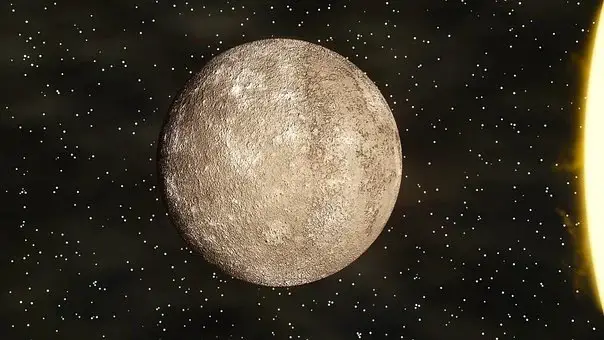
Mercury is the smallest planet in our solar system and the closest planet to the Sun. It is a rocky planet, like Earth, Mars and Venus.
It is named after Mercury, the swiftest of the ancient Roman gods, the messenger who raced about with wings on his feet. The name suits it, because Mercury is the fastest planet, racing around the Sun faster than any other.
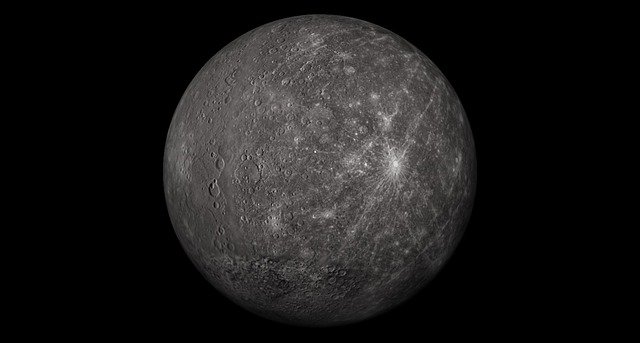
Mercury has no moons and no rings. It is a small, grey, cratered world that looks rather like our Moon, and it is only a little bigger than the Moon.
| Mercury at a glance | |
|---|---|
| Width | about 4,880 km, a little more than a third of Earth’s |
| Distance from the Sun | about 58 million km (36 million miles) |
| One year | 88 Earth days |
| One day and night | 176 Earth days |
| Hottest | about 430°C in the day |
| Coldest | about −180°C at night |
| Moons | none |
| Rings | none |
Where is Mercury?
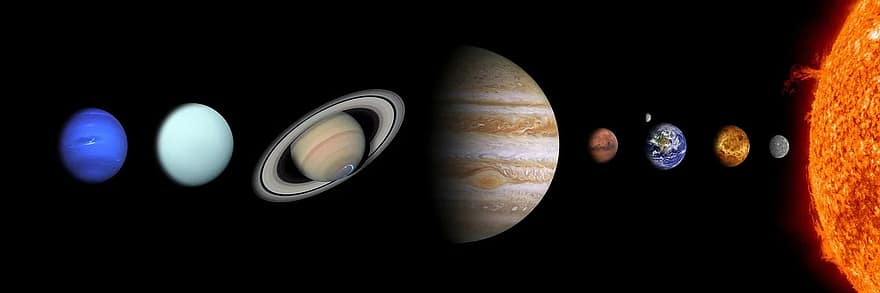
Mercury is the first planet from the Sun. On average it is about 58 million km (36 million miles) away. Scientists call that 0.4 astronomical units, which means it is about four tenths as far from the Sun as Earth is.
From Mercury, the Sun would look more than three times as big as it does from Earth, and it would be much, much brighter.
How big is Mercury?
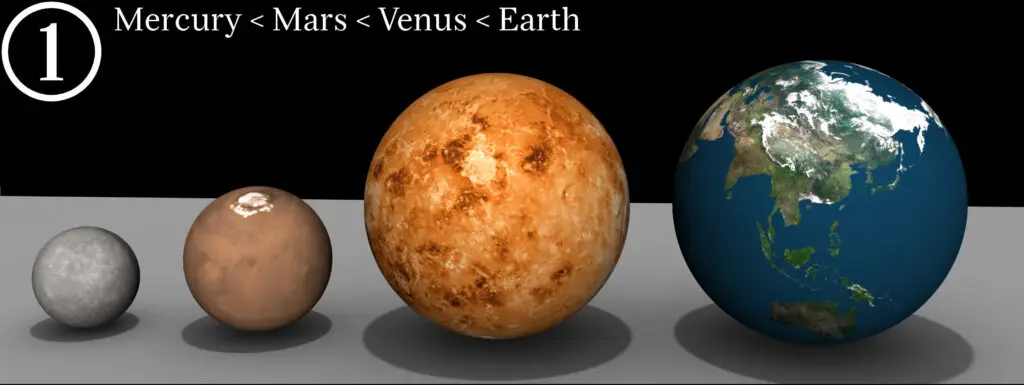
Mercury is tiny for a planet. It is about 4,880 km across, a little more than a third of the width of Earth.
It is only a little bigger than Earth’s Moon. If Earth were the size of a football, Mercury would be about the size of a tennis ball.
A short year and a long day
Mercury races around the Sun once every 88 Earth days. So a year on Mercury is less than three months long. If you lived there, you would have a birthday about every 88 days!
But Mercury spins very slowly on its axis. Because of the way its spin and its journey around the Sun fit together, one full day and night on Mercury, from one sunrise to the next, lasts 176 Earth days.
That means a single day on Mercury is longer than its whole year. It is one of the strangest things about this little planet.
A stretched-out orbit
Mercury’s path around the Sun is not a neat circle. It is the most stretched-out orbit of any planet, a bit like a squashed oval.
So at some points Mercury swoops much closer to the Sun than at others. When it is closest, it speeds up. From some places on its surface, the Sun would even seem to rise, stop, slip back down a little and then rise again.
Burning hot and freezing cold
Being so close to the Sun, Mercury gets scorching hot. In the daytime, its surface can reach about 430°C (800°F), hot enough to melt lead.
But at night it becomes freezing cold, dropping to about −180°C (−290°F). That is one of the biggest temperature swings of any planet.
Why such a big change? Mercury has almost no air to act like a blanket and hold the heat in. When the Sun sets, the heat escapes straight into space.
Even though it is closest to the Sun, Mercury is not the hottest planet. That record belongs to Venus, whose thick clouds trap heat all the time.
Craters and cliffs
Mercury’s surface is covered in craters, made by rocks from space smashing into it over billions of years. With almost no air, nothing slows these rocks down or burns them up before they hit.
One of the biggest is the Caloris Basin, a huge crater about 960 miles (1,550 km) across. Another, the Rachmaninoff basin, is about 190 miles (305 km) wide. Many of Mercury’s craters are named after famous artists, writers and musicians. Rachmaninoff, for example, is named after a Russian composer.
Mercury also has enormous cliffs. Some are hundreds of miles long and up to a mile high. Scientists think they formed as the planet’s hot insides slowly cooled and shrank, wrinkling the surface like the skin of a drying apple.
Hardly any air
Mercury does not have a proper atmosphere like Earth’s. Instead it has a very thin layer of gas called an exosphere.
It is made of atoms of oxygen, sodium, hydrogen, helium and potassium. These atoms are blasted off the surface by the solar wind, the stream of particles that flows out from the Sun.
What is inside Mercury?
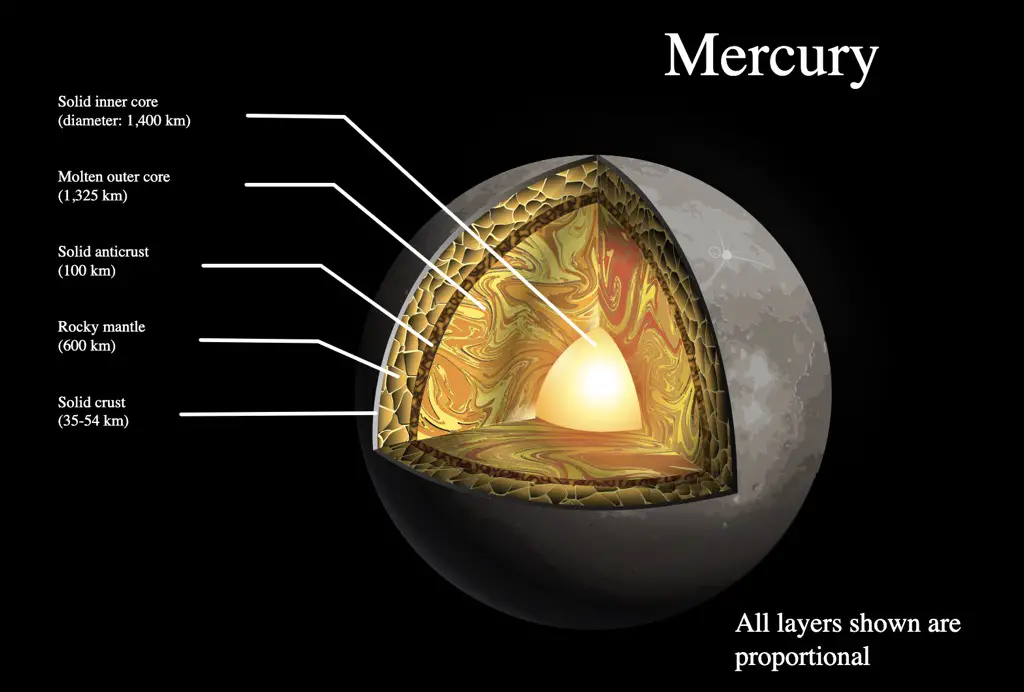
Mercury has a huge metal core. It is about 2,074 km across from the centre to its edge, which means the core takes up about 85% of the planet’s radius.
That makes Mercury a very heavy planet for its size. You can compare its layers with our own planet’s in our guide to the layers of the Earth.
Mercury also has a magnetic field, like Earth’s, but it is weak. At the surface it has just 1% of the strength of Earth’s magnetic field.
Ice on the hottest side of the solar system
Here is a big surprise. Mercury may have water ice.
Near its north and south poles are deep craters whose floors are always in shadow. Sunlight never reaches them, so they stay extremely cold, cold enough for ice to last for a very long time.
Can you see Mercury from Earth?
Yes, but it is tricky. Because Mercury is so close to the Sun, it never strays far from it in our sky.
That means you can only see it low near the horizon, just after sunset or just before sunrise. It looks like a small, bright, star-like dot. The rest of the time, it is lost in the Sun’s glare.
Never look near the Sun to find Mercury, and never use binoculars or a telescope anywhere close to the Sun. It can badly damage your eyes. Wait until the Sun has completely set.
Mercury crossing the Sun
Every so often, Mercury passes directly between Earth and the Sun. From Earth, it looks like a tiny black dot slowly crossing the Sun’s bright face. This is called a transit of Mercury.
Transits of Mercury happen about 13 times every hundred years. Astronomers watch them with special, safe equipment, because looking at the Sun directly is dangerous.
Visiting Mercury
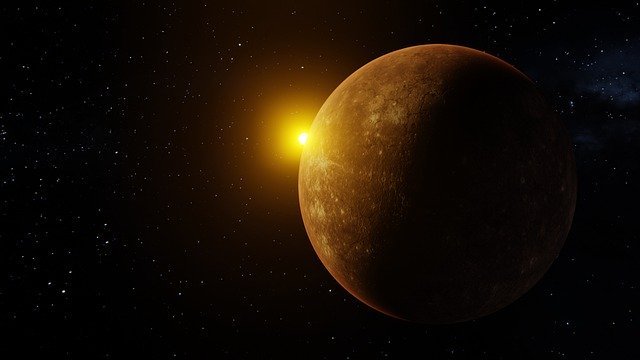
Mercury is hard to visit. A spacecraft has to fight the Sun’s strong gravity to slow down enough to stay near the planet.
The first spacecraft to visit was NASA’s Mariner 10, in the 1970s. More than 30 years later came NASA’s MESSENGER. It was launched on 3 August 2004 and went into orbit around Mercury on 18 March 2011, nearly seven years later.
MESSENGER orbited Mercury for more than four years. It found water ice at the poles, signs of old volcanoes, and water in the thin exosphere. On 30 April 2015, with its fuel used up, it crashed into Mercury at about 14,080 km/h, making a brand-new crater.
The next visitor is BepiColombo, a joint mission by the European Space Agency and Japan’s space agency, JAXA. It was launched on 20 October 2018 and is due to reach Mercury in December 2026. It carries two orbiters that will study Mercury’s ice, its magnetic field and strange hollows on its surface. These hollows are shallow, bright pits that seem to have formed as material escaped from the ground, and nobody yet knows exactly how.
Mercury and the other planets
Mercury is one of the four rocky planets closest to the Sun, along with Venus, Earth and Mars. Beyond them are the giant planets, such as Jupiter, which could swallow thousands of Mercurys.
To explore the rest of the solar system, read our space facts for kids.
Three things people get wrong
Mercury is not the hottest planet. Venus is hotter, because its thick clouds trap heat. Mercury’s nights are freezing.
Mercury does not have a short day. One day and night on Mercury lasts 176 Earth days, longer than its 88-day year.
Mercury is not too hot for ice. Deep craters near its poles never see sunlight, and they may hold water ice.
Did you know? A day on Mercury is longer than its year: one day and night lasts 176 Earth days, but a trip around the Sun takes only 88.
Try it
Work out your age in Mercury years. Multiply your age in Earth years by 365, then divide by 88. How many Mercury birthdays have you had?
Knowledge check
Why does Mercury get so cold at night?
Show answer
It has almost no air to hold heat in, so the heat escapes into space after sunset.
Which is the hottest planet?
Show answer
Venus, because its thick clouds trap heat.
Frequently asked questions
How big is Mercury?
Mercury is the smallest planet in the solar system. It is about 4,880 km across, a little more than a third of the width of Earth and only slightly bigger than our Moon.
How long is a year on Mercury?
A year on Mercury, one trip around the Sun, lasts 88 Earth days. One full day and night, from sunrise to sunrise, lasts 176 Earth days.
How hot is Mercury?
Mercury’s surface reaches about 430°C (800°F) during the day and drops to about −180°C (−290°F) at night, because it has almost no air to hold heat.
Is Mercury the hottest planet?
No. Although Mercury is closest to the Sun, Venus is the hottest planet, because its thick clouds trap heat. Mercury gets freezing cold at night.
Does Mercury have moons?
No. Mercury has no moons and no rings. Venus is the only other planet in our solar system with no moons at all.
Has any spacecraft visited Mercury?
Yes. NASA’s Mariner 10 visited in the 1970s and MESSENGER orbited Mercury from 2011 to 2015. The European and Japanese BepiColombo mission is due to arrive in December 2026.
Sources
- NASA Science: Mercury facts — size, distance, year and day length, temperatures, surface, exosphere, core, magnetic field, polar ice and name
- NASA Science: MESSENGER mission — launch, orbit, discoveries and the 2015 impact, and Mariner 10
- European Space Agency: BepiColombo — the ESA and JAXA mission, its launch, arrival date, two orbiters and questions it will answer