No, praying mantises are not dangerous to people. They have no venom and no poison, and they do not sting. A large mantis that is grabbed roughly may pinch with its spiny front legs, or rarely nip, leaving at most a tiny scratch. Mantises are dangerous only to the insects they hunt, and occasionally to a small bird.
Praying mantis quick facts
- Scientists have gathered 147 reports of mantises catching small birds, in 13 countries on every continent except Antarctica.
- Most of those birds were hummingbirds, which weigh 3 to 6 grams. A big mantis can weigh up to 7 grams.
- It is not against the law to kill a praying mantis in any US state. That story is a myth.
- Spain’s Iberian mantis never grows wings, and it is protected by European Union nature law.
- The big Chinese mantis was brought to the USA in the late 1800s to eat pests. Experts now call it invasive.
Is a praying mantis dangerous to people?
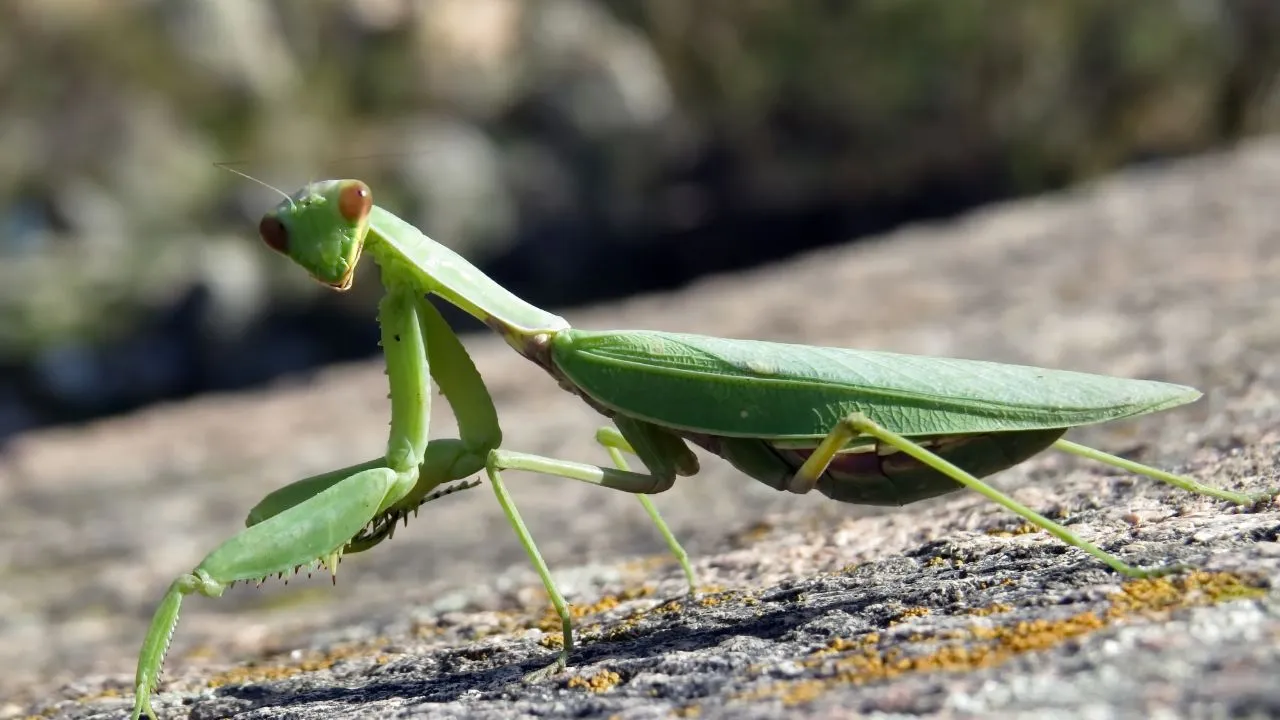
A praying mantis looks fierce. It has a triangular head, large eyes and front legs lined with spikes. To a person, though, a mantis is harmless. The worst it can do to you is pinch.
Insect experts at the University of Kentucky say praying mantids do not sting or bite, and are not normally thought of as pests. Mantid is simply another name for a mantis. Both words are correct, and so is praying mantis.

Mantises are hunters, but they hunt animals much smaller than themselves. A mantis waits very still on a plant until an insect comes close. Then it snatches the insect with its barbed front legs. You are far too big to be food, so a mantis has no reason to attack you.
Most people who meet a mantis find it sitting on a plant. The University of Kentucky notes that mantises rarely fly away and are easy to catch. That is exactly when a pinch can happen, so it helps to know how to hold one safely.
No venom, no poison, no sting
People often mix up the words venomous and poisonous. A venomous animal injects something harmful, with a bite or a sting. A poisonous animal is harmful to eat or to touch.
A praying mantis is neither. It has no venom to inject and no sting. None of the scientists and university experts behind this guide describe any mantis as venomous or poisonous to people.
That is true whatever colour the mantis is. Green mantises, brown mantises and pale mantises are all equally harmless to you. So is the pink and white orchid mantis of South East Asia. Colour helps a mantis hide among leaves and flowers. It tells you nothing about danger.
A few garden creatures really do have venom that matters to people. Our guide to the black spider with a red mark explains how to recognise one and what to do. A mantis is not on that list.
Pinches, nips and whether they hurt
The experts do not quite agree about biting. The University of Kentucky says mantids do not bite. University of Maryland Extension, answering a question about children handling mantises, says a bite is possible but rare.
Here is what University of Maryland Extension describes. A mantis may pinch with its spiny front legs if it feels it has to defend itself. It may also grab a finger because it thinks it has caught prey. While it pinches, it could bite, but that seldom happens.
Even then, the damage is small. The expert’s answer was that a bite would probably cause nothing more than a tiny wound. A mantis has chewing mouthparts made for eating insects, and a person’s finger is a very different thing.
So does a mantis bite hurt? A pinch from those spiky legs can make you jump, and a nip may sting for a moment. It cannot make you ill. Wash any scratch with soap and water, just as you would any small cut.

The best way to avoid a pinch is not to grab the mantis at all. University of Maryland Extension suggests letting it climb onto a leaf or a small branch instead. A mantis held this way usually just sits still and cleans its legs or its face. Sometimes it wanders about, or tries to jump off.
If you do let one walk onto your hand, keep your hand flat and still. Never squeeze it. Rough handling is exactly what makes a mantis defend itself.
How big mantises grow
Mantises are among the largest insects you are likely to find in a garden. Three kinds are common in the eastern USA, and they differ a lot in size. Europe has many more, including one tiny mantis that is protected by law.
| Mantis | Where it comes from | Adult length |
|---|---|---|
| Carolina mantis | native to the USA | about 6 cm (2.5 inches) |
| European mantis | southern Europe; reached the USA by accident in the 1800s | 5 to 8 cm (2 to 3 inches) |
| Chinese mantis | China; brought to the USA on purpose in the late 1800s | up to 10 cm (4 inches) |
| Iberian mantis | found only in Spain and Portugal | 2.7 to 3.6 cm (about 1 to 1.5 inches) |
The Chinese mantis is the giant of the group. The University of Kentucky says it reaches 10 cm (4 inches). That is a little longer than a bank card.
Size decides what a mantis can hunt. A bigger mantis can tackle bigger prey. It still cannot hurt a person more than a small one can. A bigger pinch from an insect is still only a pinch.
Weight tells the story best. Scientists who study mantises note that the heaviest kinds, including the group the Chinese mantis belongs to, can weigh up to 7 grams. That is a little lighter than a British pound coin. It matters for the next part of the story, because some birds weigh even less.
What mantises really are dangerous to
For insects, a mantis is a real threat. It eats moths, butterflies, caterpillars and many other insects, according to the University of Kentucky. It hunts mostly by day, keeps still, and relies on its colour to stay hidden until prey comes within reach.
Like a dragonfly, a mantis is an insect that eats other insects. The difference is the method. A dragonfly chases its prey through the air, while a mantis waits for its prey to come to it.
Mantises are dangerous to each other, too. Larger mantises catch and eat smaller ones. You may have heard that a female mantis always eats her mate. The University of Kentucky says this does sometimes happen, but not every time. The male often gets away.
Mantises have enemies of their own. They look tough, yet spiders, birds and larger mantises all eat them. Owls eat them as well. One study of tawny owls in Algeria found 46 large mantises in the pellets the owls coughed up.
Mantises have their own group of insects. They share some features with grasshoppers and crickets, such as tough front wings that protect the thin flying wings underneath. People often confuse them with walking sticks, which are long and thin too. A walking stick has no grabbing front legs, though.
Mantises that catch birds
This is the one real surprise in the story. Praying mantises sometimes catch small birds.
In 2017, three scientists from universities in Switzerland and the USA gathered every report they could find. They counted 147 cases of mantises catching birds. The cases came from 13 countries, on every continent except Antarctica.
Most of the birds were hummingbirds: 114 of the 147. The hummingbirds weighed only 3 to 6 grams each. A big mantis can weigh more than the bird it catches.
More than 70 in every 100 reports came from the USA. There, mantises waited at hummingbird feeders and on flowers that hummingbirds visit. People reported cases from 26 states. The ruby-throated hummingbird, the only hummingbird that breeds in the eastern USA, was caught most often.
It does not only happen in America. In Spain, European mantises climbed into nets that scientists had set up to catch and ring wild birds, and attacked the birds trapped inside. In Australia and Africa, mantises have caught small songbirds.
| What happened to the birds in the 147 reports | Out of every 100 |
|---|---|
| Caught and eaten by the mantis | 78 |
| Set free by a person who heard the bird | 18 |
| Escaped on its own | 2 |
| Other or unclear | about 2 |
As far as the scientists could tell, every mantis caught eating a bird was a female. They were large mantises, usually at least 6 cm (2.5 inches) long.
Because of this, the scientists urged care about releasing large mantises in gardens to eat pests. They were most concerned about mantises brought from other parts of the world. If you see a mantis waiting on a hummingbird feeder, you can gently move it to a bush further away.
Pets: dogs, cats and lizards
A mantis cannot poison a dog or a cat. It has no venom and no poison, so a pet that sniffs one, paws at it or even eats it will not be poisoned.
A big mantis may still defend itself. If a dog pushes its nose too close, the mantis may strike out with its spiny front legs. That can startle a puppy, but it will not cause real harm.
Cats love to chase insects, and a mantis on a fence is tempting. In that meeting, the mantis is in far more danger than the cat. If a pet ever seems unwell after eating any insect, ring the vet for advice.
Pet lizards are a different question. A lizard can eat a mantis without being poisoned, since there is no poison to eat. Wild insects cause problems for pet reptiles for another reason, though. The veterinary hospital at North Carolina State University tells owners of bearded dragons not to feed them wild-caught insects. Those insects often carry parasites. So do not catch a garden mantis to feed to your lizard.
Are mantises rare or protected by law?
Most mantises are common. The University of Kentucky says praying mantids in the USA are not in danger of extinction, and are not protected by any specific law.
Europe has one mantis that is protected by law. The Iberian mantis lives only on the Iberian Peninsula, the part of Europe shared by Spain and Portugal. It is small, and usually green, though some are light brown or grey. Neither the males nor the females ever grow wings.
Spain’s red book of threatened invertebrates lists the Iberian mantis as vulnerable. An invertebrate is an animal without a backbone, such as an insect or a snail. Spain’s own list of threatened species says this mantis is sensitive to damage to the places where it lives.
The Iberian mantis is also named in the European Union’s Habitats Directive. This is the law that protects Europe’s rarest wildlife and the places they live. It is listed in the Bern Convention too, an agreement between European countries to protect wild animals and plants.
Rules can also apply to a place rather than an animal. The University of Kentucky points out that in some nature reserves and wildlife sanctuaries, killing any animal at all is against the law. That includes mantises.
Mantises in British and American gardens
In much of the USA, a mantis in the garden is a normal sight. The University of Kentucky says they are common from late spring to early autumn, in weeds, gardens, shrubs and low branches.
Many American garden mantises are the large Chinese mantis. It was brought over from China in the late 1800s, in the hope that it would eat pests. Experts no longer count it as helpful, because it also eats butterflies and native mantises. Both the Chinese and the European mantis are now called invasive, which means they came from somewhere else and harm local wildlife.
Britain is different. The European mantis is not a native British insect, but it is moving north as temperatures rise. Cornwall Wildlife Trust says there are already breeding populations on the Isle of Wight and in the Channel Islands.
In September 2025, European mantises were spotted in Cornwall. Then, in August 2026, ten young mantises were found at a school in Truro. At first this looked like the first proof of mantises breeding on the British mainland.
Specialists later said the young insects could not be identified for certain. They had not yet grown the features that tell one kind of mantis from another. So the question is still open, and scientists are watching the site.
A British mantis is as harmless as an American one. The European mantis is about 7.5 cm (3 inches) long, and it eats insects such as crickets and flies. If you see one in the south of England, take a photo and send it to your local wildlife trust. Every sighting helps scientists follow its spread.
Why there is no need to kill one
There is no safety reason to kill a praying mantis. It cannot hurt you, your family or your pets in any serious way.
Does a mantis help the garden? A little. It eats some pest insects. But the University of Kentucky says mantises also eat helpful insects, and each other. Because of that, they usually do not reduce the number of pests. So a mantis is not a free pest-control service. It is a wild hunter that happens to live in your garden, and it is well worth watching.
If a mantis is somewhere it should not be, such as indoors or on a bird feeder, move it instead. Hold out a leaf or a stick, let it climb on, and set it down on a bush outside. It will soon go back to waiting for its next meal.
Three things people get wrong
1. “It is illegal to kill a praying mantis.” No US state has such a law, and US mantises are not endangered. The story may have grown from the rules in nature reserves, where harming any animal is banned.
2. “Mantises keep a garden free of pests.” Mantises eat pests, but they eat helpful insects and each other just as happily. Insect experts say they usually do not cut pest numbers.
3. “Only foreign mantises catch birds.” In the 2017 study, native American mantises caught birds as well. They were behind 42 in every 100 of the American cases shown in photographs. The oldest report, from 1888, is older than the first record of a non-native mantis in North America.
Did you know? In 18 of every 100 bird captures that scientists collected, a person heard the trapped bird’s distress calls and set it free from the mantis.
Try it
Go mantis spotting in late summer. Search tall plants and bushes slowly, because a mantis keeps still and matches the leaves. If you find one, do not pick it up. Hold out a leaf or a twig and let it climb on. Watch how it holds its front legs, then draw it and label the spikes, the eyes and the wings.
Knowledge check
Does a praying mantis have venom or poison?
Show answer
No. A mantis has no venom and no poison. The most it can do to a person is pinch with its spiny front legs.
Which birds do mantises catch most often?
Show answer
Hummingbirds, especially the ruby-throated hummingbird at garden feeders in the eastern USA.
Frequently asked questions
Are praying mantises poisonous or venomous?
Praying mantises are neither poisonous nor venomous. A mantis has no venom to inject, no poison and no sting. A pinch, a nip or a pet eating one cannot poison anyone.
Can a praying mantis hurt you?
A praying mantis can pinch with its spiny front legs if it is grabbed roughly, and very rarely it nips. University of Maryland Extension says the worst result is usually a tiny wound. Wash any scratch with soap and water.
Do praying mantis bites hurt?
Praying mantis bites are rare and small. A nip or a pinch from the spiny legs may sting for a moment and leave a tiny wound. It cannot make a person ill.
Are praying mantises endangered?
Praying mantises in the USA are not endangered, and no US law protects them. One European species, the wingless Iberian mantis, is protected by EU nature law and listed as vulnerable in Spain.
Are praying mantises dangerous to dogs and cats?
Praying mantises are not dangerous to dogs or cats. A mantis has no venom or poison, so a pet that catches or eats one will not be poisoned. A large mantis may still pinch a curious nose.
Is it illegal to kill a praying mantis?
Killing a praying mantis is not illegal in any US state. The University of Kentucky says US mantises are not endangered and no specific law protects them, although some nature reserves ban harming any animal.
Should I kill a praying mantis?
Killing a praying mantis is never needed for safety, because mantises cannot harm people or pets. A mantis in the wrong place can be moved on a leaf or twig to a bush outside.
Sources
- University of Kentucky Department of Entomology: Kentucky Critter Files, praying mantids — what mantids eat and what eats them, the three common species in the eastern USA and their sizes, when they are seen, the myth that killing a mantis is illegal, mating myths, and why mantids rarely control pests
- Nyffeler, Maxwell and Remsen: Bird predation by praying mantises, a global perspective (The Wilson Journal of Ornithology, 2017) — the 147 cases of mantises catching birds, the countries, the hummingbirds, what happened to the birds, the size and weight of the mantises, native and non-native mantises, and owls eating mantises
- Ask Extension, answered by University of Maryland Extension: praying mantis handling — pinching and biting, how small the wound is, how mantises behave when held, and moving one on a leaf or branch
- Cornwall Wildlife Trust: predatory insect breeds on UK mainland for the first time (20 August 2026) — breeding populations on the Isle of Wight and the Channel Islands, the 2025 Cornwall sightings, the 2026 Truro nymphs and the doubt over their identity, size and diet
- Spanish Ministry for the Ecological Transition (MITECO): Apteromantis aptera species sheet — the Iberian mantis’s size, lack of wings, range, Vulnerable listing in Spain and protection under the Habitats Directive and Bern Convention
- NC State University College of Veterinary Medicine: how to feed your bearded dragon — why pet lizards should not be fed wild-caught insects