
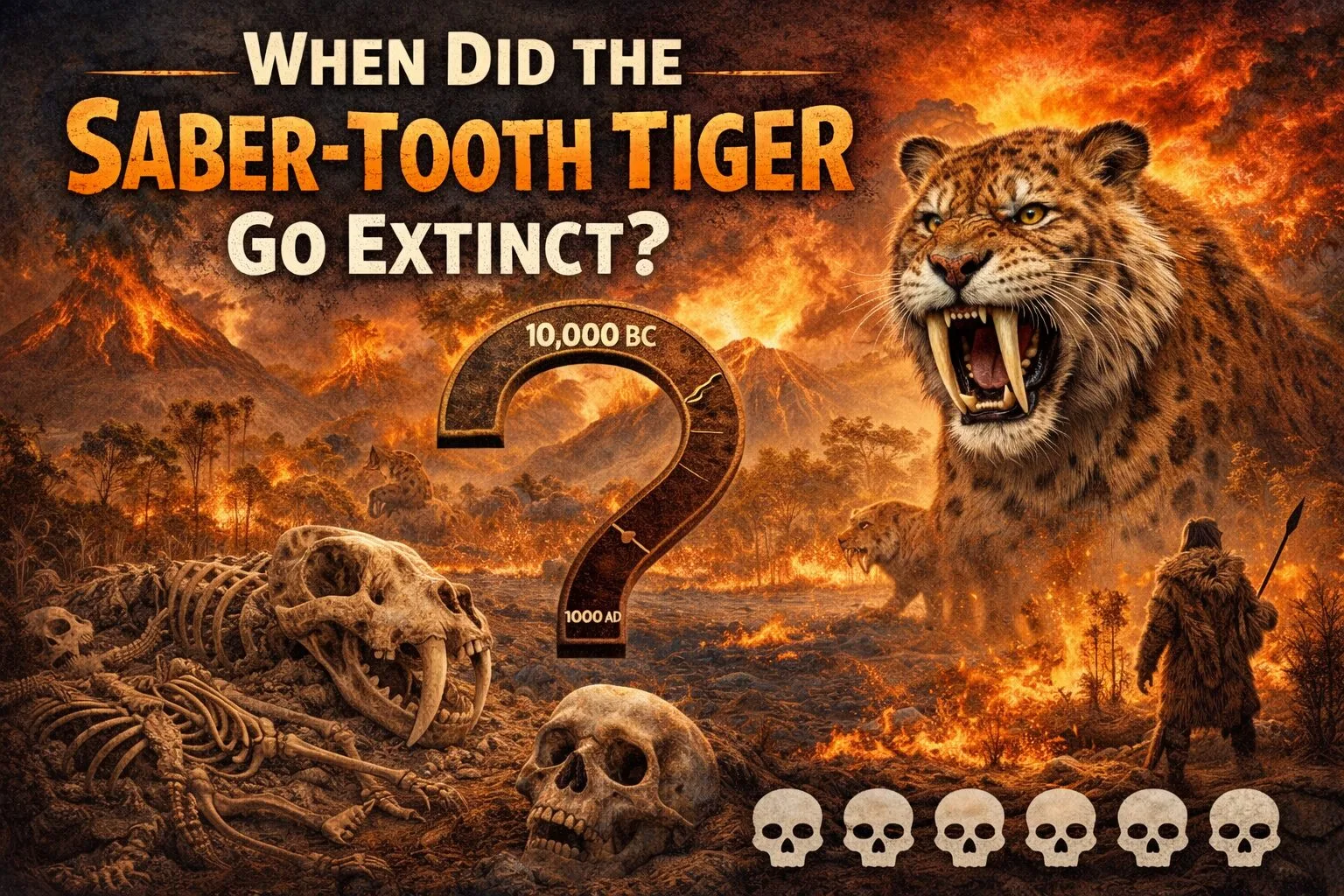
Approximately 10,000 years ago the mighty Saber-Tooth Tiger went extinct. Its fangs, longer than a man’s hand, fell silent as the Ice Age melted away. The Saber-Tooth Tiger belongs to the extinct genus Smilodon, they are not related to tigers or lions despite their name. Keep reading to discover when the Saber-tooth tiger went extinct, how it happened and can we bring back the long gone species.
When Did the Saber-Tooth Tiger Go Extinct?
The Saber-tooth tiger (Smilodon) went extinct around 10,000 years ago, near the end of the Pleistocene Epoch. According to research the oldest Smilodon species, which is known as the Smilodon gracilis, lived 2.5 million years ago. This was around the same time the Woolly Mammoths and Giant Ground Sloths disappeared.
What Was the World Like 10,000 Years Ago?
10,000 years ago the planet was warming quickly and it was the end of the Ice Age; glaciers were melting, the climate became warmer and grasslands began to shrink rapidly. The world was home to many Pleistocene megafauna during this time. These were giant animals like:
- Mammoths
- Bison
- Giant sloths
- Mastodons, etc.
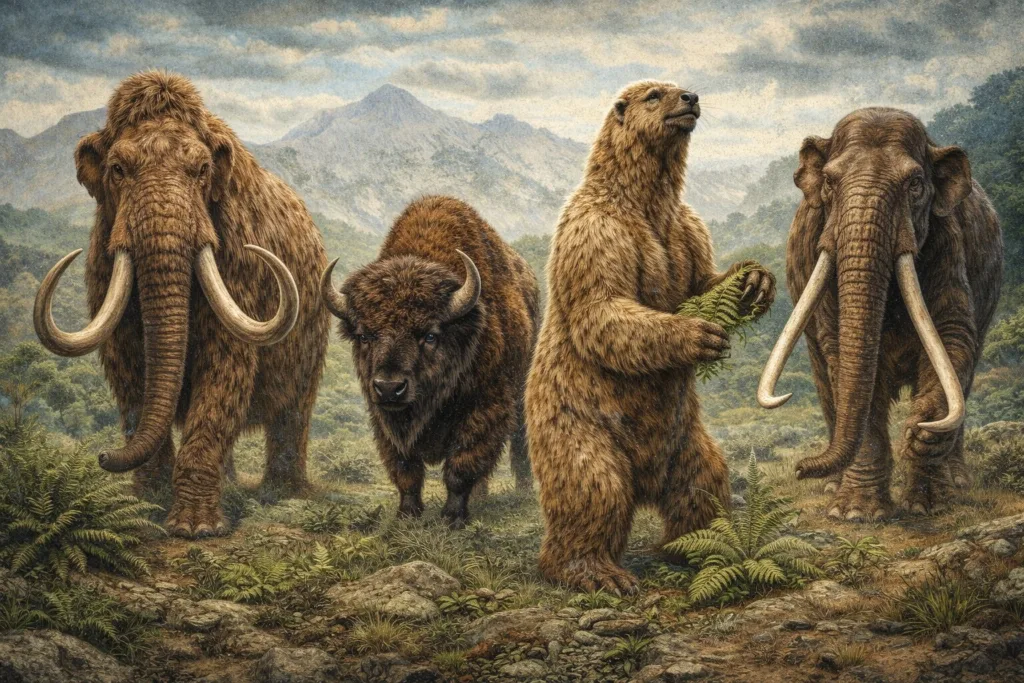
The Saber-tooth tiger (Smilodon) thrived in this world of giant herbivores, due to its sharp fangs and powerful body.
Who Was the Saber-Tooth Tiger?
Did you know the Saber-tooth tiger is not related to tigers or lions? Scientifically they belong to a genus called “Smilodon” which belongs to the family Felidae (true cats) and the now-extinct subfamily Machairodontinae. This group included other distinct saber-toothed predators, such as Homotherium and Megantereon, which were not true tigers but shared the distinctive dental adaptation of long, curved canine teeth. There were 3 primary species of Smilodons:
- Smilodon gracilis is referred to as the smallest specie which weighed between 55-100 kilograms (121 to 220 lb)
- Smilodon fatalis weighed between 160 to 280 kg (350 to 620 lb)
- Smilodon populator is referred to as the largest specie which weighed between 220 to 436 kg (485 to 961 lb)
These mighty creatures lived during the Pleistocene and early Holocene epochs (a particular period of time in history) before becoming extinct roughly 10,000 years ago.
How Do Scientists Know When the Saber-Tooth Tiger Went Extinct?
Scientists know when the Saber-Tooth Tiger went extinct through different strategies like radiocarbon analysis, which is a scientific method used to determine the age of organic materials like bones. They also used stratigraphy, which is the scientific study of Earth’s rock layers and layering; scientists studied the specific layers where they found the Saber-tooth tiger fossils. Most of the Saber-Tooth Tiger (Smilodon) fossils have been found in La Brea Tar Pits in California, dating from 40,000 to about 10,000 years ago. It is important to note that fossils found in Argentina and Brazil confirm that Smilodon went extinct around the same time across both continents.
Why Did the Saber-Tooth Tiger Go Extinct?
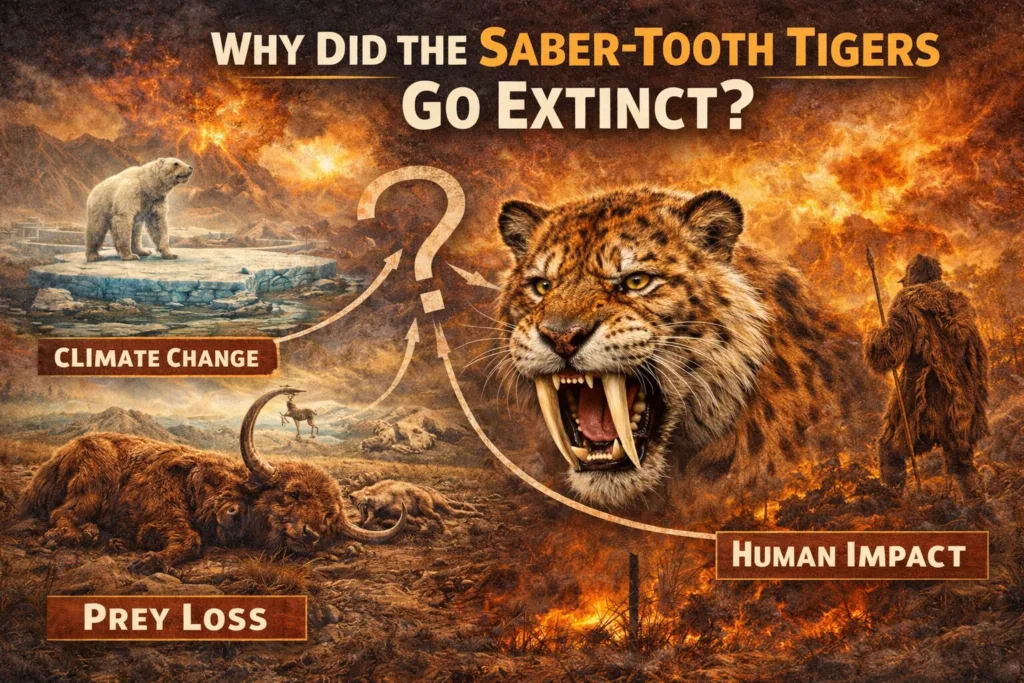
The Saber-Tooth Tiger went extinct for various reasons and scientists have not pinned down a specific one, hence, here are a couple of reasons that are suggested about Saber-tooth tigers slow extinction:
- Climate Change: According to research the time of extinction of the Smilodon is close to the time where the Ice age was ending. During the period glaciers and icecaps melted and flooded areas, which meant grasslands disappeared. This led to the reduction of habitat for the Smilodon and the prey it consumed.
- Prey Loss: Relating back to habitat shrinking, other species of animals started to go extinct like woolly mammoths, bisons, and other megafauna. Predators like the Saber-Tooth tiger and dire wolves began to starve and die due to the food chain breaking.
- Human Impact: Scientists also predict that the early humans hunted the same prey as the Smilodon or possibly killed and hunted the species as well. Human evolution with better weapons and tools could have pushed big predators on the lower level of the food chain and eventually caused extinction. An example of an animal being hunted to extinction is the Dodo bird.
What Happened After The Saber-Tooth Tiger Went Extinct?
Scientists claim that during the period of Smilodon’s extinction other species also went extinct like woolly mammoths, dire wolves and short-faced bears. Humans and other animals are estimated to rise in the food chain due to strong predators like the Smilodon disappearing. Animals like wolves, jaguars and bears, etc. became top predators. From the extinction of giant herbivores, the ecosystems began to shift from megafauna grasslands to forests that we see today. Early humans also started to grow in numbers as they shifted their way of life from survival mode to civilization and development; they began to expand their homes and domesticated animals like dogs and cattle.
Conclusion – Could Saber-Tooth Tigers Ever Come Back?
Theoretically, yes. If in the distant future scientists are able to gain access to viable DNA to map the full genome and engineer a close surrogate species for the fetus of the Saber-tooth tiger it may become possible for humans to witness the extinct creature once again. The scientific world is focusing on bringing back extinct species through a process called de-extinction. The process of de-extinction refers to creating an organism that replicates or is genetically similar to an extinct species. For example, Colossal Biosciences Inc wants to reintroduce the extinct Woolly Mammoths back to the world by the year 2028 but this raises many ethical concerns regarding the process. Professor of ecology Dr. Beth Shapiro asks, “shouldn’t we focus on things that are still alive, instead of trying to bring things back that aren’t there anymore?”.
Fun Facts About Saber-Tooth Tigers
- Saber-Tooth Tigers fangs could grow up to 11 inches long.
- They had short tails unlike modern cats.
- According to National Geographic, bones from an estimated ~3,000 Smilodon were found at La Brea Tar Pits.
- Despite the name Saber-tooth “tigers” these animals were not true tigers, neither related to the modern tigers and lions.
Frequently Asked Questions
What is de-extinction?
De-extinction is the process of creating an organism that replicates or is genetically similar to an extinct species.
How did Saber-tooth tigers go extinct?
Saber-tooth tiger went extinct for various reasons like:
- Climate change and end of Ice Age
- Extinction of Prey
- Human involvement
What are the 3 primary species of Smilodons:
- Smilodon gracilis
- Smilodon fatalis
- Smilodon populator