What was the saber-toothed tiger life cycle?
| Stage | What fossils can show | What remains uncertain |
|---|---|---|
| Newborn and dependent cub | Cubs were born without fully developed saber canines | Gestation length, litter size and appearance at birth |
| Juvenile | Adult canines began erupting after the first year | Exact weaning age and parental-care pattern |
| Young adult | Permanent canines approached full development near age three | The age of first successful independent hunts |
| Adult | Bones and teeth record injuries, diet and physical maturity | Mating behaviour and whether groups cooperated |
| Older individual | Wear, healed injuries and disease can be visible in fossils | Typical maximum lifespan in the wild |
Fossil evidence versus scientific inference
- Teeth preserve growth and wear patterns better than behaviour.
- Healed injuries show that some individuals survived serious physical damage, but they do not prove one specific social system.
- Modern cats can help scientists form hypotheses, but Smilodon was not simply a modern lion or tiger with longer teeth.
Cub and juvenile development
Young Smilodon would have depended on adults while their bodies and hunting equipment developed. Their milk teeth were replaced as the skull and jaws grew.
Research summarised by the National Park Service indicates that permanent upper canines started emerging at about 12 to 19 months and were fully developed at around three years. This unusually long development probably affected when a young animal could use an adult hunting technique.
Adult life
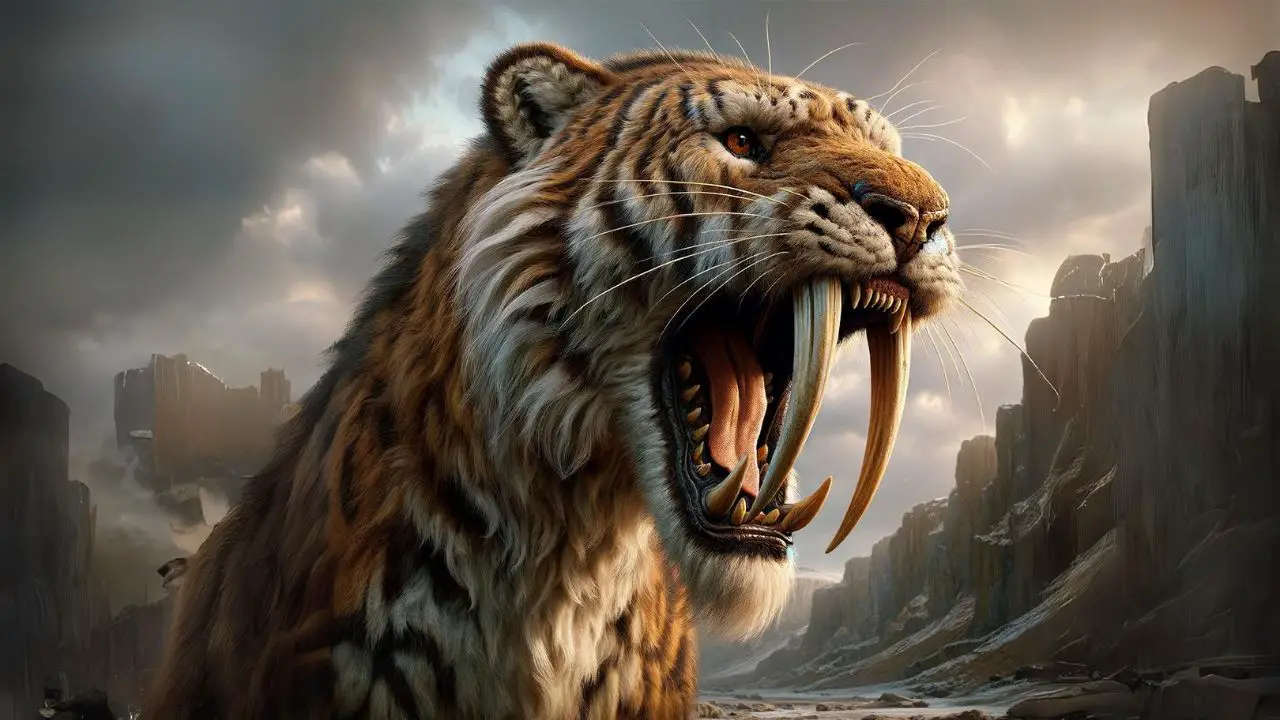
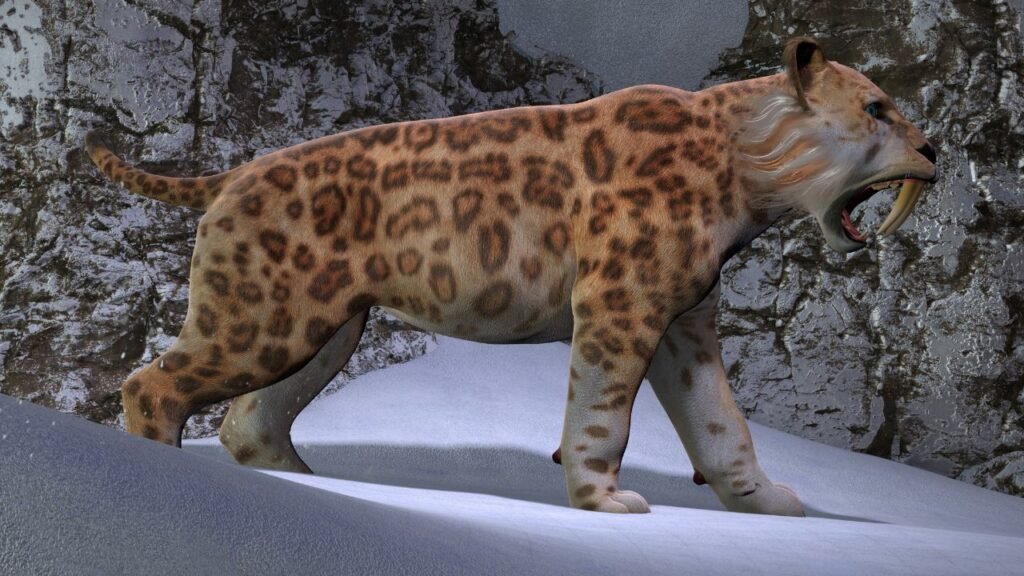
Adult Smilodon were muscular predators of large Ice Age mammals. Their skeletons show strong forelimbs for restraining prey and specialised canine teeth used with a carefully positioned bite.
Fossils can reveal age, injury, tooth wear and diet. They cannot provide a complete diary of mating, cub-rearing or group behaviour, so those topics should be explained as hypotheses.
Aging and survival
Older fossils sometimes preserve worn teeth, arthritis or healed injuries. These clues show that individuals could survive long enough to recover from damage.
Scientists cannot calculate one dependable wild lifespan from the available evidence. Any exact lifespan copied from a modern big cat would be an analogy, not a measured Smilodon fact.
Picture guide




Continue the learning path
Did you know? A Smilodon’s permanent saber canines took much longer to finish developing than the canine teeth of a modern lion.
Try it
Draw a five-stage timeline and label each statement as fossil evidence, reasonable inference or unknown.
Knowledge check
Which life-cycle facts are directly supported by Smilodon fossils?
Show answer
Fossils support growth stages, canine development, physical maturity, diet, wear and injury; exact gestation, litter size and lifespan remain uncertain.
Sources
These government, museum, zoo and scientific resources support the key facts and uncertainty statements in this guide.
- National Park Service: The Big Cats — Reports evidence about juvenile Smilodon and canine development.
- Natural History Museum: Saber-toothed cats — Museum research and explainers about Smilodon fossils and biology.
- Natural History Museum: Saber-toothed Cat 101 — Explains what the La Brea fossil collection can reveal.