
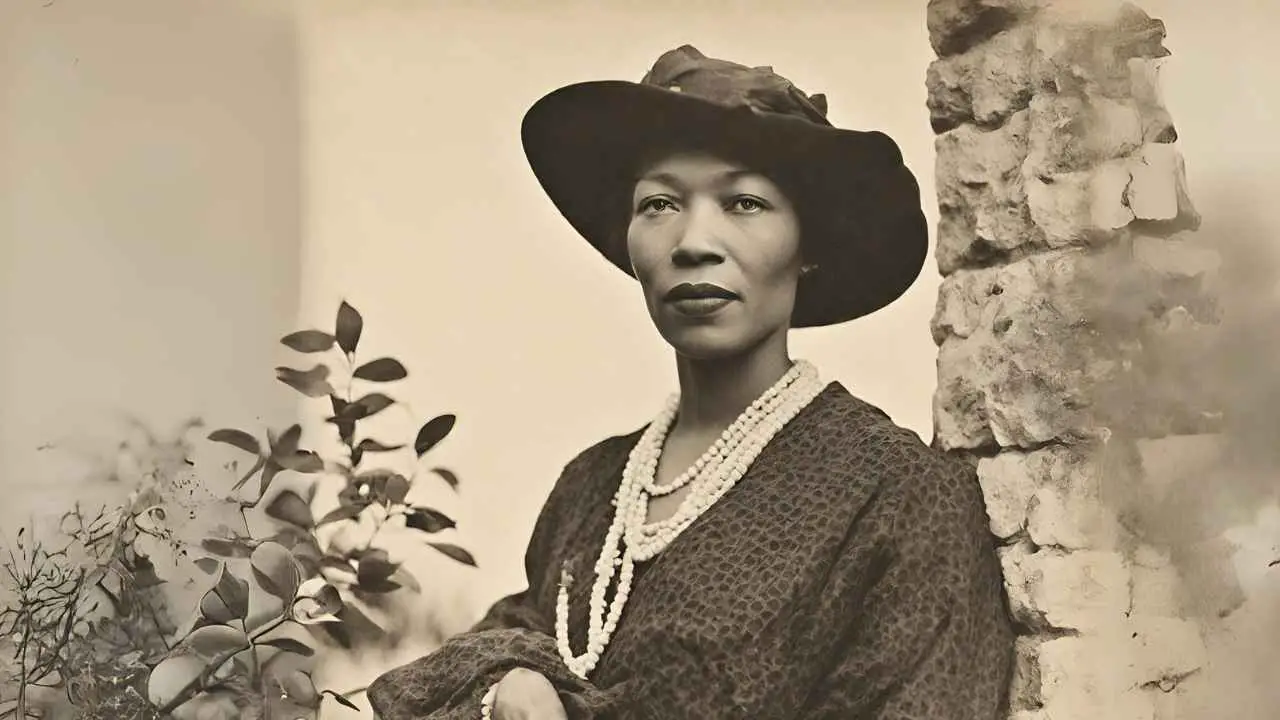
Zora Neale Hurston (1891–1960) was an American writer and folklorist of the Harlem Renaissance. She grew up in Eatonville, Florida, the first incorporated all-Black town in the US, studied anthropology at Barnard College, and collected Black folk tales across the South. Her best-known novel is Their Eyes Were Watching God (1937).
Zora Neale Hurston quick facts
- Hurston was born on 7 January 1891 in Notasulga, Alabama.
- Eatonville, Florida, where she grew up, was founded in 1887.
- She studied anthropology with Franz Boas and graduated from Barnard College in 1928.
- She wrote Their Eyes Were Watching God in seven weeks while in Haiti.
- In 1973 Alice Walker marked her grave: “A Genius of the South”.
Who was Zora Neale Hurston?
Zora Neale Hurston was an American writer and folklorist. A folklorist is someone who collects the stories, songs and sayings that people pass down by word of mouth.
She was part of the Harlem Renaissance, a burst of Black art, music and writing in New York in the 1920s. Her most famous book is the novel Their Eyes Were Watching God, published in 1937.
Over more than 30 years, she published four novels, two books of folklore, an autobiography, and many short stories, essays, articles and plays. She celebrated the everyday lives, language and stories of Black people in the rural South.
A childhood in Eatonville

Zora Neale Hurston was born on 7 January 1891 in Notasulga, Alabama. She was the fifth of eight children. Her father, John Hurston, was a carpenter and a Baptist preacher, and her mother, Lucy Potts Hurston, had been a schoolteacher.
When Zora was still a toddler, the family moved to Eatonville, in Florida, near Orlando. For the rest of her life, she thought of Eatonville as home.
Eatonville was special. Founded in 1887, it was the first all-Black town in the United States to be officially incorporated, with its own government. Zora grew up seeing Black people running the town, including her own father, who helped make its laws. She later described Eatonville as a town of five lakes, croquet courts, good swimmers, plenty of guavas, two schools and no jailhouse.
She loved listening to the grown-ups swapping stories on the porch of the village store. Those tall tales and sayings stayed with her, and later filled her books.
Her mother told Zora and her brothers and sisters to “jump at de sun”. As Zora explained later, they might not land on the sun, but at least they would get off the ground.
Hard years
Zora’s happy childhood ended in 1904, when her mother died. Zora was 13.
Her father soon remarried, and there was little time or money for the children. Zora worked at a series of low-paid jobs and struggled to finish her schooling. For a while she travelled with a theatre company, working as a maid to the lead singer.
In 1917, aged 26, she arrived in Baltimore, still without a high school diploma. To get free schooling, she needed to be a teenager, so she said she was 16 and gave her birth year as 1901. From then on, she always said she was about ten years younger than she really was.
Going to college

Zora finished her high school studies at Morgan Academy in Baltimore in 1918. Then she went to Howard University in Washington, D.C., where she published her first short story in the college magazine.
In 1925 she won a scholarship to Barnard College in New York. There she studied anthropology, the study of people and their cultures, with the famous anthropologist Franz Boas. She graduated in 1928.
The Harlem Renaissance
Zora arrived in New York in the middle of the Harlem Renaissance. She quickly became one of its brightest stars.
She knew how to make an entrance. At a literary awards dinner on 1 May 1925, she won four prizes, including second place for her short story “Spunk” and for her play Color Struck. At the party afterwards, she swept into the room, flung a long scarf around her neck and called out the name of her play.
Her friends included the poets Langston Hughes and Countee Cullen and the singer and actress Ethel Waters. A fellow writer remembered that when Zora was there, she was the party. Even so, she kept working, sometimes writing in her bedroom while a party went on in the next room.
In 1926 she and Langston Hughes, with the writer Wallace Thurman, started a magazine for young Black artists called Fire!!. Only one issue ever came out, but it included one of her best-known stories, “Sweat”.
Collecting stories
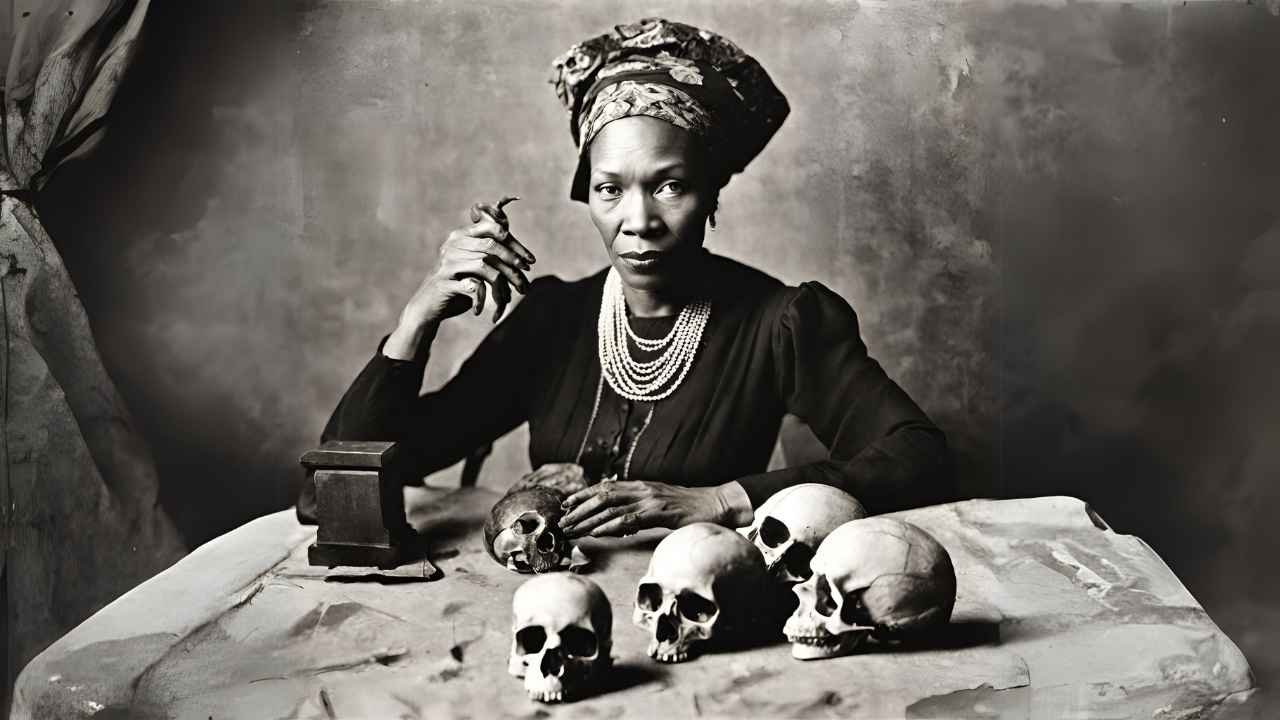
As an anthropologist, Zora travelled across the South collecting folk tales, songs, jokes and sayings from Black communities. She started in Florida in 1927.
Those stories became Mules and Men, published in 1935, a collection of African American folklore from Florida.
In 1936 she won a Guggenheim Fellowship, an important award for writers and scholars, to study traditional beliefs in Jamaica and Haiti. Her book about them, Tell My Horse, came out in 1938.
She also recorded the life story of Cudjo Lewis, believed to be the last survivor of the final ship that brought enslaved Africans to the United States. Publishers turned the book down because it used the way he really spoke. It was finally published in 2018, as Barracoon.
Her books

Zora’s first novel, Jonah’s Gourd Vine, came out in 1934. Critics praised it for showing Black life honestly, without the tired stereotypes of the time.
While she was in Haiti, she wrote Their Eyes Were Watching God in just seven weeks. It was published in September 1937. It tells the story of Janie Crawford, a Black woman searching for love and for her own voice, and many readers now call it her masterpiece.
Her autobiography, Dust Tracks on a Road, came out in 1942. It won the Anisfield-Wolf Book Award in 1943, and that year Howard University gave her its Distinguished Alumni Award. For a short time she even worked as a story consultant at Paramount Pictures, the film studio in Hollywood. Her last novel, Seraph on the Suwanee, was published in 1948.
| Book | Year | What it is |
|---|---|---|
| Jonah’s Gourd Vine | 1934 | her first novel |
| Mules and Men | 1935 | Black folklore from Florida |
| Their Eyes Were Watching God | 1937 | her most famous novel |
| Tell My Horse | 1938 | travel and anthropology in Jamaica and Haiti |
| Moses, Man of the Mountain | 1939 | a novel |
| Dust Tracks on a Road | 1942 | her autobiography |
| Seraph on the Suwanee | 1948 | her last novel |
| Barracoon | 2018 | the life of Cudjo Lewis, written in 1931 |
Later life
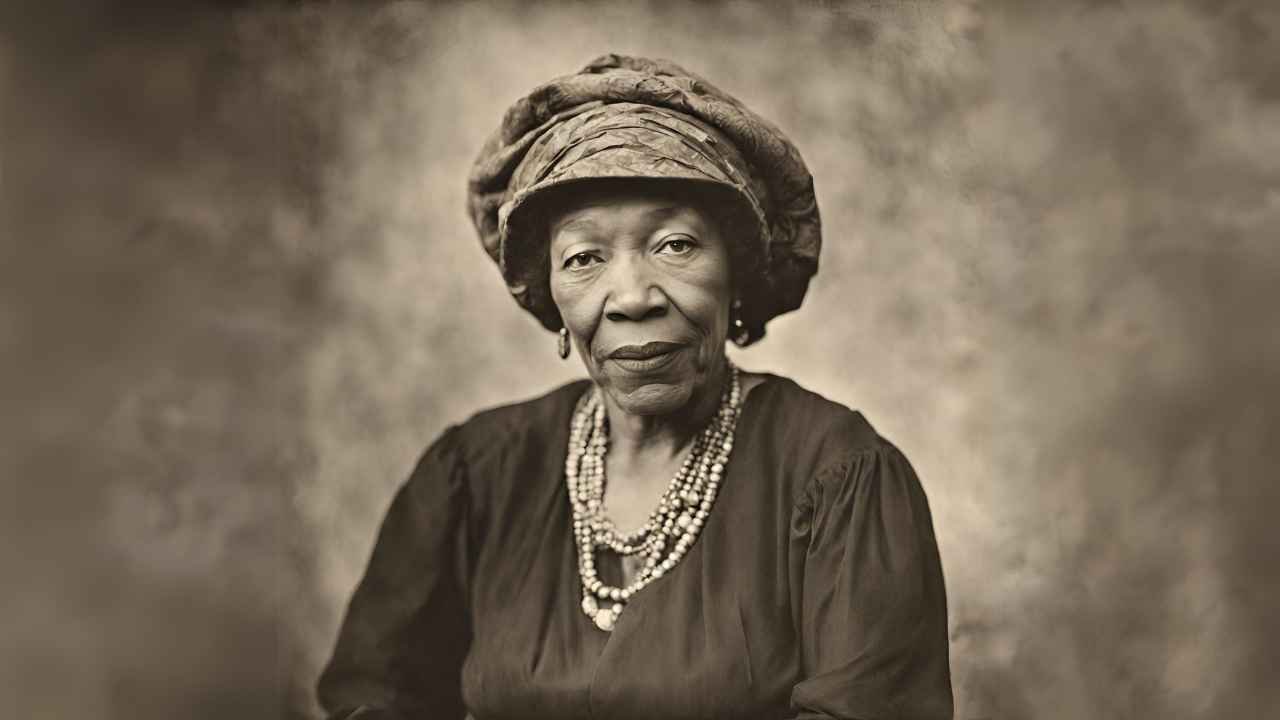
Although her books were admired, Zora never earned much money from them. The biggest royalty payment she ever received for any book was $943.75.
In 1934 she set up a school of dramatic arts at Bethune-Cookman College in Florida. Later she taught drama at a college in North Carolina for a time, worked on a project to record the history of Black Floridians, and took on many other jobs, but by the 1950s she was struggling and little remembered by the reading public. Near the end of her life, short of money and in poor health, she moved into a care home run by the local council in St Lucie County, Florida.
Zora Neale Hurston died on 28 January 1960 in Fort Pierce, Florida, after a stroke. She was 69. Her neighbours collected money for her funeral, but there was not enough for a headstone, so she was buried in an unmarked grave.
Found again
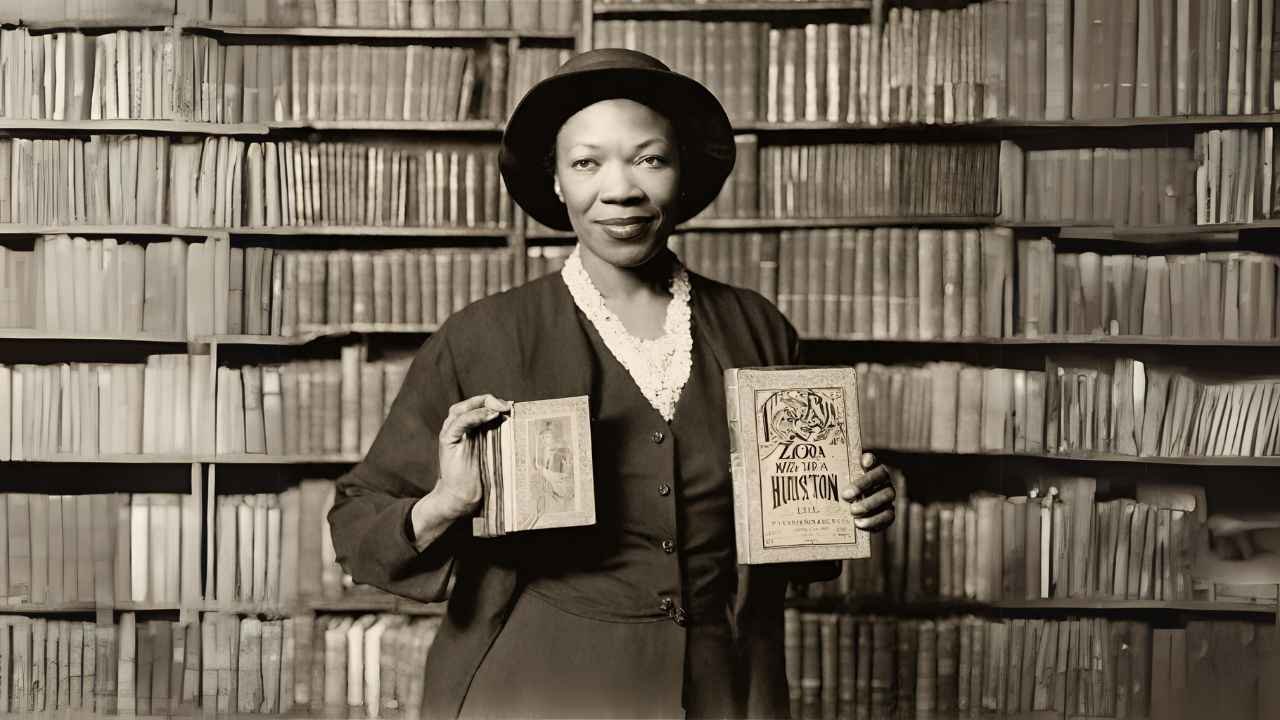
In the summer of 1973, a young writer called Alice Walker travelled to Fort Pierce to find Zora’s grave. Zora’s writing had inspired her.
The cemetery was overgrown with weeds, but Walker found the spot she believed was the grave and placed a plain grey headstone there. On it she had carved: “Zora Neale Hurston: A Genius of the South”.
After that, more and more people discovered Zora’s books again. Her work was collected in two volumes by the Library of America in 1995, and new books have kept appearing, including an unfinished novel about King Herod, completed by the scholar Deborah G. Plant and published in 2025.
Today, Their Eyes Were Watching God is read in schools and colleges across the United States.
Three things people get wrong
Zora Neale Hurston was not born in Eatonville. She was born in Notasulga, Alabama, and moved to Eatonville as a toddler.
She was not born in 1901. She was born in 1891, but she gave her age as ten years younger so that she could go back to school.
She was not famous all her life. She was little remembered when she died in 1960, and her books were rediscovered in the 1970s.
Did you know? Hurston’s book Barracoon, the life story of Cudjo Lewis, was finished in 1931 but not published until 2018.
Try it
Ask an older relative or neighbour to tell you a story from when they were young. Write it down in their own words, just as Zora Neale Hurston collected stories.
Knowledge check
What is a folklorist?
Show answer
Someone who collects the stories, songs and sayings people pass down by word of mouth.
Who found and marked Hurston’s grave in 1973?
Show answer
The writer Alice Walker.
Frequently asked questions
Who was Zora Neale Hurston?
Zora Neale Hurston was an American writer and folklorist of the Harlem Renaissance, born in 1891. She wrote novels, folklore collections and an autobiography, and is best known for Their Eyes Were Watching God.
Where did Zora Neale Hurston grow up?
Zora Neale Hurston grew up in Eatonville, Florida, near Orlando. Founded in 1887, it was the first all-Black town in the United States to be officially incorporated.
What is Zora Neale Hurston’s most famous book?
Her most famous book is the novel Their Eyes Were Watching God, published in 1937. She wrote it in seven weeks while in Haiti on a Guggenheim Fellowship.
What did Zora Neale Hurston study?
Zora Neale Hurston studied anthropology at Barnard College with Franz Boas, graduating in 1928. She then collected African American folklore across the South.
When did Zora Neale Hurston die?
Zora Neale Hurston died on 28 January 1960 in Fort Pierce, Florida, aged 69. She was buried in an unmarked grave until Alice Walker placed a headstone there in 1973.
What was the Harlem Renaissance?
The Harlem Renaissance was a flowering of Black art, music and writing centred on Harlem in New York in the 1920s. Zora Neale Hurston and Langston Hughes were among its writers.
Sources
- Encyclopaedia Britannica: Zora Neale Hurston — her dates, education, the Harlem Renaissance, her books and her posthumous publications
- The Zora Neale Hurston estate: about Zora Neale Hurston (by Valerie Boyd) — her childhood in Eatonville, her early struggles, the 1925 awards, her books, her death and Alice Walker’s headstone
- National Women’s History Museum: Zora Neale Hurston — her family, education, friendships, work in Haiti and Jamaica, the Bethune-Cookman drama school and her last years