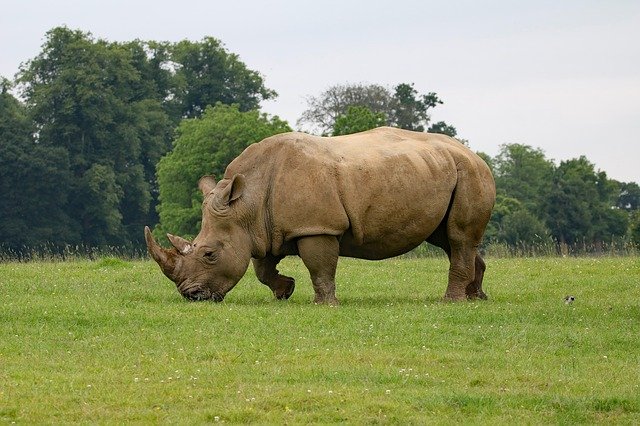
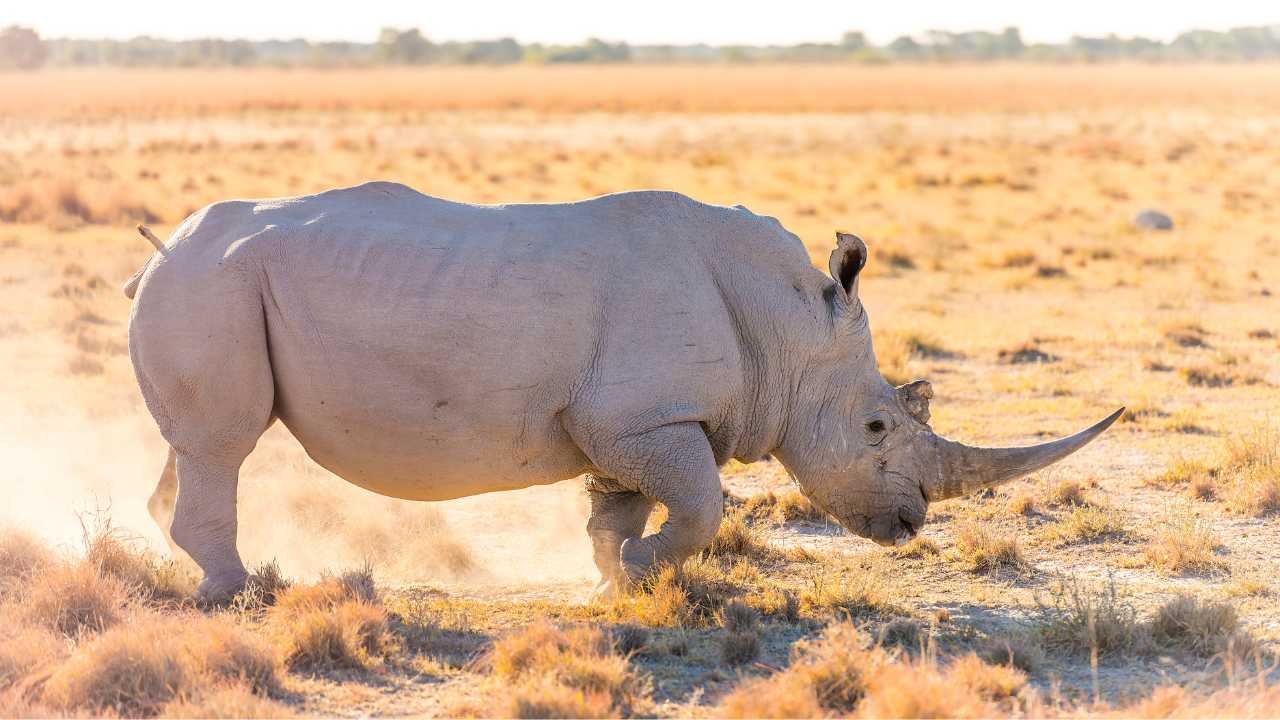
There are about 15,750 white rhinos left in the world, according to a 2025 count by the International Rhino Foundation. Almost all are southern white rhinos, living mainly in South Africa. Only two northern white rhinos are left, both female, in Kenya. Numbers have recently been falling because of poaching.
how many white rhinos are left quick facts
- About 15,750 white rhinos are left, in 11 African countries.
- Only two northern white rhinos are left, both female.
- In 1895, fewer than 100 southern white rhinos were left.
- A white rhino weighs 1,800 to 2,700 kg.
- The name white rhino comes from a word meaning wide.
How many white rhinos are left?
There are about 15,750 white rhinos left in the world. The International Rhino Foundation counted about 15,752 in August 2025, living in 11 countries in Africa.
Almost all of them are southern white rhinos. Only two northern white rhinos are left, and both of them are female.
Other counts are a little different, because rhinos are hard to count. WWF puts the number at about 16,800. Either way, white rhinos are still the most common of all the world’s rhinos. Meet the other kinds in our rhino facts for kids.
| White rhinos at a glance | |
|---|---|
| Number left | about 15,750 (International Rhino Foundation, 2025) |
| Southern white rhinos | almost all of them |
| Northern white rhinos | 2, both female |
| Where | mostly South Africa, plus Namibia, Zimbabwe, Kenya and others |
| Weight | 1,800 to 2,700 kg (4,000 to 6,000 pounds) |
| Lifespan | 35 to 40 years |
| Status | Near Threatened |
Two kinds of white rhino
WWF says there are two kinds, or subspecies, of white rhino: the southern white rhino and the northern white rhino. They are genetically different, and they come from two different parts of Africa.
Their stories are very different too. One is a great conservation success. The other is almost gone.
Southern white rhinos

Southern white rhinos live in the grasslands and savannas of southern Africa. The International Rhino Foundation says just five countries hold 99% of Africa’s white rhinos, and most of those are in South Africa.
WWF says 98.8% of southern white rhinos live in just four countries: South Africa, Namibia, Zimbabwe and Kenya.
Many live in national parks and protected areas. WWF says others live on private game reserves, where the owners protect them.
Northern white rhinos

The northern white rhino is one of the rarest animals on Earth. WWF says only two are left, both female, since the last male died in March 2018.
The two rhinos live at Ol Pejeta Conservancy in Kenya. WWF says armed guards protect them day and night.
Because there are no males left, the two females cannot have calves in the normal way. The International Rhino Foundation says this makes the northern white rhino functionally extinct, which means it cannot survive on its own.
There is still a little hope. Save the Rhino reports that scientists have created northern white rhino embryos in a laboratory. One day, these might be placed in southern white rhino mothers, who could give birth to northern white calves.
How white rhino numbers have changed

White rhino numbers have gone up and down. In recent years, they have been falling again.
The International Rhino Foundation says white rhino numbers dropped by 24% between 2012 and 2021, mostly because of poaching. They have recently dropped by a further 9.8%.
This is worrying, because white rhinos grow up slowly and have few calves. It takes many years for their numbers to recover after a big loss.
The great comeback

Southern white rhinos have already come back from the brink once. WWF says they were thought to be extinct by the end of the 1800s.
Then, in 1895, a small group of fewer than 100 was discovered in KwaZulu-Natal, in South Africa. The International Rhino Foundation says there may have been as few as 20.
Those few survivors were protected. After more than a century of care, their numbers grew. The International Rhino Foundation says there were over 21,000 southern white rhinos by 2012.
WWF says the white rhino is now listed as Near Threatened. It is the only one of the five rhino species that is not endangered.
How big is a white rhino?
White rhinos are enormous. WWF says they are the second-largest land mammal on Earth, after the elephant.
The International Rhino Foundation says a white rhino weighs 1,800 to 2,700 kg (4,000 to 6,000 pounds). It stands 1.5 to 1.8 m (5 to 6 feet) tall at the shoulder and is 3 to 5 m (10 to 16 feet) long.
White rhinos have two horns. The front horn can be 94 to 200 cm (37 to 79 inches) long, and the back horn up to about 56 cm (22 inches).
Are white rhinos really white?
No. White rhinos are grey, just like black rhinos. So where does the name come from?
WWF says the name comes from the Afrikaans word for “wide”, which describes the rhino’s wide, square mouth. The International Rhino Foundation says English speakers misheard the word as “white”, and the name stuck.
That wide mouth is why white rhinos are also called square-lipped rhinos. WWF says their square upper lip has almost no hair.
What do white rhinos eat?
White rhinos eat grass. The International Rhino Foundation says they are grazers, and their wide, square lips are perfect for cropping short grass close to the ground.
WWF says they live in savanna areas with long and short grass. They spend much of the day grazing with their heads down.
Life in the grasslands
White rhinos are more sociable than other rhinos. WWF says groups of up to 14 may form, usually females with their calves.
Adult males usually live alone. WWF says a male defends a territory of about 2.6 sq km (one square mile), which he marks with piles of dung. He will fight other males that come in, using his horn and his great size.
A mother white rhino is pregnant for about 16 months. The International Rhino Foundation says she has one calf every two to three years, and white rhinos can live for 35 to 40 years.
Why are white rhinos in danger?
The biggest threat to white rhinos is poaching, which means illegal hunting. WWF says poachers kill rhinos for their horns, which are sold illegally.
Save the Rhino reports that 420 rhinos were poached in South Africa in 2024 alone.
White rhinos are especially easy targets. WWF explains that they are fairly calm animals and live in groups, which makes them easier for poachers to find.
In the past, hunting in colonial times caused the first big drop in white rhino numbers. Today, WWF says rhinos are also losing their habitat to farms and settlements.
How people are helping white rhinos

Many people are working to protect white rhinos. WWF uses radio tracking to keep an eye on them, and it trains rangers and supports stronger laws against wildlife crime.
WWF says special prosecutors have been appointed in Kenya and South Africa to bring rhino poachers to justice. A wildlife trade monitoring group called TRAFFIC helps countries work together to stop the illegal trade in rhino horn.
There are also big plans to return rhinos to the wild. Save the Rhino reports that in 2023, a plan was announced to move 2,000 white rhinos from a large rhino farm called Platinum Rhino into protected wild areas.
Protecting rhinos helps other animals too. WWF says rhino reserves also protect many other plants and animals, and rhino tourism brings jobs to local people. Learn more on the WWF white rhino page.
Rhino territories
A male white rhino takes his territory seriously. WWF says he marks it with piles of dung, which he scrapes hard with his feet, and he patrols it regularly.
Females roam much more widely. WWF says an adult female’s home range can be more than seven times bigger than a male’s territory, depending on how much good grass there is and how many other rhinos live nearby.
When a female is ready to breed, the male tries to keep her inside his territory. Rival males may fight fiercely over her, using their horns and their great weight.
Mothers and calves
The International Rhino Foundation says white rhinos are semi-social. Females are sociable and often stay together, while adult males usually live alone.
A calf stays close to its mother for a long time. Because a mother has only one calf every two to three years, each calf is precious for the future of the species.
Stopping the horn trade
Rhino horn is smuggled across the world by criminal gangs. The International Rhino Foundation says the illegal horn trade is run by criminal networks that work across many countries.
To stop it, countries need to work together. WWF says the TRAFFIC network has helped South Africa and Vietnam share information and check their borders and ports more closely. This makes it harder for smugglers to move horn from Africa to buyers in Asia.
Three things people get wrong
White rhinos are not white. Their name comes from a word meaning wide.
White rhinos are not all safe now. Their numbers have been falling again because of poaching.
The northern white rhino is not quite gone. Two females are left, and scientists are working to save the subspecies.
Did you know? Southern white rhinos grew from fewer than 100 in 1895 to over 21,000 by 2012.
Try it
Find South Africa, Namibia, Zimbabwe and Kenya on a map of Africa. Most of the world’s white rhinos live in these four countries.
Knowledge check
How many northern white rhinos are left?
Show answer
Two, both female.
What is the biggest threat to white rhinos?
Show answer
Poaching for their horns.
Frequently asked questions
How many white rhinos are left in the world?
About 15,750. The International Rhino Foundation counted about 15,752 in August 2025. WWF puts the number at about 16,800.
How many northern white rhinos are left?
Only two northern white rhinos are left, both female. They live at Ol Pejeta Conservancy in Kenya under armed guard.
Where do white rhinos live?
White rhinos live in the grasslands and savannas of Africa. Most live in South Africa, with others in Namibia, Zimbabwe, Kenya and other countries.
Why are they called white rhinos?
The name comes from the Afrikaans word for wide, describing the rhino’s wide, square mouth. English speakers misheard it as white.
Are white rhinos endangered?
White rhinos are listed as Near Threatened, but their numbers have been falling again because of poaching. Northern white rhinos are functionally extinct.
How big is a white rhino?
A white rhino weighs 1,800 to 2,700 kg and stands 1.5 to 1.8 m tall. It is the second-largest land mammal after the elephant.
Sources
- International Rhino Foundation: white rhino — population, countries, decline, northern white rhinos, size, horns, name, diet, calves, lifespan and the comeback
- WWF: white rhino — subspecies, northern whites at Ol Pejeta, countries, 1895 discovery, status, groups, territories, threats and conservation work
- Save the Rhino: white rhino — poaching in South Africa in 2024, northern white rhino embryos and the Platinum Rhino rewilding plan