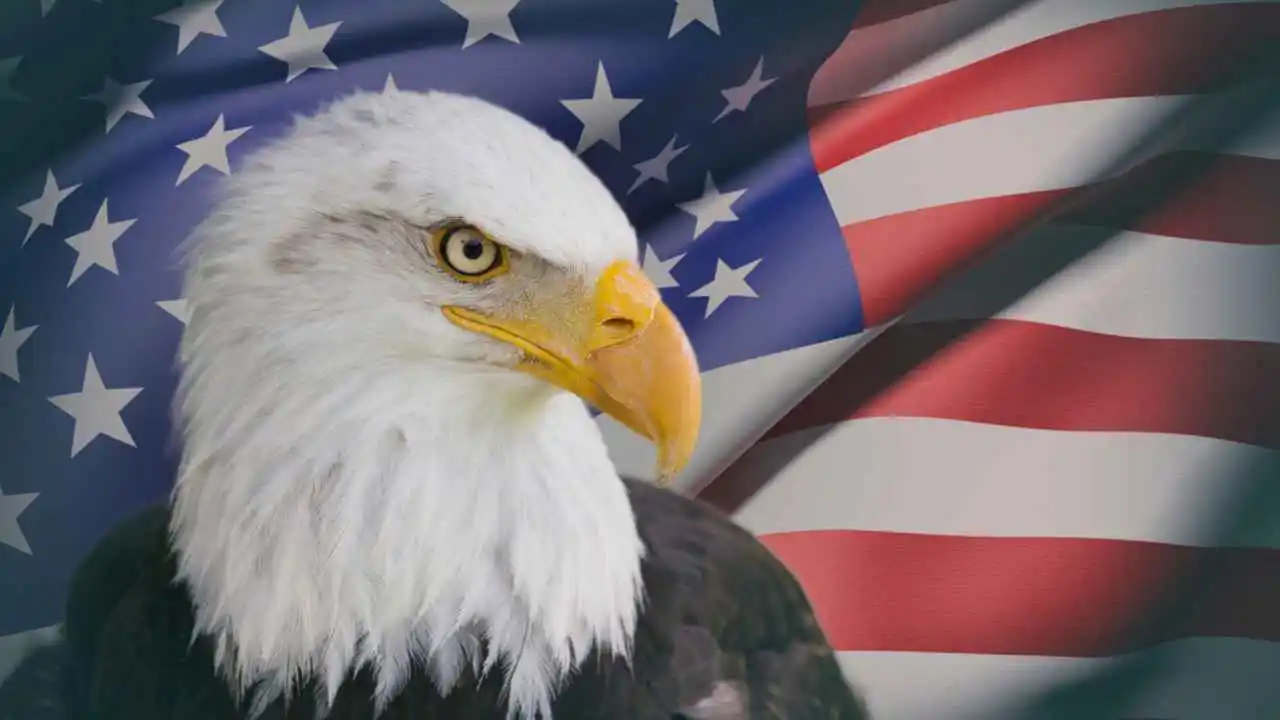
us-symbols quick facts
- The bald eagle only officially became the US national bird on 23 December 2024.
- It has been on the Great Seal since 20 June 1782, designed by Charles Thomson.
- It holds an olive branch in one talon and 13 arrows in the other.
- It faces the olive branch, meaning peace is preferred.
- E Pluribus Unum on its banner means “out of many, one”.
The short answer
The bald eagle stands for independence, strength and freedom.
That is not just a popular opinion. It is the wording Congress itself used when it finally made the bald eagle the national bird of the United States.
And the word finally is doing a lot of work in that sentence, because that only happened on 23 December 2024.
| The bald eagle as a symbol | |
|---|---|
| Stands for | Independence, strength and freedom |
| On the Great Seal since | 20 June 1782 |
| Officially the national bird since | 23 December 2024 |
| Holds in its right talon | An olive branch, for peace |
| Holds in its left talon | 13 arrows, for readiness to fight |
| Faces | The olive branch |
| Motto it carries | E Pluribus Unum, out of many, one |
| Found | Only in North America |

The Great Seal, 1782
The story starts on 4 July 1776, the same day the Declaration of Independence was adopted. Congress also resolved that the new country needed a seal.
It then took six years and three separate committees to agree on one.
Charles Thomson, Secretary of the Continental Congress, designed the version that was finally adopted on 20 June 1782.
That design is still in use today. Almost every American meaning of the bald eagle comes from it.

What the eagle is holding
Look closely at the Great Seal and the eagle is carrying four separate messages.
In one talon it holds an olive branch, the ancient symbol of peace. In the other it holds 13 arrows, standing for military strength and for the 13 original states.
Peace in one foot and war in the other, carried by the same bird at the same time.
Now look at which way its head is turned. The eagle faces the olive branch, and that is deliberate. The United States, the design says, wants peace but is ready to defend itself.
On its chest is a shield with 13 stripes. Above its head is a constellation of 13 stars.
In its beak is a banner reading E Pluribus Unum, Latin for out of many, one. Thirteen separate states were becoming a single country, and the motto says so in three words.
Count the thirteens on the seal and you keep finding them: 13 arrows in one talon, 13 stripes on the shield, and 13 stars in the constellation above the eagle’s head.
Nothing on the Great Seal is decoration. Every part of it is carrying a message about the thirteen states and how they meant to behave.
It was not the national bird until 2024
Here is the fact that surprises almost everyone, including most Americans.
For 242 years the bald eagle appeared on the Great Seal. It was on military insignia, on passports, on coins, and on the seals of the President and Congress. Everyone assumed it was the national bird.
Legally, it was not. The United States had never actually designated one.
That changed with Public Law 118–206, signed on 23 December 2024, which amended the United States Code to designate the bald eagle as the national bird.
Congress set out its reasons in the law itself. Among them: that bald eagles are a historical symbol of the United States representing independence, strength and freedom, and that the bald eagle is unique to North America.
So the answer to “what was the national bird before the bald eagle?” is: there was not one.
Did Benjamin Franklin want a turkey?
This is the most repeated bald eagle story, and it is half true.
On 26 January 1784, Benjamin Franklin wrote to his daughter Sarah Bache. He was rude about the eagle.
He called it a bird of bad moral character, complaining that it steals fish caught by other birds rather than catching its own. He said it was often very lousy, and a coward that smaller birds could chase away.
He then praised the turkey as a much more respectable bird, and a true original native of America. A turkey, he added, would not hesitate to attack a grenadier who walked into its farmyard.
So far, so familiar. Here is the part usually left out.
Franklin was not arguing about the national bird at all. He was writing privately about the emblem of the Society of the Cincinnati, a club for Revolutionary War officers. He thought its badge looked more like a turkey than an eagle anyway.
He never formally proposed the turkey for anything. The letter was private and stayed largely unknown during his lifetime.
Our guide to Thanksgiving covers the bird he was defending.

Where you can find the eagle
Once you know what to look for, it is difficult to avoid.
The Great Seal itself is kept by the Secretary of State, and around 3,000 seals are attached to official documents each year, including treaties and commissions.
The design appears on United States passports and on the back of the one dollar bill.
Congress listed the uses in the 2024 law. The bald eagle is the leading insignia across every branch of the US military. It appears on the seals of the President, Vice-President, Congress and Senate. It features on hundreds of US stamps and many coins.
It is also on federal and state flags, and used as a logo by businesses, charities and sports teams.

What the eagle means to Indigenous peoples
There is a much older set of meanings that often gets left out of this question.
The 2024 law acknowledges it directly. Congress found that bald eagles are integral to the spiritual lives and sacred belief systems of most Indigenous peoples and Tribal communities.
The law lists how: in belief, practice, stories, ceremonies, dance, traditions, songs, regalia, flags, insignia, arts and crafts.
Those meanings are far older than 1782, and they are not the same as the national symbolism. Our guide to Native American peoples covers that wider history.
It is worth holding both. The eagle on a government seal and the eagle in a ceremony are the same bird, meaning different things to different people.
The real bird behind the symbol
Congress gave one more reason for choosing it, and it is a good one: the bald eagle is unique to North America.
No other continent has this bird. That is why it works as a symbol in a way a lion or a generic eagle would not.
There is also a conservation story folded into the law. Congress credited the joint efforts of federal, state and local governments, charities and individuals with bringing the bald eagle back after it had come close to being lost.
Our bald eagle guide covers the animal itself: how big it is, what it eats, and how it recovered.
Why an eagle at all?
Eagles have been used as symbols of power for a very long time, long before the United States existed.
Roman legions carried an eagle standard. So did later empires in Europe. An eagle was the obvious shorthand for strength and authority, and the men designing the seal in 1782 knew that.
But they did not want just any eagle. They chose the bald eagle specifically.
Congress restated the reason in the 2024 law: the bald eagle is unique to North America.
That mattered. A new country breaking away from Europe did not want a borrowed European symbol. It wanted something that could only be American.
The bird gave them exactly that. You cannot find a wild bald eagle anywhere else on Earth.
Three things people get wrong
“The bald eagle has been the national bird since 1782.” It has been on the Great Seal since 20 June 1782, but it did not officially become the national bird until 23 December 2024.
“Benjamin Franklin wanted the turkey as the national bird.” He criticised the eagle and praised the turkey in a private letter of 1784, but he was writing about a club’s badge, not the national symbol, and never proposed it.
“The arrows mean America is warlike.” The eagle holds arrows in one talon and an olive branch in the other, and it faces the olive branch. The design says peace is preferred and defence is possible.
Did you know? Before December 2024 the United States had no official national bird at all. Everyone simply assumed it was the bald eagle, because it was on the Great Seal.
Try it
Look at the back of a US one dollar bill, or a picture of one. Find the eagle, the olive branch, the arrows and the 13 stars.
Knowledge check
When did the bald eagle become the official national bird?
Show answer
On 23 December 2024, under Public Law 118-206. Before that the United States had never formally designated a national bird.
Why does the eagle on the Great Seal face the olive branch?
Show answer
To show that the country prefers peace. It holds arrows in the other talon to show it can defend itself if it has to.
Frequently asked questions
What does the bald eagle represent?
Independence, strength and freedom. Those are the words Congress used in the 2024 law making it the national bird, and the idea goes back to the Great Seal of 1782.
When did the bald eagle become the national bird?
On 23 December 2024. It had appeared on the Great Seal since 1782, but no law had ever designated a national bird before then.
What was the national bird before the bald eagle?
There was not one. The United States had no officially designated national bird until December 2024.
What does the eagle hold on the Great Seal?
An olive branch in one talon, standing for peace, and 13 arrows in the other, standing for military strength and the 13 original states.
Did Benjamin Franklin want the turkey to be the national bird?
No. In a private letter of 26 January 1784 he criticised the eagle and praised the turkey, but he was writing about the badge of the Society of the Cincinnati, not the national symbol.
Where can you see the bald eagle symbol?
On the Great Seal, US passports, the back of the dollar bill, military insignia, the seals of the President and Congress, and hundreds of stamps and coins.
Sources
- Public Law 118-206, 23 December 2024: designating the bald eagle as the national bird — the designation date, the independence, strength and freedom wording, that the bird is unique to North America, its use on insignia and currency, and the findings on Indigenous peoples and on conservation
- US National Museum of American Diplomacy: the Great Seal — the 1776 resolution, the six years and three committees, Charles Thomson, the olive branch and arrows, the eagle’s gaze, the 13 stars and stripes, E Pluribus Unum and the 3,000 seals a year
- US National Archives: talking turkey — the date and recipient of Franklin’s letter, his words about the eagle and the turkey, and that he was writing about the Society of the Cincinnati rather than the national bird