
Scrat from Ice Age is a made-up cartoon animal. He is described as a “saber-toothed squirrel”. He is not a rat, and he is not a real species. But a real fanged mammal, Cronopio dentiacutus, does look a little like him. It lived more than 100 million years ago, long before the Ice Age.
Scrat quick facts
- Cronopio, the real mammal compared to Scrat, lived more than 100 million years ago, when giant dinosaurs were alive. The last Ice Age began only about 2.6 million years ago.
- Cronopio was only 10 to 15 cm (4 to 6 inches) long, about the size of a shrew, and it ate insects, not acorns.
- Squirrels bury acorns one at a time in many separate spots, and they can find them again even under 30 cm (a foot) of snow.
- After a year with a huge acorn crop, as many as 75% of the acorns squirrels store can be left in the ground, and many sprout into oak trees.
- Chris Wedge, who directed the first Ice Age film, is also the voice of Scrat.
What kind of animal Scrat is meant to be
Scrat is the small, wide-eyed animal from the Ice Age films who is always after one acorn. He is described as a “saber-toothed squirrel”. That is the American spelling. In British English it is written sabre-toothed.
The name tells you the idea. A sabre is a long, curved sword. A sabre-toothed animal has two long fangs in its upper jaw, hanging down like a pair of swords. Scrat has a squirrel’s bushy tail and a squirrel’s love of acorns, plus those two long teeth.
No real squirrel has teeth like Scrat’s. He is a cartoon mix, invented for the films. So the short answer to “what animal is Scrat?” is simple. He is a made-up one.
Scrat comes from Blue Sky Studios, the animation company that made the Ice Age films. The first film, Ice Age, came out in 2002. It was directed by Chris Wedge, and it was nominated for the Oscar for best animated feature film. That prize went to Spirited Away.
Wedge is one of the founders of Blue Sky Studios. He is also the voice of Scrat. In 2022 Wedge voiced Scrat again in Ice Age: Scrat Tales, a set of six short films made for Disney+.
Squirrel or rat: where the mix-up comes from
Lots of people search for the “rat from Ice Age”. It is easy to see why. Scrat has a long, pointed snout and a thin, stretched-out body. To many viewers, that looks more like a rat than a squirrel.
Look again and the squirrel parts win. Scrat has a huge, fluffy tail. He climbs, he digs and he buries food. Above all, he wants an acorn, the same food that many real squirrels depend on in autumn and winter.
Many fans say the name “Scrat” is a blend of “squirrel” and “rat”. That may well be true. But we could not find the film’s makers saying so in a source we trust, so treat it as a good guess rather than a fact.
The real sabre-toothed animal nicknamed after Scrat
In 2011, a team of scientists described a small, fanged mammal from Argentina. They named it Cronopio dentiacutus. The team was led by Guillermo Rougier, a palaeontologist at the University of Louisville in the United States. A palaeontologist is a scientist who studies fossils.

Rougier worked with Sebastián Apesteguía, of Maimónides University in Argentina, and with a student called Leandro Gaetano. Their report came out in the science journal Nature on 3 November 2011.
The team found two skulls. They were buried in rock in a remote part of northern Patagonia, in Argentina. Getting them out of the rock took several years of patient work in a laboratory.
The skulls were strange. Cronopio had extremely long canine teeth, a narrow muzzle and a short, rounded skull. Canine teeth are the pointed teeth near the front of the mouth. You have four of them yourself, one on each side of your top and bottom front teeth.
Rougier compared his find to a film star. “It looks somewhat like Scrat, the saber-toothed squirrel from ‘Ice Age’,” he said. That is why Cronopio is often nicknamed the sabre-toothed squirrel.
But Cronopio was not a squirrel at all. It was not even a rodent, the group that squirrels and rats belong to. It was a dryolestoid, a member of a group of mammals that died out long ago. Dryolestoids were only distant relatives of pouched mammals, such as kangaroos, and of placental mammals, such as us.
Cronopio was tiny. It was about 10 to 15 cm (4 to 6 inches) long, roughly the size of a shrew. It lived on a river plain covered in plants. Scrat wants acorns. Cronopio hunted insects, grubs and other small bugs.
What two small skulls can tell scientists
Mammal skulls from that far back are small and fragile, and they are rarely found. Scientists usually find only teeth or scraps of bone. Teeth survive best, because tooth enamel is the hardest material in a mammal’s body.
A whole skull tells scientists far more than a tooth can. It shows the shape of the snout, the jaws and the head. From that, they can work out how the animal fitted into the family tree of mammals.
Cronopio’s skulls were the first known mammal skulls from that part of South America’s past. Before they turned up, there was a gap of about 60 million years in what scientists knew about the continent’s mammals. One expert, Rich Cifelli of the University of Oklahoma, compared the find to a Rosetta Stone, the old stone that helped people read Egyptian hieroglyphs.
Some questions are still open. John Wible, a curator of mammals at the Carnegie Museum of Natural History, called Cronopio one of the most unusual mammals he had ever seen. He also said that what it did with its odd snout and oversized fangs may only become clear when more fossils are found.
Much older than the Ice Age: a timeline
Here is the twist. Cronopio did not live in the Ice Age at all. It lived more than 100 million years ago, when giant dinosaurs roamed the Earth.
The last Ice Age began only about 2.6 million years ago. That means Cronopio lived almost 40 times further back in time than the start of the Ice Age.
Try picturing it on a running track. Imagine that 100 million years is a 100-metre race, so each metre stands for a million years. Cronopio stands at the start line. The whole Ice Age fills only the last 2.6 metres before the finish. The time since the Ice Age ended is the last centimetre or so.
| When | What happened |
|---|---|
| More than 100 million years ago | Cronopio lives on a river plain in what is now Patagonia, while giant dinosaurs roam the Earth |
| About 2.6 million years ago | The Pleistocene, the time of the last Ice Age, begins |
| About 21,000 years ago | A glyptodont dies in Argentina; its bones later show 32 straight cuts |
| About 11,700 years ago | The last Ice Age ends |
| 2002 | The first Ice Age film comes out, with Scrat in it |
| 2011 | Cronopio is described in the journal Nature |
| 2022 | Ice Age: Scrat Tales, six short films, comes out on Disney+ |
What real squirrels do with acorns

Scrat’s one true love is an acorn. Real squirrels care about acorns too, but they handle them far more cleverly.
In North America, fox squirrels and grey squirrels do not hibernate. They also do not store much body fat, because extra weight would make climbing trees harder. Instead, they store their food outside their bodies.
A squirrel buries thousands of acorns. It buries them one at a time, in lots of separate places. Scientists call this scatter-hoarding. Spreading the food out makes it harder for a thief to find and steal the whole store at once.
Squirrels find their acorns again using memory and smell. They can dig one up even from under 30 cm (a foot) of snow.
Squirrels are picky, too. White oak acorns sprout soon after they fall. Once a root starts to grow, it uses up the food stored inside the nut. So squirrels and birds tend to eat white oak acorns as soon as they hit the ground.
Red oak acorns are different. They take two years to ripen and taste bitter, but they hold about three times more fat. Squirrels bury lots of them to eat later.
Sometimes a squirrel pulls off the cap of a red oak acorn, gnaws the top and buries the rest. The bite usually misses the embryo, the part of the seed that grows into a tree. Scientists found that these half-eaten acorns sprouted almost as often as whole ones.
Not every buried acorn gets eaten. After a year with a huge acorn crop, as many as 75% of the acorns squirrels have stored can be left in the ground. Oak seedlings then sprout all over the place. Without meaning to, squirrels plant oak trees.
That is the biggest difference between Scrat and a real squirrel. Scrat never gets to keep his acorn. A real squirrel that leaves one behind may be planting a forest.
Which animals really lived in the last Ice Age
The films show a cartoon Ice Age. The real one was wilder in some ways.

Scientists call this stretch of time the Pleistocene. It lasted from about 2.6 million years ago until about 11,700 years ago. It was not one long freeze. In cold spells, glaciers spread across much of the world’s cooler land. In warmer spells, called interglacials, the glaciers shrank back again.
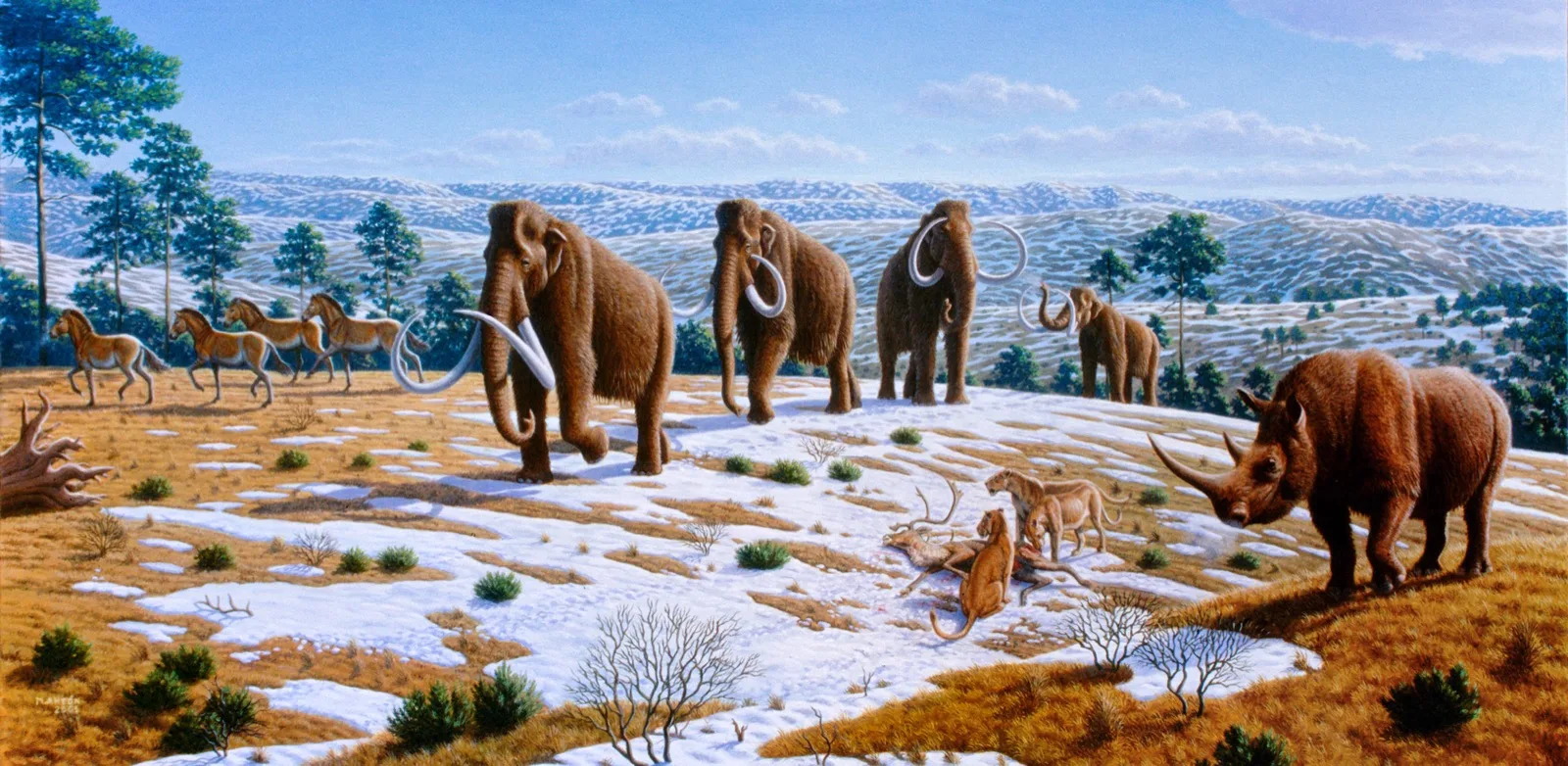
Giant mammals lived through it. Mammoths, including the woolly mammoth, and their cousins the mastodons were there. So were long-horned bison, sabre-toothed cats and giant ground sloths. These animals lived across North America, Asia and Europe.
Giant ground sloths walked on the ground, as their name says. That makes them very different from today’s tree sloths, which spend most of their lives hanging in rainforest trees.
North America had its own native horses and camels, galloping across the plains. Huge birds called teratorns hunted there too. Their wings stretched about 7.6 metres (25 feet) from tip to tip, wider than a family car is long.
Glyptodonts lived in the Americas. They were giant relatives of today’s armadillos, covered in armour made of bony scales. They roamed the Americas for more than 30 million years before dying out at the end of the last Ice Age. One glyptodont found in Argentina weighed about 300 kg (660 pounds) and was almost 1.8 metres (6 feet) long.
People were there as well. By the end of the Pleistocene, our own species had spread through most of the world. The hunters and gatherers of the Old Stone Age lived through the last Ice Age alongside these giants.
| Animal | Real or made up? | What we know |
|---|---|---|
| Scrat, the “saber-toothed squirrel” | Made up | Invented for the Ice Age films; not a real species |
| Cronopio | Real | A fanged mammal 10 to 15 cm long, from more than 100 million years ago |
| Mammoths and mastodons | Real | Ice Age giants that died out around the end of the Pleistocene |
| Sabre-toothed cats | Real | Ice Age hunters that died out around the end of the Pleistocene |
| Giant ground sloths | Real | Ground-walking sloths that died out around the end of the Pleistocene |
| Glyptodonts | Real | Armoured relatives of armadillos; one weighed about 300 kg |
| Teratorns | Real | Huge birds with wings about 7.6 metres across |
When the last Ice Age ended, and why the giants vanished
The last Ice Age ended about 11,700 years ago. Around that time, many of the big animals disappeared.
Mammoths, mastodons, sabre-toothed cats and giant ground sloths all died out. So did North America’s native horses and camels, and the glyptodonts. The horses living in North America today come from horses that people brought over from Europe much later.
Why did the giants vanish? Nobody knows for sure. Scientists have three main ideas.
The first idea is climate change. The world warmed as the ice melted. But many scientists doubt that warming alone did it, because these animals had already lived through several earlier changes in climate.
The second idea is hunting. A theory first put forward in the 1960s says human hunters caused the extinctions, or helped to cause them. Large animals do seem to vanish around the time people arrived on each continent. But it is not clear there were enough hunters, with good enough weapons, to wipe out whole species.
The third idea is disease. Some scientists have suggested that an illness spread from one species to the next. The question is still unsolved. The real answer may be a mix of all three.
New finds keep the argument going. In 2024, scientists reported a glyptodont from Argentina that died between about 20,800 and 21,100 years ago. Its bones carry 32 straight cuts, mostly on the pelvis and tail, where the big muscles were. The team says people with stone tools made them.
If they are right, humans reached South America much earlier than many experts thought. One of the team suggests people first arrived between 21,000 and 25,000 years ago, or even before. Not everyone agrees. The archaeologist Ben Potter pointed out that no stone tools were found with the bones. At real butchering sites, stone tools and chips of stone are usually everywhere.
Whether the woolly mammoth could ever be brought back is another question that scientists argue about.
Three things people get wrong
Scrat is not a rat. He is described as a sabre-toothed squirrel, and he is made up. His long snout is the reason so many people call him the rat from Ice Age.
Scrat’s real-life look-alike did not live in the Ice Age. Cronopio lived more than 100 million years ago, alongside giant dinosaurs. It was not a squirrel, and it was not any kind of rodent.
The Ice Age was not one long freeze. Over about 2.6 million years, glaciers grew in cold spells and shrank back in warmer ones.
Did you know? A glyptodont, a giant armoured relative of the armadillo, died in Argentina about 21,000 years ago. Its bones carry 32 straight cuts. Some scientists think people with stone tools made them, and others are not convinced.
Try it
Be a squirrel for a day. Hide ten small things, such as dry pasta pieces, one at a time around a room or garden, and do not write anything down. The next day, try to find them all using only your memory. Count how many you lost track of. In the wild, the acorns squirrels never dig up can grow into oak trees.
Knowledge check
Why is Cronopio sometimes called a real-life Scrat?
Show answer
It had very long canine teeth and a narrow snout, and the scientist who described it said it looks somewhat like Scrat.
Did Scrat’s real-life look-alike live during the Ice Age?
Show answer
No. Cronopio lived more than 100 million years ago, alongside giant dinosaurs. The last Ice Age began only about 2.6 million years ago.
Frequently asked questions
What is the squirrel in Ice Age called?
The squirrel in the Ice Age films is called Scrat. He is described as a “saber-toothed squirrel”, a made-up animal who is always chasing one acorn. Chris Wedge, the director of the first film, is the voice of Scrat.
Is Scrat a rat?
Scrat is not a rat. He is a made-up “saber-toothed squirrel” with a squirrel’s bushy tail and a love of acorns. His long, pointed snout and thin body are why many people call him the rat from Ice Age.
Is Scrat a real animal?
Scrat is not a real animal, and no species called Scrat has ever lived. A real fanged mammal called Cronopio dentiacutus, described from Argentina in 2011, looks a little like him. Cronopio lived more than 100 million years ago.
What animal is Scrat from Ice Age?
Scrat from Ice Age is a made-up animal. He has the bushy tail and acorn habit of a squirrel, plus two long, sabre-like fangs that no real squirrel has.
What is Cronopio dentiacutus?
Cronopio dentiacutus is an extinct mammal known from two skulls found in Patagonia, Argentina. About 10 to 15 cm long, it had very long canine teeth, ate insects and lived more than 100 million years ago. The scientist who described it said it looks somewhat like Scrat.
Who is the voice of Scrat?
Chris Wedge, a founder of Blue Sky Studios and the director of the first Ice Age film, is the voice of Scrat. Wedge voiced Scrat again in Ice Age: Scrat Tales, six short films released on Disney+ in 2022.
When did the last Ice Age end?
The last Ice Age ended about 11,700 years ago. Scientists call that long, cold stretch of time the Pleistocene, and it began about 2.6 million years ago.
Sources
- University of Louisville: UofL scientist discovers first known mammalian skull from Late Cretaceous period in South America (2011) — Cronopio’s discovery, age, size, teeth, diet and home, the team and the Nature paper, why the skulls matter, and Guillermo Rougier’s comparison with Scrat
- National Wildlife Federation, National Wildlife magazine: When Nature Goes Nuts (1999) — why squirrels scatter-hoard acorns, how they find them again, white and red oak acorns, half-eaten acorns and how left-over acorns grow into oaks
- University of California Museum of Paleontology: the Pleistocene — the dates of the last Ice Age, glaciers and interglacials, its large mammals and birds, humans spreading worldwide, and the unsolved question of why the giants died out
- Smithsonian Magazine: Was this giant, armadillo-like animal butchered by humans in Argentina 21,000 years ago? (2024) — glyptodonts, the 21,000-year-old glyptodont, its cut marks and the scientists who disagree about them
- Animation World Network: Scrat returns in Disney+’s Ice Age: Scrat Tales shorts (2022) — Scrat described as a saber-toothed squirrel, Blue Sky Studios, Chris Wedge as the voice of Scrat, and the six Scrat Tales shorts
- Academy of Motion Picture Arts and Sciences: the 75th Academy Awards (2003) — the first Ice Age film, its director Chris Wedge, and its nomination for best animated feature film


