
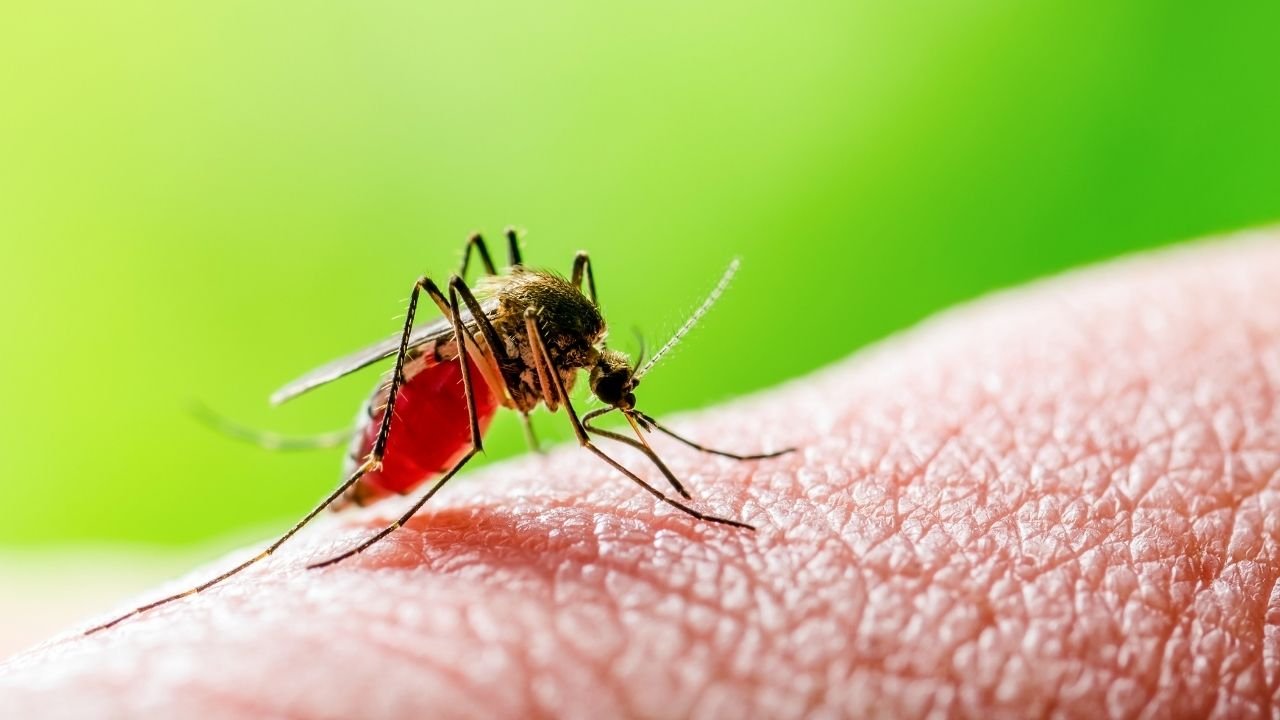
The life cycle of the malaria parasite, Plasmodium, needs two hosts. A female Anopheles mosquito injects it with a bite. It multiplies in the liver, then bursts red blood cells over and over, which causes fever. Some parasites become male and female forms. A mosquito sucks these up, they mate inside it, and new parasites move to its spit.
Malaria quick facts
- Only female Anopheles mosquitoes spread malaria, and only after biting someone who has it.
- The parasite reaches the liver within about an hour of a bite.
- P. vivax and P. ovale can sleep in the liver for months or years, then wake up.
- P. knowlesi usually lives in macaque monkeys and has a 24-hour blood cycle.
- WHO counted about 282 million malaria cases worldwide in 2024.
Malaria parasites at a glance
Malaria is one of the oldest illnesses people know about. It is caused by a tiny parasite that spends part of its life in a mosquito and part in a person. This guide follows the life cycle of the malaria parasite, one step at a time.
Every stage here comes from the CDC, the World Health Organization (WHO), the NHS and other health bodies. The guide is calm on purpose. Malaria is serious, but it can be prevented, treated and cured.
| Malaria parasite at a glance | |
|---|---|
| Cause | Plasmodium, a single-celled parasite |
| Kinds that make people ill | Five |
| Carried by | Female Anopheles mosquitoes |
| Hosts | People and mosquitoes |
| Bite to feeling ill | Usually 7 to 18 days (NHS) |
| Cases worldwide (2024) | About 282 million (WHO) |
| Vaccines | RTS,S (2021) and R21 (2023) |
What is the malaria parasite?
The malaria parasite is called Plasmodium. It is far too small to see without a microscope. The CDC explains that it is a parasite. That means it lives inside another living thing and takes what it needs from it.
Malaria is not caused by a virus, like a cold. It is not caused by bacteria either. Plasmodium is a single-celled living thing that changes its shape many times during its life.
Those changes are the key to this whole guide. Each form of the parasite has its own name and its own job. Some forms travel through the body. Some forms multiply fast. Others simply wait for a mosquito to come along.
The five kinds that make people ill
Scientists know of many kinds of Plasmodium. WHO says five of them make people ill. They are Plasmodium falciparum, Plasmodium vivax, Plasmodium ovale, Plasmodium malariae and Plasmodium knowlesi. Each name starts with Plasmodium, the name of the whole group.
WHO says Plasmodium falciparum and Plasmodium vivax cause the most harm to people.
Plasmodium knowlesi is the odd one out. The CDC says it normally lives in monkeys called macaques in South-East Asia. Only now and then does it pass to a person.
Under a microscope, Plasmodium knowlesi can look very like Plasmodium malariae. The CDC says doctors sometimes need a DNA test to tell the two apart.
Why the parasite needs two hosts
The malaria parasite cannot finish its life inside just one animal. It needs two hosts. A host is the living thing that a parasite lives inside.
One host is a person. The other is a female Anopheles mosquito. The parasite multiplies inside the person. It mates and makes new travelling forms inside the mosquito.
That is why malaria only spreads where these mosquitoes live. The NHS notes that malaria is not found in the UK. People in the UK who catch it have been bitten on a trip abroad.
It also explains why malaria does not spread like flu. The CDC says people do not catch it from a cough or by touching someone. The parasite has to pass through a mosquito first.
Meet the Anopheles mosquito

The CDC says only Anopheles mosquitoes spread malaria. Only the females bite. They need a meal of blood to make their eggs.
Not every Anopheles mosquito carries malaria. A mosquito picks up the parasite by biting someone who already has it. Only then can it pass malaria on to somebody else.
These mosquitoes usually bite late in the evening or at night, the CDC says. In the daytime they rest in dark, sheltered places.
A female lays 50 to 200 eggs at a time, straight onto water. Each egg becomes a larva, then a pupa, then an adult. The CDC says this takes 10 to 14 days. The larvae live in the water and shed their skin four times as they grow.
Adult mosquitoes do not travel far. The CDC says they usually stay within about 2 km (1.2 miles) of the water where they hatched. That is why still water close to homes matters so much.
Step 1: the bite
The human part of the story starts with a bite. When an infected female feeds, she pushes tiny parasites into the skin along with her spit. These travelling forms are called sporozoites.
The sporozoites do not stay in the skin for long. The blood carries them away. NIH says they reach the liver within about 60 minutes.
At this point the person feels completely fine. There is no rash and no fever. The parasite has only just begun its journey.
Step 2: hiding in the liver
In the liver, each sporozoite slips inside a liver cell. The CDC says it grows there into a schizont. You can think of a schizont as a bag packed with new parasites.
In time the bag bursts. It lets out thousands of new forms, called merozoites, into the blood. The liver stage is quiet, and the person still feels nothing while it happens.
Two kinds of parasite have an extra trick. The CDC and NIH say Plasmodium vivax and Plasmodium ovale can leave sleeping forms in the liver. These are called hypnozoites.
Hypnozoites can wake up weeks, months or even years later. Then they start the blood stage again, and the person becomes ill once more. Doctors call this a relapse.
Step 3: attacking red blood cells

Once the merozoites are in the blood, they break into red blood cells. Red blood cells carry oxygen around the body. For the parasite, they are both food and shelter.
Inside a red blood cell, the parasite grows. The CDC says it first looks like a small ring. Then it grows into another schizont, packed with new merozoites.
The red blood cell bursts open. The new merozoites rush out, and each one breaks into a fresh red blood cell. Then the same thing happens again, over and over.
With every round, more red blood cells are destroyed. This blood stage is when people start to feel ill. It is the part of the cycle that turns an infection into an illness.
Why malaria fevers come and go
NIH explains that the bursting of red blood cells causes the fever, chills and sweats of malaria. The body reacts each time a large batch of cells breaks open together.
The timing depends on the kind of parasite. NIH says the blood cycle of Plasmodium vivax takes about 48 hours. The CDC says Plasmodium knowlesi takes only about 24 hours, so its fevers can come every day.
The NHS lists the early signs as a high temperature, chills, sweating, a headache and aching muscles.
The NHS says symptoms usually start 7 to 18 days after the bite. The delay happens because the parasite spends the first part of that time growing in the liver.
Step 4: getting back into a mosquito
The parasite now has a problem. It is trapped inside a person, but it needs to reach a new mosquito. So some of the parasites in the blood change into a different form.
These forms are called gametocytes. The CDC says some are male and some are female. They do not make the person more ill. They simply wait in the blood.
When a female Anopheles mosquito bites the person, she sucks up the gametocytes with her meal of blood. That is how the parasite finds its way out of the body.
Inside the mosquito

In the mosquito’s stomach, the male and female forms join together. The CDC says they make a zygote. This is the only point in the whole cycle where the parasites mate.
The zygote changes into a form that can move, called an ookinete. It pushes into the wall of the mosquito’s gut. There it grows into a round oocyst.
The oocyst swells as new sporozoites form inside it. Then it bursts. The sporozoites travel through the mosquito’s body to its salivary glands, where its spit is made.
The mosquito is now ready to pass on malaria with its next bite. The CDC says the stage inside the mosquito takes about 9 to 18 days. Then the whole cycle can begin again.
How long each stage takes
| Stage | About how long | Source |
|---|---|---|
| Skin to liver | About 60 minutes | NIH |
| Bite to first symptoms | Usually 7 to 18 days | NHS |
| One blood cycle, Plasmodium vivax | About 48 hours | NIH |
| One blood cycle, Plasmodium knowlesi | About 24 hours | CDC |
| Sleeping liver forms | Weeks to years | CDC |
| Stage inside the mosquito | About 9 to 18 days | CDC |
| Mosquito egg to adult | 10 to 14 days | CDC |
These numbers are ranges, not exact times. They change with the kind of parasite and with the weather. Health bodies also give slightly different figures. The NHS says 7 to 18 days from bite to symptoms, while the CDC gives a wider range of 7 to 30 days.
NIH gives a range for each kind of parasite. It says Plasmodium falciparum usually takes 8 to 11 days to cause symptoms. Plasmodium malariae is much slower, at 18 to 40 days.
Who worked out the life cycle?
For a long time, nobody knew what caused malaria. The Linda Hall Library tells the story of Alphonse Laveran, a French army doctor. In 1880, at a military hospital in Constantine, Algeria, he saw the parasite inside red blood cells.
Laveran won a Nobel Prize in 1907. The prize was for showing that tiny living things called protozoa can cause disease.
The mosquito’s part came next. The Science Museum in London describes how Ronald Ross, who was born in India in 1857, worked for five years in a simple bungalow laboratory there. In 1897 he showed that mosquitoes carry malaria.
Ross was not alone. The Science Museum says an Italian scientist, Giovanni Grassi, reached the same answer at about the same time. The two men argued for years over who was first.
Ross won the Nobel Prize in 1902. He was knighted in 1911, and he founded the Ross Institute in London in 1926.
Malaria around the world today
WHO’s World Malaria Report 2025 gives the latest figures. It says there were about 282 million malaria cases in 2024. About 610,000 people died, a little more than the 598,000 who died in 2023.
Most cases happen in one part of the world. WHO says its African Region had about 95% of cases and deaths in 2024. Read more about the continent in our Africa facts for kids. In that region, about three in four deaths are children under five.
There is good news as well. WHO says malaria control has prevented about 2.3 billion cases since 2000. By the 2025 report, 47 countries and one territory had been certified malaria-free.
Egypt was certified in 2024, WHO says, and Georgia and Suriname followed in 2025. WHO also warns of a new worry. Resistance to artemisinin, the main malaria medicine, has been confirmed or suspected in at least eight African countries.
Vaccines and bed nets
For most of history there was no malaria vaccine. WHO recommended the first one, called RTS,S, in October 2021. It had been tested in everyday use in Ghana, Kenya and Malawi from 2019, reaching about 2 million children.
A second vaccine, R21, was recommended by WHO on 2 October 2023. WHO says that when it was given just before the rainy season, it cut malaria cases by 75% over the next 12 months in trials.
Both vaccines are given as three doses, WHO says, with a fourth booster dose about a year later.
Bed nets matter too. WHO says sleeping under insecticide-treated nets is one of the main ways countries protect people. The nets block the night-time bites that start the whole cycle.
Staying safe when travelling
Malaria is not found in the UK, but families do travel to places where it is. The NHS advises seeing a doctor or nurse 4 to 6 weeks before a trip to a malaria area.
The NHS uses the letters ABCD. A is for awareness of the risk. B is for bite prevention. C is for checking whether you need tablets. D is for getting a diagnosis quickly if you feel unwell.
Tablets are started before the trip and taken until a few weeks after coming home, the NHS says. Long sleeves, trousers, insect repellent and treated bed nets all help stop bites, especially in the evening.
Anyone who gets a fever within a year of visiting a malaria area should get medical help urgently. In the UK, that means a GP or NHS 111. The CDC says malaria can be treated and cured with the right medicine, so acting fast matters.
Three things people get wrong
Myth: every mosquito can give you malaria. The CDC says only some Anopheles mosquitoes spread it, and only the females bite. A mosquito also has to pick up the parasite from an infected person first.
Myth: you feel ill the day after the bite. The parasite spends its first stage hidden in the liver. The NHS says symptoms usually take 7 to 18 days to appear, and sometimes much longer.
Myth: once you feel better, malaria is gone for good. The CDC says Plasmodium vivax and Plasmodium ovale can hide as sleeping forms in the liver. They can wake up months or years later and cause illness again.
Did you know? Ronald Ross proved in 1897 that mosquitoes carry malaria, after five years of work in a simple bungalow laboratory in India.
Try it
Draw the life cycle as a circle with four stops: the bite, the liver, the blood and back into a mosquito. Write the name of the parasite form at each stop.
Knowledge check
Which mosquitoes spread malaria?
Show answer
Only female Anopheles mosquitoes, and only after they have bitten someone who has malaria.
Where does the parasite go first after a bite?
Show answer
To the liver, which NIH says it reaches within about 60 minutes.
Frequently asked questions
What causes malaria?
Malaria is caused by a single-celled parasite called Plasmodium. The CDC says it is spread to people through the bites of infected female Anopheles mosquitoes.
What are the main stages of the malaria life cycle?
The parasite enters the skin with a bite, multiplies in the liver, then bursts red blood cells. Some become male and female forms that mate inside a mosquito.
Why does malaria cause fevers that come and go?
NIH explains that fevers happen when many infected red blood cells burst at once. Each kind of parasite does this on its own timetable, such as every 48 hours.
How long after a bite do malaria symptoms start?
The NHS says malaria symptoms usually start 7 to 18 days after an infected bite, because the parasite first grows quietly in the liver.
Can malaria be caught from another person?
Malaria does not spread through coughs, sneezes or touching. The CDC says the parasite normally has to pass through a mosquito before it can infect someone new.
Is there a vaccine for malaria?
WHO recommended the RTS,S vaccine in 2021 and the R21 vaccine in 2023. Both are given as three doses, with a booster about a year later.
Sources
- CDC: malaria (DPDx) — every stage of the life cycle and how long it takes; its malaria basics, clinical features and Anopheles life-cycle pages, and its Emerging Infectious Diseases article on P. knowlesi, were also used
- World Health Organization: malaria fact sheet — 2024 cases and deaths, malaria-free countries and vaccines; its World Malaria Report 2025, R21 and vaccine programme pages were also used
- NHS: malaria — symptoms, how long they take to appear, and ABCD travel advice
- NIH National Library of Medicine: malaria — liver timing, symptom delays for each kind of parasite and fever cycles
- Science Museum: malaria and Ronald Ross — Ross’s 1897 discovery, Grassi and the 1902 Nobel Prize
- Linda Hall Library: Alphonse Laveran — Laveran’s 1880 discovery and 1907 Nobel Prize


