What is a polar bear?
| Feature | Polar-bear fact | Why it helps |
|---|---|---|
| Fur and body fat | Layered insulation | Reduces heat loss in Arctic conditions |
| Large paws | Spread weight and paddle in water | Support travel on ice and swimming |
| Sense of smell | Highly developed | Helps locate prey and other bears |
| Sea-ice habitat | Used for hunting and movement | Provides access to seal prey |
| Slow life cycle | Small litters and long maternal care | Makes populations slow to recover from losses |
Important polar-bear distinctions
- Polar bears live in the Arctic, not Antarctica.
- Their fur looks white because it scatters visible light; the skin underneath is dark.
- They can use land, but their long-term ecology depends on sea ice and marine prey.
- Population status varies among 19 recognised subpopulations, so one trend does not describe all bears.
- Climate-driven sea-ice loss is the leading long-term threat across their range.
Adapted to ice and cold water
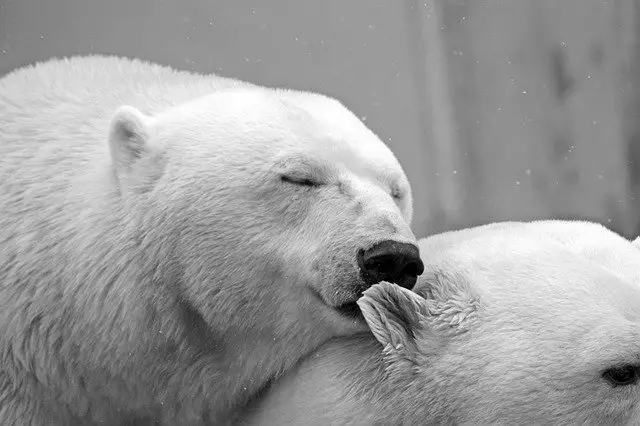
A polar bear has dense fur, a thick fat layer, small ears and a compact tail that help conserve heat. Large paws spread its mass on snow and ice. The paws also work as paddles, while the hind feet steer during swimming.
These adaptations do not make a bear immune to heat or exhaustion. Running for long distances can cause overheating, and long swims use valuable energy. An adaptation has costs as well as benefits.
Habitat, diet and cubs
Polar bears range through Arctic waters and coasts of Canada, Greenland, Norway, Russia and the United States. Sea ice gives them access to ringed and bearded seals, whose blubber supplies concentrated energy.
Pregnant females use snow dens, where cubs are born small and dependent. Cubs remain with their mother while they grow and learn to travel, feed and survive. This extended care is one reason the species reproduces slowly.
Conservation and changing sea ice
Sea ice naturally changes with the seasons, but long-term warming is reducing its extent and duration. Less hunting time can affect body condition, reproduction and survival, with effects differing between regions.
Researchers monitor bears, seals, movements, genetics and body condition. Conservation also includes reducing conflict near communities, protecting denning areas and managing human activities across international boundaries.
Picture guide

Continue the learning path
Did you know? Polar bears are classified as marine mammals because they depend on the ocean ecosystem for their food and habitat.
Try it
Choose three adaptations from the table. For each, write one benefit and one situation where it might not help.
Knowledge check
Why is sea ice more than a cold place for a polar bear to stand?
Show answer
It is the platform polar bears use to travel and reach their main seal prey within the Arctic marine food web.
Sources
These government, museum, zoo and scientific resources support the key facts and uncertainty statements in this guide.
- U.S. Fish and Wildlife Service: Polar bear — Official overview of biology, range, prey and subpopulations.
- USGS: Polar bear research — Current research on sea ice, movement, health and feeding.
- Polar Bears International: Polar bear facts — Educational material about adaptations, habitat, diet and life cycle.