What do cheetahs eat? Quick answer
| Food or prey | Where it may be eaten | Important context |
|---|---|---|
| Gazelles and small antelope | Many African habitats | Commonly suitable size for a high-speed chase |
| Impala and springbok | Eastern or southern Africa | Availability differs by region |
| Young hoofed mammals | Where larger species occur | Cheetahs usually target manageable individuals |
| Hares, rabbits and game birds | Across suitable habitats | Smaller prey can supplement the diet |
| Professionally prepared meat diet | Accredited zoos | Veterinary teams balance nutrition and enrichment |
Diet facts versus oversimplifications
- There is no single prey list that applies to every cheetah population.
- Seeing a species in the same habitat does not prove cheetahs regularly hunt it.
- Healthy zoo diets are professionally formulated and should not be copied for pets or wildlife.
- Cheetahs are predators, but they can lose kills to larger carnivores and usually avoid dangerous fights.
How cheetahs choose and catch prey
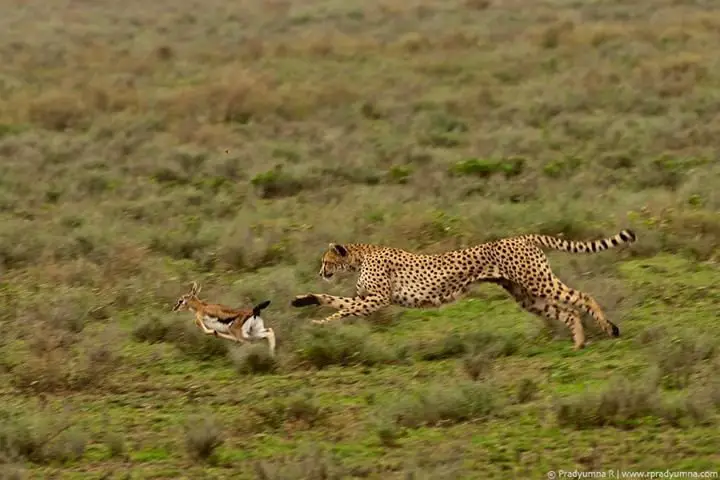
A cheetah normally scans from a raised place, stalks within striking distance and then accelerates. It relies on sharp vision, rapid turns and a short chase rather than long-distance endurance. The target must be small enough to trip and control without an extreme risk of injury.
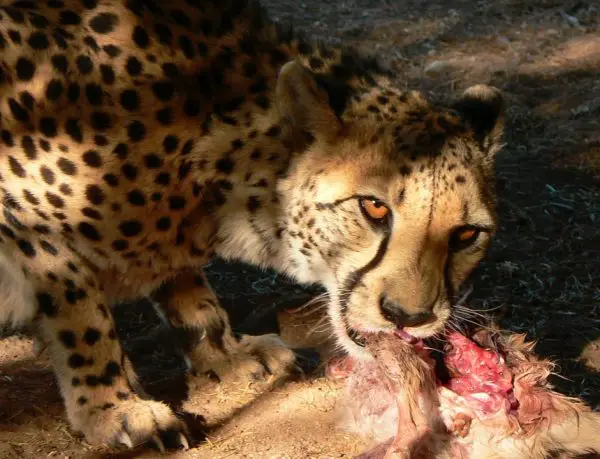
After bringing prey down, the cheetah clamps the throat to suffocate it. The animal then eats quickly because lions, hyenas and even groups of vultures may force it away. This pressure helps explain why cheetahs rarely defend a carcass for long.
Diet in Africa and Asia
African prey varies between grasslands, savannas, scrub and more mountainous landscapes. Gazelles and other small antelope are important in many regions, while local rabbits, birds or young hoofed mammals may also be taken.
The remaining Asiatic cheetahs live in Iran, where available prey differs. Scientific assessments mention gazelles, wild sheep, ibex and Cape hares among recorded foods. A regional diet should be described from local evidence, not copied from the Serengeti.
Cubs and cheetahs in zoos
Young cubs begin with their mother’s milk. As they grow, they follow her and practise hunting skills. A mother may bring live prey for older cubs to learn how to chase and handle food, but development varies between families.
Accredited zoos use diets designed by animal-care and veterinary specialists. Meat, bones or whole-prey items may be used for nutrition, dental health and natural feeding behaviour. The details depend on the individual cheetah and the institution.
Picture guide
Continue the learning path
Did you know? Unlike many cats, cheetahs usually hunt during daylight, especially in the morning and late afternoon.
Try it
Build a food web with grass, gazelle, cheetah, lion and decomposers. Use arrows to show the direction energy moves.
Knowledge check
Why does the cheetah diet change from one region to another?
Show answer
Different habitats contain different prey species, and cheetahs choose animals they can locate, chase and safely control.
Sources
These government, museum, zoo and scientific resources support the key facts and uncertainty statements in this guide.
- Smithsonian National Zoo: Cheetah — Documents prey, hunting behaviour, cub development and zoo diet.
- Cheetah Conservation Fund: About cheetahs — Explains wild diet, hunting, social behaviour and conservation.
- IUCN cheetah assessment — Reviews regional habitat, prey and threats in Africa and Iran.