
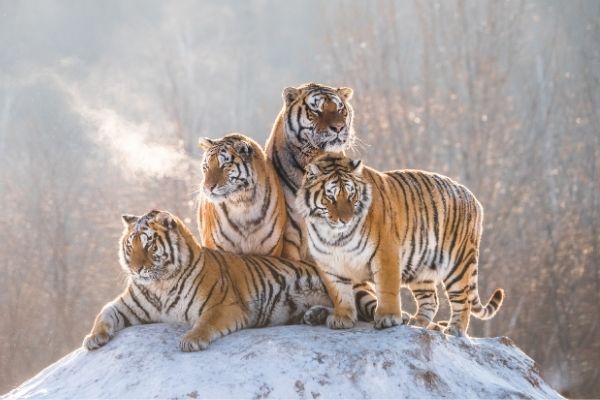
The Siberian tiger, also called the Amur tiger, is the largest cat on Earth. Males weigh 180–300 kg and can reach 3.3 m from nose to tail. It lives in the forests of the Russian Far East, where winters fall to −40 °C. Hunting cut the population to fewer than 50 in the 1940s; protection has brought it back to about 750, but it is still Endangered.
Siberian tigers quick facts
- The Siberian tiger is the largest cat in the world. Big males reach 300 kg.
- It is also called the Amur tiger, after the Amur River, and most of them do not live in Siberia.
- Fewer than 50 were left in the 1940s. A 2022 count found about 750.
- One male may patrol an area as large as 40 by 40 kilometres.
- Its winter fur is the longest and thickest of any tiger, over a fat layer up to 5 cm deep.
The Siberian tiger is the biggest cat on Earth. It is also one of the great comeback stories in conservation.
In the 1940s, fewer than 50 were left alive. Today there are around 750.
Two names, one tiger
You will see this animal called both the Siberian tiger and the Amur tiger. They are the same cat.
Scientists tend to say Amur tiger, after the Amur River in the Russian Far East. Hardly any of these tigers actually live in Siberia now.
Here is something else that surprises people. Scientists no longer treat it as its own separate kind of tiger. Since 2017 it has been grouped with the other mainland tigers, as a northern population of the same subspecies.
How big is it really?
| Male weight | 180–300 kg |
| Female weight | 100–170 kg |
| Length | up to about 3.3 m, nose to tail tip |
| Lives | Russian Far East, a few in China |
| Eats | red deer, wild boar, elk |
| Wild population | about 750 |
| Status | Endangered |
A big male can weigh as much as four adult people. Lie three of them nose to tail and you would cross most of a school swimming pool.
What Siberian tigers eat
Siberian tigers hunt large hoofed animals. Their main prey is wild boar, sika deer and red deer. In summer they also catch smaller animals, such as badgers and raccoon dogs.
They even hunt bears. In the Russian Far East, bears make up about 3% of a tiger’s diet.
A tiger hunts about once a week, and it can eat as much as 34 kg of meat in one night. It creeps close, pounces, pulls the animal to the ground and finishes it with a bite to the neck.
Tigers are stalk-and-ambush hunters. A tiger may creep towards its prey slowly and silently for 20 or 30 minutes before it springs. Its night vision is about six times better than ours, which helps it hunt at dusk and after dark.
Built for a freezing forest
Winter where these tigers live drops to −40 °C. Almost no other big cat could survive it.
Their fur grows longer and thicker than any other tiger’s. Underneath it they build a layer of fat, up to 5 cm thick, across the belly and flanks.
Their paws are enormous, which spreads their weight on deep snow. Their coat is also paler than a Bengal tiger’s, with fewer stripes, and that helps them disappear against snow and bare winter trees.
A male’s paw pad measures 10.5 to 14.5 cm across, wider than a grown-up’s hand. Scientists in the snowy forests often measure paw prints to tell males, females and cubs apart.
Built for the Cold
- Long, thick winter fur — Keeps it warm when winter drops to −40 °C
- A layer of fat up to 5 cm thick — Lies under the fur across its belly and sides
- Enormous paws — Spread its weight so it does not sink into deep snow
- A pale coat with fewer stripes — Helps it disappear against snow and bare winter trees
- Paw prints in the snow — Let scientists tell males, females and cubs apart
A life spent alone
Amur tigers are solitary. A female’s home range can be up to 20 by 20 kilometres. Some males patrol an area as large as 40 by 40 kilometres, which is bigger than many cities.
The reason is food. Prey is thin on the ground in a cold forest, so each tiger needs an enormous area to find enough of it.
They mark the edges of that territory by scratching trees and spraying scent. Cubs stay with their mother for about two years, learning to hunt, then leave to find space of their own.
Cubs and family life
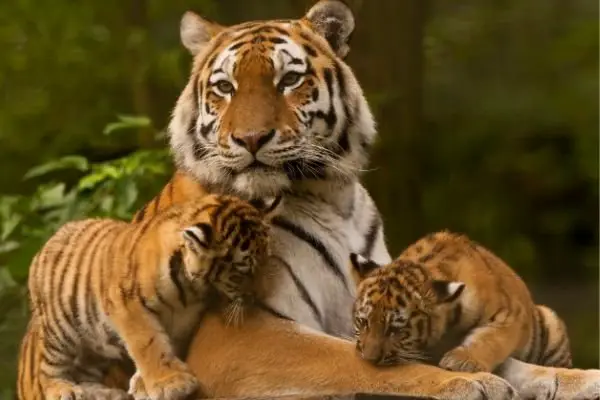
A mother tiger is pregnant for three to three and a half months. She usually has two to four cubs, though a litter can be anything from one to six.
Each cub weighs only about 1 kg when it is born. Life is risky for them: up to half of all tiger cubs do not survive their first year.
The cubs stay with her until they can hunt well on their own, usually at 18 to 24 months old. Tigers are grown up at about four years old.
In the wild, a Siberian tiger usually lives for 10 to 15 years. In zoos, where there is always food and no danger, they can live closer to 20.
Every tiger’s stripes are different, like a human fingerprint, so no two tigers look exactly alike. Tigers are also strong swimmers, able to cross rivers and lakes up to 8 km wide.
Conservationists use those patterns to recognise individual tigers. The dark stripes also break up a tiger’s outline, so it is hard to spot as it lies in wait. Tigers leave messages for each other, too, by spraying urine and clawing trees or the ground.
A Tiger’s Life in Order
- Waiting The mother carries her cubs for three to three and a half months.
- Born The cubs are born weighing only about 1 kg each.
- Learning to hunt The cubs follow their mother and learn how to hunt.
- Leaving home At 18 to 24 months old, a young tiger leaves to find its own territory.
- Grown up At about four years old, the tiger is fully grown.
- Old age In the wild, a Siberian tiger usually lives for 10 to 15 years.
Back from fifty
By the 1940s, hunting had brought the Amur tiger to the edge. Surveys found fewer than 50 left in the wild.
In 1947 the Soviet Union banned tiger hunting completely. It was one of the first countries anywhere to give a big cat full protection.
It worked. A 2022 count put the population at roughly 750, cubs included, across the Russian Far East. A small number also live across the border in China.
They are still listed as Endangered. Poaching and the loss of forest remain real dangers, and 750 is not many animals.
People are still the biggest danger. Humans cause 75 to 85% of all Amur tiger deaths, and around 30 tigers are killed each year. Forest fires are a problem too, because they can turn the tigers’ forest into open grassland where there is less prey to hunt.
Tigers returning to China
For years only a handful of Siberian tigers crossed into China. That is changing.
In 2021, China formally set up the Northeast China Tiger and Leopard National Park, along the border with Russia. Figures reported in 2026 show wild Siberian tigers in the park rising from 27 in 2017 to 72. Amur leopards there rose from 42 to 115 over the same time.
The park counts its animals with cameras and a monitoring system that uses satellites, aircraft and equipment on the ground. It can recognise tigers and leopards automatically, and gets them right more than 90% of the time.
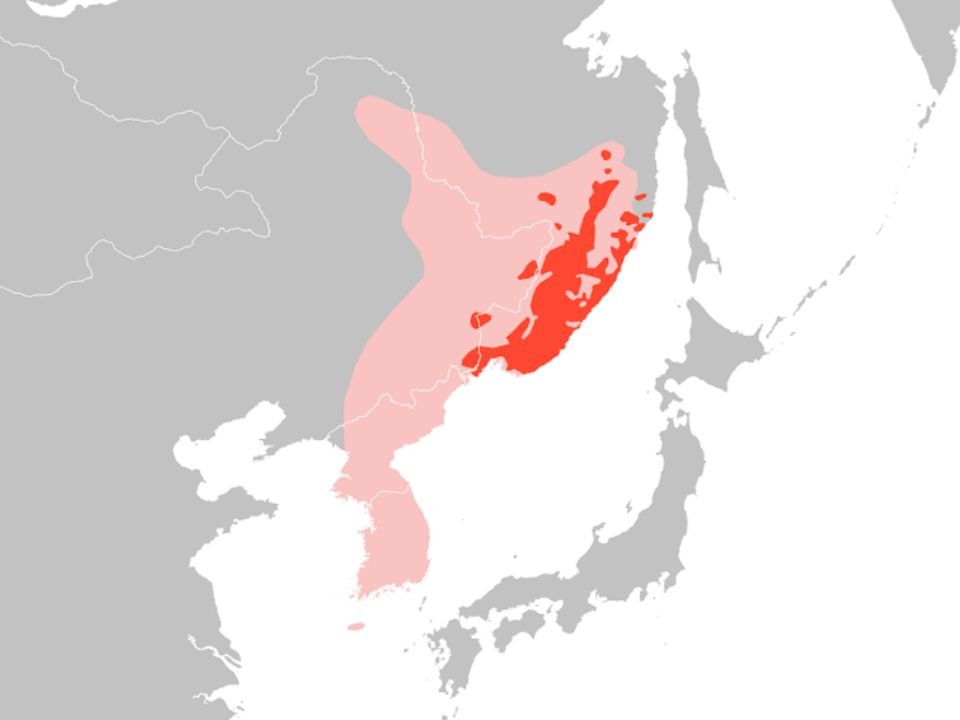
Where Siberian Tigers Live
Three things people get wrong
Siberian tigers are not white. White tigers are rare Bengal tigers with an unusual colour, and nearly all of them live in zoos. An Amur tiger is orange, just paler than most.
They do not live in snow all year. Their forests have hot summers too, reaching 30 °C. The same tiger copes with a 70-degree swing between seasons.
They mostly do not live in Siberia. Their home is the Russian Far East, further south and east, near the border with China and North Korea.
Next, find out where these cats actually live in our guide to where Siberian tigers live, or meet another giant in our elephant guide.
Did you know? In 1947 the Soviet Union banned tiger hunting outright, making it one of the first countries anywhere to give a big cat complete legal protection. The Amur tiger population has grown roughly fifteen times over since then.
Siberian Tigers: Fact or Myth?
- Siberian tigers live in big family groups, like lions.
- A tiger may creep towards its prey for 20 or 30 minutes before it pounces.
- Tigers cannot swim.
- A Siberian tiger's night vision is about six times better than ours.
- Scientists now group the Siberian tiger with the other mainland tigers.
- Siberian tigers eat only deer.
- Tigers mark their territory by scratching trees and spraying scent.
- A tiger's stripes make it easy to spot as it lies in wait.
Try it
A male Amur tiger can weigh 300 kg. Find out your own weight and work out how many of you it would take to match one. Then measure 3.3 metres along the floor with a tape measure — that is one tiger, nose to tail tip.
Knowledge check
Why is the Siberian tiger also called the Amur tiger?
Show answer
Because it lives around the Amur River in the Russian Far East, not in Siberia itself. Scientists usually prefer Amur tiger for that reason, and the two names mean the same animal.
How did Amur tigers recover from fewer than 50 animals?
Show answer
The Soviet Union banned tiger hunting completely in 1947 and protected large areas of their forest. A 2022 count found around 750 tigers, cubs included, though they are still listed as Endangered.
Frequently asked questions
How big is a Siberian tiger?
Males weigh between 180 and 300 kilograms and can measure up to 3.3 metres from nose to tail tip. Females are smaller, usually 100 to 170 kilograms. That makes the Siberian tiger the largest cat species alive.
Where do Siberian tigers live?
Mainly in the forests of the Russian Far East, in the Primorye and Khabarovsk regions near the Amur River. A small number cross into north-east China, and possibly North Korea. Despite the name, very few live in Siberia itself.
How many Siberian tigers are left?
About 750, according to a 2022 count that included cubs. That is a large recovery from the 1940s, when fewer than 50 remained in the wild, but the species is still listed as Endangered.
What do Siberian tigers eat?
Mostly large hoofed animals: red deer, wild boar, elk and sika deer. A single tiger needs a lot of food, which is one reason each one patrols such an enormous territory.
How do Siberian tigers survive the cold?
They grow the longest, thickest fur of any tiger and build a layer of fat up to 5 centimetres thick over the belly and flanks. Their paws are very wide, which spreads their weight on deep snow.
Are Siberian tigers white?
No. White tigers are rare Bengal tigers with an unusual colouring, and almost all of them live in zoos. A Siberian tiger is orange, though paler and with fewer stripes than a Bengal tiger.
Do Siberian tigers eat bears?
Yes, sometimes. In the Russian Far East, bears make up about 3% of a Siberian tiger’s diet. Most of its food is wild boar, sika deer and red deer.
How long do Siberian tigers live?
In the wild, Siberian tigers usually live for 10 to 15 years. In zoos they can live closer to 20 years.
How many cubs do Siberian tigers have?
A Siberian tiger usually has two to four cubs, though a litter can be one to six. The cubs stay with their mother for 18 to 24 months while they learn to hunt.
Are there Siberian tigers in China?
Yes. Figures reported in 2026 show 72 wild Siberian tigers in the Northeast China Tiger and Leopard National Park, up from 27 in 2017.
Sources
- WWF: tiger — threats, habitat loss and the wider tiger recovery picture.
- Britannica: Siberian tiger — size, weight, diet and territory.
- WildCats Conservation Alliance: Amur tiger facts — prey, bears in the diet, home ranges, paw sizes, cubs, lifespan and threats
- Smithsonian’s National Zoo: tiger — size, how often tigers hunt and how much they eat, stripes, swimming and how long cubs stay with their mother
- Xinhua (2026): wild Siberian tiger and leopard populations see significant growth in China — the park’s tiger and leopard numbers, as announced by China’s National Forestry and Grassland Administration.
- San Diego Zoo Wildlife Alliance: tiger — how tigers stalk and ambush, night vision, stripes, scent marking and cubs
Siberian Tiger Final Challenge
- Which is the largest cat in the world?
- About how often does a Siberian tiger hunt?
- Why does each Siberian tiger need such an enormous territory?
- How hot can summer get where Siberian tigers live?
- What do forest fires do to a tiger's home?
- Which other rare big cat is recovering in the same national park in north-east China?
- What is the biggest danger to Amur tigers today?
- How long can a big male Siberian tiger be, from nose to tail tip?