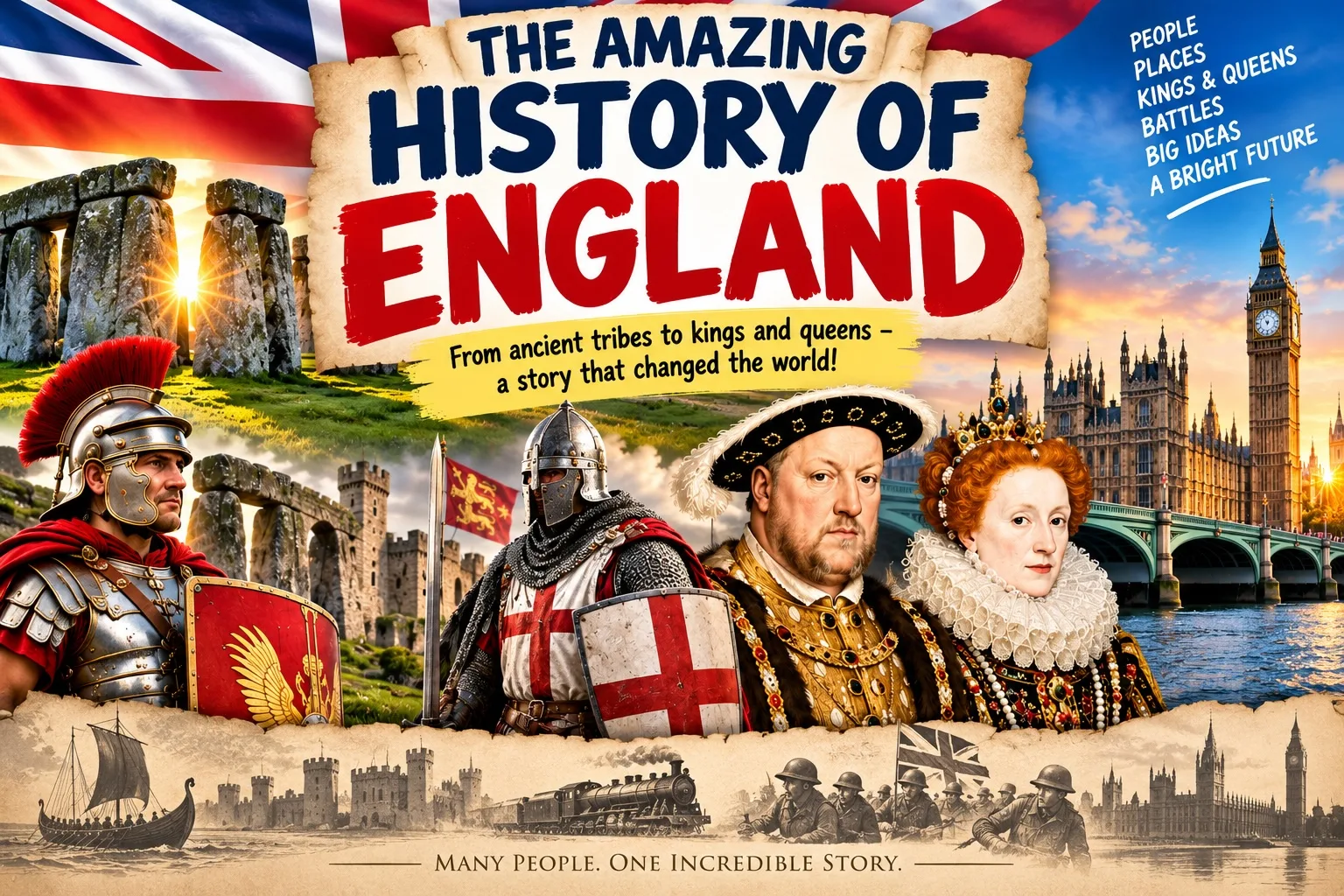
In short: England’s history stretches back thousands of years, from ancient tribes and Roman invaders to powerful kings, queens, and the modern country we know today.
History quick facts
- People have lived in England for over 40,000 years.
- England was once part of the Roman Empire.
- England has been ruled by many different kings and queens for over 1,000 years.
- England is now part of the United Kingdom, along with Scotland, Wales, and Northern Ireland.
History Of England Facts For Kids
1. What Is England – A Quick Introduction
- England is a country that is part of the United Kingdom, along with Scotland, Wales, and Northern Ireland.
- England has one of the longest and most influential histories of any country in the world.
- Its story includes ancient monuments, powerful empires, famous kings and queens, and important inventions that changed the world.
- Learning the history of England helps us understand how many modern ideas — like laws, parliaments, and the English language — began.
2. Prehistoric Britain – Before Recorded History
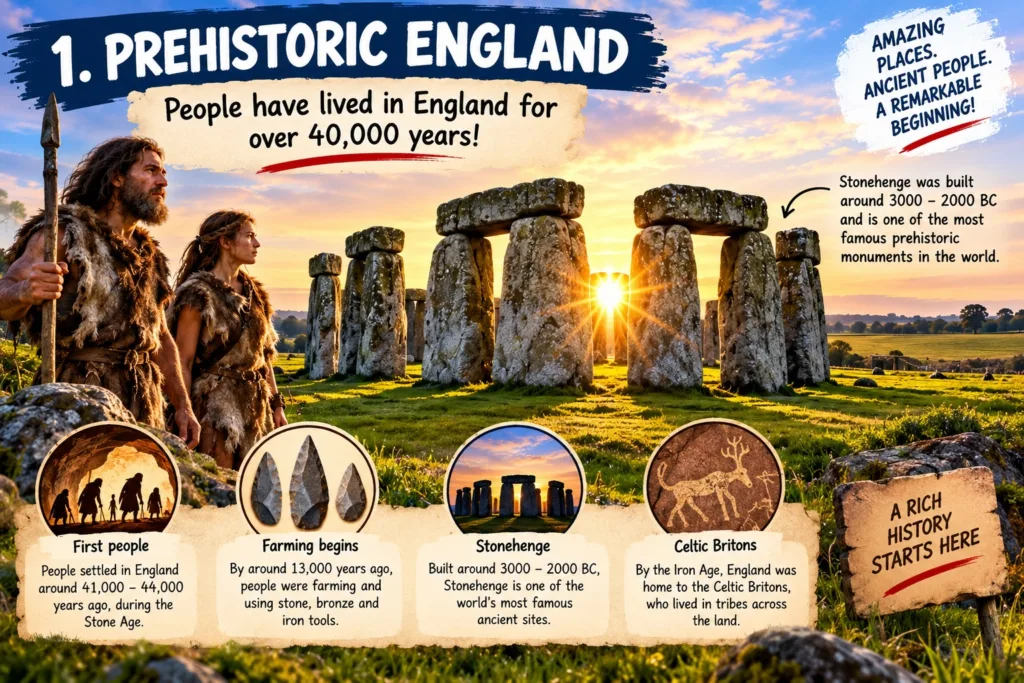
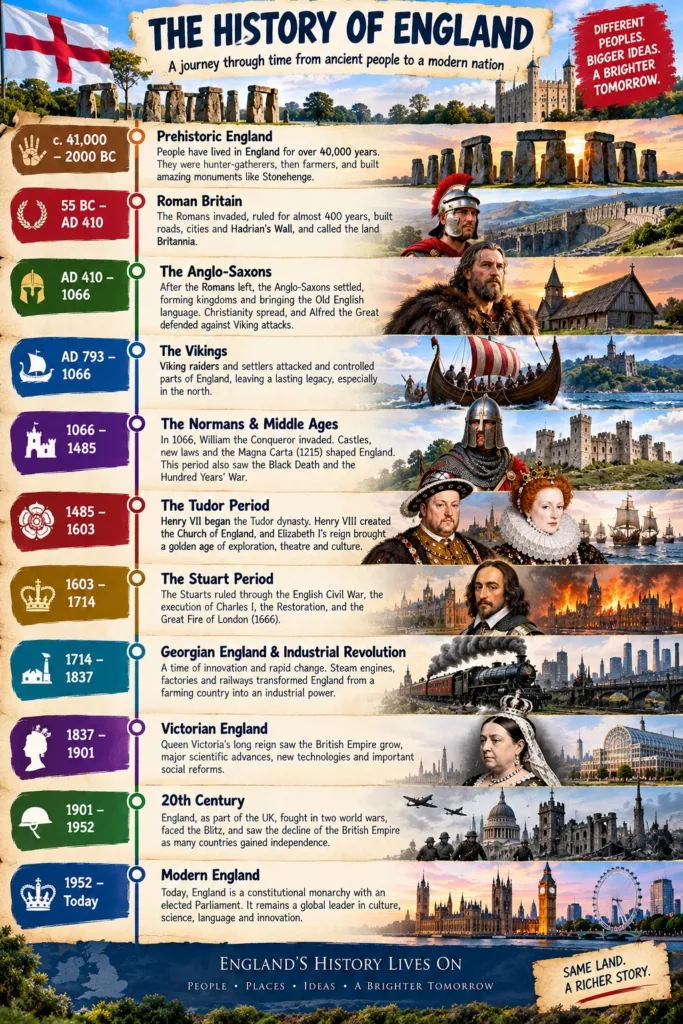
- People first settled in what is now England around 41,000 to 44,000 years ago, during the Stone Age.
- More people arrived around 13,000 years ago, at the end of the last Ice Age.
- One of the most famous prehistoric monuments in the world, Stonehenge, was built during the Bronze Age, around 3000 to 2000 BC.
- Ancient people during this time were mostly farmers who used stone, then bronze, and later iron tools.
- By the Iron Age, England was home to a people called the Celtic Britons, who lived in tribes across the land.
3. Roman Britain – When the Romans Ruled
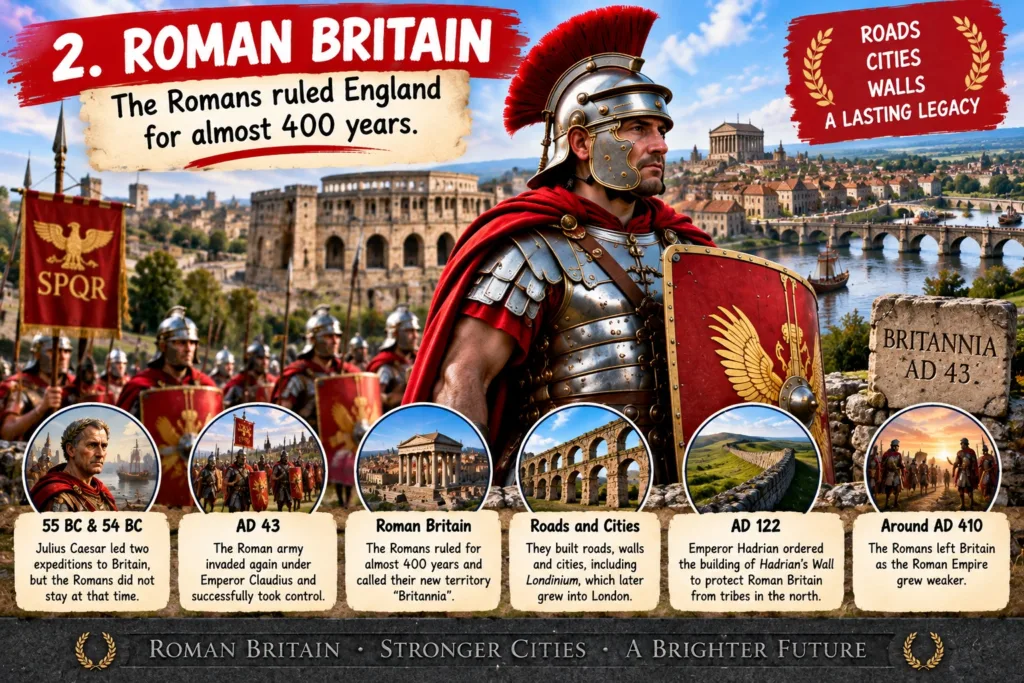
- In 55 BC and 54 BC, the Roman general Julius Caesar led two expeditions to Britain, but the Romans did not stay long-term at that time.
- In AD 43, the Roman army invaded Britain again, this time under Emperor Claudius, and successfully took control.
- The Romans called their new territory “Britannia” and ruled it for almost 400 years.
- The Romans built roads, walls, and cities, including the settlement of Londinium, which later grew into modern-day London.
- Emperor Hadrian ordered the building of Hadrian’s Wall around AD 122 to protect Roman Britain from tribes in the north.
- The Romans left Britain in the early 5th century, around AD 410, as the Roman Empire grew weaker.
4. The Anglo-Saxons – The Founding of England
- After the Romans left, groups of Germanic peoples called the Anglo-Saxons began settling in Britain.
- Many historians consider the arrival of the Anglo-Saxons to be the true beginning of England and the English people.
- The Anglo-Saxons formed several separate kingdoms, including Wessex, Mercia, Northumbria, and East Anglia.
- They brought the Old English language with them, which is the ancestor of the English spoken today.
- Christianity spread across Anglo-Saxon England starting around AD 597, when a monk named Augustine arrived and became the first Archbishop of Canterbury.
- King Alfred the Great, who became King of Wessex in AD 871, is remembered for defending England against Viking invasions and for encouraging education and writing.
5. The Vikings In England
- Viking raiders from Scandinavia first attacked England in AD 793, striking a monastery on the island of Lindisfarne.
- This attack is often seen as the beginning of the Viking Age in England.
- In AD 865, a huge Viking force known as the Great Heathen Army invaded and conquered large parts of eastern England.
- King Alfred the Great fought back against the Vikings and eventually made peace, splitting England into Anglo-Saxon and Viking-controlled areas.
- Vikings left a lasting mark on England, including many place names that still exist today, especially in the north of England.
6. The Norman Conquest of 1066
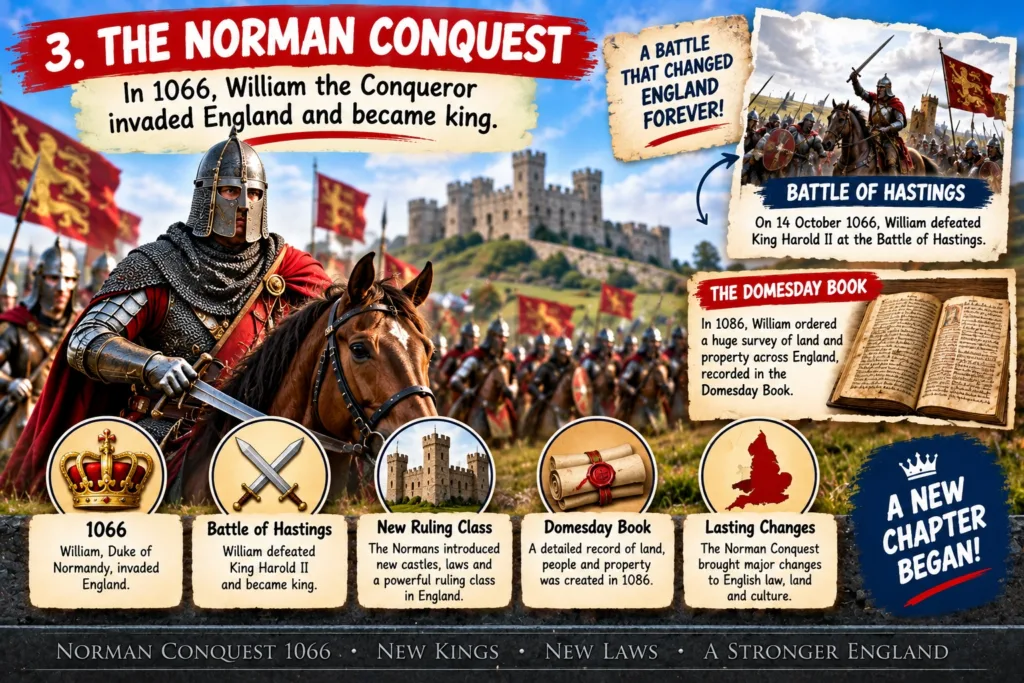
- One of the most important dates in English history is 1066, the year of the Norman Conquest.
- William, Duke of Normandy (in modern-day France), invaded England and defeated King Harold II at the Battle of Hastings.
- William became King of England and is known today as William the Conqueror.
- The Normans introduced a new ruling class, new castles, and major changes to English law and land ownership.
- In 1086, William ordered a huge survey of land and property across England, recorded in a book called the Domesday Book.
7. The Middle Ages In England
- The Middle Ages in England lasted from about 1066 to 1485 and were a time of powerful kings, knights, castles, and the beginnings of Parliament.
- In 1215, King John was forced by his nobles to sign the Magna Carta, a document that limited the power of the king and gave people certain legal rights.
- The Magna Carta is still considered one of the most important documents in the history of law and government.
- Between 1337 and 1453, England and France fought a long series of conflicts known as the Hundred Years’ War.
- In 1348, a deadly disease called the Black Death arrived in England and killed roughly one-third of the population.
- The Wars of the Roses (1455–1485) were a series of civil wars fought between two royal families, the House of Lancaster and the House of York, over who should be king.
8. The Tudor Period – Kings, Queens, and Big Changes
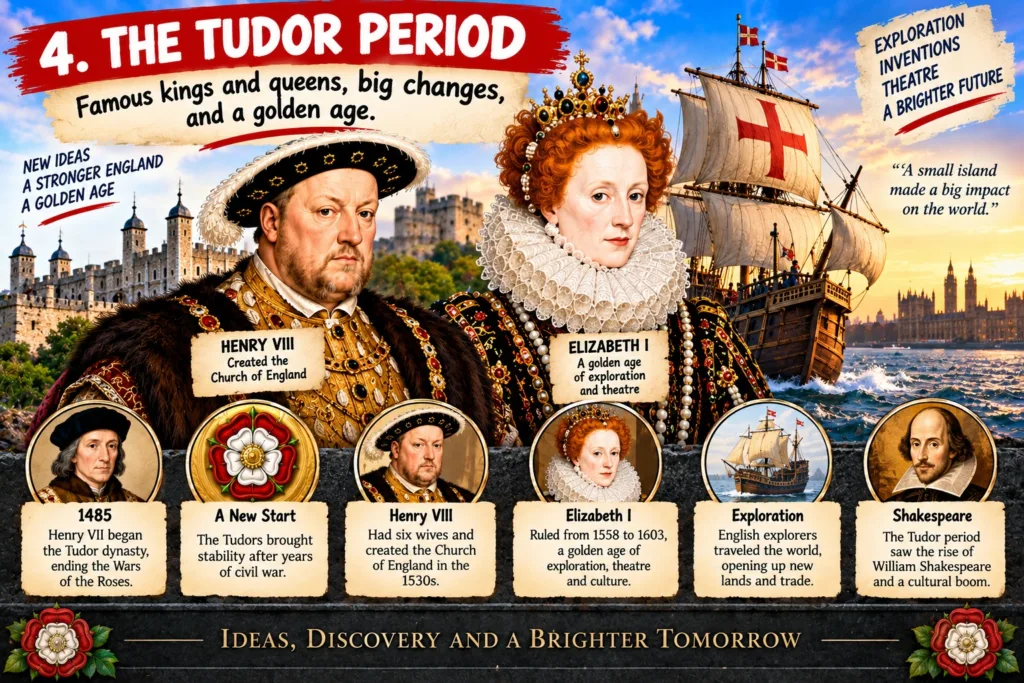
- The Tudor period began in 1485, when Henry Tudor defeated King Richard III and became King Henry VII, ending the Wars of the Roses.
- His son, King Henry VIII, is one of the most famous kings in English history and is remembered for having six wives.
- Henry VIII broke away from the Roman Catholic Church and created the Church of England in the 1530s.
- Henry VIII’s daughter, Queen Elizabeth I, ruled from 1558 to 1603, a time often called the “Golden Age,” known for exploration, theatre (including the plays of William Shakespeare), and the defeat of the Spanish Armada in 1588.
9. The Stuart Period and the English Civil War
- After Elizabeth I died without children, the throne passed to the Stuart family, beginning with King James I in 1603.
- England went through a serious conflict called the English Civil War (1642–1651), fought between supporters of King Charles I and Parliament.
- King Charles I was defeated and executed in 1649, and England briefly became a republic led by Oliver Cromwell.
- The monarchy was restored in 1660 when Charles II became king, an event known as the Restoration.
- In 1666, a large fire known as the Great Fire of London destroyed much of the city.
10. Georgian England and the Industrial Revolution
- The Georgian period (1714–1830) was named after four kings who were all named George.
- During this time, England experienced the Industrial Revolution, a period of huge change when new machines and factories transformed how people lived and worked.
- Steam engines, textile mills, and railways all developed rapidly during this era, changing England from a farming country into an industrial one.
- English cities grew quickly as people moved from the countryside to work in factories.
11. Victorian England
- Queen Victoria ruled from 1837 to 1901, one of the longest reigns in British history.
- The Victorian era was a time of huge growth for the British Empire, which at its peak included territories all around the world.
- Major inventions and achievements of this period included railways, the telephone, and huge advances in science and medicine.
- It was also a time of hardship for many working-class families, and important reforms were introduced to improve conditions for workers and children.
12. England In The 20th Century
- England, as part of the United Kingdom, fought in both World War I (1914–1918) and World War II (1939–1945).
- During World War II, England faced heavy bombing during a period known as the Blitz, especially in cities like London.
- After World War II, the British Empire gradually came to an end as many countries gained independence.
- In 1952, Queen Elizabeth II became queen, and she went on to become the longest-reigning monarch in British history before her death in 2022.
13. Modern England
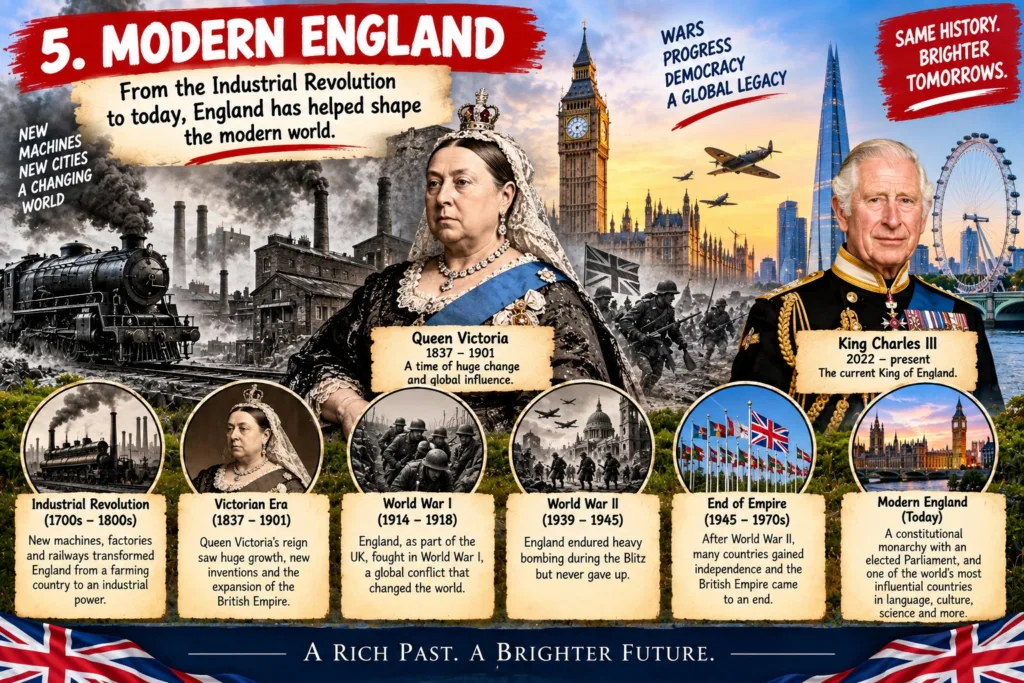
- Today, England is a constitutional monarchy, meaning it has a king or queen as head of state, along with an elected Parliament that makes the country’s laws.
- King Charles III became king in 2022, following the death of his mother, Queen Elizabeth II.
- England remains one of the world’s most influential countries in areas like language, government, science, and culture.
- London, England’s capital city, is one of the most visited cities in the world and a major global center for finance, culture, and history.
14. Famous Kings And Queens Of England
| Monarch | Reign | Known For |
|---|---|---|
| Alfred the Great | 871–899 | Defending England against the Vikings |
| William the Conqueror | 1066–1087 | The Norman Conquest |
| King John | 1199–1216 | Signing the Magna Carta |
| Henry VIII | 1509–1547 | Creating the Church of England |
| Elizabeth I | 1558–1603 | The “Golden Age” of exploration and theatre |
| Victoria | 1837–1901 | Overseeing the growth of the British Empire |
| Elizabeth II | 1952–2022 | The longest-reigning British monarch |
| Charles III | 2022–present | Current King of England |
15. History Of England Fun Facts For Kids – Interesting Facts
- England didn’t officially exist as a single kingdom until the Anglo-Saxons united its separate territories, over a thousand years after people first settled there.
- The Magna Carta of 1215 still influences legal documents around the world today, including parts of the U.S. Constitution.
- Henry VIII’s decision to create the Church of England changed the religion of an entire country almost overnight.
- The Great Fire of London in 1666 destroyed over 13,000 houses but is believed to have killed very few people.
- At its height in the early 20th century, the British Empire covered nearly a quarter of the entire world’s land area.
- London has been an important city for almost 2,000 years, since the Romans first founded it as Londinium.
Did you know? The Domesday Book, ordered by William the Conqueror in 1086, is still kept safe today and is one of the oldest government records in the world!
Source: The National Archives (UK), Britannica, and Historic UK.
Try it
Make your own timeline of English history. Draw a line and mark at least six events from this guide, from Roman Britain to modern day. Next to each event, write one sentence explaining why it was important.
Knowledge check
What is one important fact about the history of England?
Show answer: In 1066, William the Conqueror invaded England and became king, an event known as the Norman Conquest.
History Of England FAQ
How old is the history of England? People have lived in England for over 40,000 years, but England as a united kingdom began to take shape with the Anglo-Saxons after AD 410.
Who was the first king of England? Æthelstan is usually considered the first king to rule all of England as one country, becoming king in AD 927.
Why is 1066 important in English history? In 1066, William the Conqueror defeated King Harold II at the Battle of Hastings, starting the Norman Conquest, which brought major changes to English law, land, and culture.
What is the Magna Carta? The Magna Carta was a document signed by King John in 1215 that limited the power of the king and gave nobles certain legal rights, influencing modern laws around the world.
Is England still ruled by a king or queen? Yes, England is a constitutional monarchy. King Charles III is the current monarch, but the country’s laws are made by an elected Parliament.