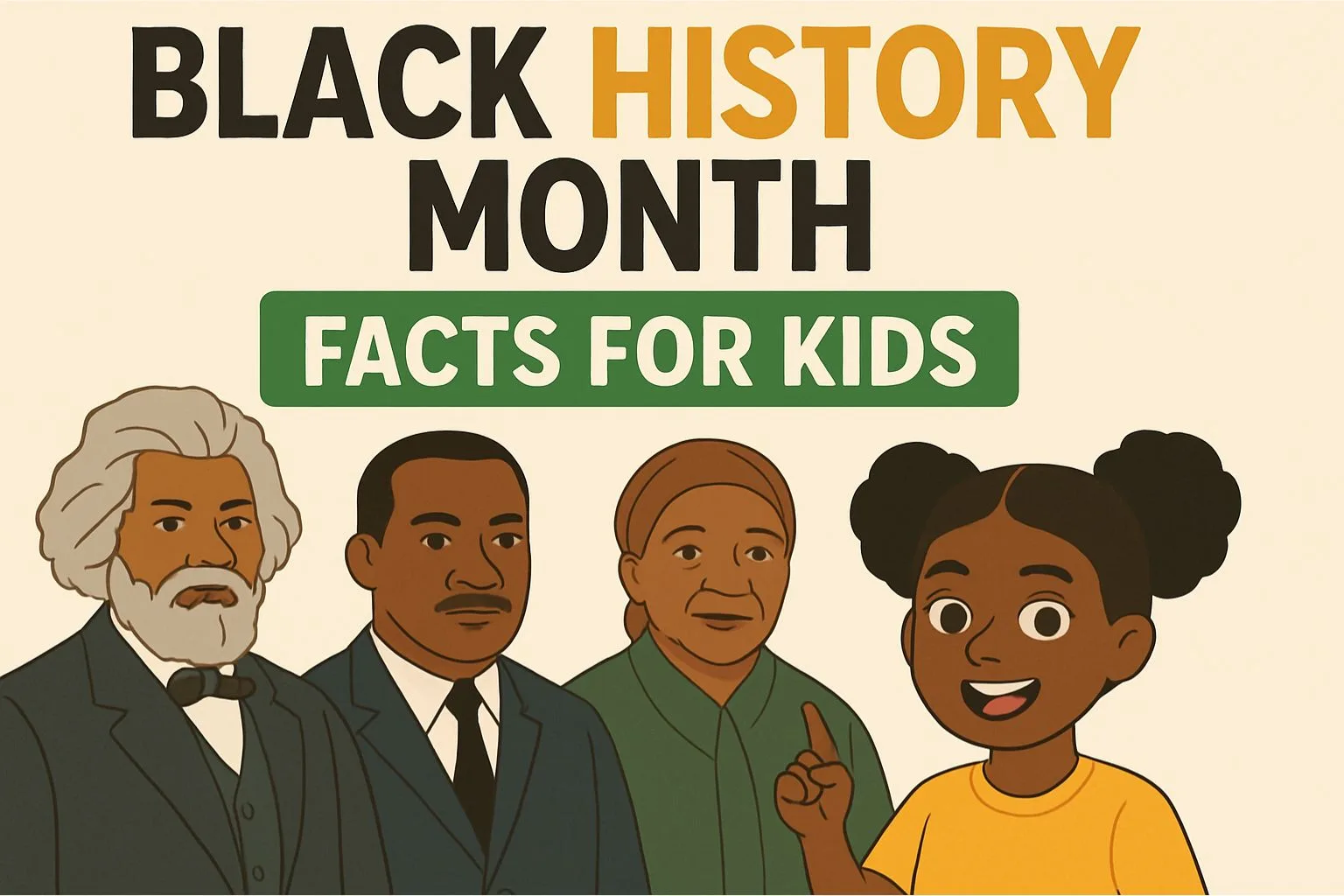
Black History Month celebrates Black history and achievements every February in the USA and Canada, and every October in the UK. Historian Carter G. Woodson started it as Negro History Week in 1926, choosing February for the birthdays of Abraham Lincoln and Frederick Douglass. It became a month in 1976.
Black History Month quick facts
- Black History Month began as a single week in February 1926.
- Frederick Douglass never knew his birthday, so he chose 14 February himself.
- Carter G. Woodson was only the second Black American to earn a history doctorate at Harvard.
- The UK holds Black History Month in October, near the start of the school year.
- 2026 marked 100 years since the first Negro History Week.
Black History Month at a glance
Black History Month is a time to learn about the history, achievements and stories of Black people. In the United States and Canada it is held every February. In the United Kingdom it is held in October.
It began in 1926 as a single week, started by a historian who believed Black history was being left out of school books. This guide explains how it grew into a month, why February was chosen, and the stories of some of the people it celebrates.
| Black History Month at a glance | |
|---|---|
| USA and Canada | February |
| United Kingdom | October |
| Started as | Negro History Week, in February 1926 |
| Founder | Historian Carter Woodson |
| Recognised by a US president | 1976, by Gerald Ford |
| Theme for 2026 (USA) | “A Century of Black History Commemorations” |
What is Black History Month?
Black History Month is a yearly celebration of Black history and culture. Schools, libraries and museums use it to share stories of Black inventors, writers, leaders, scientists, artists and ordinary people.
In the United States, seven federal organisations run the month’s official website. They include the Library of Congress, the National Archives and the Smithsonian Institution.
The month is not only about the past. It is also a chance to think about fairness and equality today, and about how history is told.
Carter G. Woodson, the father of Black history
The story begins with a historian named Carter Woodson. The National Park Service says he was born on 19 December 1875 in New Canton, Virginia. His parents had been enslaved.
Woodson loved learning, and in 1912 he earned a doctorate in history from Harvard University. The Park Service says only W.E.B. Du Bois, another Black scholar, had done so before him.
Woodson noticed that history books mostly ignored Black Americans. On 9 September 1915, he co-founded a group to study and share Black history. Today it is called the Association for the Study of African American Life and History, or ASALH.
In 1916 he started a history magazine called the Journal of Negro History. He died in 1950, and his office-home in Washington, DC, is now a National Historic Site.
Negro History Week, 1926
In 1926, Woodson’s group held the first national Negro History Week. History.com says it was held in the second week of February.
“Negro” was a common word for Black people at that time. It is not used in this way today, but it is part of the event’s historical name.
Rutgers University notes that Woodson never thought one week was enough to study Black history. He hoped that one day Black history would be taught all year round, as a normal part of American history.
Why February was chosen
Woodson chose February on purpose. History.com says the week included two birthdays that mattered deeply to Black Americans. One belonged to Abraham Lincoln, born on 12 February. The other belonged to Frederick Douglass, who celebrated his on 14 February.
Rutgers University adds that many Black communities already celebrated Lincoln’s birthday and the anniversary of the Emancipation Proclamation. Woodson built on traditions people already had.
February is also the month of Presidents’ Day in the United States. So the month brings together several important American stories.
From a week to a month
In the late 1960s, the civil rights movement inspired many college students. History.com says campuses began turning Negro History Week into a whole Black History Month.
In 1976, the year the United States turned 200, President Gerald Ford officially recognised Black History Month. History.com quotes him urging Americans to honour “the too-often neglected accomplishments of Black Americans”.
Rutgers University says Congress later passed a law in 1986 naming February as National Black (Afro-American) History Month. History.com says every US president since 1976 has marked February as Black History Month.
The 100th anniversary in 2026
The year 2026 marked 100 years since the first Negro History Week. History.com says ASALH chose the theme “A Century of Black History Commemorations” for that year.
Rutgers University explains that the theme looked back at how Woodson’s single week grew into the month-long celebration of today. Each year ASALH picks a new theme, so schools can explore a different part of Black history.
Black History Month in Canada
Canada also celebrates Black History Month in February. The Government of Canada says the city of Toronto made the first proclamation in 1979, after a petition from the Ontario Black History Society.
In December 1995, Canada’s House of Commons voted unanimously to recognise February as Black History Month. The motion was brought by Jean Augustine, the first Black Canadian woman elected to Parliament.
In 2008, Senator Donald Oliver, the first Black man appointed to Canada’s Senate, brought a similar motion in the Senate. It passed unanimously on 4 March 2008.
Black History Month in the UK
The United Kingdom celebrates Black History Month in October. Sky HISTORY says it began in 1987, led by Akyaaba Addai-Sebo, a Ghanaian activist who worked with the Greater London Council.
October was chosen because it is near the start of the school year. The idea was to help Black British children build a sense of identity and pride.
Sky HISTORY says the UK month first looked mostly at American history. Over time it has focused more on British stories, such as the Windrush generation who came from the Caribbean. The UK theme for 2026 is “Standing Firm in Power and Pride”.
Harriet Tubman
Harriet Tubman was born into slavery in Maryland around 1822. The National Park Service says her birth name was Araminta, and people called her Minty.
In 1849, when she learned she might be sold, she escaped to freedom. Over the next ten years she made about 13 trips back to Maryland and led family and friends out of slavery. She gave directions to about 70 more people who found their own way.
During the American Civil War, the Park Service says, she helped lead the Combahee River Raid on 1 June 1863. The raid freed more than 700 enslaved people. She also worked as a spy and a nurse, and later campaigned for women’s right to vote until her death in 1913.
Frederick Douglass
Frederick Douglass was born into slavery in Maryland in February 1818. The National Park Service says he never knew his real birthday, so he chose 14 February. His mother had once given him a heart-shaped cake.
On 3 September 1838 he escaped, dressed as a sailor, with help from Anna Murray, a free Black woman. He reached New York City within 24 hours.
Douglass became one of the most famous speakers against slavery. In 1845 he published the story of his life, and he later ran his own anti-slavery newspaper, The North Star, before his death in 1895.
Rosa Parks and the bus boycott
History.com says Rosa Parks was born on 4 February 1913 in Tuskegee, Alabama. She worked for the NAACP, a group that campaigned for civil rights.
On 1 December 1955, in Montgomery, Alabama, she refused to give up her bus seat to a white passenger, as the law then demanded, and she was arrested. Our Rosa Parks facts for kids tell her whole story.
The King Institute at Stanford University says her arrest sparked the Montgomery Bus Boycott, which lasted about 381 days. In November 1956, the US Supreme Court ruled that separate seating on buses was against the Constitution.
Martin Luther King Jr.
Martin Luther King Jr was born on 15 January 1929 in Atlanta, Georgia. The King Institute says he was chosen to lead the Montgomery bus boycott in December 1955, when he was just 26.
History.com says he gave his “I Have a Dream” speech on 28 August 1963, in front of about 200,000 to 300,000 people. In 1964 he became the youngest person to win the Nobel Peace Prize up to that time.
King was killed in 1968. Today the United States honours him with Martin Luther King Jr Day, held on the third Monday in January.
Two stories from Britain
Mary Seacole was born in Jamaica in 1805. The London Museum says she became known as a “doctress” who treated fevers and cholera. During the Crimean War she set up the “British Hotel” near Balaclava, a place where soldiers could rest and get help. A statue of her stands outside St Thomas’ Hospital in London.
Walter Tull was born in Folkestone, Kent, in 1888. Black History Month UK says he signed for Tottenham Hotspur in 1909, becoming one of Britain’s first Black professional footballers.
The National Army Museum says Tull joined the army in 1914. He was made an officer in 1917, one of the first Black men to become an officer in the British Army. He was killed in France in March 1918.
How kids can celebrate
There are many ways to take part. You could read a biography of someone in this guide, then tell your class three things you learned. Your library may have a special display for the month.
You could also research a Black inventor, scientist, athlete or artist from your own country or town. Local stories are often the ones that are hardest to find, and the most exciting to share.
Another idea is to make a timeline, starting with Negro History Week in 1926 and ending with the 100th anniversary in 2026.
Three things people get wrong
“Black History Month always lasted a month.” It began as one week in 1926. History.com says it grew into a month on college campuses in the late 1960s and was recognised by a US president in 1976.
“February was picked because it is the shortest month.” Woodson chose February because it held the birthdays of Abraham Lincoln and Frederick Douglass.
“Black History Month is only American.” Canada also marks it in February, and the United Kingdom holds its Black History Month in October.
Did you know? Harriet Tubman helped lead a Civil War raid in 1863 that freed more than 700 enslaved people.
Try it
Pick one person from this guide and make a fact card with their dates, one big achievement and one question you would ask them.
Knowledge check
Who started Negro History Week?
Show answer
The historian Carter G. Woodson, in 1926.
In which month does the UK celebrate Black History Month?
Show answer
October.
Frequently asked questions
When is Black History Month?
Black History Month is held every February in the United States and Canada. The United Kingdom celebrates it in October.
Who started Black History Month?
Historian Carter G. Woodson started Negro History Week in 1926. The week grew into Black History Month, recognised by President Gerald Ford in 1976.
Why is Black History Month in February?
Carter G. Woodson chose February because it included the birthdays of Abraham Lincoln on 12 February and Frederick Douglass on 14 February.
What was the Black History Month theme for 2026?
The US theme for 2026 was “A Century of Black History Commemorations”, marking 100 years since the first Negro History Week.
When did Canada start Black History Month?
Canada’s House of Commons voted unanimously in December 1995 to recognise February as Black History Month. Toronto had first proclaimed it in 1979.
Why is Black History Month in October in the UK?
Organisers chose October because it falls near the start of the school year. The UK month began in London in 1987.
Sources
- History.com: Black History Month — Negro History Week, the 1976 recognition and the 2026 theme; its Rosa Parks and Martin Luther King Jr. pages were also used
- US National Park Service: Carter G. Woodson — Woodson’s life and work; its Harriet Tubman and Frederick Douglass pages were also used
- Rutgers University: a century of commemoration — the origins of the month, the 1986 law and the centenary
- Government of Canada: about Black History Month — Toronto in 1979 and the 1995 and 2008 motions
- Sky HISTORY: the story of Black History Month — the UK month since 1987 and why October
- King Institute, Stanford University: Montgomery Bus Boycott — the boycott, the 1956 ruling and King’s role