In short: The anaconda is the giant, hidden hunter that shares the same rivers as the capybara — and is one of its biggest predators. It’s also the heaviest snake in the world, a non-venomous constrictor that spends most of its life submerged in South American rivers and swamps, waiting for prey to come close.
Myth vs. Fact ❌ Myth: Anacondas are venomous man-eaters that hunt people. ✅ Fact: Anacondas have no venom at all — they kill by squeezing, not poison — and verified attacks on humans are extremely rare. They’d much rather grab a capybara than a person.
Animals quick facts
- The green anaconda is the heaviest snake in the world.
- It is a semi-aquatic constrictor that lives in the rivers and swamps of South America.
- Anacondas are non-venomous — they kill prey by squeezing, not by biting with venom.
- Females are much bigger than males, sometimes five times heavier.
- Anacondas are famous predators of the capybara, the world’s largest rodent, and even hunt young jaguars and caimans.
Anaconda Facts For Kids
1. What Is An Anaconda – Anaconda Definition
- The anaconda is a giant, semi-aquatic snake native to South America.
- It belongs to the boa family, which means it kills prey by constriction (squeezing) rather than venom.
- There are four recognized anaconda species, but the green anaconda is the one people usually mean when they say “anaconda.”
- The name “anaconda” most likely comes from a Sri Lankan/Tamil word originally used for a different snake, later applied by European explorers to the giant South American boas.
- Think of an anaconda as a snake built like a fire hose — thick, muscular, and made for squeezing.
2. Anaconda Scientific Name
- The scientific name of the green anaconda is Eunectes murinus.
- Eunectes comes from Greek and means “good swimmer” — a perfect description of this snake.
- In 2024, scientists identified a second, genetically distinct northern population as its own species, Eunectes akayima, sometimes called the northern green anaconda.
- Other anaconda species include the yellow anaconda (Eunectes notaeus), the dark-spotted anaconda, and the Bolivian anaconda — all smaller than the green anaconda.
3. Anaconda Classification – Anaconda Taxonomy
| Kingdom | Animalia |
|---|---|
| Phylum | Chordata |
| Class | Reptilia |
| Order | Squamata |
| Suborder | Serpentes |
| Family | Boidae |
| Genus | Eunectes |
| Species | E. murinus |
| Binomial name | Eunectes murinus |
4. Anaconda Characteristics – Anaconda Features
- The anaconda has a thick, muscular, cylindrical body built for both swimming and constriction.
- Its eyes and nostrils sit on top of its head, letting it see and breathe while almost its whole body stays hidden underwater — the same trick capybaras and crocodiles use.
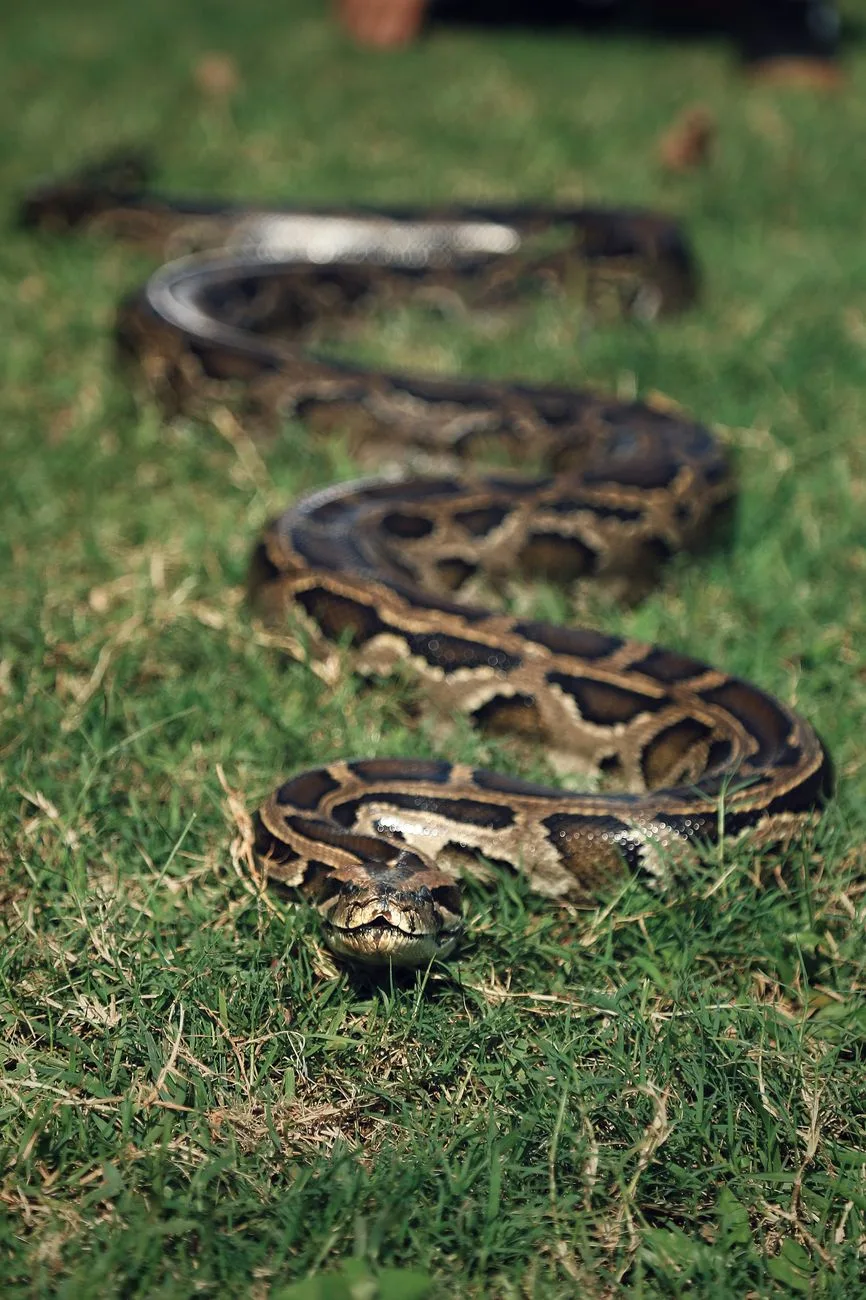
- Its skin is olive-green with large, dark oval blotches that help it hide among river plants.
- Anacondas have small, backward-curving teeth used for gripping prey, not for injecting venom.
- Like all boas, they have tiny remnants of hind legs called “spurs” near the tail — leftover clues that snakes evolved from four-legged ancestors.
5. What Do Anacondas Look Like – Anaconda Appearance
- An anaconda looks like an enormous, thick hose covered in dark olive-green spots.
- Its head is fairly small compared to its huge body, but its jaws can stretch far wider than its head thanks to stretchy ligaments.
- Females look almost identical to males but grow dramatically larger.
6. Anaconda Description – Physical Description
How Big Is An Anaconda – Anaconda Size
- An average adult green anaconda measures around 15 to 20 feet (4.6 to 6 meters) long.
- The largest scientifically verified specimens have measured over 17 feet (5.2 meters), with widely reported but harder-to-verify claims of individuals over 20 feet.
- Anacondas can be more than 12 inches (30 cm) thick at their widest point — about the width of a car tire.
How Much Does An Anaconda Weigh – Anaconda Weight
- A large adult green anaconda can weigh 200 to 300 pounds (90 to 135 kg), with the biggest verified individuals topping 400–500 pounds (180–225 kg).
- This makes the green anaconda the heaviest snake in the world, even though a few other snakes can grow slightly longer.
- Female anacondas are typically much heavier than males — sometimes five times their weight.
What Color Is An Anaconda – Anaconda Color
- Green anacondas have olive-green skin covered in large, dark brown or black oval spots.
- This blotchy pattern works as camouflage, breaking up their outline in murky river water and among plants.
7. How Fast Can An Anaconda Move – Anaconda Speed
- On land, anacondas are slow and clumsy — their huge weight makes crawling hard work.
- In water, they are fast, smooth, and powerful swimmers, using their muscular bodies to glide after prey.
8. Do Anacondas Swim – Anaconda Swimming
- Yes — anacondas are excellent swimmers and spend most of their lives in water.
- They ambush prey from just below the surface, striking quickly before dragging animals underwater.
- Because their eyes and nostrils are on top of their heads, they can lie almost completely submerged while still watching for prey.
9. What Sound Does An Anaconda Make – Anaconda Sounds
- Anacondas are mostly silent hunters, unlike more vocal animals such as capybaras.
- Like other snakes, they can produce a warning hiss by forcing air out through their windpipe when threatened.
10. Where Do Anacondas Live – Anaconda Habitat
- Anacondas are native to tropical South America, especially the Amazon and Orinoco river basins.
- They live in swamps, marshes, flooded grasslands, and slow-moving streams.
- Green anacondas share much of their range — and their prey — with capybaras, which live in the exact same rivers and wetlands.
- A small number of escaped or released anacondas have been spotted in Florida, USA, though they are not considered established there.
Anaconda Habitat Facts
- Anacondas prefer still or slow-moving water with plenty of plant cover to hide in.
- During the dry season, they may burrow into mud or find hidden pools to wait out the heat.
11. What Do Anacondas Eat – Anaconda Diet Facts
- Anacondas are carnivores and ambush predators — they eat only meat and rarely chase prey far.
- Their diet includes fish, birds, turtles, deer, wild pigs, caimans, and — famously — capybaras.
- Large female anacondas have even been recorded preying on young jaguars.
- Anacondas swallow prey whole, head-first, using stretchy jaw ligaments that let them open their mouths far wider than their own heads.
- After a big meal, an anaconda’s slow digestion means it may not need to eat again for weeks or even months.
Anaconda Eating Habits
- Anacondas hunt mostly at night, waiting motionless in water for prey to come close.
- They kill by constriction: coiling tightly around prey and squeezing until it can no longer breathe, then swallowing it whole.
12. Anaconda Predators
- Adult anacondas have very few natural predators because of their enormous size.
- Young anacondas are more vulnerable and may be eaten by:
- Jaguars
- Caimans
- Large birds of prey
- Other, larger anacondas
How Anacondas Stay Safe
- Their size alone deters most predators once they reach adulthood.
- Camouflage and staying submerged help anacondas avoid detection altogether.
13. Anaconda Social Life
- Unlike highly social capybaras, anacondas are mostly solitary and only come together to mate.
- During the breeding season, several males may compete for one female by forming a “breeding ball” — a tangled group of males coiling around a single female for days or even weeks.
14. Anaconda Reproduction
- Mating usually takes place in water during the dry season, roughly March to May.
- Female anacondas give live birth rather than laying eggs, after a gestation period of about 6 to 7 months.
- A typical litter has 20 to 40 live young, though litters of over 80 have been recorded in exceptionally large females.
- Females may not eat again for the entire gestation period, relying on stored energy instead.
15. Baby Anaconda
- A baby anaconda is roughly 2 feet (60 cm) long at birth.
- Newborn anacondas can swim and hunt almost immediately, with no help from their mother.
- Young anacondas start out eating small prey like fish and frogs before working up to larger animals.
16. How Long Do Anacondas Live – Anaconda Lifespan
- The average lifespan of a green anaconda in the wild is around 10 years.
Anaconda Lifespan In Captivity
- In zoos, where they are safe from predators and food is guaranteed, anacondas can live considerably longer, with some reports of well over 20 years.
17. Are Anacondas Endangered – Anaconda Conservation Status
- No, green anacondas are not endangered.
- The conservation status of the green anaconda on the IUCN Red List is “Least Concern.”
- The main threats anacondas face are habitat loss and hunting for their skin, not extinction risk.
- The newly recognized northern green anaconda (Eunectes akayima) has a smaller range, which scientists say could make it more vulnerable in the future.
18. Are Anacondas Dangerous To Humans
- Despite their fearsome reputation in movies, verified anaconda attacks on humans are extremely rare, and there are no well-documented human deaths from wild anacondas.
- Anacondas generally avoid humans and prefer to retreat into water rather than confront a person.
19. Anaconda Vs Capybara – What’s The Connection
- Anacondas and capybaras share the exact same rivers and wetlands across South America.
- The anaconda is a top predator of the capybara, ambushing it near the water’s edge.
- Capybaras rely on speed, swimming, and their large social groups to avoid becoming an anaconda’s next meal.
- Both animals are expert swimmers built for life in and around water, but one is a hunter and the other is often the hunted.
20. Anaconda Fun Facts For Kids
- The name Eunectes means “good swimmer” in Greek — a fitting name for an animal that spends most of its life in water.
- Anacondas can unhinge their jaws to swallow prey far wider than their own heads.
- A group of male anacondas competing for a mate is called a “breeding ball.”
- Anacondas are non-venomous — they rely entirely on muscle power, not poison, to catch prey.
- Female anacondas can be up to five times heavier than males, which is unusual among reptiles.
- Anacondas can go weeks or even months without eating after a large meal.
Did you know? An anaconda’s huge size comes with a strange trade-off — while they’re powerful swimmers, they’re clumsy and slow on dry land!
Source: National Geographic, Smithsonian’s National Zoo, and the IUCN Red List.
Try it
Draw a labeled sketch of an anaconda swimming toward a capybara at the water’s edge. Include three details from this guide, such as its top-of-head eyes, its spotted camouflage, or its stretchy jaws, and explain how each feature helps it hunt.
Knowledge check
What is one important fact about anacondas?
Show answer: The green anaconda is the heaviest snake in the world, and it hunts by squeezing (constricting) its prey rather than using venom.
Anaconda FAQ
What is the biggest snake in the world?
The green anaconda is the heaviest snake in the world, with large adults weighing 200 to 300 pounds (90–135 kg) or more.
Are anacondas venomous?
No, anacondas are not venomous. They are constrictors that kill prey by squeezing it until it can no longer breathe.
Do anacondas eat capybaras?
Yes, capybaras are one of the anaconda’s regular prey animals, since both live in the same South American rivers and wetlands.
Are anacondas dangerous to humans?
Anacondas generally avoid people, and verified attacks on humans are very rare, with no well-documented deaths from wild anacondas.
How long do anacondas live?
Green anacondas live about 10 years in the wild and can live considerably longer in captivity.