
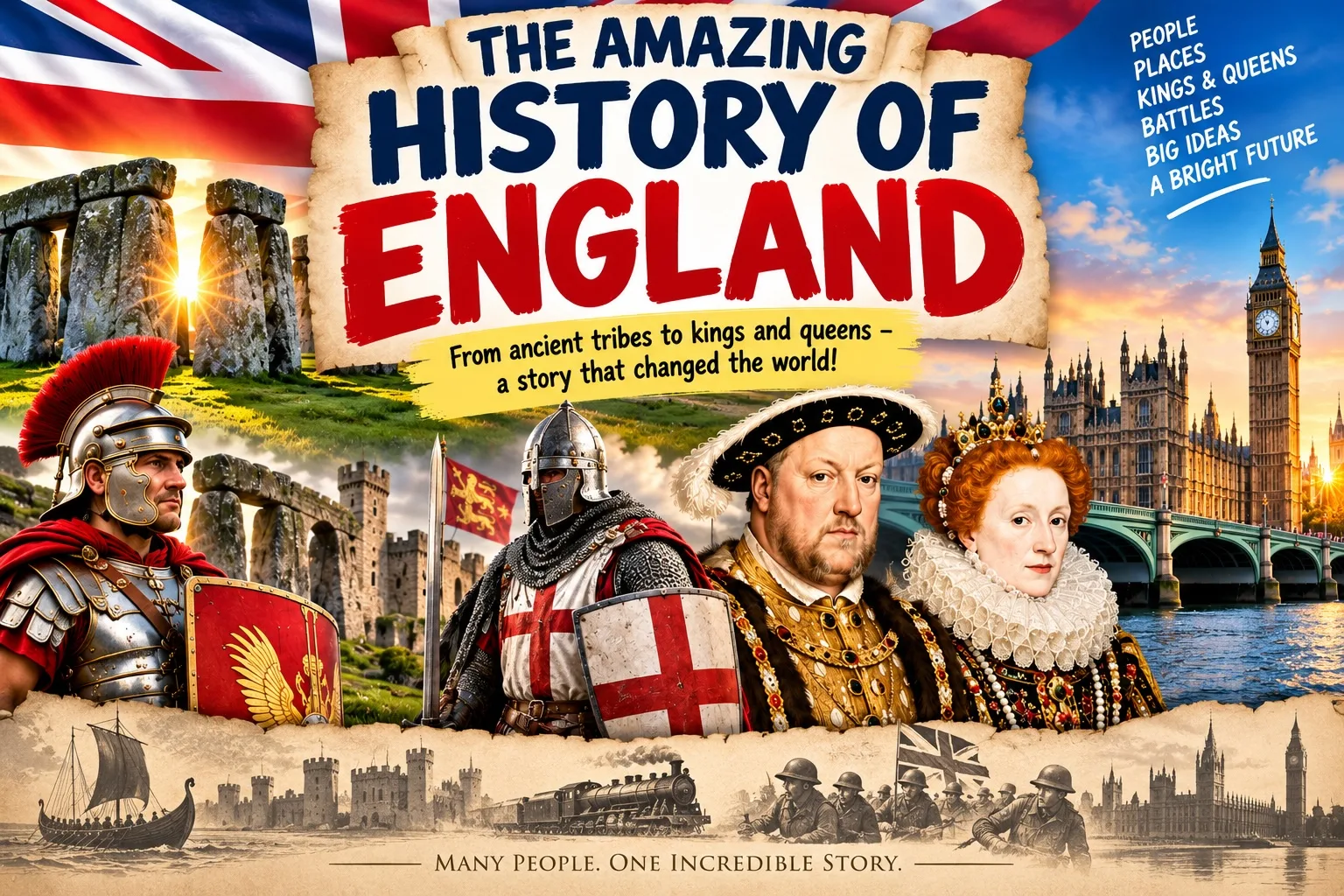
The history of England runs from the first people here, around 900,000 years ago, to the country you can visit now. England itself began in 927, when King Æthelstan joined the Anglo-Saxon kingdoms under one crown. Romans, Vikings, Normans, Tudors and factory owners all shaped what came next.
English history quick facts
- England has only existed as a single country since 927. Before that year the land was split between rival kingdoms that fought each other regularly.
- People reached Britain and then died out or left again at least eight separate times. Ice ages emptied the whole country, and nobody settled here for good until about 11,700 years ago.
- The Domesday survey of 1086 asked the same questions three times in every place. That was how William I’s inspectors caught people lying about what they owned.
- For eleven years, between 1649 and 1660, England had no king or queen at all and governed itself as a republic.
- The three Ridings of Yorkshire are named after an old word for a third. The county was simply too big to be run in one piece, so the Vikings cut it into three.

How we know any of this
England’s past is not one long written record. For most of it, nobody wrote anything down at all. What historians can use changes completely depending on how far back you go, and that is worth knowing before you trust any date.
For the first several hundred thousand years there are no words. There are footprints, flint tools, animal bones and rubbish pits. Archaeologists dig those up and date them in a laboratory. Writing arrives with the Romans, then almost stops again for two hundred years after they leave.
So a claim about 1850 can be checked against censuses, newspapers and photographs. A claim about the year 450 often rests on a single sentence, written down centuries later by someone who was not there. Good historians say so when that happens. A history book that sounds equally certain about every century is hiding something.
| Period | What historians mostly work from |
|---|---|
| Before AD 43 | Tools, bones, pollen, burials and buildings. No writing at all. |
| AD 43–410 | Roman letters, coins, carved inscriptions, forts and roads. |
| 410–600 | Archaeology, plus a few accounts written long afterwards. The thinnest evidence of any period. |
| 600–1066 | The Anglo-Saxon Chronicle, land charters and church records. |
| 1066–1500 | Domesday Book, court rolls and tax lists. |
| 1500–1837 | Parish registers of births, marriages and deaths, plus letters and printed books. |
| After 1837 | Official registration, censuses, newspapers, photographs and film. |
Before there was an England

People reached this corner of Europe long before it was an island, and the oldest traces of them are around 900,000 years old. At Boxgrove in West Sussex, archaeologists found a human shin bone about 480,000 years old. It did not belong to anyone like us. It belonged to an earlier human species that hunted here when Britain was still joined to the continent by dry land.
Here is the part most books leave out. Those early people did not stay. Ice ages pushed them out again and again, and the land emptied completely each time. Archaeologists now think Britain was settled and then abandoned at least eight separate times. Only after the last ice age ended, around 11,700 years ago, did people settle for good.
Farming arrived about 4000 BC and changed everything. People stopped following herds and started clearing fields. During the Stone Age they raised the huge circles and long barrows that still stand today. Metal followed: copper and tin in the Bronze Age, then iron. By the Iron Age the country was covered in hillforts and divided between tribes with their own kings, coins and quarrels.
Notice that none of this is English history yet. These people were not English and would not have understood the word. England did not exist as a country, a name or an idea for thousands of years after the last standing stone went up.
Before There Was an England
- What did archaeologists find at Boxgrove in West Sussex?
- Why did the earliest people in Britain keep leaving?
- What changed when farming arrived, about 4000 BC?
- What covered the country by the Iron Age?
Roman Britain, AD 43 to about 410

A Roman army landed in Kent in AD 43, sent by the emperor Claudius. Julius Caesar had come twice before, in 55 and 54 BC, but he did not stay. This time the Romans did. They named their new province Britannia and held it for nearly four centuries.
Roman Britain got towns, bathhouses, drains and a road network. It also got a frontier. From AD 122 the army built Hadrian’s Wall across the north, 73 miles of stone with a gate roughly every mile. A settlement called Londinium grew on the River Thames and became the province’s biggest town.
Not everyone welcomed them. Around AD 60 or 61 Boudica, queen of the Iceni, led a revolt that burned three Roman towns before the army crushed it.
One thing surprises most people. Hardly anybody in Roman Britain came from Italy. The great majority were Britons whose families had lived here for generations, now paying Roman taxes and sometimes taking Roman names. When Roman government ended in the early 400s, those families did not go anywhere. The coins simply stopped arriving, the towns shrank, and life became local again.
Roman Britain
- Which emperor sent the Roman army that landed in Kent?
- What did the Romans call their new province?
- What was Hadrian's Wall built to be?
- Where did most people living in Roman Britain come from?
How England became one country
After the Romans, the land split into small kingdoms ruled by warlords. Groups from across the North Sea settled alongside the Britons already here, and out of that mixture came the Anglo-Saxons. Their leaders claimed descent from the god Woden, because ancestry was how a ruler proved he deserved power.
Over time the small groups hardened into larger kingdoms: Northumbria, Mercia and East Anglia in the north and east, Wessex, Essex, Sussex and Kent in the south. In 597 a monk named Augustine arrived from Rome and began converting them to Christianity. In 793 Viking raiders attacked the monastery at Lindisfarne, and the raids turned into settlement, and the settlement turned into rule across much of the north and east.
Then comes the date that ought to be famous and is not. In 927, King Æthelstan of Wessex brought the surviving kingdoms under one crown. That is the year a single country called England begins. It is 139 years before 1066.
The Anglo-Saxons also built the machinery a country needs. Land was measured in hides, meaning roughly enough ground to support one household. Hides were grouped into hundreds, which held their own local courts, and hundreds were grouped into shires run by an official called an ealdorman. The king took advice from a council called the Witan, or “men of knowledge”. Under Æthelstan the Witan included bishops, abbots and landowners from across the kingdom, Danish as well as English.
Some of those words are still on the map. In the areas the Vikings settled, a hundred was called a wapentake. Yorkshire and Lincolnshire were so large they were cut into three parts each, called thirdings. Say “thirding” quickly enough and you get Riding, which is what people still call the three parts of Yorkshire.
Anglo-Saxon Words
- Hide — Enough land for one household
- Hundred — A group of hides with its own court
- Shire — An area run by an ealdorman
- Witan — The council that advised the king
- Wapentake — A hundred in the Viking areas
- Riding — One of three parts of Yorkshire
1066, and the book that counted everything

Harold II had a terrible autumn. In September 1066 he beat a Norwegian invasion in Yorkshire, then marched his army roughly 200 miles south. On 14 October he met William of Normandy near Hastings and lost both the battle and his life.
The Normans replaced almost the entire ruling class. They built castles to hold the country down, and they brought French, which is why English ended up with two words for so many things. A farmer minded a cow, a sheep or a pig. The lord at the table ate beef, mutton or pork.
Twenty years later William wanted to know exactly what he had conquered. In 1086 he sent inspectors across England to ask fixed questions in local courts: what is this place called, who holds it, how many people live here, how many cattle, what is it worth? To catch anyone lying, each set of questions was asked three times. The answers filled two volumes now known as Little Domesday and Great Domesday.
People called it the Domesday Book because there was no arguing with it, the way there is no arguing on Judgement Day. It is the oldest government record kept at The National Archives, and it still answers questions. It shows, for instance, that the old Viking areas held far more free men than the rest of the country did.
1066: Fact or Myth?
- Before Hastings, Harold II beat a Norwegian invasion in Yorkshire.
- The Normans brought the German language to England.
- In Norman England, the lord at the table ate beef while the farmer minded a cow.
- The Normans built castles to hold the country down.
- The Domesday answers filled just one small notebook.
A charter, a plague and a war of cousins
In 1215 a group of angry barons forced King John to seal a document at Runnymede. Magna Carta was not a bill of rights for ordinary people, whatever you may have heard. Most of its clauses deal with feudal payments, debts, forests and fish traps. One idea in it outlived all the rest: that the king is under the law and not above it.
In 1348 the plague reached England. Within about two years it killed somewhere between a third and a half of everyone in the country. Historians still argue about the exact share, because the records are patchy. The scale of what followed is not in doubt. England’s population did not climb back to where it had been for roughly 250 years.
That had a strange consequence. With so few workers left, the ones who survived could demand better pay, and lords who refused found nobody to bring in the harvest. When Parliament tried to freeze wages, resentment boiled over into the Peasants’ Revolt of 1381.
The century closed badly too. From 1455 two branches of the same royal family fought each other for the throne, on and off, for thirty years. The fighting ended at Bosworth in 1485, and a new family took over.
The Tudors and a church of their own

Henry VII won at Bosworth and founded the Tudor line. His son Henry VIII did the thing that changed England most. In the 1530s he broke with the Pope in Rome and made himself head of a separate Church of England.
That decision was not only about religion. Henry closed the monasteries and took their land and money, which was a great deal of both. If you have ever walked round a roofless abbey in a field, you have seen the result. Those buildings were not ruined by time. They were stripped on purpose, and the lead was sold off the roofs.
Elizabeth I ruled from 1558 to 1603. Her reign brought playhouses, printed books and long sea voyages. It also brought the first English ships to carry enslaved Africans across the Atlantic, with the queen’s knowledge. Both things are true, and a history that mentions only the plays is not telling you the whole reign.
The eleven years England had no king
Elizabeth died childless in 1603, and the crown passed to her cousin’s son James, already King of Scotland. One man now wore both crowns, though England and Scotland stayed separate countries with separate parliaments. Two years later a group of plotters tried to blow up Parliament, which is why Bonfire Night is still marked every November.
James’s son Charles I believed a king answered to God alone. Parliament disagreed, loudly, about money and about religion. From 1642 the argument became a war that split families and towns down the middle.
Parliament won. On 30 January 1649 Charles I was executed outside a banqueting hall in London, in front of a crowd. England then did something it has never done before or since. It abolished the monarchy and governed itself as a republic, for eleven years, mostly under Oliver Cromwell. In 1660 Parliament invited Charles I’s son back, and the monarchy has continued ever since.
Put England’s Story in Order
- Romans land in Kent A Roman army arrives and stays for nearly four centuries.
- Augustine arrives A monk from Rome begins converting the Anglo-Saxons to Christianity.
- Raid on Lindisfarne Viking raiders attack a monastery in the north.
- Æthelstan unites England The kingdoms come under one crown.
- Magna Carta Barons force King John to seal a document at Runnymede.
- Battle of Bosworth Henry VII wins and the Tudor family takes over.
- Gunpowder Plot Plotters try to blow up Parliament, which is why Bonfire Night is marked.
- The monarchy returns Parliament invites Charles I's son back as king.
Machines, empire and who paid for them
In 1707 England and Scotland merged into a single state called Great Britain. From that moment England stopped being a country with its own government, and English history becomes part of a larger British story.
Then came the machines. Coal, steam and iron turned a farming country into a factory one, earlier than anywhere else on Earth. Villages became cities within a lifetime. The work was dangerous, the hours were long, and children did a great deal of it. The clock tower holding Big Ben started keeping time in 1859, near the peak of all this.
Britain also built the largest empire the world has seen, and part of its wealth came from slavery. That is not a footnote to the period. It is one of the engines of it. In 1772 a court case brought by an enslaved man called James Somerset established that he could not be forced out of England against his will. Parliament banned the slave trade in 1807 and abolished slavery across most of the empire in 1833.
Those laws did not appear because politicians simply changed their minds. Enslaved people rebelled, repeatedly and at enormous risk, in Jamaica and elsewhere. Formerly enslaved writers toured Britain describing what they had survived. Abolition was argued into existence, and the people with most at stake did much of the arguing.
The last hundred years

Two world wars dominate the first half of the twentieth century. During the Second World War, German bombers attacked British cities night after night in the period known as the Blitz. Children were evacuated from cities to the countryside, often alone, with a label tied to their coats.
Then came 1948, which gave England two things it still has. On 5 July the National Health Service opened, and medical care stopped depending on whether a family could pay. And on 21 June a ship called the Empire Windrush docked at Tilbury carrying 1,027 passengers, many of them from the Caribbean, answering Britain’s call for workers after the war.
Two details about that ship get repeated wrongly almost everywhere. It was not the first. The Ormonde sailed from the West Indies in March 1947 and the Almanzora followed later that year. And the famous figure of 492 passengers is far too low: the actual passenger list records 1,027. Between 1947 and 1970, nearly half a million people moved to Britain from across the Commonwealth.
England today is one of the four countries of the United Kingdom. Scotland, Wales and Northern Ireland each have their own parliament or assembly. England does not. Laws for England are made at Westminster by a parliament that covers the whole UK, which is one of the odder results of all this history.
1948: Two Big Changes
- What opened on 5 July 1948?
- Where did the Empire Windrush dock in June 1948?
- Which of these is NOT true about the Windrush?
- Which country of the United Kingdom has no parliament or assembly of its own?
Three things people get wrong about English history
1. English history did not begin in 1066. The Norman Conquest is the most famous date in the country’s past, and plenty of books start there. England was already a single kingdom under one king by 927, nearly 140 years earlier. What changed in 1066 was who ruled the country, not whether the country existed.
2. Nobody has been King or Queen of England since 1707. That year England and Scotland became one state. Every monarch since has ruled Great Britain, and later the United Kingdom. Charles III is King of the United Kingdom, not King of England, however often you see the phrase printed.
3. The Windrush was not the first ship, and 492 is the wrong number. Two ships had already brought passengers from the Caribbean before it, and the passenger list records 1,027 people aboard rather than the 492 usually quoted. The Windrush became a symbol, which is not the same as being first.
Did you know? The Anglo-Saxon Chronicle was still being added to in 1154, nearly ninety years after the Norman Conquest. Monks at Peterborough kept writing it long after the English kingdom that started it had gone.
Try it
Take a local map and work out which language your place names came from. The endings give it away. Names ending in -ton or -ham are Anglo-Saxon and mean a farm or a homestead. Names ending in -by or -thorpe were left by Viking settlers. Names containing -chester, -caster or -cester mean a Roman fort stood there. Write down five names from near you and sort them into three piles.
Knowledge check
Why is 927 a better birthday for England than 1066?
Show answer
In 927 King Æthelstan brought the separate Anglo-Saxon kingdoms under one crown, so a single country called England existed from that year onwards. The Norman Conquest of 1066 changed who ruled that country, but the country was already there.
Why were the same questions asked three times during the Domesday survey?
Show answer
Asking three times let the inspectors compare the answers and catch anyone lying. The survey decided how much tax each place would pay, so people had a good reason to understate the land, animals and money they held.
Frequently asked questions
When did England become a country?
England became a single country in 927, when King Æthelstan of Wessex brought the separate Anglo-Saxon kingdoms under one crown. Before that year the land was divided between rival kingdoms including Northumbria, Mercia, East Anglia and Wessex.
What happened in 1066?
In 1066 William of Normandy defeated King Harold II at the Battle of Hastings on 14 October and took the English throne. The Norman Conquest replaced almost the entire ruling class, covered the country in castles, and pushed thousands of French words into the English language.
What is the Domesday Book?
The Domesday Book is a survey of England ordered by William the Conqueror in 1086. Inspectors recorded who held each piece of land, how many people lived there and what it was worth, so the king could work out his taxes. The Domesday Book is the oldest government record held at The National Archives.
How many people did the Black Death kill in England?
The plague that reached England in 1348 killed somewhere between a third and a half of the population within about two years. Historians still argue about the exact share because the records are incomplete. England’s population took roughly 250 years to climb back to where it had been.
Has England ever had no king or queen?
England had no monarch between 1649 and 1660. Parliament defeated Charles I in the Civil War and executed him, then abolished the monarchy and governed the country as a republic, led for much of that time by Oliver Cromwell. Parliament invited Charles II back in 1660.
Why is there no King of England today?
England and Scotland joined into a single state called Great Britain in 1707, so the separate title stopped existing. Every monarch since has ruled Great Britain and later the United Kingdom. Charles III is King of the United Kingdom, not King of England.
What did Magna Carta actually do?
Magna Carta, sealed by King John in 1215, was mostly a list of baronial complaints about feudal payments, debts, royal forests and fish traps. Magna Carta matters today because of one principle inside it: that the king is bound by the law rather than standing above it.
Sources
- English Heritage: The Story of England — the period framework used across this guide, from prehistory and Roman Britain through the early medieval, medieval, Tudor, Stuart, Georgian and Victorian eras
- English Heritage: Early medieval power and politics — warlords and claimed descent from Woden, the Anglian and Saxon kingdoms, hides, hundreds and shires, ealdormen, the Witan under Æthelstan (r.924–39), wapentakes in the Danelaw, the Yorkshire and Lincolnshire thirdings that became Ridings, and the free men recorded in the Danelaw
- English Heritage: Early Medieval England — the period from the end of Roman rule in about AD 410 to 1066, the struggle between Britons, Anglo-Saxons and Vikings, St Augustine’s mission of 597, the Viking raid on Lindisfarne in 793, and Harold II’s march before Hastings
- The National Archives: Domesday Book — the 1086 survey, why William I ordered it, the fixed questions asked in local courts, the questions being asked three times, Little Domesday and Great Domesday, and its status as the oldest government record held at The National Archives
- The National Archives: Magna Carta, 1215 and beyond — King John’s quarrel with his barons, the taxation and inheritance disputes behind the charter, its sealing in 1215 and its reissues in 1217 and 1225
- The National Archives: Bound for Britain — the Empire Windrush docking at Tilbury on 21 June 1948 with 1,027 passengers, the earlier voyages of the Ormonde in March 1947 and the Almanzora, and the nearly half a million people who moved to Britain from the Commonwealth between 1947 and 1970
History of England Quiz
- Around when did people settle in Britain for good?
- Who led a revolt against the Romans that burned three Roman towns?
- Why did Anglo-Saxon leaders claim descent from the god Woden?
- Why was the Peasants' Revolt of 1381 sparked?
- What did Henry VIII do in the 1530s?
- Why are many old abbeys roofless today?
- When James became King of England in 1603, what else was he already?
- Which of these helped turn England into a factory country?
- When did the clock tower holding Big Ben start keeping time?
- What did the 1772 James Somerset case establish?
- Until what year were monks still adding to the Anglo-Saxon Chronicle?
- A place name ending in -by was most likely left by whom?


